PUBLISHER: Mordor Intelligence | PRODUCT CODE: 2117315

PUBLISHER: Mordor Intelligence | PRODUCT CODE: 2117315
France Lubricants - Market Share Analysis, Industry Trends & Statistics, Growth Forecasts (2026 - 2031)
According to Mordor Intelligence, the France lubricants market size was valued at 527.84 million liters in 2025 and estimated to grow from 525.26 million liters in 2026 to reach 512.47 million liters by 2031, at a CAGR of -0.49% during the forecast period (2026-2031).
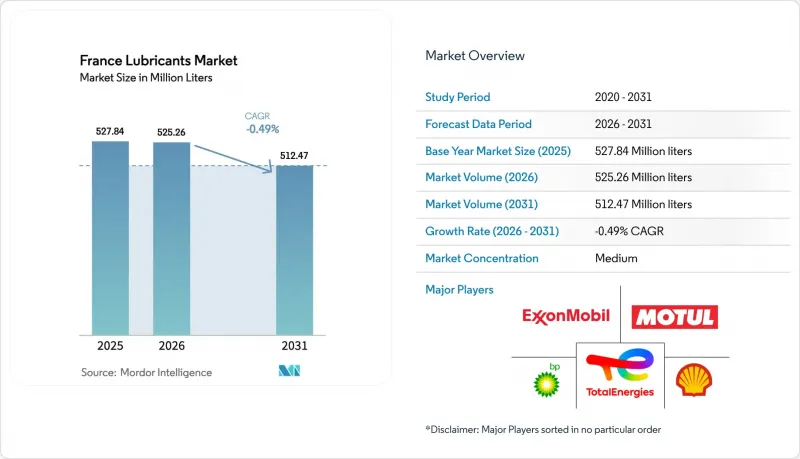
This report is Segmented by Product Type (Automotive Engine Oil, Industrial Engine Oil, Transmission Fluids, Gear Oil, Brake Fluids, Hydraulic Fluids, Greases, Turbine Oil, and More), End-User Industry (Automotive, Heavy Equipment, Aerospace, Industrial, and More), and Base Stock Type (Mineral Oil-Based Lubricants, Semi-Synthetic Lubricants, and More). The Market Forecasts are Provided in Terms of Volume (Liters).
France Lubricants Market Trends and Insights
Stricter Euro-7 Emission Limits Accelerating Adoption of High-Performance Synthetics
Euro-7 rules in force from 2025 impose sulfated-ash, phosphorus, and sulfur thresholds that conventional mineral oils cannot meet, locking in demand for synthetic or semi-synthetic low-SAPS blends. TotalEnergies introduced its Quartz EV3R range in 2024, reducing carbon footprints by 35% while meeting OEM drain interval targets of 30,000 km. French assemblers have already shifted factory-fill specifications to Euro-7-compliant grades, cementing a permanent advantage for synthetics. Distributors that fail to list approved products risk being excluded from warranty-related benefits within dealership networks. The France lubricants market, therefore, sees synthetics gaining structural share as reverting to mineral alternatives would breach compliance.
Rising French Vehicle-Parc and Vehicle-Kilometers Post-COVID
More than 2 million rechargeable vehicles were on French roads by 2024, up 40% from 2022; yet the legacy ICE parc continued to grow as owners delayed replacements amid supply shortages. INSEE traffic indicators show that total vehicle-kilometers are back at pre-pandemic highs, and commercial traffic is up 8% compared to 2019, fueling the consumption of high-viscosity engine oils for urban delivery fleets. The national average vehicle age reached 10.2 years in 2024, resulting in increased maintenance-related lubricant throughput. Heavy-duty fleets stationed around Paris and Lyon operate extended idle-stop cycles, which accelerate oil oxidation, thereby reinforcing demand for premium synthetics with robust additive retention. Altogether, operating-hour intensity rather than fleet size is sustaining lubricant volumes in the France lubricants market.
Prolonged Slowdown in Domestic Auto Production from 2024
French passenger-car output declined 18% in 2024 as manufacturers retooled for battery models, reducing factory-fill demand for break-in oils. Stellantis shifted selected assembly lines abroad, reducing local industrial lubricant use for machining and component washing. Because pure EVs need about 70% less lubricant than ICE vehicles, unit losses are amplified in volume terms. Job cuts in Sochaux and Mulhouse cascaded down the supply chain, resulting in reduced short-run orders for specialty process oils. The France lubricants market, therefore, faces near-term headwinds until EV volumes plateau and specialized EV fluids scale up.
Other drivers and restraints analyzed in the detailed report include:
- OEM-Mandated Extended Drain Intervals
- Electrification of Inland-Waterway Fleet Spurring Demand for Biodegradable Hydraulic Oils
- Crude-Price Volatility Inflating Base-Oil Costs
For complete list of drivers and restraints, kindly check the Table Of Contents.
Segment Analysis
The France lubricants market share for automotive engine oils reached 36.74% of total demand in 2025. Turbine oils, however, are projected to post the fastest 2.05% CAGR as France extends the lifetimes of its nuclear reactors and accelerates the roll-out of offshore wind. In commercial practice, synthetics dominate new-generation turbine units that operate at higher temperatures and tighter clearances. Brake-fluid volumes contract as regenerative systems reduce hydraulic-brake duty cycles, whereas biodegradable hydraulic oils increase in use with the growing electric construction equipment sector. Gear oils serving wind-turbine gearboxes and heavy-duty trucks maintain a stable demand, supported by the growth of renewables and logistics. White and process oils serve the rubber, plastics, and personal-care industries, delivering flat though profitable niches. Metal-working fluids gain incremental volumes at Airbus' Toulouse hub, where increased A320 machining requires high-lubricity, low-foaming coolants. Overall, the product mix tilts toward high-performance, low-volume specialties, underlining how the France lubricants market optimizes value per liter.
The adoption of Euro-7-ready engine oils is accelerating, with at least 30% of factory-fill demand expected to shift to low-SAPS synthetics by 2025. Transmission-fluid demand benefits from extended-drain mandates, an area where OEM approvals dictate supplier access. Meanwhile, demand for transformer oils aligns with grid-reinforcement projects that integrate onshore renewables. Altogether, turbine-oil momentum and specialty niches partially offset structural headwinds in mainstream engine oils, keeping the France lubricants market diversified across applications.
Complete Report Scope:
- By Product Type
- Automotive Engine Oil
- Industrial Engine Oil
- Transmission Fluids
- Gear Oil
- Brake Fluids
- Hydraulic Fluids
- Greases
- Process Oil (Including Rubber Process Oil and White Oil)
- Metalworking Fluids
- Turbine Oil
- Transformer Oil
- Other Product Types
- By End-user Industry
- Automotive
- Passenger Vehicles
- Commercial Vehicles
- Two-Wheelers
- Marine
- Aerospace
- Heavy Equipment
- Construction
- Mining
- Agriculture
- Industrial
- Power Generation
- Metallurgy and Metalworking
- Textiles
- Oil and Gas
- Other End-Use Industries
- Automotive
- By Base Stock Type
- Mineral Oil-Based Lubricants
- Synthetic Lubricants
- Semi-Synthetic Lubricants
- Bio-Based Lubricants
List of Companies Covered in this Report:
- TotalEnergies
- Shell plc
- BP p.l.c.
- Exxon Mobil Corporation
- Motul
- FUCHS SE
- LIQUI MOLY GmbH
- Valvoline Inc.
- Chevron Corporation
- Eni S.p.A.
- Repsol S.A.
- Bardahl Manufacturing Corporation
Additional Benefits:
- The market estimate (ME) sheet in Excel format
- 3 months of analyst support
TABLE OF CONTENTS
1 Introduction
- 1.1 Study Assumptions and Market Definition
- 1.2 Scope of the Study
2 Research Methodology
3 Executive Summary
4 Market Landscape
- 4.1 Market Overview
- 4.2 Market Drivers
- 4.2.1 Stricter Euro-7 emission limits accelerating adoption of high-performance synthetics
- 4.2.2 Rising French vehicle-parc and vehicle-kilometres post-COVID
- 4.2.3 OEM-mandated extended drain intervals
- 4.2.4 Electrification of inland-waterway fleet spurring demand for biodegradable hydraulic oils
- 4.2.5 Maintenance cycle for France's nuclear-submarine fleet boosting specialty gear and turbine oils
- 4.3 Market Restraints
- 4.3.1 Prolonged slowdown in domestic auto production from 2024
- 4.3.2 Crude-price volatility inflating base-oil costs
- 4.3.3 Closure of French steam-cracker and Group-I lines tightening feed-stock supply
- 4.3.4 EU-taxonomy sustainability rules raising compliance costs for SME blenders
- 4.4 Value Chain Analysis
- 4.5 Regulatory Framework
- 4.6 End-User Trends
- 4.6.1 Automotive Industry
- 4.6.2 Manufacturing Industry
- 4.7 Porter's Five Forces
- 4.7.1 Bargaining Power of Suppliers
- 4.7.2 Bargaining Power of Buyers
- 4.7.3 Threat of New Entrants
- 4.7.4 Threat of Substitutes
- 4.7.5 Degree of Competition
5 Market Size and Growth Forecasts (Volume)
- 5.1 By Product Type
- 5.1.1 Automotive Engine Oil
- 5.1.2 Industrial Engine Oil
- 5.1.3 Transmission Fluids
- 5.1.4 Gear Oil
- 5.1.5 Brake Fluids
- 5.1.6 Hydraulic Fluids
- 5.1.7 Greases
- 5.1.8 Process Oil (Including Rubber Process Oil and White Oil)
- 5.1.9 Metalworking Fluids
- 5.1.10 Turbine Oil
- 5.1.11 Transformer Oil
- 5.1.12 Other Product Types
- 5.2 By End-user Industry
- 5.2.1 Automotive
- 5.2.1.1 Passenger Vehicles
- 5.2.1.2 Commercial Vehicles
- 5.2.1.3 Two-Wheelers
- 5.2.2 Marine
- 5.2.3 Aerospace
- 5.2.4 Heavy Equipment
- 5.2.4.1 Construction
- 5.2.4.2 Mining
- 5.2.4.3 Agriculture
- 5.2.5 Industrial
- 5.2.5.1 Power Generation
- 5.2.5.2 Metallurgy and Metalworking
- 5.2.5.3 Textiles
- 5.2.5.4 Oil and Gas
- 5.2.5.5 Other End-Use Industries
- 5.2.1 Automotive
- 5.3 By Base Stock Type
- 5.3.1 Mineral Oil-Based Lubricants
- 5.3.2 Synthetic Lubricants
- 5.3.3 Semi-Synthetic Lubricants
- 5.3.4 Bio-Based Lubricants
6 Competitive Landscape
- 6.1 Market Concentration
- 6.2 Strategic Moves
- 6.3 Market Share**(%)/Ranking Analysis
- 6.4 Company Profiles (includes Global level Overview, Market level overview, Core Segments, Financials as available, Strategic Information, Market Rank/Share, Products and Services, Recent Developments)
- 6.4.1 TotalEnergies
- 6.4.2 Shell plc
- 6.4.3 BP p.l.c.
- 6.4.4 Exxon Mobil Corporation
- 6.4.5 Motul
- 6.4.6 FUCHS SE
- 6.4.7 LIQUI MOLY GmbH
- 6.4.8 Valvoline Inc.
- 6.4.9 Chevron Corporation
- 6.4.10 Eni S.p.A.
- 6.4.11 Repsol S.A.
- 6.4.12 Bardahl Manufacturing Corporation
7 Market Opportunities and Future Outlook
- 7.1 White-space and Unmet-need Assessment
8 Key Strategic Questions for CEOs

