PUBLISHER: Mordor Intelligence | PRODUCT CODE: 2117373

PUBLISHER: Mordor Intelligence | PRODUCT CODE: 2117373
Indonesia Crawler Earthmoving Machines - Market Share Analysis, Industry Trends & Statistics, Growth Forecasts (2026 - 2031)
According to Mordor Intelligence, the indonesian crawler earthmoving machines market size was valued at USD 1.12 billion in 2025 and is estimated to grow from USD 1.17 billion in 2026 to reach USD 1.44 billion by 2031, at a CAGR of 4.32% over 2026-2031.
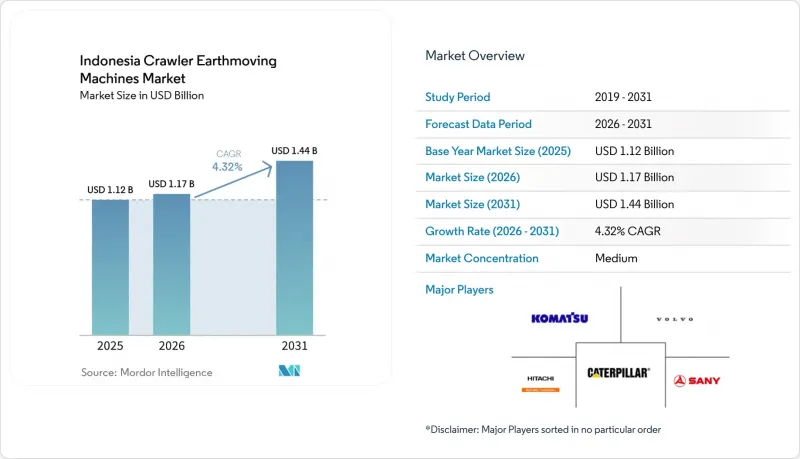
This report is Segmented by Equipment Type (Excavators, Bulldozers, Graders, Dump Trucks, and More), Propulsion (Internal-Combustion Engine, and More), Distribution Channel (Direct and Dealer and Distributor Network), End-Use Industry (Construction, Mining and Quarrying, and Others), and Geography. The Market Forecasts are Provided in Terms of Value (USD) and Volume (Units).
Indonesia Crawler Earthmoving Machines Market Trends and Insights
Massive Public-Sector Infrastructure Pipeline
Nusantara has earmarked a significant budget, while a new phase recently commenced with additional allocations for earthworks . Despite a reduction in overall toll-road expansions, the industry's shift towards concentrated megaprojects has sustained a robust demand for large excavators and bulldozers, essential for continuous operation on compact sites. Meikarta's ambitious housing units under the 3 Million Homes Program, spearheading the vertical-housing initiative, further amplify demand for tracked equipment suited to deep foundation work. The completion of the Java gas pipeline underscored the importance of heavy trenching machines and established a benchmark for the upcoming civil packages of Masela LNG. Collectively, these ventures have counterbalanced a decline in highway expenditures, ensuring a steady order pipeline for high-capacity crawler equipment.
Accelerated Nickel and Copper Mine Expansions
Vale Indonesia secured financing commitments exceeding significant amounts, while CNGR garnered substantial funding, highlighting a prolonged mining cycle intricately linked to EV supply chains. Even with a downward revision to the RKAB production quota, Indonesia is poised to boost its nickel output to a high level. Achieving this will necessitate aggressive overburden removal, utilizing excavators designed for heavy-duty cycles. While policy-driven supply discipline has injected short-term volatility, downstream mandates, coupled with multi-billion-dollar HPAL projects, ensure robust equipment demand extending well beyond the forecast horizon.
Commodity-Price Volatility Suppresses Capex Cycles
The heavy equipment sales declined, likely due to fluctuations in coal and nickel prices. During downturns, smaller contractors often struggle to service equipment loans, leading them to liquidate crawler assets. This action not only shrinks the pool of used-machine values but also highlights the market's volatility. In response, tier-one miners are increasingly opting for versatile excavator-dozer combinations, allowing them to redeploy across different ore bodies. However, their overall spending remains closely tied to commodity price forecasts. Meanwhile, OEMs are strategically diversifying into construction rentals, a move that aligns their demand more with government budgets than with export earnings.
Other drivers and restraints analyzed in the detailed report include:
- Rapid Urbanization Fueling Real-Estate Projects
- OEM Dealer-Credit and Rental Penetration
- Shortage of Certified Machine Operators
For complete list of drivers and restraints, kindly check the Table Of Contents.
Segment Analysis
Excavators still held 53.82% of Indonesia's crawler earthmoving machine market share in 2025 because they are used for overburden removal at nickel pits, trenching for the Java gas pipeline, and foundation work for the 3 Million Homes towers. Bulldozers are projected to post a 7.76% CAGR through 2031 as food-estate projects, IKN site grading, and early-stage Masela LNG earthworks drive demand for high-drawbar-pull machines. Dozer advances are tied to Presidential Regulation No. 110/2025, which caps carbon allocations and pushes operators to retire fuel-hungry scrapers in favor of electro-hydraulic D8- to D10-class units that lower emissions by up to 10% per load cycle.
OEM innovation centers on electric mini-excavators for emissions-sensitive urban pockets and high-horsepower dozers with remote blade control for mining benches. Import tariffs on undercarriage assemblies keep the economics of localization favorable for the domestic fabrication of frames and track groups. Rental fleets skew toward 30-ton excavators because they balance transportability with broad job applicability, minimizing idle days. Meanwhile, mining firms acquire 70-ton-and-above models outright, leveraging longer payback horizons associated with long-life ore bodies. This dichotomy sustains tiered demand across weight classes within the Indonesian crawler earthmoving machines market.
Internal-combustion engines held 86.43% share of the Indonesian crawler earthmoving machines market in 2025 due to mature fueling networks and familiarity among operators. Tier 3 and Tier 4 interim engines remain prevalent, though carbon pricing since 2022 has introduced direct operating-cost penalties, sharpening interest in alternative powertrains. Battery-electric units exhibit an 8.42% CAGR, led by 20-ton excavators inside emission-restricted urban zones. However, uncertainty around import duties on traction batteries hinders upfront affordability, leading some contractors to defer purchases until policy clarity emerges. Hybrid systems occupy the middle ground by offering 15-20% fuel savings without a charging infrastructure.
State-owned utilities plan to build pilot charging yards at Nusantara to service crawler equipment during shift breaks, signaling future scalability. OEMs such as Komatsu and Hyundai propose swappable battery packs to mitigate charging downtimes on remote mining benches. Even so, long-cycle jobs in Kalimantan's overburden removal still favor diesel due to its higher energy density and faster refueling speed. Therefore, the Indonesian crawler earthmoving machines market size is expected to remain ICE-heavy through 2030, with electrification proceeding first in regulated urban clusters.
Complete Report Scope:
- By Equipment Type
- Excavators
- Bulldozers
- Graders
- Dump Trucks
- Skid-Steer Loaders and Others
- By Propulsion
- Internal-Combustion Engine
- Hybrid
- Battery-Electric
- By Distribution Channel
- Direct
- Dealer and Distributor Network
- By End-Use Industry
- Construction
- Mining and Quarrying
- Oil and Gas Infrastructure
- Others (Agriculture, Forestry)
List of Companies Covered in this Report:
- Caterpillar Inc.
- Komatsu Ltd.
- Hitachi Construction Machinery Co., Ltd.
- Volvo Construction Equipment
- Liebherr Group
- XCMG Group
- Sany Heavy Industry Co., Ltd.
- JCB Limited
- HD Hyundai Construction Equipment Co., Ltd.
- Case Construction Equipment
- Zoomlion Heavy Industry Science & Technology Co., Ltd.
- Sumitomo Heavy Industries Ltd.
- Doosan Infracore Co., Ltd.
- Yanmar Compact Equipment
- Kobelco Construction Machinery Co., Ltd.
- Shantui Construction Machinery Co., Ltd.
- LiuGong Machinery Co., Ltd.
Additional Benefits:
- The market estimate (ME) sheet in Excel format
- 3 months of analyst support
TABLE OF CONTENTS
1 Introduction
- 1.1 Study Assumptions and Market Definition
- 1.2 Scope of the Study
2 Research Methodology
3 Executive Summary
4 Market Landscape
- 4.1 Market Overview
- 4.2 Market Drivers
- 4.2.1 Massive Public-Sector Infrastructure Pipeline (Nusantara, Toll Roads)
- 4.2.2 Accelerated Nickel and Copper Mine Expansions
- 4.2.3 Rapid Urbanization Fueling Real-Estate Projects
- 4.2.4 OEM Dealer-Credit and Rental Penetration
- 4.2.5 Telematics-Enabled Predictive Maintenance Uptake
- 4.2.6 Carbon-Pricing Drives Scraper-To-Excavator Shift
- 4.3 Market Restraints
- 4.3.1 Commodity-Price Volatility Suppresses Capex Cycles
- 4.3.2 Limited SME Contractor Financing Options
- 4.3.3 Shortage of Certified Machine Operators
- 4.3.4 Uncertain Import Duties on EV/Hybrid Drivetrain Parts
- 4.4 Value/Supply-Chain Analysis
- 4.5 Regulatory Landscape
- 4.6 Technological Outlook
- 4.7 Porter's Five Forces
- 4.7.1 Threat of New Entrants
- 4.7.2 Bargaining Power of Buyers/Consumers
- 4.7.3 Bargaining Power of Suppliers
- 4.7.4 Threat of Substitute Products
- 4.7.5 Intensity of Competitive Rivalry
5 Market Size and Growth Forecasts
- 5.1 By Equipment Type
- 5.1.1 Excavators
- 5.1.2 Bulldozers
- 5.1.3 Graders
- 5.1.4 Dump Trucks
- 5.1.5 Skid-Steer Loaders and Others
- 5.2 By Propulsion
- 5.2.1 Internal-Combustion Engine
- 5.2.2 Hybrid
- 5.2.3 Battery-Electric
- 5.3 By Distribution Channel
- 5.3.1 Direct
- 5.3.2 Dealer and Distributor Network
- 5.4 By End-Use Industry
- 5.4.1 Construction
- 5.4.2 Mining and Quarrying
- 5.4.3 Oil and Gas Infrastructure
- 5.4.4 Others (Agriculture, Forestry)
6 Competitive Landscape
- 6.1 Market Concentration
- 6.2 Strategic Moves
- 6.3 Market Share Analysis
- 6.4 Company Profiles
- 6.4.1 Caterpillar Inc.
- 6.4.2 Komatsu Ltd.
- 6.4.3 Hitachi Construction Machinery Co., Ltd.
- 6.4.4 Volvo Construction Equipment
- 6.4.5 Liebherr Group
- 6.4.6 XCMG Group
- 6.4.7 Sany Heavy Industry Co., Ltd.
- 6.4.8 JCB Limited
- 6.4.9 HD Hyundai Construction Equipment Co., Ltd.
- 6.4.10 Case Construction Equipment
- 6.4.11 Zoomlion Heavy Industry Science & Technology Co., Ltd.
- 6.4.12 Sumitomo Heavy Industries Ltd.
- 6.4.13 Doosan Infracore Co., Ltd.
- 6.4.14 Yanmar Compact Equipment
- 6.4.15 Kobelco Construction Machinery Co., Ltd.
- 6.4.16 Shantui Construction Machinery Co., Ltd.
- 6.4.17 LiuGong Machinery Co., Ltd.
7 Market Opportunities and Future Outlook

