PUBLISHER: Mordor Intelligence | PRODUCT CODE: 2154277

PUBLISHER: Mordor Intelligence | PRODUCT CODE: 2154277
Singapore Crawler Earthmoving Machines - Market Share Analysis, Industry Trends & Statistics, Growth Forecasts (2026 - 2031)
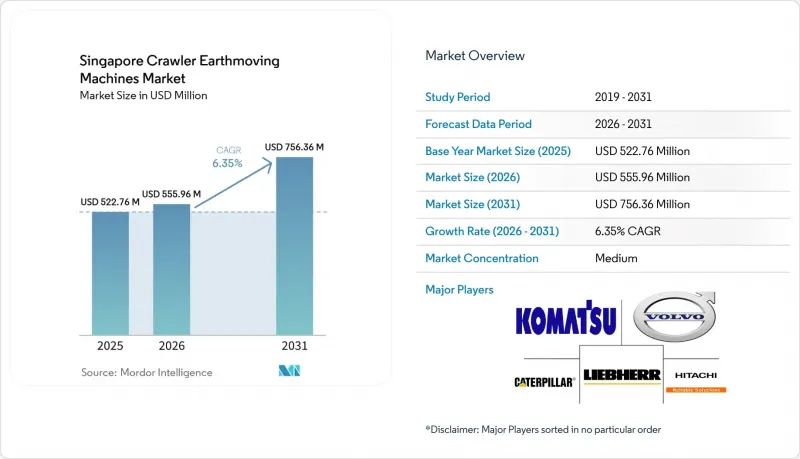
According to Mordor Intelligence, the Singapore crawler earthmoving machines market size was valued at USD 522.76 million in 2025 and is estimated to grow from USD 555.96 million in 2026 to reach USD 756.36 million by 2031, at a CAGR of 6.35% during the forecast period (2026-2031).
Singapore Crawler Earthmoving Machines Market Trends and Insights
Public-Private Funding of Autonomous Tuas Port Logistics
Tuas Megaport is rolling out more than 200 autonomous vehicles that require crawler platforms capable of seamless machine-to-machine communication. OEMs are responding by embedding remote diagnostic modules and ISO 15143-3-compliant data protocols into mid-range excavators. Field pilots show double-digit improvements in uptime because predictive analytics reduce unplanned service stops. Rental fleets view these gains as a path to justify premium day rates. As additional port phases come online, demand should focus on factory-ready autonomous kits rather than aftermarket retrofits.
Singapore Green Plan 2030 Infrastructure Pipeline
The Green Plan allocates multi-year funding to coastal protection works and the expansion of the Changi Water Reclamation Plant. Such projects favor crawler excavators rated for corrosive, marine-adjacent environments. Contractors holding long-term maintenance contracts now specify zero-emission or Stage V-compliant machinery. Compact tracked loaders proved their worth during the Sentosa Sensoryscape redevelopment, where strict noise limits barred the use of larger diesel equipment. Long-duration pipelines give OEMs the confidence to introduce subscription-based battery-leasing models that reduce contractors' upfront capital outlay.
High Upfront CAPEX and Tightening Credit
Electric crawlers currently cost significantly more than diesel equivalents, placing pressure on contractors with thin margins. Elevated benchmark lending rates have driven up leasing costs, prompting some fleets to extend replacement cycles. Although grants defray a portion of the delta, subsidies seldom cover the entire premium. Smaller firms consequently gravitate toward rental agreements rather than outright purchases. Near-term demand, therefore, hinges on easing in the credit market.
Other drivers and restraints analyzed in the detailed report include:
- Digital Twins and Telematics-Driven OPEX Savings
- Electrification Incentives and Stage V Emission Mandates
- Raw-Material and Component-Supply Volatility
For complete list of drivers and restraints, kindly check the Table Of Contents.
Segment Analysis
Crawler excavators held the highest 46.62% Singapore crawler earthmoving machines market share in 2025. They remain the workhorses for bulk earthmoving, grading, and marine reclamation duties that define national infrastructure projects. In contrast, compact tracked loaders and skid-steers are slated to record the fastest 9.75% CAGR, propelled by demolition mandates that reward low-emission, small-footprint machines. Contractors appreciate that tracked loaders can swap between buckets, breakers, and mulchers in minutes, raising utilization without adding headcount. Rental companies, sensing this versatility, are enlarging loader fleets to capture rising short-term demand.
Compact loaders also align with Singapore's move toward vertical redevelopment, where basements and narrow corridors limit turning radii. Leading OEMs now ship electric loader models that comply with Stage V noise thresholds and qualify for electrification grants. Conversely, crawler bulldozers occupy niche use cases in coastal-protection berms. Crawler cranes and pipe-layers, although critical for port phases, transact in low volumes and seldom affect headline growth. The upshot is a segmented landscape: excavators ensure baseline revenue, while compact loaders inject the momentum that propels the Singapore crawler earthmoving machines market forward.
Diesel platforms retained the dominant 67.84% market share of Singapore crawler earthmoving machines in 2025. Even so, battery-electric models are forecast to post the fastest CAGR at 29.52% as incentives kick in. Stage V compliance costs have narrowed diesel's price advantage, making the switch more palatable for fleet owners who value silent, zero-tailpipe operation on urban job sites. Hybrid diesel-electric variants offer a bridging solution but risk regulatory obsolescence as full-electric runtimes improve.
OEM roadmaps now emphasize modular battery packs and grid-connect options that suit Singapore's dense charging network plans. Diesel remains indispensable for 24/7 dredging and heavy grading, yet electric alternatives are carving out a share in shift-based municipal work. The propulsion mix reflects a transitional equilibrium: diesel currently anchors market volume. At the same time, electric power provides the growth pathway that will reshape the Singapore crawler earthmoving machines market over the next decade.
Complete Report Scope:
- By Equipment Type
- Crawler Excavators
- Crawler Bulldozers
- Crawler Loaders
- Crawler Cranes and Pipe-layers
- Compact Tracked Loaders and Skid-steers
- Others (Trencher, Drill Rig, etc.)
- By Propulsion
- Diesel (Stage III-V)
- Hybrid Diesel-Electric
- Battery-Electric
- Hydrogen Fuel-cell (Pilot)
- By Engine Power Output
- Less than 100 HP
- 100 to 200 HP
- 201 to 400 HP
- More than 400 HP
- By Application
- Earthmoving and Grading
- Demolition and Recycling
- Forestry and Agriculture
- Mining and Quarrying
- Pipeline and Energy Infrastructure
- Rental Fleet Operations
- By End-user
- Construction (Residential, Non-residential)
- Mining and Quarrying
- Oil and Gas Infrastructure
- Industrial and Logistics Parks
- Municipal Services
- Agriculture and Forestry
- By Distribution Channel
- Direct OEM Sales
- Authorised Dealers
- Rental and Leasing Firms
- Online/Digital Marketplaces
List of Companies Covered in this Report:
- Caterpillar Inc.
- Komatsu Ltd.
- Volvo Construction Equipment AB
- Hitachi Construction Machinery Co., Ltd.
- Liebherr-International AG
- HD Hyundai Construction Equipment
- CNH Industrial - CASE CE
- XCMG Group
- SANY Group
- JCB Ltd.
- Zoomlion Heavy Industry
- Kobelco Construction Machinery
- Sumitomo Construction Machinery
- Develon (Doosan)
Additional Benefits:
- The market estimate (ME) sheet in Excel format
- 3 months of analyst support
TABLE OF CONTENTS
1 Introduction
- 1.1 Study Assumptions and Market Definition
- 1.2 Scope of the Study
2 Research Methodology
3 Executive Summary
4 Market Landscape
- 4.1 Market Overview
- 4.2 Market Drivers
- 4.2.1 Public-Private Funding of Autonomous Tuas Port Logistics
- 4.2.2 Singapore Green Plan 2030 Infrastructure Pipeline
- 4.2.3 Digital Twins and Telematics-Driven OPEX Savings
- 4.2.4 Electrification Incentives and Stage V Emission Mandates
- 4.2.5 Surge in Deconstruction and Circular-Demolition Projects
- 4.2.6 Aging National Construction-Fleet Replacement Cycle
- 4.3 Market Restraints
- 4.3.1 High Upfront CAPEX and Tightening Credit
- 4.3.2 Raw-Material and Component-Supply Volatility
- 4.3.3 Scarcity of Fast-Charging Infrastructure for More than 20-Ton Crawlers
- 4.3.4 ESG-Linked Cost of Ownership for Diesel Units
- 4.4 Value / Supply-Chain Analysis
- 4.5 Regulatory Landscape
- 4.6 Technological Outlook
- 4.7 Porter's Five Forces Analysis
- 4.7.1 Threat of New Entrants
- 4.7.2 Bargaining Power of Buyers
- 4.7.3 Bargaining Power of Suppliers
- 4.7.4 Threat of Substitutes
- 4.7.5 Competitive Rivalry
5 Market Size and Growth Forecasts (Value (USD) and Volume (Units))
- 5.1 By Equipment Type
- 5.1.1 Crawler Excavators
- 5.1.2 Crawler Bulldozers
- 5.1.3 Crawler Loaders
- 5.1.4 Crawler Cranes and Pipe-layers
- 5.1.5 Compact Tracked Loaders and Skid-steers
- 5.1.6 Others (Trencher, Drill Rig, etc.)
- 5.2 By Propulsion
- 5.2.1 Diesel (Stage III-V)
- 5.2.2 Hybrid Diesel-Electric
- 5.2.3 Battery-Electric
- 5.2.4 Hydrogen Fuel-cell (Pilot)
- 5.3 By Engine Power Output
- 5.3.1 Less than 100 HP
- 5.3.2 100 to 200 HP
- 5.3.3 201 to 400 HP
- 5.3.4 More than 400 HP
- 5.4 By Application
- 5.4.1 Earthmoving and Grading
- 5.4.2 Demolition and Recycling
- 5.4.3 Forestry and Agriculture
- 5.4.4 Mining and Quarrying
- 5.4.5 Pipeline and Energy Infrastructure
- 5.4.6 Rental Fleet Operations
- 5.5 By End-user
- 5.5.1 Construction (Residential, Non-residential)
- 5.5.2 Mining and Quarrying
- 5.5.3 Oil and Gas Infrastructure
- 5.5.4 Industrial and Logistics Parks
- 5.5.5 Municipal Services
- 5.5.6 Agriculture and Forestry
- 5.6 By Distribution Channel
- 5.6.1 Direct OEM Sales
- 5.6.2 Authorised Dealers
- 5.6.3 Rental and Leasing Firms
- 5.6.4 Online/Digital Marketplaces
6 Competitive Landscape
- 6.1 Market Concentration
- 6.2 Strategic Moves and Partnerships
- 6.3 Market Share Analysis
- 6.4 Company Profiles (Includes Global Level Overview, Market Level Overview, Core Segments, Financials as Available, Strategic Information, Market Rank/Share for Key Companies, Products and Services, SWOT Analysis, and Recent Developments)
- 6.4.1 Caterpillar Inc.
- 6.4.2 Komatsu Ltd.
- 6.4.3 Volvo Construction Equipment AB
- 6.4.4 Hitachi Construction Machinery Co., Ltd.
- 6.4.5 Liebherr-International AG
- 6.4.6 HD Hyundai Construction Equipment
- 6.4.7 CNH Industrial - CASE CE
- 6.4.8 XCMG Group
- 6.4.9 SANY Group
- 6.4.10 JCB Ltd.
- 6.4.11 Zoomlion Heavy Industry
- 6.4.12 Kobelco Construction Machinery
- 6.4.13 Sumitomo Construction Machinery
- 6.4.14 Develon (Doosan)
7 Market Opportunities and Future Outlook
- 7.1 White-space and Unmet-need Assessment

