PUBLISHER: Mordor Intelligence | PRODUCT CODE: 2117405

PUBLISHER: Mordor Intelligence | PRODUCT CODE: 2117405
Magnet Free Electric Axle System - Market Share Analysis, Industry Trends & Statistics, Growth Forecasts (2026 - 2031)
According to Mordor Intelligence, the magnet free electric axle system market size was valued at USD 3.26 billion in 2025, is estimated at USD 3.66 billion in 2026, and is projected to reach USD 6.48 billion by 2031, registering a 12.14% CAGR between 2026 and 2031.
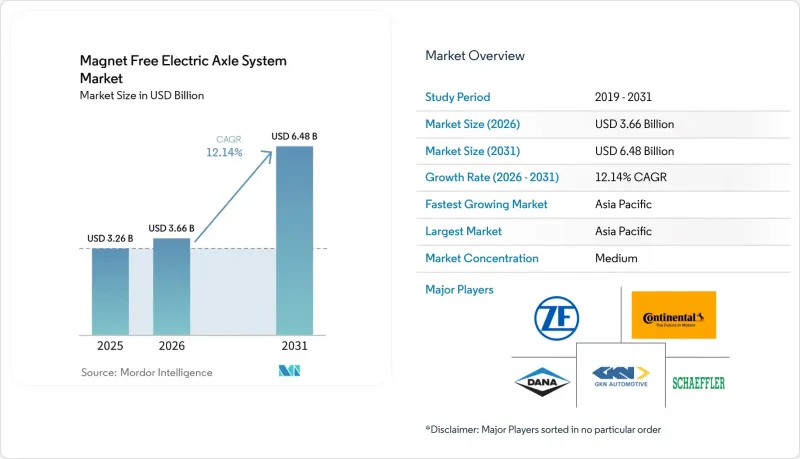
This report is Segmented by Motor Type (Externally Excited Synchronous Motors, Induction Motors, and More), Drive Type (Fully Electric Drive, Hybrid Drive, and More), E-Axle Configuration (Single E-Axle, Dual E-Axle, and More), Vehicle Type (Passenger Cars, Commercial Vehicles), and Geography (North America, South America, and More). The Market Forecasts are Provided in Terms of Value (USD).
Global Magnet Free Electric Axle System Market Trends and Insights
Supply-Chain Security from Rare-Earth Independence
China's export-licensing delays for dysprosium and terbium caused European spot prices to surge significantly, prompting OEMs to shift their e-axle roadmaps toward magnet-free motors. The country continues to dominate global heavy-rare-earth separation capacity, creating a bottleneck that Western refineries cannot resolve in the near term. A contract for induction motors by BorgWarner with a U.S. truck manufacturer demonstrates a strategic move to mitigate magnet shortages. Even with new refineries expected to increase production, Western output will meet only a small fraction of the demand, reinforcing the importance of magnet-free designs for achieving scalability and sovereignty. The EU's Critical Raw Materials Act caps any single-country supply at 65% by 2030, cementing the adoption of magnet-free technologies.
Lower Lifetime Cost Versus PM E-Axles
Studies suggest that induction-motor e-axles achieve cost parity with permanent-magnet units after extended use in commercial duty cycles. This is attributed to their ability to avoid high neodymium costs and eliminate maintenance challenges associated with demagnetization. In externally excited designs, field-winding copper and lamination expenses are significantly lower than rare-earth procurement costs when neodymium prices increase substantially. Dana's TM4 SUMO MD induction motor, designed to deliver continuous high power, operates entirely without rare-earth content. This innovation helps fleets avoid the need for magnet replacements over the long term. Additionally, EU battery passport regulations support the adoption of magnet-free motors, as rare-earth recycling is less efficient than the recovery rates of copper and steel, leading to higher end-of-life costs for permanent-magnet drives.
Lower Power/Torque Density Versus PM Motors
Permanent-magnet units achieve higher power density per liter compared to induction and externally excited motors. This difference forces OEMs to either enlarge housings or compromise on packaging in compact EVs. For instance, high-performance segments rely on magnets to deliver significant power output in a smaller volume. SRMs lag behind PMSMs in torque density at the same rotor diameters, which impacts payload capacity in heavy trucks. Research highlights that copper field losses can reduce continuous ratings under high temperatures, posing challenges for externally excited designs during demanding duty cycles. Additionally, torque-vectoring EVs require rapid response times, a benchmark that induction motors struggle to meet without relying on oversized and more expensive inverters.
Other drivers and restraints analyzed in the detailed report include:
- OEM Carbon-Neutral Targets and ESG Mandates
- Regulatory Incentives Favoring Non-Rare-Earth Motors
- Higher Acoustic and Torque Ripple Issues
For complete list of drivers and restraints, kindly check the Table Of Contents.
Segment Analysis
Externally excited synchronous motors accounted for 48.13% of 2025 revenue, reflecting the automaker's efforts to marry rare-earth independence with sinusoidal torque characteristics that consumers recognize as smooth, while switched reluctance motors are expected to grow at a CAGR of 14.17% through 2031. Induction motors prevail in fleets that value ruggedness over peak efficiency, while switched reluctance is gaining popularity as silicon-carbide inverters damp historic ripple, moving the Magnet Free Electric Axle System market toward broader acceptance. BMW's sixth-generation eDrive confirms premium momentum by pairing an EESM with an 800 V SiC inverter delivering 400 kW without neodymium, a configuration that satisfies both ESG metrics and driver expectations.
Research published in 2025 showed field-current modulation within EESMs unlocks real-time flux weakening, erasing demagnetization limits that hamper PMSMs at highway speeds. Valeo and MAHLE's iBEE brings 48-V EESM technology into mild hybrids, embedding rare-earth-free design in price-sensitive sub-segments. Meanwhile, induction motors are increasingly the front-axle choice in dual-motor AWD layouts, where their lower cogging torque reduces drag when decoupled- a bridge strategy until SRM matures
Hybrid drives accounted for 57.22% of 2025 revenue as OEMs leveraged magnet-free motors across plug-in and mild-hybrid models, which carry lower battery costs. Fully electric architectures are on track for 17.64% CAGR through 2031 because urban zero-emission zones and declining battery prices align to make rare-earth-free e-axles economically compelling, especially in last-mile logistics. Plug-in hybrids serve a transitional role, using magnet-free motors to meet the Inflation Reduction Act's mineral criteria while retaining combustion for long-haul trips.
Daimler Truck's delivery of 75 eActros 600 units to Simon Loos in 2026 illustrates cost parity between full-electric magnet-free trucks and diesel in city routes. China's subsidy structure, rewarding electric-only ranges above 50 km, further boosts magnet-free hybrids by offsetting the cost of high-silicon electrical steel. Plug-in hybrids will shrink in Europe as ICE sales bans approach, reallocating R&D spend toward fully electric e-axles, where magnet free electric axle system market growth concentrates
Complete Report Scope:
- By Motor Type
- Externally Excited Synchronous Motors (EESM)
- Induction Motors
- Switched Reluctance Motors
- By Drive Type
- Fully Electric Drive
- Hybrid Drive
- Plug-in Hybrid Drive
- By E-Axle Configuration
- Single E-Axle
- Dual E-Axle
- Integrated E-Axle
- By Vehicle Type
- Passenger Cars
- Hatchbacks
- Sedans
- SUV and MUVs
- Commercial Vehicles
- Light Commercial Vehicles
- Medium and Heavy Commercial Vehicles
- Buses and Coaches
- Passenger Cars
- By Geography
- North America
- United States
- Canada
- Rest of North America
- South America
- Brazil
- Argentina
- Rest of South America
- Europe
- Germany
- United Kingdom
- Spain
- Italy
- France
- Netherlands
- Rest of Europe
- Asia-Pacific
- India
- China
- Japan
- South Korea
- Indonesia
- Rest of Asia-Pacific
- Middle East and Africa
- United Arab Emirates
- Saudi Arabia
- Turkey
- Egypt
- South Africa
- Rest of Middle East and Africa
- North America
Geography Analysis
Asia-Pacific held 44.61% of the 2025 magnet free electric axle system market share and is poised for a 15.71% CAGR through 2031, driven by China's dual-circulation strategy, which enhances domestic electrical-steel production, and India's PLI scheme, which provides reimbursements for local e-axle capital expenditures. Continental has made a major investment in a Tianjin electric-drive facility to produce EESM units using Baosteel's ultra-thin steel. This initiative supports Chinese OEMs in meeting EU export regulations that limit reliance on single-country raw materials. Additionally, Japan's Nidec has significantly expanded its e-axle production capacity and diversified its manufacturing operations to Serbia and Mexico, ensuring resilience against geopolitical risks while maintaining strong demand in the Asia-Pacific region .
Europe, under strict rare-earth quotas, is seeing a shift as major automakers like BMW, Mercedes-Benz, and Volkswagen prioritize magnet-free motors and strengthen regional supply chains. Schaeffler's production of magnet-free e-axles for hybrid programs exemplifies this transition. Furthermore, logistics fleets in cities such as Amsterdam and Barcelona are adopting dual-e-axle trucks from DAF and Volvo, advancing electrification efforts.
North America is capitalizing on policy measures that discourage the use of Chinese magnet content, prompting automakers to adopt induction and EESM solutions that qualify for consumer tax credits. BorgWarner's contract for a magnet-free drive module in a heavy-truck platform highlights the region's focus on local sourcing strategies. While Canada and the U.S. emphasize electrification of medium-duty delivery vehicles, Latin America is emerging as a key player. Brazil is actively attracting investments to reduce dependence on Asia, and Argentina is leveraging its lithium-centric ecosystems to align with the growing demand for magnet-free powertrains.
- Continental AG
- ZF Friedrichshafen AG
- Schaeffler AG
- GKN Automotive
- Dana Incorporated
- Magna International
- BorgWarner Inc.
- Nidec Corporation
- American Axle & Manufacturing
- Valeo SA
- Mahle GmbH
- Vitesco Technologies
- Punch Powertrain
Additional Benefits:
- The market estimate (ME) sheet in Excel format
- 3 months of analyst support
TABLE OF CONTENTS
1 Introduction
- 1.1 Study Assumptions and Market Definition
- 1.2 Scope of the Study
2 Research Methodology
3 Executive Summary
4 Market Landscape
- 4.1 Market Overview
- 4.2 Market Drivers
- 4.2.1 Supply-Chain Security from Rare-Earth Independence
- 4.2.2 Lower Lifetime Cost Versus PM E-Axles
- 4.2.3 OEM Carbon-Neutral Targets and ESG Mandates
- 4.2.4 Regulatory Incentives Favoring Non-Rare-Earth Motors
- 4.2.5 Breakthroughs in High-Si Electrical Steel
- 4.2.6 Circular-Economy Pull for Fully Recyclable Powertrains
- 4.3 Market Restraints
- 4.3.1 Lower Power/Torque Density Versus PM Motors
- 4.3.2 Higher Acoustic and Torque Ripple Issues
- 4.3.3 Elevated Inverter Switching Losses at High Frequencies
- 4.3.4 IP Concentration Around SRM Control Software
- 4.4 Value / Supply-Chain Analysis
- 4.5 Regulatory Landscape
- 4.6 Technological Outlook
- 4.7 Porter's Five Forces
- 4.7.1 Threat of New Entrants
- 4.7.2 Bargaining Power of Suppliers
- 4.7.3 Bargaining Power of Buyers
- 4.7.4 Threat of Substitutes
- 4.7.5 Competitive Rivalry
5 Market Size and Growth Forecasts (Value in USD)
- 5.1 By Motor Type
- 5.1.1 Externally Excited Synchronous Motors (EESM)
- 5.1.2 Induction Motors
- 5.1.3 Switched Reluctance Motors
- 5.2 By Drive Type
- 5.2.1 Fully Electric Drive
- 5.2.2 Hybrid Drive
- 5.2.3 Plug-in Hybrid Drive
- 5.3 By E-Axle Configuration
- 5.3.1 Single E-Axle
- 5.3.2 Dual E-Axle
- 5.3.3 Integrated E-Axle
- 5.4 By Vehicle Type
- 5.4.1 Passenger Cars
- 5.4.1.1 Hatchbacks
- 5.4.1.2 Sedans
- 5.4.1.3 SUV and MUVs
- 5.4.2 Commercial Vehicles
- 5.4.2.1 Light Commercial Vehicles
- 5.4.2.2 Medium and Heavy Commercial Vehicles
- 5.4.2.3 Buses and Coaches
- 5.4.1 Passenger Cars
- 5.5 By Geography
- 5.5.1 North America
- 5.5.1.1 United States
- 5.5.1.2 Canada
- 5.5.1.3 Rest of North America
- 5.5.2 South America
- 5.5.2.1 Brazil
- 5.5.2.2 Argentina
- 5.5.2.3 Rest of South America
- 5.5.3 Europe
- 5.5.3.1 Germany
- 5.5.3.2 United Kingdom
- 5.5.3.3 Spain
- 5.5.3.4 Italy
- 5.5.3.5 France
- 5.5.3.6 Netherlands
- 5.5.3.7 Rest of Europe
- 5.5.4 Asia-Pacific
- 5.5.4.1 India
- 5.5.4.2 China
- 5.5.4.3 Japan
- 5.5.4.4 South Korea
- 5.5.4.5 Indonesia
- 5.5.4.6 Rest of Asia-Pacific
- 5.5.5 Middle East and Africa
- 5.5.5.1 United Arab Emirates
- 5.5.5.2 Saudi Arabia
- 5.5.5.3 Turkey
- 5.5.5.4 Egypt
- 5.5.5.5 South Africa
- 5.5.5.6 Rest of Middle East and Africa
- 5.5.1 North America
6 Competitive Landscape
- 6.1 Market Concentration
- 6.2 Strategic Moves
- 6.3 Market Share Analysis
- 6.4 Company Profiles (Includes Global Level Overview, Market Level Overview, Core Segments, Financials as Available, Strategic Information, Market Rank/Share for Key Companies, Products and Services, SWOT Analysis, and Recent Developments)
- 6.4.1 Continental AG
- 6.4.2 ZF Friedrichshafen AG
- 6.4.3 Schaeffler AG
- 6.4.4 GKN Automotive
- 6.4.5 Dana Incorporated
- 6.4.6 Magna International
- 6.4.7 BorgWarner Inc.
- 6.4.8 Nidec Corporation
- 6.4.9 American Axle & Manufacturing
- 6.4.10 Valeo SA
- 6.4.11 Mahle GmbH
- 6.4.12 Vitesco Technologies
- 6.4.13 Punch Powertrain
7 Market Opportunities and Future Outlook
- 7.1 White-space and Unmet-need Assessment

