PUBLISHER: Mordor Intelligence | PRODUCT CODE: 2117411

PUBLISHER: Mordor Intelligence | PRODUCT CODE: 2117411
Europe Magnet Free Electric Axle System - Market Share Analysis, Industry Trends & Statistics, Growth Forecasts (2026 - 2031)
According to Mordor Intelligence, the Europe magnet free electric axle system market size was valued at USD 1.68 billion in 2025 and is estimated to grow from USD 1.91 billion in 2026 to reach USD 3.64 billion by 2031, at a CAGR of 13.76% during the forecast period (2026-2031).
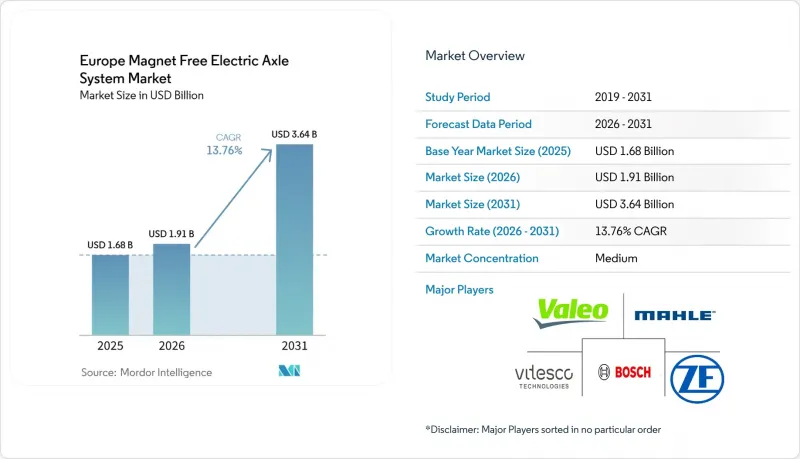
This report is Segmented by Motor Type (Externally Excited Synchronous Motors and More), Drive Type (Fully Electric and More), E-Axle Configuration (Single and More), Vehicle Type (Passenger Cars and Commercial Vehicles), and Geography (Germany, United Kingdom, Spain, Italy, France, Netherlands, and Rest of Europe). The Market Forecasts are Provided in Terms of Value (USD).
Europe Magnet Free Electric Axle System Market Trends and Insights
EV-led CO2-cut Mandates Across EU-27 Tighten Post-2025
Penalties of EUR 95 per gram over the 93.6 g CO2/km passenger-car limit expose OEMs to significant compliance costs, driving battery-electric adoption and boosting demand for magnet free electric axle systems. With the engine phase-out, hybrid fallback strategies are no longer available. This shift accelerates ROI cycles for magnet free e-axles, which avoid the pitfalls of rare-earth dependencies. While fleet averaging provides a brief respite, manufacturers are hastening their platform rollouts. Stellantis allocated significant investments to several of its Italian plants to align with these new targets. As WLTP and the forthcoming regulations impose real-world evaluations, magnet free motors gain an advantage. These motors maintain their output on highways without facing thermal derating.
OEM Shift to Rare-Earth-Free Motors to De-Risk China Supply Chain
China's tighter export rules on rare-earth processing triggered a swift shift towards wound-field and reluctance machines in the electric axle system market. BMW's Gen6 e-axle, now free of neodymium, boasts significantly lower losses and reduced weight compared to its predecessor. Valeo and MAHLE introduced an EESM platform with a substantially smaller carbon footprint than traditional permanent-magnet systems. While Europe's ResourceEU initiative aims to increase domestic recycling, current capacities remain limited, making magnet free architectures a pragmatic choice.
Stator Copper Price Volatility Inflates BOM Cost
LME futures experienced significant volatility, leading to higher bill-of-materials costs for magnet free motors, which require more copper than magnet-based designs. Without robust hedging markets, tier-1 suppliers faced margin pressures, necessitating renegotiation of long-term contracts or a shift towards recycled feedstock. Although the EU's initiative aims to increase the use of recycled copper, the recovery rate for motor-grade copper remains low.
Other drivers and restraints analyzed in the detailed report include:
- Battery Cost Parity Accelerates Demand for Fully Electric E-Axles
- Fleet-Operator TCO Models Favor Integrated E-Axles
- Limited Field Experience with SRM Acoustic NVH in Europe Buses
For complete list of drivers and restraints, kindly check the Table Of Contents.
Segment Analysis
Externally excited synchronous motors held 46.56% revenue in 2025, reflecting their balance of efficiency and geopolitical resilience within the magnet free electric axle system market. Switched reluctance motors are forecast to expand at 15.42% CAGR, the highest among motor types, once waveform-shaping inverters verify ISO-compatible noise levels for bus duty cycles. Induction machines, while aiding front axles in dual-motor setups, compromise efficiency at highway speeds, resulting in a modest market share. Meanwhile, permanent-magnet units find their niche solely in budget-conscious compact car programs.
A joint platform is set to enter series production, aiming to achieve a significant reduction in carbon footprint. A flexible solution allows OEMs to choose between a rare-earth-free or magnet-based design. An upcoming induction module, tailored for a premium client, highlights the transatlantic exchange of technology. Lastly, patents addressing NVH challenges underscore the final hurdle for the mass adoption of SRM, leaving its market forecast vulnerable to the timing of execution.
Fully electric drivetrains captured 63.28% of installations in 2025 and are growing at an 18.28% CAGR, vastly outpacing plug-in and mild hybrids in the magnet free electric axle system market. As battery prices drop significantly, the total cost of ownership (TCO) advantages of dual-powertrain models diminish. Meanwhile, regulations are set to halt the sale of combustion engines in the future.
While plug-in hybrids are projected to account for a notable share of the market volume, their margin for maneuvering shrinks as compliance credits become scarcer. Although hybrids continue to operate in duty cycles where public chargers are absent, data indicate that toll incentives are rapidly bridging this gap. In a clear shift, a major automaker is launching its new platform exclusively as a pure electric model, underscoring the industry's move away from plug-in architecture.
Complete Report Scope:
- By Motor Type
- Externally Excited Synchronous Motors (EESM)
- Induction Motors
- Switched Reluctance Motors
- Permanent Magnet Motors
- By Drive Type
- Fully Electric Drive
- Hybrid Drive
- Plug-in Hybrid Drive
- By E-Axle Configuration
- Single E-Axle
- Dual E-Axle
- Integrated E-Axle
- By Vehicle Type
- Passenger Cars
- Hatchbacks
- Sedans
- SUV and MUVs
- Commercial Vehicles
- Light Commercial Vehicles
- Medium and Heavy Commercial Vehicles
- Buses and Coaches
- Passenger Cars
- By Country
- Germany
- United Kingdom
- Spain
- Italy
- France
- Netherlands
- Rest of Europe
List of Companies Covered in this Report:
- ZF Friedrichshafen AG
- Robert Bosch GmbH
- Vitesco Technologies Group AG
- GKN Automotive Ltd
- Valeo SA
- MAHLE GmbH
- Dana Incorporated
- BorgWarner Inc.
- Schaeffler AG
- AVL List GmbH
- Siemens AG
- Magna International Inc.
- Punch Powertrain NV
- Nidec Corporation
- Continental AG
- Allison Transmission Holdings Inc.
- American Axle and Manufacturing Holdings Inc.
- Hitachi Astemo Ltd
- Infinitum Electric Inc.
- Parker Hannifin Corp.
Additional Benefits:
- The market estimate (ME) sheet in Excel format
- 3 months of analyst support
TABLE OF CONTENTS
1 Introduction
- 1.1 Study Assumptions and Market Definition
- 1.2 Scope of the Study
2 Research Methodology
3 Executive Summary
4 Market Landscape
- 4.1 Market Overview
- 4.2 Market Drivers
- 4.2.1 EV-Led CO2-cut Mandates Across EU-27 Tighten Post-2025
- 4.2.2 OEM Shift to Rare-earth-free motors to De-risk China Supply Chain
- 4.2.3 Battery Cost Parity Accelerates Demand for Fully Electric E-axles
- 4.2.4 Fleet-operator TCO Models Favor Integrated E-axles
- 4.2.5 High-voltage SiC Inverters Boost Magnet-free Motor Efficiency
- 4.2.6 Tier-1/OEM joint IP on Wound-rotor Cooling Unlocks 20-30 kW/kg Motors
- 4.3 Market Restraints
- 4.3.1 Stator Copper Price Volatility Inflates BOM Cost
- 4.3.2 Limited Field Experience with SRM Acoustic NVH in Europe Buses
- 4.3.3 Standards Gap for EESM Rotor Insulation Longevity
- 4.3.4 Scarcity of EU-scale Laminations Stamping Capacity
- 4.4 Value/Supply-Chain Analysis
- 4.5 Regulatory Landscape
- 4.6 Technological Outlook
- 4.7 Porter's Five Forces
- 4.7.1 Threat of New Entrants
- 4.7.2 Bargaining Power of Suppliers
- 4.7.3 Bargaining Power of Buyers
- 4.7.4 Threat of Substitutes
- 4.7.5 Competitive Rivalry
5 Market Size and Growth Forecasts (Value (USD))
- 5.1 By Motor Type
- 5.1.1 Externally Excited Synchronous Motors (EESM)
- 5.1.2 Induction Motors
- 5.1.3 Switched Reluctance Motors
- 5.1.4 Permanent Magnet Motors
- 5.2 By Drive Type
- 5.2.1 Fully Electric Drive
- 5.2.2 Hybrid Drive
- 5.2.3 Plug-in Hybrid Drive
- 5.3 By E-Axle Configuration
- 5.3.1 Single E-Axle
- 5.3.2 Dual E-Axle
- 5.3.3 Integrated E-Axle
- 5.4 By Vehicle Type
- 5.4.1 Passenger Cars
- 5.4.1.1 Hatchbacks
- 5.4.1.2 Sedans
- 5.4.1.3 SUV and MUVs
- 5.4.2 Commercial Vehicles
- 5.4.2.1 Light Commercial Vehicles
- 5.4.2.2 Medium and Heavy Commercial Vehicles
- 5.4.2.3 Buses and Coaches
- 5.4.1 Passenger Cars
- 5.5 By Country
- 5.5.1 Germany
- 5.5.2 United Kingdom
- 5.5.3 Spain
- 5.5.4 Italy
- 5.5.5 France
- 5.5.6 Netherlands
- 5.5.7 Rest of Europe
6 Competitive Landscape
- 6.1 Market Concentration
- 6.2 Strategic Moves
- 6.3 Market Share Analysis
- 6.4 Company Profiles (Includes Global level Overview, Market level overview, Core Segments, Financials as available, Strategic Information, Market Rank/Share for key companies, Products and Services, and Recent Developments)
- 6.4.1 ZF Friedrichshafen AG
- 6.4.2 Robert Bosch GmbH
- 6.4.3 Vitesco Technologies Group AG
- 6.4.4 GKN Automotive Ltd
- 6.4.5 Valeo SA
- 6.4.6 MAHLE GmbH
- 6.4.7 Dana Incorporated
- 6.4.8 BorgWarner Inc.
- 6.4.9 Schaeffler AG
- 6.4.10 AVL List GmbH
- 6.4.11 Siemens AG
- 6.4.12 Magna International Inc.
- 6.4.13 Punch Powertrain NV
- 6.4.14 Nidec Corporation
- 6.4.15 Continental AG
- 6.4.16 Allison Transmission Holdings Inc.
- 6.4.17 American Axle and Manufacturing Holdings Inc.
- 6.4.18 Hitachi Astemo Ltd
- 6.4.19 Infinitum Electric Inc.
- 6.4.20 Parker Hannifin Corp.
7 Market Opportunities and Future Outlook
- 7.1 White-space and Unmet-Need Assessment

