PUBLISHER: Mordor Intelligence | PRODUCT CODE: 2117406

PUBLISHER: Mordor Intelligence | PRODUCT CODE: 2117406
China Magnet Free Electric Axle System - Market Share Analysis, Industry Trends & Statistics, Growth Forecasts (2026 - 2031)
According to Mordor Intelligence, the China magnet free electric axle system market size was valued at USD 1.14 billion in 2025 and is estimated at USD 1.30 billion in 2026, and is projected to reach USD 2.47 billion by 2031, growing at a CAGR of 13.74% from 2026 to 2031.
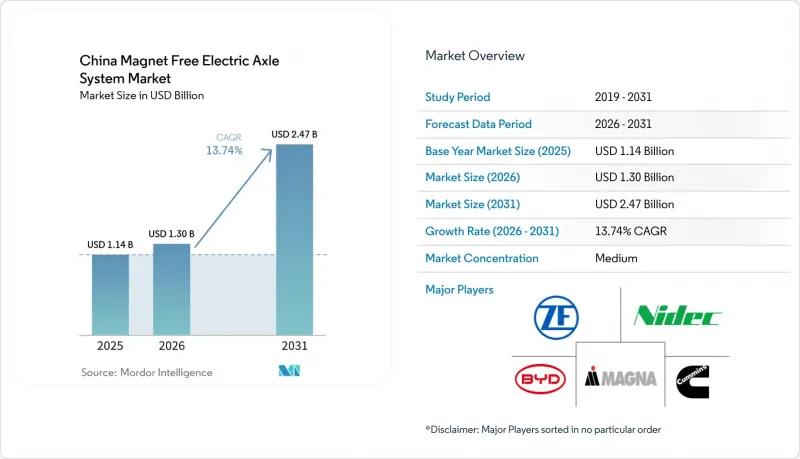
This report is Segmented by Motor Type (Externally Excited Synchronous Motors, Induction Motors, and Switched Reluctance Motors), Drive Type (Fully Electric Drive, Hybrid Drive, and More), E-Axle Configuration (Single E-Axle, Dual E-Axle, and Integrated E-Axle), and Vehicle Type (Passenger Cars and Commercial Vehicles). The Market Forecasts are Provided in Terms of Value (USD).
China Magnet Free Electric Axle System Market Trends and Insights
Government NEV Mandates and Local-Content Rules
Beijing will raise the minimum electric range for plug-in hybrids, significantly increasing the requirement. Under the revised dual-credit framework, permanent-magnet motors without domestic traceability will receive zero credits. This adjustment directs OEM investments towards induction and externally excited synchronous systems. Additionally, purchase-tax exemptions are now contingent on achieving a higher battery energy density. This benchmark becomes more attainable when utilizing a lighter, magnet-free motor rotor. Recent export licensing restrictions on overseas shipments of permanent-magnet drive units are encouraging foreign joint ventures to shift towards locally sourced induction modules. Collectively, these regulations establish a protective policy framework that accelerates the localization of magnet-free supply chains and motivates automakers to redesign their drivetrains efficiently.
Rare-earth Price Volatility Accelerates OEM Shift to Magnet-Free Motors
Neodymium-praseodymium oxide prices experienced a significant surge, driven primarily by disruptions in the Strait of Hormuz and the enforcement of stricter export quotas. In response, BYD is adjusting its strategy by increasing production of its induction motor while also advancing research and development on variable-flux permanent-magnet synchronous designs. By eliminating neodymium from their induction systems, OEMs can secure stable long-term pricing. This approach aligns with fleet operators' priorities for maintaining a consistent total cost of ownership (TCO). Urban logistics companies, deploying large numbers of vans annually, are now prioritizing cost stability over minor efficiency improvements. Consequently, they are rapidly transitioning to magnet-free e-axles. The growing demand is driving volume economies, reducing per-unit costs, and further reinforcing the shift away from magnets.
Higher Inverter Cost for High-Frequency Operation
SR machines are increasingly turning to SiC MOSFETs, which come at a higher cost than traditional silicon IGBTs. This price increase erodes the bill-of-materials edge that permanent-magnet motors once enjoyed in city cars priced at the lower end of the market. While Tiancheng's larger wafers hold the promise of cost reductions, it's important to highlight that commercial yields are still trailing. Induction motors, while capable of efficient operation with cheaper silicon, experience a slight efficiency dip. As a result, a temporary pricing window has emerged. During this timeframe, premium car manufacturers are likely to stick with magnets, avoiding the extra costs tied to inverters.
Other drivers and restraints analyzed in the detailed report include:
- Breakthroughs in Control Algorithms for SR and EESM Motors
- Lower Total Cost of Ownership vs. PM E-axles
- NVH and Torque-Density Gap with PM Motors
For complete list of drivers and restraints, kindly check the Table Of Contents.
Segment Analysis
The China magnet free electric axle system market size for induction motor-type adoption reached equal to 47.13% share. SR designs expand at 15.17% CAGR through 2031, supported by nation-funded research that halves torque ripple. Due to established coil-winding plants and seamless software portability, OEMs continue to place their trust in induction. ZF's e-axle empowers automakers to switch between asynchronous and synchronous variants without altering the gearbox, serving as a safeguard against fluctuations in rare-earth prices.
Breakthroughs in control algorithms are steering SR motors closer to passenger car suitability. With algorithm intellectual property emerging as the pivotal differentiator over rotor hardware, suppliers are now bundling firmware licenses with their hardware deliveries. Externally excited synchronous motors are finding their place in heavy trucks and luxury tour buses, where extended maintenance intervals make slip-ring maintenance a viable option. As SR and induction choices evolve, procurement teams are now factoring in spot neodymium prices before finalizing orders, leading to a more dynamic mix of motor types over time.
Fully electric drive captured 64.22% of the China magnet free electric axle system market share in 2025. The segment rises at a 16.78% CAGR due to range parity with early plug-in hybrids and a rapid rollout of chargers. MIIT's 100-km electric-only requirement erases the earlier cost edge of hybrids, which must now carry near-BEV battery packs yet still include internal-combustion engines.
Plug-in hybrids drift toward a niche role as range extenders for buses running along sparse highway charging corridors. Pure battery-electric simplifies e-axle software because there's no torque blending with engines, allowing SR motors to run in optimal zones. BYD sales data show BEVs topping PHEVs since April 2025, echoing the broader market tilt. Hybrids remain relevant for rural customers, but urban fleets and private buyers outside remote areas go straight to pure-electric powertrains.
Complete Report Scope:
- By Motor Type
- Externally Excited Synchronous Motors (EESM)
- Induction Motors
- Switched Reluctance Motors
- By Drive Type
- Fully Electric Drive
- Hybrid Drive
- Plug-in Hybrid Drive
- By E-Axle Configuration
- Single E-Axle
- Dual E-Axle
- Integrated E-Axle
- By Vehicle Type
- Passenger Cars
- Hatchbacks
- Sedans
- SUV and MUVs
- Commercial Vehicles
- Light Commercial Vehicles
- Medium and Heavy Commercial Vehicles
- Buses and Coaches
- Passenger Cars
List of Companies Covered in this Report:
- ZF Friedrichshafen AG
- Nidec Corporation
- BYD Co. Ltd.
- Magna International
- Meritor (Cummins)
- Allison Transmission
- Shuanglin Group
- SinoHytec
- Tesla (Gigafactory Shanghai)
- Vitesco Technologies
- Schaeffler AG
- Mahle GmbH
Additional Benefits:
- The market estimate (ME) sheet in Excel format
- 3 months of analyst support
TABLE OF CONTENTS
1 Introduction
- 1.1 Study Assumptions and Market Definition
- 1.2 Scope of the Study
2 Research Methodology
3 Executive Summary
4 Market Landscape
- 4.1 Market Overview
- 4.2 Market Drivers
- 4.2.1 Government NEV Mandates and Local-Content Rules
- 4.2.2 Rare-Earth Price Volatility Accelerates OEM Shift to Magnet-Free Motors
- 4.2.3 Breakthroughs in Control Algorithms for SR and EESM Motors
- 4.2.4 Lower Total Cost of Ownership vs. PM E-Axles
- 4.2.5 Mandatory Carbon-Footprint Reporting for Tier-1 Suppliers
- 4.2.6 Domestic SiC-Chip Breakthroughs Enabling High-Voltage Inverters
- 4.3 Market Restraints
- 4.3.1 Higher Inverter Cost for High-Frequency Operation
- 4.3.2 NVH and Torque-Density Gap with PM Motors
- 4.3.3 Thermal-Management Complexity for Integrated E-Axle Systems
- 4.3.4 Lack of Unified Motor Insulation Standards Above 800 V
- 4.4 Value / Supply-Chain Analysis
- 4.5 Regulatory Landscape
- 4.6 Technological Outlook
- 4.7 Porter's Five Forces
- 4.7.1 Threat of New Entrants
- 4.7.2 Bargaining Power of Suppliers
- 4.7.3 Bargaining Power of Buyers
- 4.7.4 Threat of Substitutes
- 4.7.5 Competitive Rivalry
5 Market Size and Growth Forecasts (Value in USD)
- 5.1 By Motor Type
- 5.1.1 Externally Excited Synchronous Motors (EESM)
- 5.1.2 Induction Motors
- 5.1.3 Switched Reluctance Motors
- 5.2 By Drive Type
- 5.2.1 Fully Electric Drive
- 5.2.2 Hybrid Drive
- 5.2.3 Plug-in Hybrid Drive
- 5.3 By E-Axle Configuration
- 5.3.1 Single E-Axle
- 5.3.2 Dual E-Axle
- 5.3.3 Integrated E-Axle
- 5.4 By Vehicle Type
- 5.4.1 Passenger Cars
- 5.4.1.1 Hatchbacks
- 5.4.1.2 Sedans
- 5.4.1.3 SUV and MUVs
- 5.4.2 Commercial Vehicles
- 5.4.2.1 Light Commercial Vehicles
- 5.4.2.2 Medium and Heavy Commercial Vehicles
- 5.4.2.3 Buses and Coaches
- 5.4.1 Passenger Cars
6 Competitive Landscape
- 6.1 Market Concentration
- 6.2 Strategic Moves
- 6.3 Market Share Analysis
- 6.4 Company Profiles (Includes Global Level Overview, Market Level Overview, Core Segments, Financials as Available, Strategic Information, Market Rank/Share for Key Companies, Products and Services, SWOT Analysis, and Recent Developments)
- 6.4.1 ZF Friedrichshafen AG
- 6.4.2 Nidec Corporation
- 6.4.3 BYD Co. Ltd.
- 6.4.4 Magna International
- 6.4.5 Meritor (Cummins)
- 6.4.6 Allison Transmission
- 6.4.7 Shuanglin Group
- 6.4.8 SinoHytec
- 6.4.9 Tesla (Gigafactory Shanghai)
- 6.4.10 Vitesco Technologies
- 6.4.11 Schaeffler AG
- 6.4.12 Mahle GmbH
7 Market Opportunities and Future Outlook
- 7.1 White-space and Unmet-Need Assessment

