PUBLISHER: Mordor Intelligence | PRODUCT CODE: 2117482

PUBLISHER: Mordor Intelligence | PRODUCT CODE: 2117482
United States Electronics Manufacturing Services - Market Share Analysis, Industry Trends & Statistics, Growth Forecasts (2026 - 2031)
According to Mordor Intelligence, the United States electronics manufacturing services market size in 2026 is projected to expand from USD 172.85 billion in 2025 and USD 185.30 billion in 2026 to USD 267.44 billion by 2031, registering a CAGR of 7.61% between 2026 to 2031.
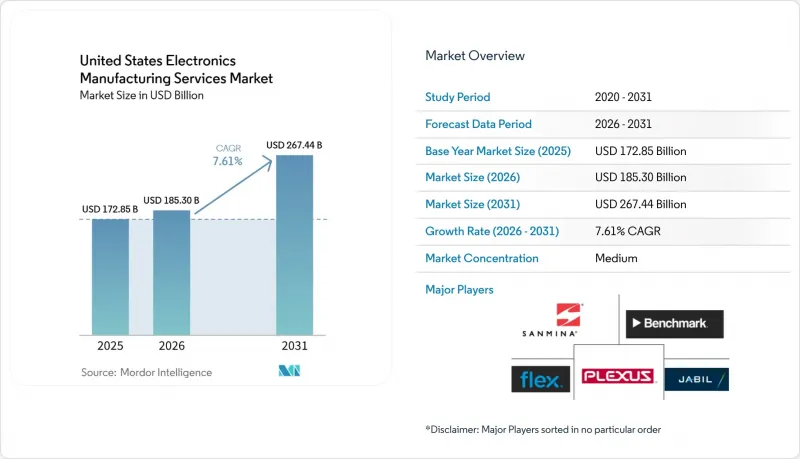
This report is Segmented by Service Type (Electronic Manufacturing Services, Engineering Services, and More), Business Model (Contract Manufacturing, Original Design Manufacturing, and More), Manufacturing Process (Surface Mount Technology, Through-Hole Technology, and More), End-User (Mobile, Consumer, and More). The Market Forecasts are Provided in Terms of Value (USD).
United States Electronics Manufacturing Services Market Trends and Insights
Accelerating Reshoring Incentives And CHIPS Act Subsidies
Federal incentives lowered the after-tax cost of new SMT and optical-inspection equipment by 25% under the Advanced Manufacturing Investment Credit, tipping marginal business cases into positive territory. Nearly all of the USD 39 billion CHIPS grant pool was committed by late 2025, including USD 6.6 billion to TSMC, USD 7.86 billion to Intel, and USD 4.74 billion to Samsung, each tied to co-located advanced-packaging capacity that depends on domestic EMS partners reported. Reshoring Initiative data confirm 244,000 U.S. manufacturing jobs announced in 2024, with computer and electronics accounting for 35%, the highest share since tracking began. Together, these levers shorten design-for-manufacturability loops by bringing assembly within a one-day truck haul of wafer output.
Medical-Device Miniaturization Driving Precision SMT Adoption
Implantable cardioverter defibrillators, insulin pumps, and portable ultrasound probes now rely on 01005 passives and µBGAs that demand placement tolerances tighter than 30 µm, prompting EMS providers to upgrade pick-and-place heads and x-ray inspection lines. ISO 13485 audits increasingly require traceability down to individual reel lots, pushing factories to deploy laser marking and automated data-capture systems that feed electronic device history records in real time. Providers with in-house micro-laser welding and conformal-coating booths win more contracts because they can ship fully finished assemblies ready for sterilization, trimming OEM validation cycles by several weeks. The net result is a steady inflow of low-volume, high-margin medical programs that reinforce demand for precision SMT capacity across U.S. campuses.
Persistent Skilled-Labor Shortage In U.S. Electronics Assembly
In 2025, the Bureau of Labor Statistics highlighted a significant challenge in the electronics assembly sector, reporting a 12% vacancy rate. This shortage extended the median time-to-fill for IPC-A-610 Class 3 roles beyond 90 days. As a result of these vacancies, wage premiums surged by 18% year over year. This wage spike had a tangible impact, trimming provider EBIT by approximately 120 basis points. Furthermore, the labor crunch has hastened the adoption of collaborative robots on SMT lines, underscoring the industry's push towards automation. While community-college certificate programs aim to address these shortages, their impact won't be felt until 2027, leading to a projected 0.7% dip in near-term growth.
Other drivers and restraints analyzed in the detailed report include:
- Tier-2 And Tier-3 OEMs Outsourcing NPI For Time-To-Market Gains
- Rising Demand For Secure ITAR-Compliant Defense Production
- Margin Compression From Commodity Component Price Swings
For complete list of drivers and restraints, kindly check the Table Of Contents.
Segment Analysis
Electromechanical assembly and box build revenue is expected to grow at a 8.65% CAGR to 2031, steadily narrowing the 48.29% 2025 lead held by PCB assembly as the laregets sub-segment of the United States EMS Market. This surge reflects automakers outsourcing battery-management systems and ADAS compute modules to domestic partners that can bundle enclosure fabrication, cable harnesses, and end-of-line functional tests. Tier-1 providers leverage scale purchasing for aluminum housings and high-current busbars, then amortize tooling across multiple vehicle platforms, a dynamic that smaller captive plants cannot replicate.
PCB assembly remains indispensable for smartphones, routers, and industrial controllers, yet its unit volume is flattening as consumer upgrade cycles lengthen. Prototyping orders from AI-hardware startups partially offset this softness, bringing short-run, high-layer-count work into premium-priced Class 3 lines. Engineering services linked to design-for-manufacturability have become table stakes, and providers capable of performing in-circuit test development inside the same campus win a larger share of follow-on production. Logistics services round out turnkey contracts by freeing OEMs from component financing, a decisive edge in capital-constrained medical and industrial niches.
Contract manufacturing accounted for 71.93% share of 2025 of the United States EMS Market's revenue, but Original Design Manufacturing (ODM) segment is advancing at a 9.97% CAGR as OEMs seek single-invoice solutions that cover materials, assembly, and regulatory documentation. Under turnkey deals, EMS providers shoulder component-sourcing risk, hold buffer stock, and manage supplier scorecards, features that appeal to medical-device start-ups scrambling to meet FDA submission deadlines. Hybrid contracts carve out firmware and algorithm IP for the customer while delegating PCB layout and test-fixture design to the EMS house, protecting core technology yet expediting builds.
Original design manufacturing remains a niche pathway centered on white-label networking gear and point-of-sale terminals where differentiation is thin. Nonetheless, hybrid models offer a stepping stone for OEMs wary of relinquishing control, and Plexus reported double-digit gains from such engagements in 2025. As supply-chain unpredictability persists, invoice consolidation and faster engineering change-order cycles give the hybrid cohort a durable structural advantage in the United States electronics manufacturing services (EMS) market.
Complete Report Scope:
- By Service Type
- Electronic Manufacturing Services
- PCB Assembly
- Electromechanical Assembly/Box Build
- Prototyping
- Other Electronic Manufacturing Services
- Engineering Services
- Test and Development Implementation Services
- Logistics Services
- Other Service Types
- Electronic Manufacturing Services
- By Business Model
- Contract Manufacturing (CM)
- Original Design Manufacturing (ODM)
- Hybrid / Turnkey / Other Business Models
- By Manufacturing Process
- Surface Mount Technology (SMT)
- Through-Hole Technology (THT)
- Advanced Packaging / Hybrid Processes
- By End-user
- Mobile Devices (Smartphones and Tablets)
- Consumer Electronics
- Computer (PCs/Desktop/Laptops)
- Industrial
- Automotive
- Communication
- Lighting
- Medical
- Other End-users
List of Companies Covered in this Report:
- Jabil Inc.
- Flex Ltd.
- Sanmina Corporation
- Celestica Inc.
- Plexus Corp.
- Benchmark Electronics Inc.
- Kimball Electronics Inc.
- Key Tronic Corporation
- SigmaTron International Inc.
- Creation Technologies LP
- IEC Electronics Corp.
- TT Electronics plc
- Vexos Corporation
- Nortech Systems Inc.
- Sparton Corporation
- Zollner Elektronik AG
- Fabrinet USA
- OnCore Manufacturing Services LLC
- MC Assembly LLC
- Computrol Inc.
Additional Benefits:
- The market estimate (ME) sheet in Excel format
- 3 months of analyst support
TABLE OF CONTENTS
1 INTRODUCTION
- 1.1 Study Assumptions and Market Definition
- 1.2 Scope of the Study
2 RESEARCH METHODOLOGY
3 EXECUTIVE SUMMARY
4 MARKET LANDSCAPE
- 4.1 Market Overview
- 4.2 Market Drivers
- 4.2.1 Accelerating Reshoring Incentives and CHIPS Act Subsidies
- 4.2.2 Generative-AI Hardware Boom Requiring High-Mix, High-Speed Assembly
- 4.2.3 Automotive Electronics Pivot to EV Powertrains and ADAS
- 4.2.4 Rising Demand for Secure, ITAR-Compliant Defense Production
- 4.2.5 Medical-Device Miniaturization Driving Precision SMT Adoption
- 4.2.6 Tier-2/3 OEMs Outsourcing NPI for Time-to-Market Gains
- 4.3 Market Restraints
- 4.3.1 Persistent Skilled-Labor Shortage in U.S. Electronics Assembly
- 4.3.2 Margin Compression from Commodity Component Price Swings
- 4.3.3 Fragile PCB Supply Chain for Advanced Substrates
- 4.3.4 Cyber-Security and IP Leakage Concerns Limiting Cloud-Based Collaboration
- 4.4 Industry Value-Chain Analysis
- 4.5 Regulatory Landscape
- 4.6 Technological Outlook
- 4.7 Impact of Macroeconomic Factors on the Market
- 4.8 Porter's Five Forces Analysis
- 4.8.1 Threat of New Entrants
- 4.8.2 Bargaining Power of Suppliers
- 4.8.3 Bargaining Power of Buyers
- 4.8.4 Threat of Substitutes
- 4.8.5 Intensity of Competitive Rivalry
5 MARKET SIZE AND GROWTH FORECASTS (VALUE)
- 5.1 By Service Type
- 5.1.1 Electronic Manufacturing Services
- 5.1.1.1 PCB Assembly
- 5.1.1.2 Electromechanical Assembly/Box Build
- 5.1.1.3 Prototyping
- 5.1.1.4 Other Electronic Manufacturing Services
- 5.1.2 Engineering Services
- 5.1.3 Test and Development Implementation Services
- 5.1.4 Logistics Services
- 5.1.5 Other Service Types
- 5.1.1 Electronic Manufacturing Services
- 5.2 By Business Model
- 5.2.1 Contract Manufacturing (CM)
- 5.2.2 Original Design Manufacturing (ODM)
- 5.2.3 Hybrid / Turnkey / Other Business Models
- 5.3 By Manufacturing Process
- 5.3.1 Surface Mount Technology (SMT)
- 5.3.2 Through-Hole Technology (THT)
- 5.3.3 Advanced Packaging / Hybrid Processes
- 5.4 By End-user
- 5.4.1 Mobile Devices (Smartphones and Tablets)
- 5.4.2 Consumer Electronics
- 5.4.3 Computer (PCs/Desktop/Laptops)
- 5.4.4 Industrial
- 5.4.5 Automotive
- 5.4.6 Communication
- 5.4.7 Lighting
- 5.4.8 Medical
- 5.4.9 Other End-users
6 COMPETITIVE LANDSCAPE
- 6.1 Market Concentration
- 6.2 Strategic Moves
- 6.3 Market Share Analysis
- 6.4 Company Profiles (includes Global Level Overview, Market Level Overview, Core Segments, Financials as available, Strategic Information, Market Rank/Share, Products and Services, Recent Developments)
- 6.4.1 Jabil Inc.
- 6.4.2 Flex Ltd.
- 6.4.3 Sanmina Corporation
- 6.4.4 Celestica Inc.
- 6.4.5 Plexus Corp.
- 6.4.6 Benchmark Electronics Inc.
- 6.4.7 Kimball Electronics Inc.
- 6.4.8 Key Tronic Corporation
- 6.4.9 SigmaTron International Inc.
- 6.4.10 Creation Technologies LP
- 6.4.11 IEC Electronics Corp.
- 6.4.12 TT Electronics plc
- 6.4.13 Vexos Corporation
- 6.4.14 Nortech Systems Inc.
- 6.4.15 Sparton Corporation
- 6.4.16 Zollner Elektronik AG
- 6.4.17 Fabrinet USA
- 6.4.18 OnCore Manufacturing Services LLC
- 6.4.19 MC Assembly LLC
- 6.4.20 Computrol Inc.
7 MARKET OPPORTUNITIES AND FUTURE OUTLOOK
- 7.1 White-space and Unmet-Need Assessment

