PUBLISHER: Mordor Intelligence | PRODUCT CODE: 2125747

PUBLISHER: Mordor Intelligence | PRODUCT CODE: 2125747
North America Electronics Manufacturing Services - Market Share Analysis, Industry Trends & Statistics, Growth Forecasts (2026 - 2031)
According to Mordor Intelligence, North America electronics manufacturing services market size was valued at USD 197.22 billion in 2025 and is estimated to grow from USD 207.98 billion in 2026 to reach USD 283.91 billion by 2031, at a CAGR of 6.42% during the forecast period (2026-2031).
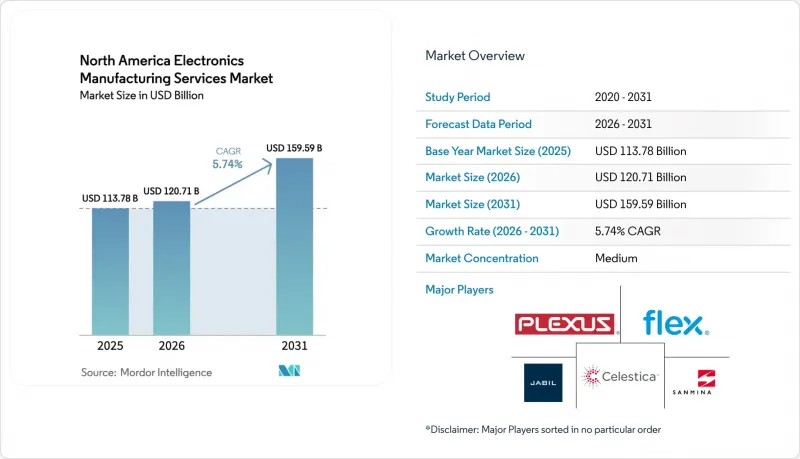
This report is Segmented by Service Type (Engineering Services, Logistics Services, and More), Business Model (Contract Manufacturing (CM), Original Design Manufacturing (ODM), and More), Manufacturing Process (Surface Mount Technology (SMT), and More), End-User (Industrial, Automotive, and More), and Geography. The Market Forecasts are Provided in Terms of Value (USD).
North America Electronics Manufacturing Services Market Trends and Insights
Robust Reshoring Incentives from the CHIPS and Science Act
Awards totaling USD 36.4 billion across 40 fabrication and packaging projects by late 2025 ignited a downstream wave of electronics assembly investments. Contract manufacturers colocate new surface-mount lines near fabs to offer OEMs integrated wafer-to-board supply chains that shorten lead times and mitigate logistics risk. Jabil's USD 500 million North Carolina project, announced in mid-2025, typifies the strategy of aligning box-build capacity with advanced packaging nodes to capture AI and high-performance computing demand. Reshoring Initiative data showing 287,299 U.S. manufacturing jobs announced in 2023 place electrical equipment and electronics at the top of the repatriation list. Tax credits under Section 48D further improve project economics, driving a sustained capex cycle through 2028 even if end-market demand temporarily softens. Policy-driven capacity additions are therefore expected to keep the North America electronics manufacturing services market on an above-trend growth trajectory.
Accelerating Demand for Automotive Electronics in EV and ADAS Platforms
Electric-vehicle powertrains use three to five times more circuit-board real estate than internal-combustion equivalents, while ADAS sensor-fusion modules require quick-turn iterations at small and mid volumes that Asian sites struggle to support cost-effectively. Foxconn's June 2025 EV.OS platform illustrates that even top Asian electronics manufacturing service providers now need North American hubs for co-development with local OEMs. U.S. National Highway Traffic Safety Administration proposals mandating automatic emergency braking on all new light vehicles by model year 2029 will embed radar and vision hardware into mass-market cars, boosting demand for printed circuit boards across Mexico and the U.S. automotive belts. Strategic collaborations such as DENSO and ROHM's silicon-carbide inverter program intensify design complexity, making proximity to chip suppliers and prototyping labs a competitive necessity. These factors underpin the 7.54% CAGR outlook for automotive electronics revenue through 2031.
Skilled Labor Shortages Across Tier-2/3 EMS Providers
The average U.S. manufacturing worker's age reached 56.5 years in 2025, and retirements outpace incoming talent, making soldering, inspection, and process-engineering roles scarce. Tier-1 firms run their own IPC certification academies, but smaller shops in rural clusters cannot match wage offers from automotive assembly plants. Community-college apprenticeship programs launched in North Carolina, Texas, and Arizona graduate fewer than 500 students per state each year, which is inadequate for the 40 CHIPS Act projects scheduled through 2028. Consequently, new capacity ramps more slowly than capital budgets anticipate, reducing effective supply in the North America EMS market and tempering growth despite healthy demand.
Other drivers and restraints analyzed in the detailed report include:
- Growing Need for Rapid NPI Turn-Around in Regulated Medical Devices
- Expansion of AI-Server and High-Speed Computing Hardware Production
- Margin Pressure from Asian High-Volume Contract Manufacturers
For complete list of drivers and restraints, kindly check the Table Of Contents.
Segment Analysis
Electromechanical assembly and box build generated the fastest revenue growth, rising at a 6.72% CAGR, driven by defense primes and medical-device OEMs outsourcing final integration to save engineering bandwidth. The segment now captures growing portions of the North America EMS market as OEMs delegate full system-level testing, regulatory documentation, and thermal-solution co-design to trusted partners. Printed-circuit-board assembly still accounted for 42.76% of the 2025 value but shows maturity, with demand shifting from commodity placement to high-reliability Class 3 builds. Engineering services focused on design-for-manufacturability, failure-mode-and-effects analysis, and obsolescence monitoring deepen supplier embeddedness and raise switching costs. Prototyping and test implementation businesses flourish as mixed-signal content in industrial IoT and low-earth-orbit (LEO) satellite hardware multiplies the need for automated-test-equipment programming. Jabil's Hanley Energy acquisition illustrates how logistics and power-delivery know-how now differentiate leading providers. Surface-mount lines remain ubiquitous; nonetheless, system-integration shops offering conformal coating, potting, and environmental stress screening capture premium pricing in aerospace and defense, pulling further profit toward box-build specialists.
Demand inflection in AI servers heightens the importance of enclosure, cold-plate, and cable-assembly expertise, further lifting box-build wallet share. Tier-2 players such as Plexus, which won the Evolv Technology contract in November 2025, underscore that quick-turn system integration creates opportunity outside megacaps. Over 2026-2031, the North America EMS market size for box-build work is forecast to approach USD 40 billion, roughly one-quarter of the regional value, as turnkey bookings displace purely board-level awards.
Contract manufacturing maintained a 64.58% share in 2025, reflecting deep legacy agreements in industrial automation, telecom, and automotive electronics. Yet hybrid and turnkey models post a 6.81% CAGR because OEMs want single-invoice accountability for materials procurement, design verification, and compliance paperwork. In AI-server assembly, hyperscalers specify performance envelopes and delegate sourcing risk for high-bandwidth memory and substrates to their electronics manufacturing services partner, paying a 5-8% premium to reduce allocation surprises. Hybrid agreements also dominate new medical-device NPIs, where OEMs co-own tooling but the contractor manages FDA audits. Original design manufacturing remains a niche for North America electronics manufacturing services participants, concentrated in consumer peripherals and carrier-branded IoT nodes, yet cloud appliance vendors increasingly adopt design assistance to minimize reliance on in-house hardware teams.
Jabil's North Carolina AI campus typifies the hybrid model: customers retain firmware, while Jabil co-invests in automation and owns test fixtures, delivering speed advantages that consignment shops cannot match. Kimball Electronics discloses over 30% revenue concentration across its top three auto clients, signaling that traditional contract manufacturing carries customer-dependency risk. As OEMs prioritize supply resilience over marginal cost, turnkey agreements penetrate deeper into automotive and defense, reshaping revenue mix through 2031.
Complete Report Scope:
- By Service Type
- Electronics Manufacturing Services
- PCB Assembly
- Electromechanical Assembly/Box Build
- Prototyping
- Other Electronics Manufacturing Services
- Engineering Services
- Test and Development Implementation Services
- Logistics Services
- Other Service Types
- Electronics Manufacturing Services
- By Business Model
- Contract Manufacturing (CM)
- Original Design Manufacturing (ODM)
- Hybrid / Turnkey / Other Business Models
- By Manufacturing Process
- Surface Mount Technology (SMT)
- Through-Hole Technology (THT)
- Advanced Packaging / Hybrid Processes
- By End-user
- Mobile Devices (Smartphones and Tablets)
- Consumer Electronics
- Computer (PCs/Desktop/Laptops)
- Industrial
- Automotive
- Communication
- Lighting
- Medical
- Other End-users
- By Geography
- North America
- United States
- Canada
- Mexico
- North America
List of Companies Covered in this Report:
- Jabil Inc.
- Flex Ltd.
- Celestica Inc.
- Sanmina Corporation
- Plexus Corp.
- Benchmark Electronics, Inc.
- Kimball Electronics, Inc.
- Creation Technologies LP
- SigmaTron International, Inc.
- Nortech Systems Incorporated
- Hon Hai Precision Industry Co., Ltd.
- Pegatron Corporation
- Compal Electronics Inc.
- Quanta Computer Inc.
- Wistron Corporation
- BYD Electronic (International) Company Limited
- Luxshare Precision Industry Co., Ltd.
- Zollner Elektronik AG
- Asteelflash SAS
Additional Benefits:
- The market estimate (ME) sheet in Excel format
- 3 months of analyst support
TABLE OF CONTENTS
1 INTRODUCTION
- 1.1 Study Assumptions and Market Definition
- 1.2 Scope of the Study
2 RESEARCH METHODOLOGY
3 EXECUTIVE SUMMARY
4 MARKET LANDSCAPE
- 4.1 Market Overview
- 4.2 Market Drivers
- 4.2.1 Robust Reshoring Incentives from the CHIPS and Science Act
- 4.2.2 Accelerating Demand for Automotive Electronics in EV and ADAS Platforms
- 4.2.3 Growing Need for Rapid NPI Turn-Around in Regulated Medical Devices
- 4.2.4 Expansion of AI-Server and High-Speed Computing Hardware Production
- 4.2.5 Defense Mandatory ITAR Compliance Driving On-Shore Box-Build Contracts
- 4.2.6 Low-Earth-Orbit Satellite Constellation Builds Requiring Quick-Turn PCB Assembly
- 4.3 Market Restraints
- 4.3.1 Skilled Labor Shortages Across Tier-2/3 EMS Providers
- 4.3.2 Margin Pressure from Asian High-Volume Contract Manufacturers
- 4.3.3 Accelerating PFAS and RoHS Regulatory Compliance Costs
- 4.3.4 Wave of Baby-Boomer Engineering Retirements Eroding Institutional Know-How
- 4.4 Impact of Macroeconomic Factors on the Market
- 4.5 Industry Value Chain Analysis
- 4.6 Regulatory Landscape
- 4.7 Technological Outlook
- 4.8 Porter's Five Forces Analysis
- 4.8.1 Threat of New Entrants
- 4.8.2 Bargaining Power of Suppliers
- 4.8.3 Bargaining Power of Buyers
- 4.8.4 Threat of Substitutes
- 4.8.5 Intra-Industry Rivalry
5 MARKET SIZE AND GROWTH FORECASTS (VALUE)
- 5.1 By Service Type
- 5.1.1 Electronics Manufacturing Services
- 5.1.1.1 PCB Assembly
- 5.1.1.2 Electromechanical Assembly/Box Build
- 5.1.1.3 Prototyping
- 5.1.1.4 Other Electronics Manufacturing Services
- 5.1.2 Engineering Services
- 5.1.3 Test and Development Implementation Services
- 5.1.4 Logistics Services
- 5.1.5 Other Service Types
- 5.1.1 Electronics Manufacturing Services
- 5.2 By Business Model
- 5.2.1 Contract Manufacturing (CM)
- 5.2.2 Original Design Manufacturing (ODM)
- 5.2.3 Hybrid / Turnkey / Other Business Models
- 5.3 By Manufacturing Process
- 5.3.1 Surface Mount Technology (SMT)
- 5.3.2 Through-Hole Technology (THT)
- 5.3.3 Advanced Packaging / Hybrid Processes
- 5.4 By End-user
- 5.4.1 Mobile Devices (Smartphones and Tablets)
- 5.4.2 Consumer Electronics
- 5.4.3 Computer (PCs/Desktop/Laptops)
- 5.4.4 Industrial
- 5.4.5 Automotive
- 5.4.6 Communication
- 5.4.7 Lighting
- 5.4.8 Medical
- 5.4.9 Other End-users
- 5.5 By Geography
- 5.5.1 North America
- 5.5.1.1 United States
- 5.5.1.2 Canada
- 5.5.1.3 Mexico
- 5.5.1 North America
6 COMPETITIVE LANDSCAPE
- 6.1 Market Concentration
- 6.2 Strategic Moves
- 6.3 Market Share Analysis
- 6.4 Company Profiles (includes Global Level Overview, Market Level Overview, Core Segments, Financials as Available, Strategic Information, Market Rank/Share for Key Companies, Products and Services, and Recent Developments)
- 6.4.1 Jabil Inc.
- 6.4.2 Flex Ltd.
- 6.4.3 Celestica Inc.
- 6.4.4 Sanmina Corporation
- 6.4.5 Plexus Corp.
- 6.4.6 Benchmark Electronics, Inc.
- 6.4.7 Kimball Electronics, Inc.
- 6.4.8 Creation Technologies LP
- 6.4.9 SigmaTron International, Inc.
- 6.4.10 Nortech Systems Incorporated
- 6.4.11 Hon Hai Precision Industry Co., Ltd.
- 6.4.12 Pegatron Corporation
- 6.4.13 Compal Electronics Inc.
- 6.4.14 Quanta Computer Inc.
- 6.4.15 Wistron Corporation
- 6.4.16 BYD Electronic (International) Company Limited
- 6.4.17 Luxshare Precision Industry Co., Ltd.
- 6.4.18 Zollner Elektronik AG
- 6.4.19 Asteelflash SAS
7 MARKET OPPORTUNITIES AND FUTURE OUTLOOK
- 7.1 White-Space and Unmet-Need Assessment

