PUBLISHER: Mordor Intelligence | PRODUCT CODE: 2117563

PUBLISHER: Mordor Intelligence | PRODUCT CODE: 2117563
United States Table Grapes - Market Share Analysis, Industry Trends & Statistics, Growth Forecasts (2026 - 2031)
According to Mordor Intelligence, the United States table grapes market was valued at USD 3.85 billion in 2025 and is projected to grow from USD 4.08 billion in 2026 to USD 5.45 billion by 2030, registering a CAGR of 5.96% during the forecast period from 2026 to 2031.
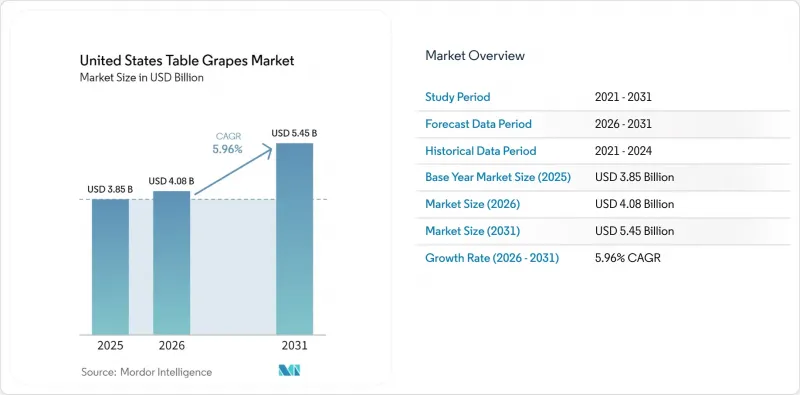
The United States Table Grapes Market Report Includes Production Analysis (Volume, Area Harvested, and Yield), Consumption Analysis (Value and Volume), Import Analysis (Value and Volume), Export Analysis (Value and Volume), Wholesale Price Trend Analysis and Forecast, Regulatory Framework, Logistics and Infrastructure, and Seasonality Analysis. The Market Forecasts are Provided in Terms of Value (USD) and Volume (Metric Tons).
United States Table Grapes Market Trends and Insights
Rising Demand for Seedless and Premium Varieties
The market is driven by consumer preference for premium eating quality, prompting growers and retailers to expand seedless and proprietary grape offerings. According to a 2025 HortScience study, United States consumers were willing to pay USD 3.59 more per pound for seedless grapes than seeded grapes, reflecting a strong preference for premium varieties that offer greater convenience and quality. This trend is driving investments in breeding programs and vineyard redevelopment toward higher-value cultivars with improved flavor, texture, shelf life, and retail differentiation. As a result, premium seedless varieties continue to support value realization and long-term growth across the United States table grapes market.
Retailers Expanding Proprietary and Branded Grape Programs
Retail merchandising is becoming an important growth driver in the United States table grapes market as retailers prioritize proprietary and branded varieties to strengthen consumer loyalty and differentiate produce assortments. According to the California Table Grape Commission (2026), its global marketing campaign for the 2026 season targets the United States and 22 export markets, supporting retailer promotions through digital campaigns, shopper apps, recipes, health messaging, and in-store merchandising. These initiatives reinforce premium variety positioning, encourage repeat purchases, and increase demand for licensed genetics and consistently high-quality fruit, benefiting growers with strong retail partnerships and branded programs.
Rising Labor and Compliance Costs in California Production
The United States table grapes market faces increasing cost pressures as California producers contend with rising labor costs and stricter regulatory compliance requirements for hand-harvested grape production. According to the United States Department of Labor, in 2025, California recorded the highest H-2A Adverse Effect Wage Rate (AEWR) in the continental United States at USD 19.97 per hour in 2025. In addition to higher wages, growers must bear mandatory housing, transportation, recruitment, and visa-related costs for H-2A workers, substantially increasing production expenses. These escalating labor and compliance costs reduce profit margins, discourage new vineyard investment, and limit the market's growth potential.
Other drivers and restraints analyzed in the detailed report include:
- Import Seasonality Supports Year-Round Shelf Availability
- Consumer Preference for Snackable Fresh Fruit
- Water Stress and Acreage Contraction in Key Growing Areas
For complete list of drivers and restraints, kindly check the Table Of Contents.
Complete Report Scope:
- Production Analysis
- Production Volume
- Area Harvested and Yield
- Consumption Analysis (Value and Volume)
- Trade Analysis (Value and Volume)
- Import Market Analysis
- Import Value and Volume
- Key Supplying Markets
- Export Market Analysis
- Export Value and Volume
- Key Destinations Markets
- Import Market Analysis
- Wholesale Price Trend Analysis and Forecast
- Regulatory Framework
- Logistics and Infrastructure
- Seasonality Analysis
Additional Benefits:
- The market estimate (ME) sheet in Excel format
- 3 months of analyst support
TABLE OF CONTENTS
1 Introduction
- 1.1 Study Assumptions and Market Definition
- 1.2 Scope of the Study
2 Research Methodology
3 Executive Summary
4 Market Landscape
- 4.1 Market Overview
- 4.2 Market Drivers
- 4.2.1 Rising demand for seedless and premium varieties
- 4.2.2 Retailers expanding proprietary and branded grape programs
- 4.2.3 Import seasonality supports year-round shelf availability
- 4.2.4 Consumer preference for snackable fresh fruit
- 4.2.5 Improved postharvest handling and cold chain reach
- 4.2.6 Breeding advances extend shelf life and flavor profiles
- 4.3 Market Restraints
- 4.3.1 Rising labor and compliance costs in California production
- 4.3.2 Water stress and acreage contraction in key growing areas
- 4.3.3 Import competition pressures domestic pricing
- 4.3.4 Variety turnover increases vineyard redevelopment costs
- 4.4 Opportunities
- 4.5 Challenges
- 4.6 Value Chain Analysis
- 4.7 Technologies and usage of AI in the Industry
- 4.8 Input Market Analysis
- 4.8.1 Seeds
- 4.8.2 Fertilizers
- 4.8.3 Crop Protection Chemicals
- 4.9 Distribution Channel Analysis
- 4.10 Market Sentiment Analysis
- 4.11 PESTLE Analysis
5 Market Size and Growth Forecasts (Value and Volume)
- 5.1 Production Analysis
- 5.1.1 Production Volume
- 5.1.2 Area Harvested and Yield
- 5.2 Consumption Analysis (Value and Volume)
- 5.3 Trade Analysis (Value and Volume)
- 5.3.1 Import Market Analysis
- 5.3.1.1 Import Value and Volume
- 5.3.1.2 Key Supplying Markets
- 5.3.2 Export Market Analysis
- 5.3.2.1 Export Value and Volume
- 5.3.2.2 Key Destinations Markets
- 5.3.1 Import Market Analysis
- 5.4 Wholesale Price Trend Analysis and Forecast
- 5.5 Regulatory Framework
- 5.6 Logistics and Infrastructure
- 5.7 Seasonality Analysis
6 End Use and Application
- 6.1 Primary Applications and Emerging Applications
- 6.2 Consumption Breakdown by Industries
7 Competitive Landscape
- 7.1 Overview of the Competition
- 7.2 Recent Developments
- 7.3 Market Concentration Analysis
- 7.4 List of Key Players
- 7.4.1 Sun World International, LLC (Bridgepoint Group plc)
- 7.4.2 BLOOM FRESH International (AMFRESH Group)
- 7.4.3 Grapa Global LLC
- 7.4.4 Giumarra Vineyards Corporation
- 7.4.5 Anthony Vineyards, Inc.
- 7.4.6 Four Star Fruit, Inc.
- 7.4.7 Divine Flavor, LLC (Grupo Alta)
- 7.4.8 Sun Pacific Shippers, L.P.
- 7.4.9 Kings River Packing, LP
- 7.4.10 Munger Brothers, LLC
- 7.4.11 Hronis, Inc.
- 7.4.12 Pandol Bros., Inc.
8 Market Opportunities and Future Outlook

