PUBLISHER: Mordor Intelligence | PRODUCT CODE: 2117983

PUBLISHER: Mordor Intelligence | PRODUCT CODE: 2117983
India Table Grapes - Market Share Analysis, Industry Trends & Statistics, Growth Forecasts (2026 - 2031)
According to Mordor Intelligence, the India table grapes market size is expected to grow from USD 4.21 billion in 2025 to USD 4.32 billion in 2026 and is forecast to reach USD 4.97 billion by 2031 at 2.80% CAGR over 2026-2031.
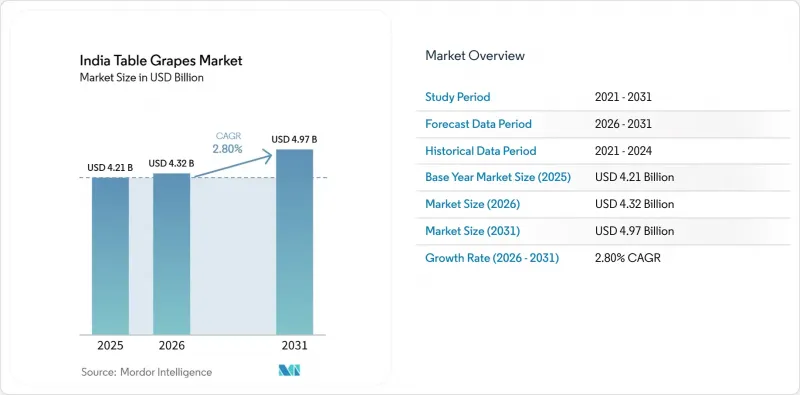
India Table Grapes Market Report Covers Production Analysis (Volume), Consumption Analysis (Value and Volume), Import Analysis (Value and Volume), Export Analysis (Value and Volume), Wholesale Price Trend Analysis, and More. The Market Forecasts are Provided in Terms of Value (USD) and Volume (Metric Tons).
India Table Grapes Market Trends and Insights
Rising Export Demand for Fresh Table Grapes
India harvests grapes from January to April, which gives the India table grapes market a clear timing edge when Northern Hemisphere orchards are not supplying stores. This supply window helps Indian exporters place fruit in European Union retail chains when competing availability is lower, and buyer interest is steadier. According to the Agricultural and Processed Food Products Export Development Authority (APEDA), Southeast Asia has become more important because grape imports across the Philippines, Indonesia, Vietnam, and Malaysia rose at a 5-13% CAGR from 2021 to 2026, while Bangladesh also recorded strong growth over the same period. Vietnam granted market access to Indian fresh grapes effective May 6, 2026, with mandatory cold treatment at 1.1°C pulp temperature for 15 consecutive days, which raises the bar for shipment discipline but also opens a certified demand lane for the India table grapes market. The Association of Southeast Asian Nations-India Free Trade Agreement improves pricing competitiveness against suppliers such as Australia and Chile in several target markets. Stronger export pull also supports farmgate realizations, which keep acreage economics attractive in Maharashtra and support value growth in the India table grapes market.
Expansion of Seedless and Premium Varieties
The shift toward seedless and patented premium grapes is changing the commercial structure of the India table grapes market. Thompson Seedless and Sonaka accounted for 55% of the cultivated area, but buyer preference in the European Union is shifting toward longer berries, firmer texture, and higher sweetness levels. The 2025-26 season highlighted the vulnerability of traditional Thompson Seedless vineyards in Nashik's Dindori and Satara belts, where prolonged monsoon rainfall reportedly reduced yields by 45-55%. Industry reports indicate that newer patented grape varieties demonstrated greater resilience under the same conditions, supporting increased adoption of improved genetics in India's table grape sector. This means the varietal mix will shape future pricing power in the India table grapes market more than simple area expansion. Maharashtra orchard registrations for the 2025-26 season fell 28% year over year, which suggests that weather-sensitive farms are being pressured faster than resilient premium orchards are being added.
Climate Volatility and Water Stress in Vineyard Belts
The 2025-26 season exposed how vulnerable the India table grapes market remains to weather swings. Continuous rainfall from May to mid-October 2025 in Maharashtra's major grape-growing regions, followed by hailstorms between 19 March and 3 April 2026, reduced fruit quality and shortened the export window. As a result, Nashik's grape exports declined by 9.6% in the 2025-26 season, falling from 160,000 metric tons to 140,000 metric tons. The damage was not limited to current harvest losses, as abnormal rainfall patterns also weakened bud fertility and reduced usable bunch formation in traditional varieties. Many growers operate on farms of about 1 hectare, so multi-season varietal change and water risk adaptation remain difficult without support from farmer-producer organizations and public co-investment. This keeps climate volatility as the heaviest structural restraint on the India table grapes market.
Other drivers and restraints analyzed in the detailed report include:
- Adoption of Drip Irrigation and Precision Vineyard Practices
- Strengthening Packhouse, Cold Chain, and Residue Compliance Infrastructure
- Residue Compliance and Rejection Risk in Export Markets
For complete list of drivers and restraints, kindly check the Table Of Contents.
Complete Report Scope:
- India
- Production Analysis (Volume)
- Overview
- Area Harvested and Yield
- Consumption Analysis (Value and Volume)
- Trade Analysis (Value and Volume)
- Import Market Analysis
- Overview
- Key Supplying Markets
- Export Market Analysis
- Overview
- Key Destinations Markets
- Import Market Analysis
- Wholesale Price Trend Analysis & Forecast
- Seasonality Analysis
- Production Analysis (Volume)
Additional Benefits:
- The market estimate (ME) sheet in Excel format
- 3 months of analyst support
TABLE OF CONTENTS
1 Introduction
- 1.1 Study Assumptions and Market Definition
- 1.2 Scope of the Study
2 Research Methodology
3 Executive Summary
4 Market Landscape
- 4.1 Market Overview
- 4.2 Market Drivers
- 4.2.1 Rising export demand for fresh table grapes
- 4.2.2 Expansion of seedless and premium varieties
- 4.2.3 Adoption of drip irrigation and precision vineyard practices
- 4.2.4 Strengthening packhouse, cold chain, and residue-compliance infrastructure
- 4.2.5 Longer export window versus northern hemisphere suppliers
- 4.2.6 Digital traceability and buyer-led quality audits
- 4.3 Market Restraints
- 4.3.1 Climate volatility and water stress in vineyard belts
- 4.3.2 Residue compliance and rejection risk in export markets
- 4.3.3 Fragmented farmer base and uneven farm-level standardization
- 4.3.4 High post-harvest losses and logistics bottlenecks
- 4.4 Opportunities
- 4.5 Challenges
- 4.6 Value Chain Analysis
- 4.7 Technologies and usage of AI in the Industry
- 4.8 Input Market Analysis
- 4.8.1 Seeds
- 4.8.2 Fertilizers
- 4.8.3 Crop Protection Chemicals
- 4.9 Distribution Channel Analysis
- 4.10 Market Sentiment Analysis
- 4.11 PESTLE Analysis
5 Market Size and Growth Forecasts (Value and Volume)
- 5.1 India
- 5.1.1 Production Analysis (Volume)
- 5.1.1.1 Overview
- 5.1.1.2 Area Harvested and Yield
- 5.1.2 Consumption Analysis (Value and Volume)
- 5.1.3 Trade Analysis (Value and Volume)
- 5.1.3.1 Import Market Analysis
- 5.1.3.1.1 Overview
- 5.1.3.1.2 Key Supplying Markets
- 5.1.3.2 Export Market Analysis
- 5.1.3.2.1 Overview
- 5.1.3.2.2 Key Destinations Markets
- 5.1.3.1 Import Market Analysis
- 5.1.4 Wholesale Price Trend Analysis & Forecast
- 5.1.5 Seasonality Analysis
- 5.1.1 Production Analysis (Volume)
6 End Use Applications and Industries
- 6.1 Primary Applications and Emerging Applications
- 6.2 Consumption Breakdown by Industries
7 Competitive Landscape
- 7.1 Overview of the Competition
- 7.2 Recent Developments
- 7.3 Market Concentration Analysis
- 7.4 List of Key Players
- 7.4.1 Sahyadri Farms Post Harvest Care Ltd
- 7.4.2 Kay Bee Exports Private Limited
- 7.4.3 Puretrop Fruits Limited
- 7.4.4 Mahagrapes Farmers' Producer Company Ltd
- 7.4.5 UPL Ltd
- 7.4.6 Jain Irrigation Systems Ltd
- 7.4.7 Reliance Retail Ventures Limited
- 7.4.8 BigBasket.com (Tata Digital Limited)
- 7.4.9 Nature's Basket Limited (Spencer's Retail Limited)
- 7.4.10 Agro Star Private Limited
- 7.4.11 Sula Vineyards Limited
- 7.4.12 Grover Zampa Vineyards Limited
- 7.4.13 Fratelli Vineyards Limited
- 7.4.14 M. R. Fruits and Vegetables Pvt. Ltd.
- 7.4.15 Rajdheer Exports
8 Market Opportunities and Future Outlook

