PUBLISHER: Mordor Intelligence | PRODUCT CODE: 2117593

PUBLISHER: Mordor Intelligence | PRODUCT CODE: 2117593
Indonesia Pet Treats - Market Share Analysis, Industry Trends & Statistics, Growth Forecasts (2026 - 2031)
According to Mordor Intelligence, the Indonesia pet treats market was valued at USD 127.41 million in 2025 and is projected to grow from USD 133.88 million in 2026 to USD 181.88 million by 2031, at a CAGR of 6.55% during the forecast period (2026-2031).
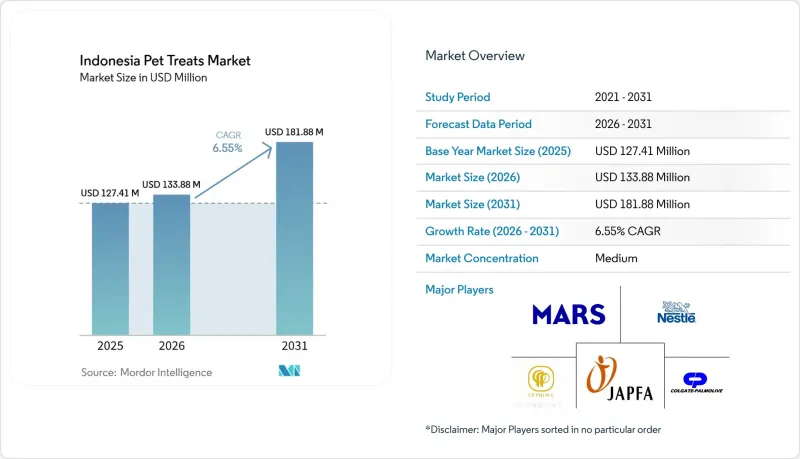
This report is Segmented by Sub Product (Crunchy Treats, Dental Treats, and More), by Pets (Cats, Dogs, Other Pets), and by Distribution Channel (Convenience Stores, Online Channel and More). The Market Forecasts are Provided in Terms of Value (USD) and Volume (Metric Tons).
Indonesia Pet Treats Market Trends and Insights
Pet Humanization Driving Premium Treat Purchases
In Indonesia, pet care spending is increasingly driven by emotional factors, with cats remaining the most commonly owned pets and younger adults accounting for the largest share of pet owners. As emotional attachment grows, treats are no longer viewed as casual add-ons but are integrated into daily bonding and reward routines, increasing basket value even with stable feeding frequency, as owners combine standard crunchy treats with single-protein or function-focused options. Brands that position treats as essential to care, wellness, and bonding are better placed to capture premium spending in the Indonesian pet treats market. Supporting this trend, individual disposable income grew from USD 2,454.0 to USD 2,950.9 in 2024 over the past four years, according to Agriculture and Agri-Food Canada (AAFC). This rise in disposable income, combined with increased pet care spending, supports overall market growth in the country.
Increasing Cat Ownership and Routine Treat Consumption
Cats play a significant role in driving the volume growth of the Indonesian pet treats market. Their prominence within the ownership base influences product design, distribution channels, and repeat purchase behaviors.This ownership pattern encourages more frequent snacking occasions, as cat owners typically use treats for daily interactions rather than training purposes. Lickable treats, bite-sized rewards, and small portion packs align well with this routine, unlike larger formats designed for dogs. Consequently, the demand profile favors high repurchase rates and cat-specific product innovations over species-neutral planning. This structural preference ensures that the Indonesian pet treats market remains closely aligned with feline nutrition trends, providing cat-focused brands with a clearer path to scale and growth.
Price Sensitivity in Mass-Market Pet Households
Price remains a significant constraint on premium adoption within the Indonesia pet treats market, particularly outside upper-income urban households. Many pet owners allocate a limited portion of their household budgets to overall pet care, leaving less room for discretionary purchases such as premium treats. As a result, higher-priced products continue to face lower acceptance in the mass market, even though premium offerings perform well through specialty stores and online channels. This dynamic has created a clear divide between economy products, which drive higher sales volumes, and premium products, which primarily target a smaller urban consumer base. Local manufacturers also face cost pressures, as developing functional formulations requires higher investment before production volumes are sufficient to achieve economies of scale. Although value packs and multi-pack formats help improve affordability, their availability remains limited, preventing a complete reduction in price-related barriers.
Other drivers and restraints analyzed in the detailed report include:
- E-Commerce Expansion and Convenience-Led Buying
- Growing Demand for Functional and Veterinary-Backed Treats
- Limited Formal Retail Reach Outside Major Urban Corridors
For complete list of drivers and restraints, kindly check the Table Of Contents.
Segment Analysis
Freeze-dried and jerky treats accounted for 24.0% of the Indonesia pet treats market size in 2025, with this format projected to grow at a 7.55% CAGR between 2026 and 2031. This combination of current market share and anticipated growth indicates that premiumization in the Indonesia pet treats industry is well-established rather than emerging. Urban consumers are increasingly drawn to single-protein labeling, visible ingredient quality, and the minimally processed image associated with freeze-dried products. Similar trends have been observed in other Southeast Asian pet food markets, where premium single-protein and freeze-dried formats are gaining popularity among urban pet owners.
Crunchy treats continue to dominate everyday consumption due to their affordability and strong sales through supermarkets and convenience stores. Soft and chewy treats are gaining traction in senior pet care and scenarios where texture sensitivity is important, such as post-dental procedures or during recovery. Dental treats benefit from veterinary recommendations and functional claims, enabling them to maintain price premiums in the Indonesia pet treats market. Functional and supplement treats, which offer the highest value per gram, are experiencing growth driven by increased owner interest in urinary, digestive, coat, and weight-related care. Other treat formats, such as lickable pastes and topper-style products, are also gaining popularity through social commerce. Small pack sizes lower the barrier for first-time purchases and align well with cat feeding routines.
Complete Report Scope:
- By Sub Product
- Crunchy Treats
- Dental Treats
- Freeze-dried and Jerky Treats
- Soft and Chewy Treats
- Other Treats
- By Pets
- Cats
- Dogs
- Other Pets
- By Distribution Channel
- Convenience Stores
- Online Channel
- Specialty Stores
- Supermarkets/Hypermarkets
- Other Channels
List of Companies Covered in this Report:
- Mars, Incorporated
- Nestle S.A. (Purina PetCare)
- PT Central Proteina Prima Tbk (CP Prima)
- PT Nutricell Pacific
- PT Citra Mandiri Kencana
- PT Japfa Comfeed Indonesia Tbk
- PT Evo Nusa Bersaudara
- Unicharm Corporation
- Colgate-Palmolive Company (Hill's Pet Nutrition)
- Farmina Pet Foods Holding B.V
Additional Benefits:
- The market estimate (ME) sheet in Excel format
- 3 months of analyst support
TABLE OF CONTENTS
1 INTRODUCTION
- 1.1 Study Assumptions and Market Definition
- 1.2 Scope of the Study
- 1.3 Research Methodology
2 REPORT OFFERS
3 EXECUTIVE SUMMARY AND KEY FINDINGS
4 KEY INDUSTRY TRENDS
- 4.1 Pet Population
- 4.1.1 Cats
- 4.1.2 Dogs
- 4.1.3 Other Pets
- 4.2 Pet Expenditure
- 4.3 Consumer Trends
5 SUPPLY AND PRODUCTION DYNAMICS
- 5.1 Trade Analysis
- 5.2 Ingredient Trends
- 5.3 Value Chain and Distribution Channel Analysis
- 5.4 Regulatory Framework
- 5.5 Market Drivers
- 5.5.1 Pet humanization driving premium treat purchase
- 5.5.2 Increasing cat ownership and routine treat consumption
- 5.5.3 E-Commerce expansion and convenience-led buying
- 5.5.4 Growing demand for functional and veterinary-backed treats
- 5.5.5 Local formulation flexibility and halal-ready branding
- 5.5.6 Imported premium ingredient positioning
- 5.6 Market Restraints
- 5.6.1 Price sensitivity in mass-market pet households
- 5.6.2 Limited formal retail reach outside major urban corridors
- 5.6.3 Raw material volatility in meat-based treats
- 5.6.4 Low awareness of repeat treat use in rural areas
6 MARKET SIZE AND GROWTH FORECASTS (VALUE AND VOLUME)
- 6.1 By Sub Product
- 6.1.1 Crunchy Treats
- 6.1.2 Dental Treats
- 6.1.3 Freeze-dried and Jerky Treats
- 6.1.4 Soft and Chewy Treats
- 6.1.5 Other Treats
- 6.2 By Pets
- 6.2.1 Cats
- 6.2.2 Dogs
- 6.2.3 Other Pets
- 6.3 By Distribution Channel
- 6.3.1 Convenience Stores
- 6.3.2 Online Channel
- 6.3.3 Specialty Stores
- 6.3.4 Supermarkets/Hypermarkets
- 6.3.5 Other Channels
7 COMPETITIVE LANDSCAPE
- 7.1 Strategic Moves
- 7.2 Market Share Analysis
- 7.3 Market Concentration
- 7.4 Brand Positioning Matrix
- 7.5 Market Claim Analysis
- 7.6 Company Landscape
- 7.7 Company Profiles (Includes Global Level Overview, Market Level Overview, Core Business Segments, Financials, Key Information, Market Rank, Market Share, Products and Services, and Analysis of Recent Developments)
- 7.7.1 Mars, Incorporated
- 7.7.2 Nestle S.A. (Purina PetCare)
- 7.7.3 PT Central Proteina Prima Tbk (CP Prima)
- 7.7.4 PT Nutricell Pacific
- 7.7.5 PT Citra Mandiri Kencana
- 7.7.6 PT Japfa Comfeed Indonesia Tbk
- 7.7.7 PT Evo Nusa Bersaudara
- 7.7.8 Unicharm Corporation
- 7.7.9 Colgate-Palmolive Company (Hill's Pet Nutrition)
- 7.7.10 Farmina Pet Foods Holding B.V
8 KEY STRATEGIC QUESTIONS FOR STAKEHOLDERS

