PUBLISHER: Mordor Intelligence | PRODUCT CODE: 2118061

PUBLISHER: Mordor Intelligence | PRODUCT CODE: 2118061
Germany Pet Treats - Market Share Analysis, Industry Trends & Statistics, Growth Forecasts (2026 - 2031)
According to Mordor Intelligence, the Germany pet treats market size is anticipated to increase from USD 1.46 billion in 2025 and USD 1.58 billion in 2026 to reach USD 2.21 billion by 2031, growing at a CAGR of 6.94% during 2026 to 2031.
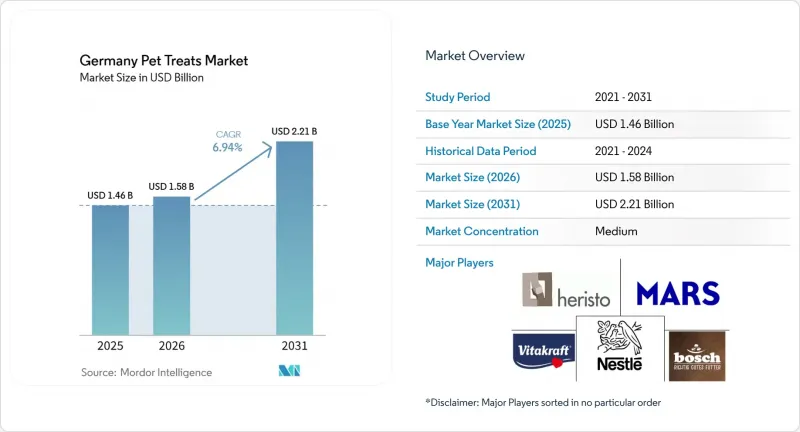
This report is Segmented by Sub Product (Crunchy Treats, Dental Treats, Freeze-Dried and Jerky Treats, and More), by Pet Type (Cats, Dogs, and More), and by Distribution Channel (Convenience Stores, Online Channel, Specialty Stores, and More). The Market Forecasts are Provided in Terms of Value (USD) and Volume (Metric Tons).
Germany Pet Treats Market Trends and Insights
Humanization of Pets and Premium Treat Buying
The Germany pet treats market is gaining support from a deeper shift in how owners relate to pets in everyday life. Treats are no longer seen only as small add-on purchases, because many owners now use them as part of bonding, training, and routine care. This behavior matters in Germany because households already show strong attention to ingredient quality and product claims in food purchases. That same scrutiny carries over into the way many owners shop for pet treats, especially when products are positioned around natural ingredients, traceability, or targeted benefits. According to the German Pet Trade & Industry Association (Zentralverband Zoologischer Fachbetriebe Deutschlands e.V.), 67% of German families with children owned at least one pet in 2025. The strong emotional attachment to companion animals continues to drive spending on premium, functional, and indulgent pet treats that support health, training, and daily bonding. In the Germany pet treats market, this supports stronger pricing power for products that can justify a premium through formulation, origin, or a clear daily-use role. It also raises the standard for brands because emotional appeal alone is no longer enough when retail buyers and consumers expect clear product proof.
Rising Demand for Functional Dental and Digestive Treat Formats
The Germany pet treats market is also moving further toward products that combine reward with a practical health role. Dental treats are a clear example, as owners increasingly want a product that supports oral care while still fitting into a normal treat routine. Functional digestive snacks are following the same path, especially when they are positioned around digestive comfort, fiber support, or a lighter ingredient profile. These formats are harder to produce well than basic reward treats because texture, ingredient balance, and consistency all affect how credible the product feels. As of 2025, European Union feed rules also favor brands that can substantiate their ingredient and function claims with proper documentation, thereby reducing room for loosely positioned products. In the Germany pet treats market, this creates an advantage for companies with research, quality control, and established veterinary relationships. It also helps explain why functional formats continue to attract investment even when standard treat categories remain widely available, and price competition stays intense.
Price Inflation in Animal Protein, Fats, and Grains
The Germany pet treats market remains exposed to raw material and production cost pressure because many treat formats rely heavily on meat inputs, fats, and specialized processing. This pressure is stronger in premium treats than in complete diets because dried meats, dental chews, and functional snacks often carry a higher ingredient cost for their weight. When production costs rise, brands do not always have room to pass the increase through quickly, especially in channels where private label and value packs are already well established. The pressure is made harder by energy-intensive production methods such as extrusion and drying, which increase the cost gap between standard biscuits and more premium formats. Mars, Incorporated's 2026 manufacturing network changes in Europe also reflect how cost discipline remains a live issue even for the biggest players. In the Germany pet treats market, mid-tier brands are the most exposed because they lack the procurement strength of global leaders and the pricing freedom of small specialist brands. If inflation stays elevated for proteins and utilities, product mix could shift more slowly toward premium treats than manufacturers want. That would not stop growth, but it could reduce the pace of trade-up and compress margins across the category.
Other drivers and restraints analyzed in the detailed report include:
- Retailer Private Label Expansion in Premium Treat Shelves
- Growth of Direct-to-Consumer and Subscription Treat Replenishment
- Regulatory Scrutiny of Novel Functional Ingredients and Claims
For complete list of drivers and restraints, kindly check the Table Of Contents.
Segment Analysis
Crunchy Treats held 23.2% of the Germany pet treats market size in 2025, which kept them in the lead because they remain easy to find, easy to price, and closely tied to routine reward use. The format works well in food retail and pet specialty stores, and it still appeals to owners who want a familiar product at a manageable price point. Vitakraft pet care GmbH and Co. KG (Tiernahrung Deuerer GmbH) also reinforced the long life of this segment when the Kracker range marked its 60th year in 2025.
Freeze-dried and jerky treats are anticipated to post the fastest 8.1% CAGR through 2031, showing that growth is shifting toward more premium and ingredient-led formats in the Germany pet treats market. These products align well with the owner's interest in simple meat-based offerings and cleaner labels, while dental treats continue to benefit from a more practical daily use case. Soft and chewy treats also remain relevant because they suit training, smaller pets, and cats well. Manufacturing support in Germany adds to this momentum because companies can test and scale more specialized drying and extrusion formats with lower execution risk
Complete Report Scope:
- By Sub Product
- Crunchy Treats
- Dental Treats
- Freeze-Dried and Jerky Treats
- Soft and Chewy Treats
- Other Treats
- By Pet Type
- Dogs
- Cats
- Other Pets
- By Distribution Channel
- Supermarkets and Hypermarkets
- Specialty Stores
- Online Channel
- Convenience Stores
- Other Channels
List of Companies Covered in this Report:
- Mars, Incorporated
- Nestle S.A.
- heristo aktiengesellschaft
- Hill's Pet Nutrition, Inc. (Colgate-Palmolive Company)
- General Mills Inc.
- Clearlake Capital Group, L.P. (Wellness Pet Company, Inc.)
- Affinity Petcare S.A
- Virbac
- Bosch Tiernahrung GmbH and Co. KG
- Farmina Pet Foods Holding Ltd. (Russo Family)
- Mera Tiernahrung GmbH
- Vitakraft pet care GmbH and Co. KG (Tiernahrung Deuerer GmbH)
- IQ Interquell
- Beaphar
- Dr. Clauder's Germany GmbH and Co. KG
Additional Benefits:
- The market estimate (ME) sheet in Excel format
- 3 months of analyst support
TABLE OF CONTENTS
1 INTRODUCTION
- 1.1 Study Assumptions and Market Definition
- 1.2 Scope of the Study
- 1.3 Research Methodology
2 REPORT OFFERS
3 EXECUTIVE SUMMARY AND KEY FINDINGS
4 KEY INDUSTRY TRENDS
- 4.1 Pet Population
- 4.1.1 Cats
- 4.1.2 Dogs
- 4.1.3 Other Pets
- 4.2 Pet Expenditure
- 4.3 Consumer Trends
5 SUPPLY AND PRODUCTION DYNAMICS
- 5.1 Trade Analysis
- 5.2 Ingredient Trends
- 5.3 Value Chain and Distribution Channel Analysis
- 5.4 Regulatory Framework
- 5.5 Market Drivers
- 5.5.1 Humanization of pets and premium treat buying
- 5.5.2 Rising demand for functional dental and digestive treat formats
- 5.5.3 Retailer private label expansion in premium treat shelves
- 5.5.4 Growth of direct-to-consumer and subscription treat replenishment
- 5.5.5 Advanced extrusion and freeze-drying capability in Germany-based manufacturing
- 5.5.6 Upcycled meat by-products and sustainability-led treat positioning
- 5.6 Market Restraints
- 5.6.1 Price inflation in animal protein, fats, and grains
- 5.6.2 Regulatory scrutiny of novel functional ingredients and claims
- 5.6.3 Consumer skepticism toward insect and alternative protein treats
- 5.6.4 Veterinary caution on grain-free and highly processed claims
6 MARKET SIZE AND GROWTH FORECASTS (VALUE AND VOLUME)
- 6.1 By Sub Product
- 6.1.1 Crunchy Treats
- 6.1.2 Dental Treats
- 6.1.3 Freeze-Dried and Jerky Treats
- 6.1.4 Soft and Chewy Treats
- 6.1.5 Other Treats
- 6.2 By Pet Type
- 6.2.1 Dogs
- 6.2.2 Cats
- 6.2.3 Other Pets
- 6.3 By Distribution Channel
- 6.3.1 Supermarkets and Hypermarkets
- 6.3.2 Specialty Stores
- 6.3.3 Online Channel
- 6.3.4 Convenience Stores
- 6.3.5 Other Channels
7 COMPETITIVE LANDSCAPE
- 7.1 Market Concentration
- 7.2 Strategic Moves
- 7.3 Market Share Analysis
- 7.4 Company Profiles (Includes Global Level Overview, Market Level Overview, Core Business Segments, Financials, Key Information, Market Rank, Market Share, Products and Services, and Analysis of Recent Developments)
- 7.4.1 Mars, Incorporated
- 7.4.2 Nestle S.A.
- 7.4.3 heristo aktiengesellschaft
- 7.4.4 Hill's Pet Nutrition, Inc. (Colgate-Palmolive Company)
- 7.4.5 General Mills Inc.
- 7.4.6 Clearlake Capital Group, L.P. (Wellness Pet Company, Inc.)
- 7.4.7 Affinity Petcare S.A
- 7.4.8 Virbac
- 7.4.9 Bosch Tiernahrung GmbH and Co. KG
- 7.4.10 Farmina Pet Foods Holding Ltd. (Russo Family)
- 7.4.11 Mera Tiernahrung GmbH
- 7.4.12 Vitakraft pet care GmbH and Co. KG (Tiernahrung Deuerer GmbH)
- 7.4.13 IQ Interquell
- 7.4.14 Beaphar
- 7.4.15 Dr. Clauder's Germany GmbH and Co. KG
8 KEY STRATEGIC QUESTIONS FOR STAKEHOLDERS

