PUBLISHER: Mordor Intelligence | PRODUCT CODE: 2118194

PUBLISHER: Mordor Intelligence | PRODUCT CODE: 2118194
Singapore Plastic Waste Management Services - Market Share Analysis, Industry Trends & Statistics, Growth Forecasts (2026 - 2031)
According to Mordor Intelligence, the Singapore plastic waste management services market size is projected to expand from USD 0.26 billion in 2025 and USD 0.27 billion in 2026 to USD 0.36 billion by 2031, registering a CAGR of 5.92% between 2026 to 2031.
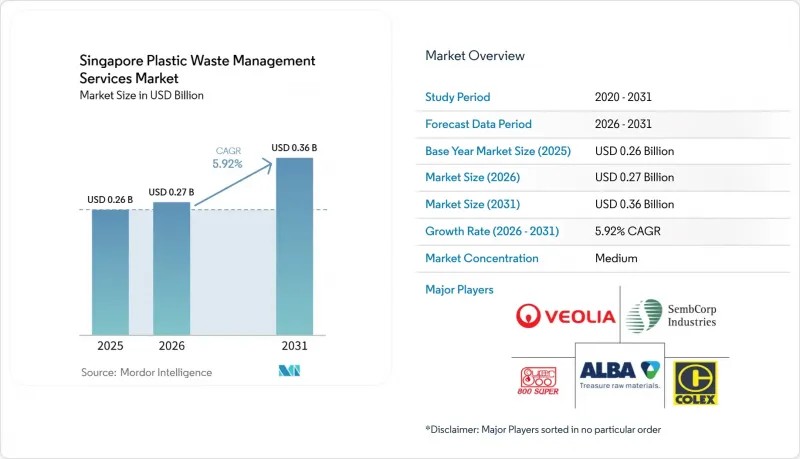
This report is Segmented by Source (Residential, Commercial, Industrial, and Others), by Service Provider (Public/Municipal, Private Waste Management Companies, and Others), and by Service Type (Collection, Transportation, Sorting & Segregation, Disposal / Treatment, and Others). The Market Forecasts are Provided in Terms of Value (USD) and Volume (Tons).
Singapore Plastic Waste Management Services Market Trends and Insights
Implementation of the Beverage Container Return Scheme (BCRS)
The Singapore plastic waste management services market is seeing its clearest operational shift through the Beverage Container Return Scheme, which began on 1 April 2026 under regulations issued under the Resource Sustainability Act 2019. The scheme applies a SGD 0.1 deposit (USD 0.08), on plastic and metal beverage containers ranging from 150 ml to 3,000 ml, providing the system with a direct financial mechanism to improve returns and material traceability. BCRS Ltd., the licensed not-for-profit operator, is responsible for collection, sorting, and recycling on behalf of producers, and around 800 companies representing more than 95% of market volume were registered or in the process of registration as of March 2026. This matters for the Singapore plastic waste management services market because it creates a cleaner PET stream outside the mixed blue-bin system, thereby improving feedstock quality and supporting dedicated transport and aggregation work for service providers. NEA targets a 60% return rate in 2026 and 80% by 2029, which means the scheme can quickly lift formal plastic collection volumes and also shape the design of future producer responsibility rules beyond beverage packaging.
Government Funding for Circular Economy and Recycling Innovation
The Singapore plastic waste management market is also gaining support from direct public funding aimed at building circular-economy capacity and advancing treatment innovation. NEA and NTU launched the TREASURES Centre in June 2026 with SGD 35 million (USD 26.8 million) under the Closing the Resource Loop Funding Initiative, and the centre runs from January 2026 to March 2030. The centre brings together NTU, NUS, and other higher education institutions, providing the country with a formal platform to advance waste research toward operational use in treatment systems. In parallel, NEA's 3R Fund can co-fund up to 80% of qualifying waste reduction and recycling projects, with support capped at SGD 1 million (USD 0.8 million) per project, which lowers the entry barrier for pilots and mid-scale process upgrades. This funding mix helps the Singapore plastic waste management services market move beyond collection alone and toward sorting improvement, treatment design, and higher-value resource recovery. It also supports a gradual shift away from an export-heavy model toward greater domestic processing capacity, which is important because current recycling flows still rely heavily on overseas markets.
Heavy Dependence on Waste-to-Energy Incineration
The Singapore plastic waste management services market still operates within a system in which incineration is the default treatment for a large share of waste. Singapore's four active waste-to-energy plants process a combined 9,710 tonnes per day, and plastics remain useful to those plants because of their calorific value. That operating logic makes it harder to expand recycling because diverting plastic away from WTE does not always yield a stronger short-term economic outcome under the current system. The gap is evident in the data: plastic recycling was 4% in 2025, while the overall recycling rate was 52%. The first phase of the Integrated Waste Management Facility is planned to be progressively completed from 2027, adding further treatment capacity unless recycling and EPR measures grow in parallel. This keeps the Singapore plastic waste management services market more supportive of collection and WTE-adjacent services than of broad recycling growth in the near term.
Other drivers and restraints analyzed in the detailed report include:
- Expansion of Reverse Vending Machine (RVM) Network
- Mandatory Packaging Reporting for Producers
- Limited Land Availability for Recycling Infrastructure
For complete list of drivers and restraints, kindly check the Table Of Contents.
Segment Analysis
The commercial segment held 39.4% of the Singapore plastic waste management services market in 2025, making it the largest source category by value. This segment includes retail outlets, food and beverage establishments, hotels, shopping malls, and offices, where packaging use is concentrated, and waste generation is easier to document through formal contracts. Singapore's dense food service and retail environment supports recurring volumes of single-use beverage containers, food packaging films, and retail plastics that are suitable for specialized collection programs. The Singapore plastic waste management services market, therefore, sees commercial locations as the most serviceable source base for formal contracts and traceable recovery routes.
That position is also supported by regulation and operating patterns. Since March 2024, large commercial and industrial food waste generators in new buildings have had to segregate, treat, and report food waste, which has improved waste stream documentation and strengthened collection visibility in mixed commercial settings. The industrial segment still contributes important volumes from Jurong Island and Tuas, especially industrial film and PP and PE materials that need specialized sorting. Residential plastic waste remains large in tonnage because around 80% of the population lives in HDB estates. Still, mixed household streams are lower in value and harder to recover because contamination stays high in blue-bin collection. In the Singapore plastic waste management services market, that mix leaves commercial waste as the clearest anchor for near-term service demand.
Complete Report Scope:
- By Source
- Residential
- Commercial (Retail, Office, etc.)
- Industrial
- Others (Institutional, Agricultural, etc)
- By Service Provider
- Public/Municipal
- Private Waste Management Companies
- Others - Producer Responsibility Organizations (PROs), etc.
- By Service Type
- Collection, Transportation, Sorting & Segregation
- Disposal / Treatment
- Landfill
- Recycling & Resource Recovery
- Incineration & Waste-to-Energy
- Others (Chemical Treatment, etc.)
- Others (Consulting, Audit & Training, etc.)
List of Companies Covered in this Report:
- Veolia Singapore
- SembWaste Pte Ltd
- ALBA Group Asia
- 800 Super Waste Management
- Colex Holdings Limited
- Blue Planet Environmental Solutions
- Wah & Hua Pte Ltd
- TES Envirocorp Pte. Ltd.
- LHN Recycling Pte Ltd
- Hiap Shing Recycling
- Remondis Singapore
- Envcares Waste Management
- Re Sustainability Limited
- TerraCycle
- Virogreen (Singapore) Pte. Ltd.
- SGRecycle Pte. Ltd.
- ECO Industrial Environmental Engineering
- Bee Joo Industries Pte. Ltd.
- Sembcorp Environment Pte. Ltd.
- Choon Poh Recycling Pte. Ltd.
Additional Benefits:
- The market estimate (ME) sheet in Excel format
- 3 months of analyst support
TABLE OF CONTENTS
1 Introduction
- 1.1 Study Assumptions & Market Definition
- 1.2 Scope of the Study
2 Research Methodology
3 Executive Summary
4 Market Landscape
- 4.1 Market Overview
- 4.2 Market Drivers
- 4.2.1 Implementation of the Beverage Container Return Scheme (BCRS)
- 4.2.2 Mandatory Packaging Reporting for Producers
- 4.2.3 Expansion of Reverse Vending Machine (RVM) Network
- 4.2.4 Growth of Circular Packaging Initiatives by FMCG Companies
- 4.2.5 Increasing Plastic Waste from Food Delivery and Convenience Retail
- 4.2.6 Government Funding for Circular Economy and Recycling Innovation
- 4.3 Market Restraints
- 4.3.1 Heavy Dependence on Waste-to-Energy Incineration
- 4.3.2 Limited Land Availability for Recycling Infrastructure
- 4.3.3 High Contamination in Household Plastic Waste
- 4.3.4 Dependence on Export or Specialized Processing for Certain Plastic Streams
- 4.4 Value / Supply-Chain Analysis
- 4.5 Regulatory Landscape
- 4.6 Technological Outlook
- 4.7 Impact Assessment of Geoplotical Events on the Singapore Plastic Waste Management Services Market
- 4.8 Startup Ecosystem Analysis
- 4.9 Analysis of Recycled Plastics on Virgin Plastics
- 4.10 Global Trade Flows & Import Restrictions (Waste Plastics)
5 Market Size and Growth Forecasts
- 5.1 By Source
- 5.1.1 Residential
- 5.1.2 Commercial (Retail, Office, etc.)
- 5.1.3 Industrial
- 5.1.4 Others (Institutional, Agricultural, etc)
- 5.2 By Service Provider
- 5.2.1 Public/Municipal
- 5.2.2 Private Waste Management Companies
- 5.2.3 Others - Producer Responsibility Organizations (PROs), etc.
- 5.3 By Service Type
- 5.3.1 Collection, Transportation, Sorting & Segregation
- 5.3.2 Disposal / Treatment
- 5.3.2.1 Landfill
- 5.3.2.2 Recycling & Resource Recovery
- 5.3.2.3 Incineration & Waste-to-Energy
- 5.3.2.4 Others (Chemical Treatment, etc.)
- 5.3.3 Others (Consulting, Audit & Training, etc.)
6 Competitive Landscape
- 6.1 Market Concentration
- 6.2 Strategic Moves
- 6.3 Market Share Analysis
- 6.4 Company Profiles {(includes Global level Overview, Market level overview, Core Segments, Financials as available, Strategic Information, Products & Services, and Recent Developments)}
- 6.4.1 Veolia Singapore
- 6.4.2 SembWaste Pte Ltd
- 6.4.3 ALBA Group Asia
- 6.4.4 800 Super Waste Management
- 6.4.5 Colex Holdings Limited
- 6.4.6 Blue Planet Environmental Solutions
- 6.4.7 Wah & Hua Pte Ltd
- 6.4.8 TES Envirocorp Pte. Ltd.
- 6.4.9 LHN Recycling Pte Ltd
- 6.4.10 Hiap Shing Recycling
- 6.4.11 Remondis Singapore
- 6.4.12 Envcares Waste Management
- 6.4.13 Re Sustainability Limited
- 6.4.14 TerraCycle
- 6.4.15 Virogreen (Singapore) Pte. Ltd.
- 6.4.16 SGRecycle Pte. Ltd.
- 6.4.17 ECO Industrial Environmental Engineering
- 6.4.18 Bee Joo Industries Pte. Ltd.
- 6.4.19 Sembcorp Environment Pte. Ltd.
- 6.4.20 Choon Poh Recycling Pte. Ltd.
7 Market Opportunities & Future Outlook
- 7.1 White-space & Unmet-need Assessment

