PUBLISHER: Mordor Intelligence | PRODUCT CODE: 2118232

PUBLISHER: Mordor Intelligence | PRODUCT CODE: 2118232
China Enterprise Content Management (ECM) - Market Share Analysis, Industry Trends & Statistics, Growth Forecasts (2026 - 2031)
According to Mordor Intelligence, the China enterprise content management (ECM) market size is projected to be USD 3.43 billion in 2025, USD 3.88 billion in 2026, and reach USD 7.58 billion by 2031, growing at a CAGR of 14.33% from 2026 to 2031.
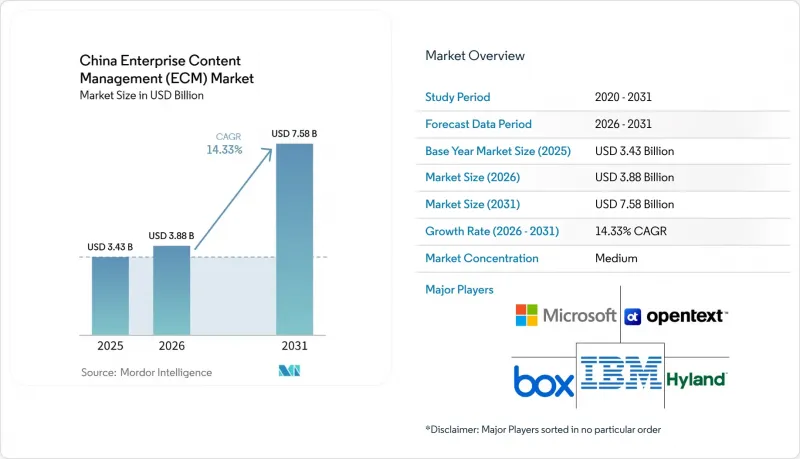
This report is Segmented by Solution Type (Document Management, Records Management, and More), Deployment Mode (On-Premises, Cloud, and Hybrid), Enterprise Size (Small and Medium Enterprises, and Large Enterprises), and End-User Industry (BFSI, Government and Public Sector, Healthcare, and More). The Market Forecasts are Provided in Terms of Value (USD).
China Enterprise Content Management (ECM) Market Trends and Insights
Accelerating Digital Records Migration in Chinese Enterprises
Chinese enterprises still carry a large volume of paper-heavy records that limit access, slow response times, and increase retention risk. This pressure is strongest in regulated fields such as banking, energy, and pharmaceuticals, where archive volumes often stretch across many years. Migration work is therefore becoming a practical buying trigger, not just a modernization project. It also underscores the importance of capture, scanning, indexing, and metadata preparation, as these steps determine how useful digitized content will be after migration. Vendors that can pair repository control with faster ingest and better industry-specific document structures are likely to benefit as the China Enterprise Content Management (ECM) Market expands.
AI-Driven Content Classification and Retrieval Efficiency
AI is shifting the role of enterprise content systems from storage toward active decision support. Buyers now expect platforms to classify files, detect duplication, flag conflicts, and surface relevant content without long manual review cycles. WPS 365's Smart Document Library upgrade in January 2026 reported 95% duplicate-detection accuracy and 80% conflict-identification accuracy, demonstrating how content control is becoming more operational in daily work. This change matters in the China Enterprise Content Management (ECM) Market because Chinese-language business records, procurement files, and regulatory documents require robust local-language support. IBM's November 2025 preview of its Core Content Services MCP Server also showed that global vendors are linking AI models directly to content repositories, raising the bar for AI-ready information management.
Complex Localization and Data Residency Requirements
Localization remains a meaningful barrier in the China Enterprise Content Management (ECM) Market because data governance rules affect architecture, hosting, and release management. Foreign suppliers often need separate local environments, tighter data segregation, and China-specific operating practices to compete effectively. That adds cost and can slow the rollout of new features when compared with their global product cycles. Domestic vendors have a clearer path in these situations because their platforms are already aligned with local deployment expectations. The launch of the WPS Xinhua Intelligent Security Version for government office use in May 2026 highlights how fully localized stacks are being positioned as a practical advantage in sensitive environments.
Other drivers and restraints analyzed in the detailed report include:
- Cloud-First Enterprise Software Procurement
- Regulatory Demand for Audit-Ready Information Retention
- High Switching Costs from Legacy Document Repositories
For complete list of drivers and restraints, kindly check the Table Of Contents.
Segment Analysis
Document Management accounted for 26.42% of the China Enterprise Content Management (ECM) Market in 2025, making it the largest solution category. It remains the starting point for many buyers because version control, central storage, and file access rules are usually the first steps in formal content governance. This leadership also reflects a common purchase path in which enterprises stabilize documents first, then move to broader retention, review, and process control. Records Management and Web Content Management usually expand after that first layer is in place, especially when compliance or publishing needs become harder to manage manually.
Workflow and Business Process Management is projected to grow at a 16.94% CAGR through 2031, making it the fastest-moving solution segment in the China Enterprise Content Management (ECM) Market. Demand is rising because enterprises want approvals, reviews, and content-based decisions to move faster across departments. Digital Asset Management and Case Management remain smaller but important layers, with Digital Asset Management gaining relevance where enterprises handle media libraries and branded files, while Case Management matters more in government, legal, and healthcare settings. The wider pattern is that buyers now expect content systems to support review paths, retention logic, AI-supported search, and better visibility across teams rather than function as stand-alone repositories. IBM's 2025 MCP Server preview reflects this direction because it links AI models with document and metadata operations, helping turn stored content into actionable workflow input.
Cloud accounted for 71.28% of the China Enterprise Content Management (ECM) Market in 2025 and is forecast to grow at a 17.31% CAGR through 2031. That combination shows that cloud adoption is still in an active expansion stage rather than a mature replacement cycle. Buyers are choosing cloud deployments because they reduce setup time, simplify updates, and enable broader access across distributed teams. The leading position of cloud in the China Enterprise Content Management (ECM) Market also reflects the fact that many new deployments are starting from digital workflow goals rather than from infrastructure ownership preferences.
The shape of demand is still more nuanced than a simple shift away from local infrastructure. Many enterprises in sensitive sectors are choosing controlled cloud models that support local hosting and tighter governance over access and data flow, while hybrid deployment remains relevant for organizations that need to separate sensitive records from broader collaboration content. On-premises environments still hold an important place in state-owned enterprises, government bodies, and security-sensitive organizations where physical isolation and internal control remain central to procurement. Global suppliers are adapting with sovereign and compliance-focused deployment strategies, while local suppliers are using domestic stacks to reduce trust barriers. In July 2025, a Guangxi smart archive platform developed with Huawei passed compatibility certifications for the Ascend AI and Kunpeng 920 architectures, demonstrating how infrastructure localization and content platform validation are increasingly linked.
Complete Report Scope:
- By Solution Type
- Document Management
- Records Management
- Workflow and Business Process Management
- Case Management
- Digital Asset Management
- Web Content Management
- Other Solutions
- By Deployment Mode
- On-Premises
- Cloud
- Hybrid
- By Enterprise Size
- Small and Medium Enterprises
- Large Enterprises
- By End-User Industry
- BFSI
- Government and Public Sector
- Healthcare
- IT and Telecommunications
- Manufacturing
- Retail
- Media and Entertainment
- Education
- Energy and Utilities
- Other End-User Industries
List of Companies Covered in this Report:
- Microsoft Corporation
- OpenText Corporation
- IBM Corporation
- Hyland Software, Inc.
- Box, Inc.
- Oracle Corporation
- SAP SE
- Adobe Inc.
- Newgen Software Technologies Limited
- Laserfiche Inc.
- M-Files, Inc.
- DocuWare GmbH
- Alfresco Software, Inc.
- Tencent Cloud
- Yonyou Network Technology
- Alibaba Cloud
- Kingsoft Office Software
- Tungsten Automation Corporation
- Xerox Holdings Corporation
- Zoho Corporation Private Limited
Additional Benefits:
- The market estimate (ME) sheet in Excel format
- 3 months of analyst support
TABLE OF CONTENTS
1 INTRODUCTION
- 1.1 Study Assumptions and Market Definition
- 1.2 Scope of the Study
2 RESEARCH METHODOLOGY
3 EXECUTIVE SUMMARY
4 MARKET LANDSCAPE
- 4.1 Market Overview
- 4.2 Market Drivers
- 4.2.1 Accelerating Digital Records Migration in Chinese Enterprises
- 4.2.2 AI-Driven Content Classification and Retrieval Efficiency
- 4.2.3 Cloud-First Enterprise Software Procurement
- 4.2.4 Regulatory Demand for Audit-Ready Information Retention
- 4.2.5 Workflow Automation for High-Volume Document Operations
- 4.2.6 Cross-Platform Integration With ERP, CRM, and Case Systems
- 4.3 Market Restraints
- 4.3.1 Complex Localization and Data Residency Requirements
- 4.3.2 High Switching Costs From Legacy Document Repositories
- 4.3.3 Cybersecurity and Sensitive Data Exposure Risks
- 4.3.4 Fragmented Buyer Readiness Across Mid-Market Enterprises
- 4.4 Industry Value-Chain Analysis
- 4.5 Regulatory Landscape
- 4.6 Technological Outlook
- 4.7 Impact of Macroeconomic Factors on the Market
- 4.8 Porter's Five Forces Analysis
- 4.8.1 Threat of New Entrants
- 4.8.2 Bargaining Power of Buyers
- 4.8.3 Bargaining Power of Suppliers
- 4.8.4 Threat of Substitutes
- 4.8.5 Intensity of Competitive Rivalry
5 MARKET SIZE AND GROWTH FORECASTS (VALUE)
- 5.1 By Solution Type
- 5.1.1 Document Management
- 5.1.2 Records Management
- 5.1.3 Workflow and Business Process Management
- 5.1.4 Case Management
- 5.1.5 Digital Asset Management
- 5.1.6 Web Content Management
- 5.1.7 Other Solutions
- 5.2 By Deployment Mode
- 5.2.1 On-Premises
- 5.2.2 Cloud
- 5.2.3 Hybrid
- 5.3 By Enterprise Size
- 5.3.1 Small and Medium Enterprises
- 5.3.2 Large Enterprises
- 5.4 By End-User Industry
- 5.4.1 BFSI
- 5.4.2 Government and Public Sector
- 5.4.3 Healthcare
- 5.4.4 IT and Telecommunications
- 5.4.5 Manufacturing
- 5.4.6 Retail
- 5.4.7 Media and Entertainment
- 5.4.8 Education
- 5.4.9 Energy and Utilities
- 5.4.10 Other End-User Industries
6 COMPETITIVE LANDSCAPE
- 6.1 Market Concentration
- 6.2 Strategic Moves
- 6.3 Market Share Analysis
- 6.4 Company Profiles (includes Global Level Overview, Market Level Overview, Core Segments, Financials as Available, Strategic Information, Market Rank/Share for Key Companies, Products and Services, and Recent Developments)
- 6.4.1 Microsoft Corporation
- 6.4.2 OpenText Corporation
- 6.4.3 IBM Corporation
- 6.4.4 Hyland Software, Inc.
- 6.4.5 Box, Inc.
- 6.4.6 Oracle Corporation
- 6.4.7 SAP SE
- 6.4.8 Adobe Inc.
- 6.4.9 Newgen Software Technologies Limited
- 6.4.10 Laserfiche Inc.
- 6.4.11 M-Files, Inc.
- 6.4.12 DocuWare GmbH
- 6.4.13 Alfresco Software, Inc.
- 6.4.14 Tencent Cloud
- 6.4.15 Yonyou Network Technology
- 6.4.16 Alibaba Cloud
- 6.4.17 Kingsoft Office Software
- 6.4.18 Tungsten Automation Corporation
- 6.4.19 Xerox Holdings Corporation
- 6.4.20 Zoho Corporation Private Limited
7 MARKET OPPORTUNITIES AND FUTURE OUTLOOK
- 7.1 White-Space and Unmet-Need Assessment

