PUBLISHER: Mordor Intelligence | PRODUCT CODE: 2120625

PUBLISHER: Mordor Intelligence | PRODUCT CODE: 2120625
Enterprise Content Management - Market Share Analysis, Industry Trends & Statistics, Growth Forecasts (2026 - 2031)
According to Mordor Intelligence, the enterprise content management market size is expected to grow from USD 38.58 billion in 2025 to USD 44.29 billion in 2026 and is forecast to reach USD 81.22 billion by 2031 at 12.89% CAGR over 2026-2031.
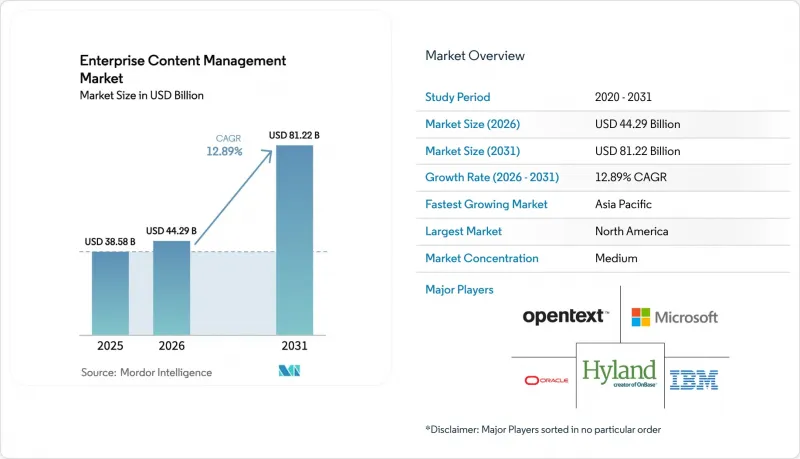
This report is Segmented by Solution Type (Content Management, Document Management, Case Management, Workflow Management, and More), Deployment Mode (On-Premises, and Cloud), Enterprise Size (Small and Medium Enterprises, and Large Enterprises), End-User Industry (Telecom and IT, BFSI, Retail and E-Commerce, and More), and Geography. The Market Forecasts are Provided in Terms of Value (USD).
Global Enterprise Content Management Market Trends and Insights
Regulatory Compliance Mandates for Content Lifecycle Governance
Stringent rules such as GDPR, the UK Data Protection Act 2018, and India's Digital Personal Data Protection Act 2023 impose retention schedules, right-to-erasure protocols, and immutable audit-trail requirements. The May 2024 EUR 251 million (USD 283 million) penalty on Meta highlighted regulators' willingness to levy material fines, driving enterprises toward geo-fenced repositories and auto-classification engines. Financial institutions face overlapping Basel III and MiFID II mandates, while healthcare providers juggle HIPAA with state privacy statutes, reinforcing the need for integrated governance within the Enterprise Content Management market. Solution roadmaps now embed policy templates that map regional statutes to metadata fields, enabling defensible deletion and automated litigation holds. Boards increasingly view non-compliant content workflows as financial and reputational liabilities, elevating ECM adoption to a core risk-mitigation strategy.
Explosion of Enterprise Unstructured Data Volumes
Unstructured documents, emails, CAD files, and sensor logs account for more than 80% of corporate data, growing by double digits annually. Manual tagging cannot scale, so enterprises turn to NLP-infused platforms that surface relevant information in milliseconds. Microsoft's Copilot for SharePoint Premium cuts search time by up to 70%, while Adobe's AI Agents autogenerate summaries for marketing assets, signaling a pivot from passive storage to proactive knowledge discovery. The productivity gains justify investment even during budget tightening, especially as legal teams leverage auto-redaction to streamline e-discovery. In Asia Pacific, data-growth velocity is amplified by IoT rollouts, positioning next-generation ECM as an operational necessity rather than a discretionary upgrade.
Security and Privacy Concerns in Cloud and Mobile ECM
The February 2024 Change Healthcare ransomware attack affecting over 100 million individuals and costing USD 22 million in ransom brought cloud-repository vulnerabilities to the forefront. Snowflake's breach four months later fuelled deeper scepticism toward shared-credential models. Chief information security officers now mandate immutability, real-time anomaly detection, and device-level encryption for mobile access before green-lighting cloud migration. Liability frameworks increasingly hold data controllers accountable for third-party incidents, raising insurance costs and elongating procurement cycles in risk-averse industries such as banking and defense. While vendors race to certify zero-trust architectures, security fears will continue to dilute near-term Enterprise Content Management market expansion.
Other drivers and restraints analyzed in the detailed report include:
- Accelerated Shift to Cloud-Native ECM Deployments
- AI-Driven Content Intelligence and Hyper-Automation
- Cross-Border Data-Transfer Restrictions (GDPR, DPDPA, etc.)
For complete list of drivers and restraints, kindly check the Table Of Contents.
Segment Analysis
Document Management retained a 28.19% revenue lead in 2025 because regulated verticals rely on version control for contracts, policies, and filings. However, Digital Asset Management is scaling at a 13.36% CAGR as retailers and media houses orchestrate thousands of omnichannel images and videos. The Enterprise Content Management market size for Digital Asset Management is projected to double by 2031 as AI-driven auto-cropping, format conversion, and rights management become table stakes. Adobe's fiscal 2025 revenue of USD 23.8 billion illustrates monetization potential as generative models simplify asset reuse. Increasingly, vendors bundle document, asset, and workflow capabilities, dissolving traditional category boundaries and nudging buyers toward platform commitments that minimize point-solution sprawl.
Content creators now demand real-time collaboration, intuitive search, and embedded analytics that surface asset performance metrics. Microsoft's Copilot integration allows marketers to locate "blue-background images" without manual tagging, while Oracle streamlines brand-kit governance across dispersed agencies. Case Management and Workflow engines, once sold separately, are now embedded into Digital Asset modules, routing creative approvals and enforcing brand-consistency checkpoints. This convergence elevates lock-in risk, prompting procurement teams to prioritize open APIs and metadata-interoperability standards. As solution boundaries blur, platform extensibility and ecosystem depth will dictate wallet share within the Enterprise Content Management market.
On-Premises deployments held 53.48% of 2025 revenue because banks, defense contractors, and hospitals still favour air-gapped environments for sensitive records. Yet the cloud sub-segment is advancing at a 13.91% CAGR, underscoring a decisive shift toward elastic compute and pay-as-you-go economics. The Enterprise Content Management market size associated with cloud offerings is set to eclipse on-premises spend by 2029 if current momentum persists. Usage-based pricing, highlighted by L.E.K. Consulting research, aligns vendor revenue with customer consumption, driving higher renewal rates and stickier net-retention metrics.
OpenText's Express, Premium, and Ultimate Documentum tiers demonstrate granular metering that lowers pilot costs while preserving upsell pathways. Hybrid architectures keep master data on-site but use cloud analytics for anomaly detection and full-text indexing, mitigating compliance hurdles without sacrificing AI functionality. Nevertheless, the Snowflake breach reminded enterprises that encryption-key ownership and zero-trust segmentation are non-negotiable. As cyber-underwriting criteria tighten, buyers will favour vendors that furnish audit-ready SOC 2 Type II reports and native cyber-insurance endorsements.
Complete Report Scope:
- By Solution Type
- Content Management
- Document Management
- Case Management
- Workflow Management
- Record Management
- Digital Asset Management
- Other Solution Types
- By Deployment Mode
- On-Premises
- Cloud
- By Enterprise Size
- Small and Medium Enterprises (SME)
- Large Enterprises
- By End-User Industry
- Telecom and IT
- BFSI
- Retail and E-Commerce
- Education
- Manufacturing
- Media and Entertainment
- Government and Public Sector
- Other End-User Industries
- By Geography
- North America
- United States
- Canada
- Mexico
- South America
- Brazil
- Argentina
- Rest of South America
- Europe
- United Kingdom
- Germany
- France
- Rest of Europe
- Asia Pacific
- China
- Japan
- India
- South Korea
- Australia
- Rest of Asia Pacific
- Middle East
- United Arab Emirates
- Saudi Arabia
- Rest of Middle East
- Africa
- South Africa
- Kenya
- Rest of Africa
- North America
Geography Analysis
North America retained 38.73% of 2025 revenue, reflecting early cloud adoption, vendor density, and strict sectoral regulations that favour enterprise-grade platforms. Mature ECM installations in banking and federal agencies emphasize integration with compliance analytics, while Mexico's automotive suppliers deploy content workflows to satisfy IATF 16949 traceability. Meta's EUR 251 million fine, imposed by Ireland's regulator yet impacting U.S. operations, illustrates how extraterritorial enforcement shapes the Enterprise Content Management market even within home jurisdictions.
Asia Pacific is projected to grow at a 13.51% CAGR through 2031, propelled by China's software-localization edicts, India's public-service digitization drives, and Japan's demographic-led automation push. China's Data Security Law compels multinationals to operate in-country ECM stacks, spurring demand for modular designs that synchronize metadata globally while localizing personal data. India's Digital Personal Data Protection Act enforces similar localization, prompting hybrid cloud builds that isolate sensitive datasets inside national borders. South Korea's 5G ubiquity accelerates mobile ECM uptake, while Australia's anti-money-laundering reforms sustain financial-sector investment.
Europe, South America, Middle East and Africa collectively comprise the remaining share, with Europe anchored by GDPR-induced platform refreshes in Germany, France, and the United Kingdom. Brazil's open-banking regulations encourage banks to standardize content pipelines, whereas Saudi Arabia's smart-city ambitions necessitate centralized citizen-service repositories. Divergent retention schedules and consent frameworks across these regions elevate the importance of configurable policy engines. Enterprises that deploy federated architectures as regional instances governed by a unified control plane can reconcile local compliance with global collaboration, carving a defensible path in the Enterprise Content Management market.
- Microsoft Corporation
- OpenText Corporation
- IBM Corporation
- Hyland Software Inc.
- Oracle Corporation
- Box Inc.
- Adobe Inc.
- Xerox Holdings Corporation
- M-Files Corporation
- Alfresco Software Inc. (Hyland)
- DocuWare GmbH
- Datamatics Global Services Ltd.
- Hewlett Packard Enterprise Company
- Capgemini SE
- Newgen Software Technologies Ltd.
- Laserfiche Inc.
- SER Group
- Fabasoft AG
- Everteam Global Services
- KnowledgeLake Inc.
- iManage LLC
- Egnyte Inc.
Additional Benefits:
- The market estimate (ME) sheet in Excel format
- 3 months of analyst support
TABLE OF CONTENTS
1 INTRODUCTION
- 1.1 Study Assumptions and Market Definition
- 1.2 Scope of the Study
2 RESEARCH METHODOLOGY
3 EXECUTIVE SUMMARY
4 MARKET LANDSCAPE
- 4.1 Market Overview
- 4.2 Market Drivers
- 4.2.1 Regulatory Compliance Mandates for Content Lifecycle Governance
- 4.2.2 Explosion of Enterprise Unstructured Data Volumes
- 4.2.3 Accelerated Shift to Cloud-Native ECM Deployments
- 4.2.4 AI-Driven Content Intelligence and Hyper-Automation
- 4.2.5 Rising Adoption of Industry-Specific Pretrained Language Models for Domain Document Automation
- 4.2.6 Token-Based Consumption Pricing Reshaping Mid-Market Adoption
- 4.3 Market Restraints
- 4.3.1 Security and Privacy Concerns in Cloud and Mobile ECM
- 4.3.2 Complexity of Merging Legacy Repositories Post-M&A
- 4.3.3 Cross-Border Data-Transfer Restrictions (GDPR, DPDPA, etc.)
- 4.3.4 Escalating API Rate-Limit Costs in Content Collaboration Platforms
- 4.4 Industry Value-Chain Analysis
- 4.5 Regulatory Landscape
- 4.6 Technological Outlook
- 4.7 Impact of Macroeconomic Factors on the Market
- 4.8 Porter's Five Forces Analysis
- 4.8.1 Threat of New Entrants
- 4.8.2 Bargaining Power of Buyers
- 4.8.3 Bargaining Power of Suppliers
- 4.8.4 Threat of Substitutes
- 4.8.5 Intensity of Competitive Rivalry
5 MARKET SIZE AND GROWTH FORECASTS (VALUE)
- 5.1 By Solution Type
- 5.1.1 Content Management
- 5.1.2 Document Management
- 5.1.3 Case Management
- 5.1.4 Workflow Management
- 5.1.5 Record Management
- 5.1.6 Digital Asset Management
- 5.1.7 Other Solution Types
- 5.2 By Deployment Mode
- 5.2.1 On-Premises
- 5.2.2 Cloud
- 5.3 By Enterprise Size
- 5.3.1 Small and Medium Enterprises (SME)
- 5.3.2 Large Enterprises
- 5.4 By End-User Industry
- 5.4.1 Telecom and IT
- 5.4.2 BFSI
- 5.4.3 Retail and E-Commerce
- 5.4.4 Education
- 5.4.5 Manufacturing
- 5.4.6 Media and Entertainment
- 5.4.7 Government and Public Sector
- 5.4.8 Other End-User Industries
- 5.5 By Geography
- 5.5.1 North America
- 5.5.1.1 United States
- 5.5.1.2 Canada
- 5.5.1.3 Mexico
- 5.5.2 South America
- 5.5.2.1 Brazil
- 5.5.2.2 Argentina
- 5.5.2.3 Rest of South America
- 5.5.3 Europe
- 5.5.3.1 United Kingdom
- 5.5.3.2 Germany
- 5.5.3.3 France
- 5.5.3.4 Rest of Europe
- 5.5.4 Asia Pacific
- 5.5.4.1 China
- 5.5.4.2 Japan
- 5.5.4.3 India
- 5.5.4.4 South Korea
- 5.5.4.5 Australia
- 5.5.4.6 Rest of Asia Pacific
- 5.5.5 Middle East
- 5.5.5.1 United Arab Emirates
- 5.5.5.2 Saudi Arabia
- 5.5.5.3 Rest of Middle East
- 5.5.6 Africa
- 5.5.6.1 South Africa
- 5.5.6.2 Kenya
- 5.5.6.3 Rest of Africa
- 5.5.1 North America
6 COMPETITIVE LANDSCAPE
- 6.1 Market Concentration
- 6.2 Strategic Moves
- 6.3 Market Share Analysis
- 6.4 Company Profiles (includes Global Level Overview, Market Level Overview, Core Segments, Financials as Available, Strategic Information, Market Rank/Share for Key Companies, Products & Services, and Recent Developments)
- 6.4.1 Microsoft Corporation
- 6.4.2 OpenText Corporation
- 6.4.3 IBM Corporation
- 6.4.4 Hyland Software Inc.
- 6.4.5 Oracle Corporation
- 6.4.6 Box Inc.
- 6.4.7 Adobe Inc.
- 6.4.8 Xerox Holdings Corporation
- 6.4.9 M-Files Corporation
- 6.4.10 Alfresco Software Inc. (Hyland)
- 6.4.11 DocuWare GmbH
- 6.4.12 Datamatics Global Services Ltd.
- 6.4.13 Hewlett Packard Enterprise Company
- 6.4.14 Capgemini SE
- 6.4.15 Newgen Software Technologies Ltd.
- 6.4.16 Laserfiche Inc.
- 6.4.17 SER Group
- 6.4.18 Fabasoft AG
- 6.4.19 Everteam Global Services
- 6.4.20 KnowledgeLake Inc.
- 6.4.21 iManage LLC
- 6.4.22 Egnyte Inc.
7 MARKET OPPORTUNITIES AND FUTURE OUTLOOK
- 7.1 White-Space and Unmet-Need Assessment

