PUBLISHER: Mordor Intelligence | PRODUCT CODE: 2118238

PUBLISHER: Mordor Intelligence | PRODUCT CODE: 2118238
Singapore Enterprise Content Management (ECM) - Market Share Analysis, Industry Trends & Statistics, Growth Forecasts (2026 - 2031)
According to Mordor Intelligence, the Singapore enterprise content management (ECM) market size was valued at USD 315.06 million in 2025 and estimated to grow from USD 368.47 million in 2026 to reach USD 848.75 million by 2031, at a CAGR of 18.16% during the forecast period 2026-2031.
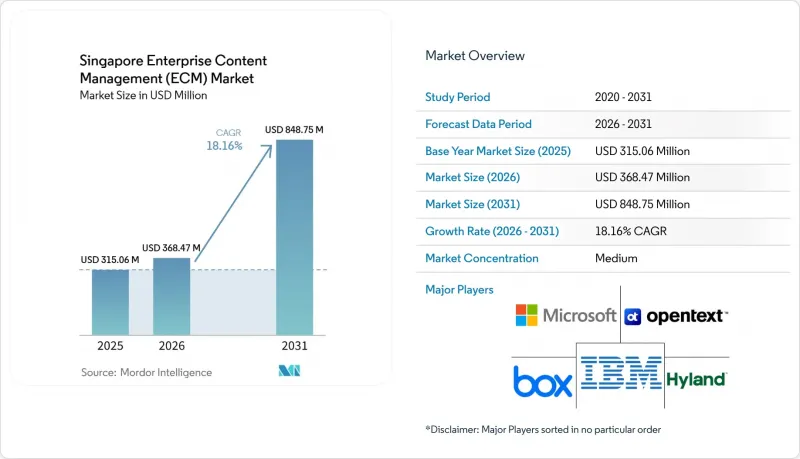
This report is Segmented by Solution Type (Document Management, Records Management, and More), Deployment Mode (On-Premises, Cloud, and Hybrid), Enterprise Size (Small and Medium Enterprises, and Large Enterprises), and End-User Industry (BFSI, Government and Public Sector, Healthcare, IT and Telecommunications, and More). The Market Forecasts are Provided in Terms of Value (USD).
Singapore Enterprise Content Management (ECM) Market Trends and Insights
AI Copilots Embedded in Content Workflows
AI copilots are changing how the Singapore enterprise content management (ECM) market handles stored information, because users now expect platforms to guide work rather than only retrieve files. These tools can suggest classifications, route approvals, and surface exceptions during document handling, reducing manual effort for operations and compliance teams. Hyland launched its Enterprise Context Engine in June 2026, featuring sector-specific ontologies for healthcare, financial services, insurance, and government, demonstrating how vendors are integrating domain-aware AI into content systems. GovTech also deployed AISAY v2 in Singapore government agencies, and the platform can process large document sets in seconds and return structured JSON outputs for workflow use. This shift is boosting demand in the Singapore enterprise content management (ECM) market, as buyers now see AI-driven content handling as part of day-to-day process control rather than a future add-on.
Data Residency and Sovereignty Requirements
Data residency rules are becoming a core buying factor in the Singapore enterprise content management (ECM) market, especially for organizations that manage sensitive financial, personal, or clinical records. Singapore's PDPA imposes obligations on how personal data is handled and transferred, keeping cross-border controls central to content platform selection. This issue is more visible in BFSI and healthcare, where content repositories hold records that need clear jurisdictional protection and stronger governance controls. Microsoft's USD 5.5 billion investment in cloud and AI infrastructure in Singapore from 2025 through 2029 reinforces the local capacity needed to support this demand in the Singapore enterprise content management (ECM) market. As a result, vendors that can align cloud performance with jurisdictional assurance are better placed in competitive evaluations across the Singapore enterprise content management (ECM) market.
High Integration Complexity With Legacy Systems
Integration complexity remains the biggest structural restraint in the Singapore enterprise content management (ECM) market, especially among large enterprises with long-established information systems. Older repositories in BFSI and government often include custom metadata structures, point-to-point links, and poorly documented connections to ERP, HRMS, and core operating systems. This makes migration slower, costlier, and more dependent on staged transition plans than many buyers first expect. A May 2026 GeBIZ tender from the Housing and Development Board for an AI-driven knowledge management system explicitly required integration with existing information systems, document storage, and role-based access controls, underscoring the centrality of the integration burden. Because of this, deployment timelines in the Singapore enterprise content management (ECM) market can stretch well beyond initial plans even when procurement approval is already in place.
Other drivers and restraints analyzed in the detailed report include:
- Zero Trust Content Access Controls
- Cloud Migration of Legacy Repositories
- User Resistance to Content Governance Discipline
For complete list of drivers and restraints, kindly check the Table Of Contents.
Segment Analysis
Document management held the largest share at 32.14% in 2025, which made it the clearest entry point for buyers in the Singapore enterprise content management (ECM) market. It remained central because BFSI institutions needed reliable control over loan files, KYC records, and regulatory correspondence that aligned with retention and audit expectations. This part of the Singapore enterprise content management (ECM) industry also kept its weight because compliance-driven document handling is recurring and less exposed to short-term budget swings. Records management and case management stayed smaller, but they remained important where organizations needed stronger lifecycle control and structured handling of regulated files.
Workflow and business process management is projected to grow at a 20.83% CAGR from 2026 to 2031, making it the fastest-growing solution area in the Singapore enterprise content management (ECM) market. Growth is being driven by the broader adoption of AI for approval routing, exception handling, and cross-team handoffs that were once handled manually. Digital asset management continued to serve more focused needs in media, retail, and marketing functions, while web content management supported publishing and disclosure workflows across financial services and the public sector. The other solutions group, which includes document capture and email archiving, remained relevant for mid-market buyers entering the Singapore enterprise content management (ECM) market through early-stage digitization programs.
Cloud deployment held a 79.41% share in 2025 and ranked as the fastest-growing mode at a 21.24% CAGR, underscoring how firmly the Singapore enterprise content management (ECM) market has aligned around cloud-first buying. This is not a split market between old and new architectures, because most new investments are now expanding cloud use rather than testing it for the first time. The fact that cloud is both the largest and fastest-growing segment suggests that enterprise confidence in this model has already moved beyond the pilot stage. For many buyers, cloud is now the default architecture for new content programs in the Singapore enterprise content management (ECM) market.
That momentum is supported by local infrastructure expansion and stronger confidence in governed hosting environments. Microsoft's multiyear infrastructure commitment in Singapore is reinforcing the capacity needed for sovereign and AI-ready workloads. Hybrid deployment still held a practical role among large BFSI institutions and government agencies that needed tighter control over selected content classes, while on-premises systems remained necessary in limited use cases involving sensitive or classified material. Even so, the longer-term direction still points toward additional migration away from traditional deployments, which should keep the cloud at the center of the Singapore enterprise content management (ECM) market.
Complete Report Scope:
- By Solution Type
- Document Management
- Records Management
- Workflow and Business Process Management
- Case Management
- Digital Asset Management
- Web Content Management
- Other Solutions
- By Deployment Mode
- On-Premises
- Cloud
- Hybrid
- By Enterprise Size
- Small and Medium Enterprises
- Large Enterprises
- By End-User Industry
- BFSI
- Government and Public Sector
- Healthcare
- IT and Telecommunications
- Manufacturing
- Retail
- Media and Entertainment
- Education
- Energy and Utilities
- Other End-User Industries
List of Companies Covered in this Report:
- Microsoft Corporation
- OpenText Corporation
- IBM Corporation
- Hyland Software, Inc.
- Oracle Corporation
- Box, Inc.
- Adobe Inc.
- Xerox Holdings Corporation
- M-Files Corporation
- Alfresco Software, Inc.
- DocuWare GmbH
- Datamatics Global Services Limited
- Newgen Software Technologies Limited
- Laserfiche, Inc.
- Yonyou Singapore
- Fujifilm Business Innovation Corp
- KYOCERA Document Solutions Singapore Pte. Ltd
- KnowledgeLake, Inc.
- iManage, LLC
- Egnyte, Inc.
- Objective Corporation Limited
- Zoho Corporation Pvt. Ltd.
Additional Benefits:
- The market estimate (ME) sheet in Excel format
- 3 months of analyst support
TABLE OF CONTENTS
1 INTRODUCTION
- 1.1 Study Assumptions and Market Definition
- 1.2 Scope of the Study
2 RESEARCH METHODOLOGY
3 EXECUTIVE SUMMARY
4 MARKET LANDSCAPE
- 4.1 Market Overview
- 4.2 Market Drivers
- 4.2.1 AI Copilots Embedded in Content Workflows
- 4.2.2 Data Residency and Sovereignty Requirements
- 4.2.3 Zero Trust Content Access Controls
- 4.2.4 Cloud Migration of Legacy Repositories
- 4.2.5 Industry-Specific Compliance Automation
- 4.2.6 No-Code Workflow Orchestration Demand
- 4.3 Market Restraints
- 4.3.1 High Integration Complexity With Legacy Systems
- 4.3.2 User Resistance to Content Governance Discipline
- 4.3.3 Vendor Lock-In Concerns in Platform Suites
- 4.3.4 Skills Gap in Intelligent Content Operations
- 4.4 Industry Value-Chain Analysis
- 4.5 Regulatory Landscape
- 4.6 Technological Outlook
- 4.7 Impact of Macroeconomic Factors on the Market
- 4.8 Porter's Five Forces Analysis
- 4.8.1 Threat of New Entrants
- 4.8.2 Bargaining Power of Buyers
- 4.8.3 Bargaining Power of Suppliers
- 4.8.4 Threat of Substitutes
- 4.8.5 Intensity of Competitive Rivalry
5 MARKET SIZE AND GROWTH FORECASTS (VALUE)
- 5.1 By Solution Type
- 5.1.1 Document Management
- 5.1.2 Records Management
- 5.1.3 Workflow and Business Process Management
- 5.1.4 Case Management
- 5.1.5 Digital Asset Management
- 5.1.6 Web Content Management
- 5.1.7 Other Solutions
- 5.2 By Deployment Mode
- 5.2.1 On-Premises
- 5.2.2 Cloud
- 5.2.3 Hybrid
- 5.3 By Enterprise Size
- 5.3.1 Small and Medium Enterprises
- 5.3.2 Large Enterprises
- 5.4 By End-User Industry
- 5.4.1 BFSI
- 5.4.2 Government and Public Sector
- 5.4.3 Healthcare
- 5.4.4 IT and Telecommunications
- 5.4.5 Manufacturing
- 5.4.6 Retail
- 5.4.7 Media and Entertainment
- 5.4.8 Education
- 5.4.9 Energy and Utilities
- 5.4.10 Other End-User Industries
6 COMPETITIVE LANDSCAPE
- 6.1 Market Concentration
- 6.2 Strategic Moves
- 6.3 Market Share Analysis
- 6.4 Company Profiles (includes Global Level Overview, Market Level Overview, Core Segments, Financials as Available, Strategic Information, Market Rank/Share for Key Companies, Products and Services, and Recent Developments)
- 6.4.1 Microsoft Corporation
- 6.4.2 OpenText Corporation
- 6.4.3 IBM Corporation
- 6.4.4 Hyland Software, Inc.
- 6.4.5 Oracle Corporation
- 6.4.6 Box, Inc.
- 6.4.7 Adobe Inc.
- 6.4.8 Xerox Holdings Corporation
- 6.4.9 M-Files Corporation
- 6.4.10 Alfresco Software, Inc.
- 6.4.11 DocuWare GmbH
- 6.4.12 Datamatics Global Services Limited
- 6.4.13 Newgen Software Technologies Limited
- 6.4.14 Laserfiche, Inc.
- 6.4.15 Yonyou Singapore
- 6.4.16 Fujifilm Business Innovation Corp
- 6.4.17 KYOCERA Document Solutions Singapore Pte. Ltd
- 6.4.18 KnowledgeLake, Inc.
- 6.4.19 iManage, LLC
- 6.4.20 Egnyte, Inc.
- 6.4.21 Objective Corporation Limited
- 6.4.22 Zoho Corporation Pvt. Ltd.
7 MARKET OPPORTUNITIES AND FUTURE OUTLOOK
- 7.1 White-Space and Unmet-Need Assessment

