PUBLISHER: Mordor Intelligence | PRODUCT CODE: 2118862

PUBLISHER: Mordor Intelligence | PRODUCT CODE: 2118862
Middle East and Africa Net-Zero Energy Buildings - Market Share Analysis, Industry Trends & Statistics, Growth Forecasts (2026 - 2031)
According to Mordor Intelligence, the Middle East and Africa net-Zero energy buildings market size is projected to expand from USD 1.75 billion in 2025 and USD 1.89 billion in 2026 to USD 3.88 billion by 2031, registering a CAGR of 15.47% between 2026 to 2031.
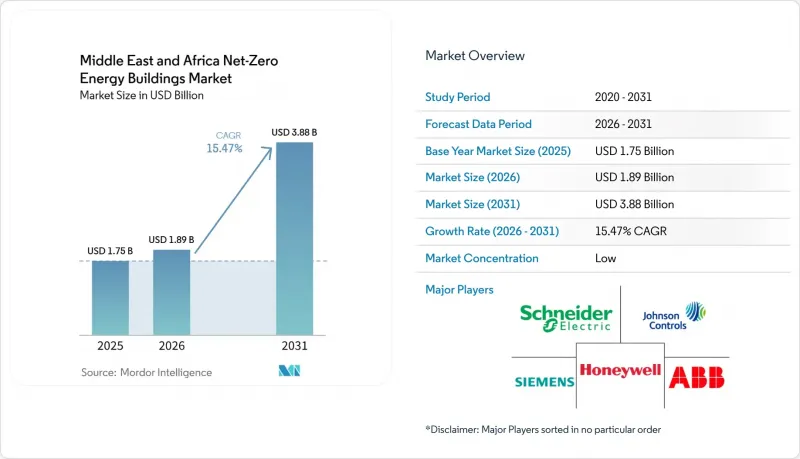
This report is Segmented by Building Type (Residential, Commercial, Institutional, and Industrial), by Offerings (Solutions and Services), by Construction Type (New Construction and Renovation), and by Geography (United Arab Emirates, Saudi Arabia, South Africa, Egypt, and More). The Market Forecasts are Provided in Terms of Value (USD).
Middle East and Africa Net-Zero Energy Buildings Market Trends and Insights
National Net-Zero Mandates and Green Building Codes Accelerate Adoption
Regulatory mandates are a direct source of demand for the Middle East and Africa net-zero energy buildings market. Dubai requires its Al Sa'fat Silver baseline for new building permits, linking sustainability documentation to approval and completion processes. Saudi Arabia has embedded sustainability requirements into its building code and assessment framework, moving the subject beyond pilot projects. Kenya launched its National Buildings and Construction Decarbonization Roadmap for 2026 to 2040, including minimum energy performance standards for new public buildings by 2030. South Africa's Climate Change Act and its higher carbon tax rate created a clearer financial reason to reduce building emissions. These measures give building owners, designers, and suppliers clearer reasons to address energy performance earlier in a project.
Declining Costs of Solar, Storage, and Smart HVAC Systems Improve Project Viability
Lower technology costs are improving the business case for the Middle East and Africa net-zero energy buildings market. A peer-reviewed study of hot-climate retrofits found that envelope upgrades combined with photovoltaic (PV) systems could yield a 3-year payback for the envelope component in Saudi Arabia. The same source showed that combined retrofit packages can bring energy demand close to the thresholds for near-zero energy buildings. Better controls for heating, ventilation, and air conditioning, or HVAC, systems can reduce waste during daily operation. Shorter payback periods make upgrades to existing buildings more financially credible for owners who cannot replace their properties. This shift broadens the Middle East and Africa net-zero energy buildings market beyond new construction pipelines.
High Upfront Capital Requirements Limit Adoption
High upfront costs continue to constrain the Middle East and Africa net-zero energy buildings market. Net-zero buildings can cost 5% to 10% more to construct than conventional buildings, according to research on South Africa. South African borrowing costs reached 15% in 2024, potentially lengthening the payback periods for efficiency and renewable energy investments. A King Abdullah Petroleum Studies and Research Center survey found that 20.4% of 137 respondents identified high initial cost as a barrier to energy conservation in Gulf buildings. The survey also identified residential buildings as the most difficult segment to retrofit. Longer financing structures and better evaluation of energy performance contracts remain important for advancing projects.
Other drivers and restraints analyzed in the detailed report include:
- Utility Costs and Grid Reliability Challenges Increase Demand for Energy-Efficient Buildings
- Green Finance and Certification Incentives Support Building Investments
- Shortage of Specialized Professionals Delays Project Delivery
For complete list of drivers and restraints, kindly check the Table Of Contents.
Segment Analysis
Commercial buildings held 48.20% of the Middle East and Africa net-zero energy buildings market share in 2025. Their position reflects the concentration of offices, hotels, retail properties, and large mixed-use developments in Gulf urban centers. Developers are responding to certification requirements and to tenant requests for more credible energy performance. Schneider Electric's NEST headquarters in Dubai achieved a 37% reduction in annual energy use and Leadership in Energy and Environmental Design, or LEED, ID+C Platinum certification in 2025. The example shows how a commercial office can serve as a visible reference project for building controls and on-site generation. Commercial owners can also use verified operating data to support environmental, social, and governance disclosures.
Institutional buildings are forecast to post the fastest CAGR of 16.30% through 2031. Public agencies, universities, hospitals, and campuses control larger portfolios and can set common standards across multiple facilities. Siemens and the United Arab Emirates Higher Colleges of Technology agreed on a 5-year Smart Campus Framework that covers energy, water, waste, and clean mobility systems. Such agreements support recurring technology and services rather than a single equipment order. Residential demand is growing in South Africa and Egypt because building owners value greater self-sufficiency during unreliable power supply. Industrial facilities also widen the addressable base when manufacturers use high-performance designs for new plants.
Complete Report Scope:
- By Building Type
- Residential
- Commercial
- Institutional
- Industrial
- By Offerings
- Solutions (New Net-Zero Energy Building Development, Net-Zero Building Retrofit, Integrated Design & Delivery and Smart Net-Zero Building Solutions)
- Services (Architectural & Engineering Design, Construction Services, Commissioning & Certification Services and Consulting Services)
- By Construction Type
- New Construction
- Renovation
- By Country
- United Arab Emirates
- Saudi Arabia
- South Africa
- Egypt
- Rest of Middle East and Africa
List of Companies Covered in this Report:
- Johnson Controls International plc
- Schneider Electric SE
- Siemens AG
- Honeywell International Inc.
- ABB Ltd.
- Daikin Industries, Ltd.
- Trane Technologies plc
- Carrier Global Corporation
- Mitsubishi Electric Corporation
- Saint-Gobain S.A.
- Kingspan Group plc
- ROCKWOOL A/S
- Bosch Building Technologies
- Legrand SA
- ENGIE SA
- Masdar
- ACCIONA, S.A.
- Al-Futtaim Engineering and Technologies
- ELSEWEDY ELECTRIC
- Dalkia
Additional Benefits:
- The market estimate (ME) sheet in Excel format
- 3 months of analyst support
TABLE OF CONTENTS
1 Introduction
- 1.1 Study Assumptions and Market Definition
- 1.2 Scope of the Study
2 Research Methodology
3 Executive Summary
4 Market Landscape
- 4.1 Market Overview
- 4.2 Market Drivers
- 4.2.1 National Net-Zero Mandates and Green Building Codes Accelerate Market Adoption
- 4.2.2 Utility Cost and Grid Reliability Challenges Increase Demand for Energy-Efficient Buildings
- 4.2.3 Declining Costs of Solar, Storage, and Smart HVAC Systems Improve Project Viability
- 4.2.4 Green Finance and Certification Incentives Support Net-Zero Building Investments
- 4.2.5 Cooling-Dominant Building Loads Enhance Retrofit Payback Potential
- 4.2.6 Building Energy Performance Data Improves Access to Green Financing
- 4.3 Market Restraints
- 4.3.1 High Upfront Capital Requirements Limit Net-Zero Building Adoption
- 4.3.2 Shortage of Specialized Net-Zero Building Professionals Delays Project Delivery
- 4.3.3 Split Incentives and Weak Operational Performance Monitoring Reduce Investment Returns
- 4.3.4 Extreme Heat, Water Stress, and Renewable Energy Variability Challenge Building Performance
- 4.4 Value and Supply-Chain Analysis
- 4.5 Regulatory Landscape
- 4.6 Technological Outlook
- 4.7 Market Evolution and Adoption Trends
- 4.8 Key Net-Zero Energy Building Projects
- 4.9 Porter's Five Forces Analysis
- 4.9.1 Bargaining Power of Suppliers
- 4.9.2 Bargaining Power of Consumers
- 4.9.3 Threat of New Entrants
- 4.9.4 Threat of Substitutes
- 4.9.5 Intensity of Competitive Rivalry
5 Market Size & Growth Forecasts (Value, USD)
- 5.1 By Building Type
- 5.1.1 Residential
- 5.1.2 Commercial
- 5.1.3 Institutional
- 5.1.4 Industrial
- 5.2 By Offerings
- 5.2.1 Solutions (New Net-Zero Energy Building Development, Net-Zero Building Retrofit, Integrated Design & Delivery and Smart Net-Zero Building Solutions)
- 5.2.2 Services (Architectural & Engineering Design, Construction Services, Commissioning & Certification Services and Consulting Services)
- 5.3 By Construction Type
- 5.3.1 New Construction
- 5.3.2 Renovation
- 5.4 By Country
- 5.4.1 United Arab Emirates
- 5.4.2 Saudi Arabia
- 5.4.3 South Africa
- 5.4.4 Egypt
- 5.4.5 Rest of Middle East and Africa
6 Competitive Landscape
- 6.1 Market Concentration
- 6.2 Strategic Moves
- 6.3 Market Share Analysis
- 6.4 Company Profiles (Includes Global Level Overview, Market Level Overview, Core Segments, Financials as Available, Strategic Information, Products & Services, and Recent Developments)
- 6.4.1 Johnson Controls International plc
- 6.4.2 Schneider Electric SE
- 6.4.3 Siemens AG
- 6.4.4 Honeywell International Inc.
- 6.4.5 ABB Ltd.
- 6.4.6 Daikin Industries, Ltd.
- 6.4.7 Trane Technologies plc
- 6.4.8 Carrier Global Corporation
- 6.4.9 Mitsubishi Electric Corporation
- 6.4.10 Saint-Gobain S.A.
- 6.4.11 Kingspan Group plc
- 6.4.12 ROCKWOOL A/S
- 6.4.13 Bosch Building Technologies
- 6.4.14 Legrand SA
- 6.4.15 ENGIE SA
- 6.4.16 Masdar
- 6.4.17 ACCIONA, S.A.
- 6.4.18 Al-Futtaim Engineering and Technologies
- 6.4.19 ELSEWEDY ELECTRIC
- 6.4.20 Dalkia
7 Market Opportunities & Future Outlook
- 7.1 White-Space and Unmet-Need Assessment

