PUBLISHER: Mordor Intelligence | PRODUCT CODE: 2119084

PUBLISHER: Mordor Intelligence | PRODUCT CODE: 2119084
North America Net-Zero Energy Buildings - Market Share Analysis, Industry Trends & Statistics, Growth Forecasts (2026 - 2031)
According to Mordor Intelligence, the North America net-Zero energy buildings market size is expected to grow from USD 8.84 billion in 2025 to USD 9.35 billion in 2026 and is forecast to reach USD 17.07 billion by 2031 at 12.79% CAGR over 2026-2031.
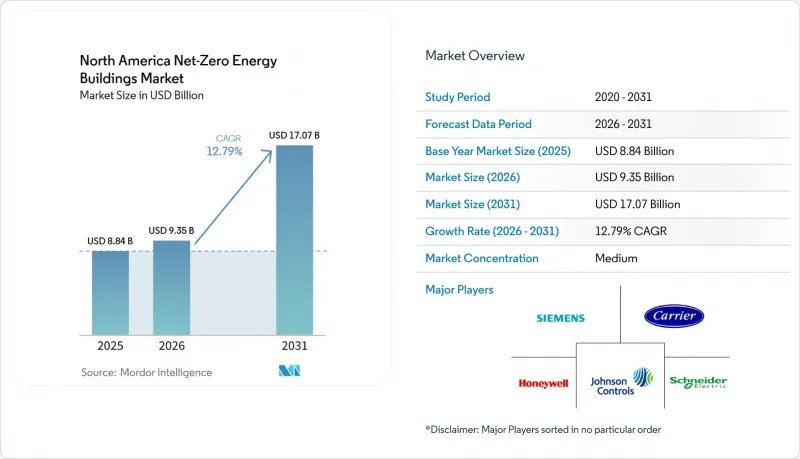
This report is Segmented by Building Type (Residential, Commercial, Institutional, Industrial), Offerings (Solutions, Services), Construction Type (New Construction, Renovation), and Geography (United States, Canada, Mexico). The Market Forecasts are Provided in Terms of Value (USD).
North America Net-Zero Energy Buildings Market Trends and Insights
Stringent Energy Codes and Net-Zero Performance Targets
Energy codes are raising the level of building performance that owners must meet in the North American net-zero energy buildings market. Canada's National Energy Code of Canada for Buildings 2025 introduced operational greenhouse gas performance tiers and energy-use pathways, giving provinces a common route toward lower-carbon construction. The code structure allows provinces to set their own adoption pace while preserving a common technical direction. In the United States, updated energy codes and state building performance rules are making high-efficiency mechanical systems, envelope upgrades, and measurement practices more central to project design. Developers that operate in several jurisdictions must plan for uneven adoption schedules and different documentation requirements. This favors firms with capabilities in code, engineering, and commissioning across multiple states and provinces.
Deep Energy Retrofit Incentives
Financial incentives have supported the retrofit pipeline in the North America net-zero energy buildings market, especially for large commercial and institutional properties. The U.S. federal framework has encouraged owners to assess energy upgrades alongside planned capital replacements, rather than treating efficiency work as a separate project. Incentive programs also increase demand for energy modeling and certification because owners need documentation to qualify for support. Public procurement has helped suppliers build experience with low-carbon materials, advanced controls, and performance verification. The scheduled change to some federal incentives after June 2026 may bring forward projects already under development. It also makes stable state, utility, and private financing programs more important for maintaining future renovation activity.
High Upfront Capital Costs and Long Payback Periods
Whole-building retrofits can require envelope work, mechanical replacement, electrical upgrades, and controls at the same time. This creates a high initial cost for the North America net-zero energy buildings market, particularly where cold-climate upgrades require extensive insulation and air-sealing measures. Some owners have difficulty approving projects with payback periods longer than their usual capital planning cycle. Smaller commercial owners also may not have the staff to navigate complex incentive and financing programs. Property Assessed Clean Energy financing and utility financing can help, but their availability differs by jurisdiction. As a result, large institutions and corporate portfolios can move sooner than smaller owners with similar building needs.
Other drivers and restraints analyzed in the detailed report include:
- Electrification of Space Heating and Cooling
- Corporate Portfolio Decarbonization
- Skilled Labor and Commissioning Capacity Shortages
For complete list of drivers and restraints, kindly check the Table Of Contents.
Segment Analysis
Commercial buildings held 46.8% of the North America net-zero energy buildings market in 2025, supported by office, logistics, and retail retrofit activity. Corporate occupiers in these properties are increasingly asking for carbon data and energy performance evidence as part of leasing and procurement. Institutional buildings are forecast to expand at a 13.9% CAGR through 2031, the fastest rate among building types. Hospitals, universities, and government facilities often have long operating lives and public commitments that support major capital programs. UCI Health opened its all-electric acute care hospital in Irvine, California, in December 2025, using on-site solar and renewable grid electricity. The project shows that a high-energy-use healthcare facility can adopt an all-electric design.
Residential buildings remain harder to address because ownership is fragmented and project-level technical support is limited. Industrial demand is growing in Mexico, where nearshoring-related construction must meet the requirements of multinational tenants. The North America net-zero energy buildings industry also benefits when institutional procurement creates repeatable specifications for suppliers and contractors. Cowichan District Hospital in British Columbia earned the Canada Green Building Council's Zero Carbon Building Design Standard certification in 2025. Such projects provide reference points for healthcare owners assessing electrification and low-carbon design. Across building types, the most durable opportunity lies in projects that pair operational targets with long-term maintenance and verification.
Complete Report Scope:
- By Building Type
- Residential
- Commercial
- Institutional
- Industrial
- By Offerings
- Solutions (New Net-Zero Energy Building Development, Net-Zero Building Retrofit, Integrated Design & Delivery and Smart Net-Zero Building Solutions)
- Services (Architectural & Engineering Design, Construction Services, Commissioning & Certification Services and Consulting Services)
- By Construction Type
- New Construction
- Renovation
- By Country
- United States
- Canada
- Mexico
List of Companies Covered in this Report:
- Johnson Controls International plc
- Schneider Electric SE
- Siemens AG
- Honeywell International Inc.
- Carrier Global Corporation
- Trane Technologies plc
- Daikin Industries Ltd.
- Mitsubishi Electric Corporation
- ABB Ltd.
- Eaton Corporation plc
- Legrand SA
- Robert Bosch GmbH
- Saint-Gobain
- Kingspan Group plc
- ROCKWOOL A/S
- Owens Corning
- Lutron Electronics Co., Inc.
- Signify N.V.
- Canadian Solar Inc.
- Integrated Environmental Solutions Ltd.
Additional Benefits:
- The market estimate (ME) sheet in Excel format
- 3 months of analyst support
TABLE OF CONTENTS
1 Introduction
- 1.1 Study Assumptions and Market Definition
- 1.2 Scope of the Study
2 Research Methodology
3 Executive Summary
4 Market Insights and Dynamics
- 4.1 Market Overview
- 4.2 Market Drivers
- 4.2.1 Stringent Energy Codes and Net-Zero Performance Targets
- 4.2.2 Deep Energy Retrofit Incentives
- 4.2.3 Electrification of Space Heating and Cooling
- 4.2.4 Corporate Portfolio Decarbonization
- 4.2.5 Grid-Interactive Building Demand Response
- 4.2.6 Cold-Climate Envelope and Heat Pump Innovation
- 4.3 Market Restraints
- 4.3.1 High Upfront Capital Costs and Long Payback Periods
- 4.3.2 Skilled Labor and Commissioning Capacity Shortages
- 4.3.3 Fragmented State, Provincial, and Municipal Regulations
- 4.3.4 Interoperability, Cybersecurity, and Performance Verification Risks
- 4.4 Value and Supply-Chain Analysis
- 4.5 Regulatory Landscape
- 4.6 Technological Outlook
- 4.7 Market Evolution and Adoption Trends
- 4.8 Key Net-Zero Energy Building Projects
- 4.9 Porter's Five Forces Analysis
- 4.9.1 Bargaining Power of Suppliers
- 4.9.2 Bargaining Power of Consumers
- 4.9.3 Threat of New Entrants
- 4.9.4 Threat of Substitutes
- 4.9.5 Intensity of Competitive Rivalry
5 Market Size & Growth Forecasts (Value, USD)
- 5.1 By Building Type
- 5.1.1 Residential
- 5.1.2 Commercial
- 5.1.3 Institutional
- 5.1.4 Industrial
- 5.2 By Offerings
- 5.2.1 Solutions (New Net-Zero Energy Building Development, Net-Zero Building Retrofit, Integrated Design & Delivery and Smart Net-Zero Building Solutions)
- 5.2.2 Services (Architectural & Engineering Design, Construction Services, Commissioning & Certification Services and Consulting Services)
- 5.3 By Construction Type
- 5.3.1 New Construction
- 5.3.2 Renovation
- 5.4 By Country
- 5.4.1 United States
- 5.4.2 Canada
- 5.4.3 Mexico
6 Competitive Landscape
- 6.1 Market Concentration
- 6.2 Strategic Moves
- 6.3 Market Share Analysis
- 6.4 Company Profiles (Includes Global Level Overview, Market Level Overview, Core Segments, Financials as Available, Strategic Information, Products & Services, and Recent Developments)
- 6.4.1 Johnson Controls International plc
- 6.4.2 Schneider Electric SE
- 6.4.3 Siemens AG
- 6.4.4 Honeywell International Inc.
- 6.4.5 Carrier Global Corporation
- 6.4.6 Trane Technologies plc
- 6.4.7 Daikin Industries Ltd.
- 6.4.8 Mitsubishi Electric Corporation
- 6.4.9 ABB Ltd.
- 6.4.10 Eaton Corporation plc
- 6.4.11 Legrand SA
- 6.4.12 Robert Bosch GmbH
- 6.4.13 Saint-Gobain
- 6.4.14 Kingspan Group plc
- 6.4.15 ROCKWOOL A/S
- 6.4.16 Owens Corning
- 6.4.17 Lutron Electronics Co., Inc.
- 6.4.18 Signify N.V.
- 6.4.19 Canadian Solar Inc.
- 6.4.20 Integrated Environmental Solutions Ltd.
7 Market Opportunities & Future Outlook
- 7.1 White-Space and Unmet-Need Assessment

