PUBLISHER: Mordor Intelligence | PRODUCT CODE: 2118886

PUBLISHER: Mordor Intelligence | PRODUCT CODE: 2118886
Metal Injection Molding - Market Share Analysis, Industry Trends & Statistics, Growth Forecasts (2026 - 2031)
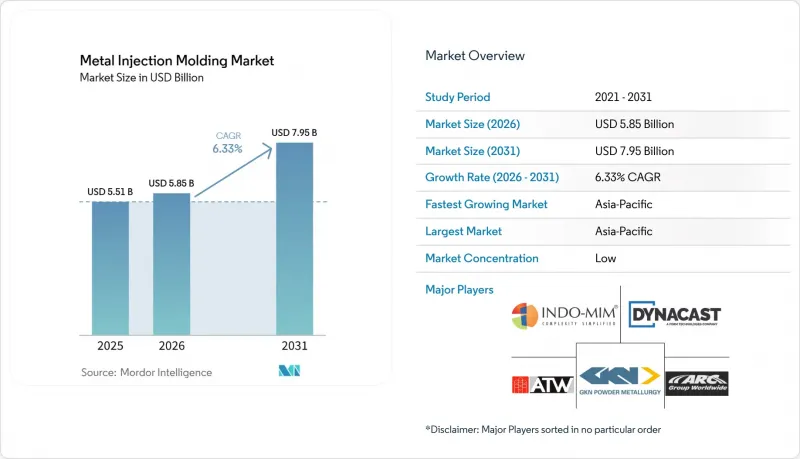
According to Mordor Intelligence, the metal injection molding market was valued at USD 5.51 billion in 2025 and is estimated to grow from USD 5.85 billion in 2026 to reach USD 7.95 billion by 2031, at a CAGR of 6.33% during the forecast period (2026-2031).
This report is Segmented by Material Type (Stainless Steel, Low Alloy Steel, Carbon Steel, and More), Application (Structural Components, Precision Mechanical Components, and More), End-Use Industry (Automotive, Medical and Healthcare, and More), and Geography (Asia-Pacific, North America, Europe, South America, and Middle-East and Africa). The Market Forecasts are Provided in Terms of Value (USD).
Global Metal Injection Molding Market Trends and Insights
Growing Demand for Miniaturized and High-Precision Metal Components
Miniaturization is changing the range of metal parts that can be produced in volume. Metal injection molding can make sub-gram and sub-millimeter components while retaining the repeatability needed for commercial programs. Compact wearables, smartphones, and dense electronic assemblies have increased demand for internal structural hardware with small and complex forms. The same design direction affects catheter hardware and implantable sensors, where biocompatibility and small dimensions are both required. Suppliers that improve tolerance control, surface finish, and dimensional repeatability can address requirements that alternative processes may not meet at comparable production volumes.
Increasing Replacement of Conventionally Machined Parts with Net-Shape Metal Injection Molded Components
Net-shape production can reduce the number of machining steps for suitable complex parts. This advantage matters most when production volumes can absorb tooling costs and when material waste from machining is significant. Metal injection molding supports housings, brackets, actuators, and other parts that require repeatable geometry. It also gives manufacturers a route to combine functions into a single molded component instead of assembling several machined pieces. The approach is relevant in North America, Europe, and the Asia-Pacific region, where automotive, industrial, medical, and consumer products require high production consistency. Its adoption is limited by the need to validate feedstock, tooling, sintering behavior, and final dimensions before series production begins.
High Costs Associated with Metal Powder Feedstock and Material Qualification
Metal powder feedstock represents 70-85% of the total MIM feedstock cost. Standard stainless steel grades such as 316L and 17-4 PH cost USD 20-40 per kilogram, while titanium Ti-6Al-4V costs USD 50-80 per kilogram, and aerospace grades can exceed USD 100 per kilogram. New powder lots for medical or aerospace programs require 8-12 weeks of traceability testing and lot-acceptance validation. Nickel and titanium price changes can complicate long-term pricing commitments for suppliers and their customers. Indo-MIM is constructing an iron powder facility in Gowribidanur, Karnataka, for an FY2027 launch, which supports its plan for greater supply-chain control. Pure converters without powder production capabilities may find it harder to match the cost position of integrated suppliers.
Other drivers and restraints analyzed in the detailed report include:
- Rising Adoption of Metal Injection Molding for Complex Medical Device Components
- Increasing Demand for High-Precision Components in Defense and Firearms Applications and Growing Use in Electric Vehicle Components
- Dimensional Control Challenges Due to Sintering Shrinkage
For complete list of drivers and restraints, kindly check the Table Of Contents.
Segment Analysis
Stainless steel accounted for 53.18% of global revenue by value in 2025. Its use reflects corrosion resistance, biocompatibility, and familiarity with 316L and 17-4 PH grades. These grades are used in automotive sensor housings, medical instruments, firearms components, consumer electronics hinges, and industrial actuators. Research published in 2026 found that MIM SS316L made with agar binder systems achieved mechanical properties consistent with wrought equivalents. Low-alloy steels serve transmission and driveline applications where wear resistance and cost remain important.
Titanium alloys are forecast to grow at a 7.92% CAGR through 2031, making them the fastest-growing material group in the metal injection molding market. A 2025 study reported tensile strengths of 900-1,100 MPa for a MIM beta titanium alloy with 0.5 wt% graphite, bringing its performance closer to wrought specifications. Hydride-dehydride powder processing has improved the cost case against gas-atomized powder. Soft magnetic Fe-Si, Fe-Co, and Fe-Ni alloys are also gaining attention in motors and actuators as vehicle electrification expands. Cobalt alloys remain relevant for orthopedic wear surfaces, tungsten alloys for radiation shielding, and carbon steel for secondary structural programs.
Complete Report Scope:
- By Material Type
- Stainless Steel
- Low Alloy Steel
- Soft Magnetic Alloys
- Carbon Steel
- Titanium Alloys
- Cobalt Alloys
- Tool Steel
- Tungsten Alloys
- Other Material Types
- By Application
- Structural Components
- Precision Mechanical Components
- Wear-Resistant Parts
- Miniature Components
- Surgical and Orthopedic Components
- Electronic Components
- Decorative Components
- Other Applications
- By End-Use Industry
- Automotive
- Medical and Healthcare
- Electrical and Electronics
- Industrial Machinery
- Aerospace and Defense
- Firearms
- Consumer Products
- Luxury Goods and Jewelry
- Other End-Use Industries
- By Geography
- Asia-Pacific
- China
- India
- Japan
- South Korea
- Rest of Asia-Pacific
- North America
- United States
- Canada
- Mexico
- Europe
- Germany
- United Kingdom
- France
- Italy
- Russia
- Rest of Europe
- South America
- Brazil
- Argentina
- Rest of South America
- Middle-East and Africa
- Saudi Arabia
- South Africa
- Rest of Middle-East and Africa
- Asia-Pacific
Geography Analysis
Asia-Pacific held 46.39% of the global metal injection molding market share in 2025 and is forecast to grow at a 6.93% CAGR through 2031. MIM content per new energy vehicle in China is more than 20% higher by part count than in comparable internal combustion vehicles. India is becoming an important production location, and Indo-MIM began operations at its Chennai plant in 2025. Japan and South Korea contribute precision-grade capacity for medical device and semiconductor equipment hardware.
North America has high-value demand for medical devices, defense, and firearms. These applications typically have higher per-part margins than consumer electronics or commodity automotive programs. European demand is supported by Germany's automotive and industrial machinery base. AFT-Hungary reported fivefold growth in firearm MIM component volumes for NATO customers in April 2026. The company's activity indicates a growing defense-focused cluster in Eastern Europe.
South America, and Middle-East and Africa remain smaller development areas for the metal injection molding market. Brazil and Argentina have demand through automotive parts manufacturing and industrial equipment supply chains. The Middle-East is developing as a customer base through defense modernization in Saudi Arabia and precision engineering investment in the UAE. South Africa provides an early demand base through mining and automotive activity.
- Advanced Powder Products
- ARC Group Worldwide
- ATW Companies
- Dean Group International
- Dynacast
- Epson Atmix Corporation
- GKN Powder Metallurgy
- Greene Group Industries, Inc. (Britt Manufacturing)
- INDO-MIM
- Kinetics Climax
- Ningbo JX Advanced Metals Co., Ltd.
- Rockleigh Industries
- Schunk Sintermetalltechnik GmbH
- Sintex
- Smith Metal Products
Additional Benefits:
- The market estimate (ME) sheet in Excel format
- 3 months of analyst support
TABLE OF CONTENTS
1 Introduction
- 1.1 Study Assumptions and Market Definition
- 1.2 Scope of the Study
2 Research Methodology
3 Executive Summary
4 Market Landscape
- 4.1 Market Overview
- 4.2 Market Drivers
- 4.2.1 Growing Demand for Miniaturized and High-Precision Metal Components
- 4.2.2 Increasing Replacement of Conventionally Machined Parts with Net-Shape Metal Injection Molded Components
- 4.2.3 Rising Adoption of Metal Injection Molding for Complex Medical Device Components
- 4.2.4 Increasing Demand for High-Precision Components in Defense and Firearms Applications
- 4.2.5 Growing Use of Metal Injection Molding in Electric Vehicle (EV) and Electrified Powertrain Components
- 4.3 Market Restraints
- 4.3.1 High Costs Associated with Metal Powder Feedstock and Material Qualification
- 4.3.2 Dimensional Control Challenges Due to Sintering Shrinkage
- 4.3.3 Lengthy Product Qualification and Regulatory Approval Processes in Medical and Defense Applications
- 4.4 Value Chain Analysis
- 4.5 Porter's Five Forces Analysis
- 4.5.1 Threat of New Entrants
- 4.5.2 Bargaining Power of Suppliers
- 4.5.3 Bargaining Power of Buyers
- 4.5.4 Threat of Substitutes
- 4.5.5 Competitive Rivalry
5 Market Size and Growth Forecasts (Value)
- 5.1 By Material Type
- 5.1.1 Stainless Steel
- 5.1.2 Low Alloy Steel
- 5.1.3 Soft Magnetic Alloys
- 5.1.4 Carbon Steel
- 5.1.5 Titanium Alloys
- 5.1.6 Cobalt Alloys
- 5.1.7 Tool Steel
- 5.1.8 Tungsten Alloys
- 5.1.9 Other Material Types
- 5.2 By Application
- 5.2.1 Structural Components
- 5.2.2 Precision Mechanical Components
- 5.2.3 Wear-Resistant Parts
- 5.2.4 Miniature Components
- 5.2.5 Surgical and Orthopedic Components
- 5.2.6 Electronic Components
- 5.2.7 Decorative Components
- 5.2.8 Other Applications
- 5.3 By End-Use Industry
- 5.3.1 Automotive
- 5.3.2 Medical and Healthcare
- 5.3.3 Electrical and Electronics
- 5.3.4 Industrial Machinery
- 5.3.5 Aerospace and Defense
- 5.3.6 Firearms
- 5.3.7 Consumer Products
- 5.3.8 Luxury Goods and Jewelry
- 5.3.9 Other End-Use Industries
- 5.4 By Geography
- 5.4.1 Asia-Pacific
- 5.4.1.1 China
- 5.4.1.2 India
- 5.4.1.3 Japan
- 5.4.1.4 South Korea
- 5.4.1.5 Rest of Asia-Pacific
- 5.4.2 North America
- 5.4.2.1 United States
- 5.4.2.2 Canada
- 5.4.2.3 Mexico
- 5.4.3 Europe
- 5.4.3.1 Germany
- 5.4.3.2 United Kingdom
- 5.4.3.3 France
- 5.4.3.4 Italy
- 5.4.3.5 Russia
- 5.4.3.6 Rest of Europe
- 5.4.4 South America
- 5.4.4.1 Brazil
- 5.4.4.2 Argentina
- 5.4.4.3 Rest of South America
- 5.4.5 Middle-East and Africa
- 5.4.5.1 Saudi Arabia
- 5.4.5.2 South Africa
- 5.4.5.3 Rest of Middle-East and Africa
- 5.4.1 Asia-Pacific
6 Competitive Landscape
- 6.1 Market Concentration
- 6.2 Strategic Moves
- 6.3 Market Share (%)/Ranking Analysis
- 6.4 Company Profiles (includes Global Overview, Market Overview, Core Segments, Financials as available, Strategic Information, Products and Services, and Recent Developments)
- 6.4.1 Advanced Powder Products
- 6.4.2 ARC Group Worldwide
- 6.4.3 ATW Companies
- 6.4.4 Dean Group International
- 6.4.5 Dynacast
- 6.4.6 Epson Atmix Corporation
- 6.4.7 GKN Powder Metallurgy
- 6.4.8 Greene Group Industries, Inc. (Britt Manufacturing)
- 6.4.9 INDO-MIM
- 6.4.10 Kinetics Climax
- 6.4.11 Ningbo JX Advanced Metals Co., Ltd.
- 6.4.12 Rockleigh Industries
- 6.4.13 Schunk Sintermetalltechnik GmbH
- 6.4.14 Sintex
- 6.4.15 Smith Metal Products
7 Market Opportunities and Future Outlook
- 7.1 White-Space and Unmet-Need Assessment

