PUBLISHER: Mordor Intelligence | PRODUCT CODE: 2118914

PUBLISHER: Mordor Intelligence | PRODUCT CODE: 2118914
Asia-Pacific Urban Design - Market Share Analysis, Industry Trends & Statistics, Growth Forecasts (2026 - 2031)
According to Mordor Intelligence, the Asia-Pacific urban design market size is expected to increase from USD 35.80 billion in 2025 to USD 38.10 billion in 2026 and reach USD 58.80 billion by 2031, growing at a CAGR of 9.06% over 2026-2031.
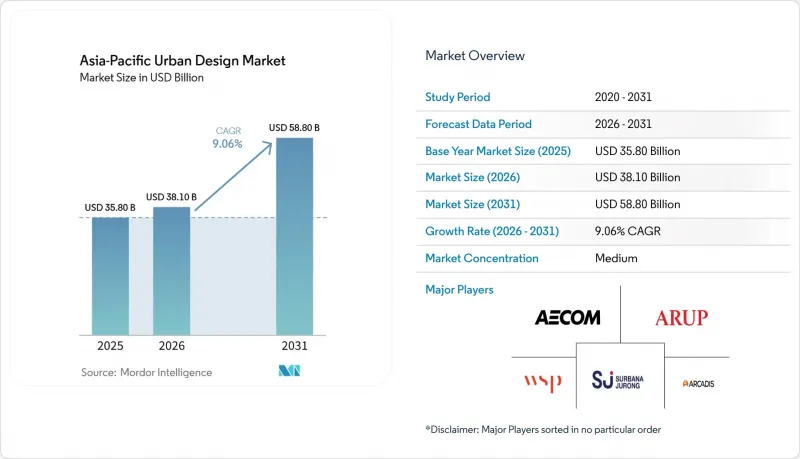
This report is Segmented by Type (Master Planning and Land-Use Planning, Urban Design, Public Realm and Landscape Design, and More), Sector (Mixed-Use and Township Developments, Transportation and Infrastructure, and More), Investor Type (Public, Private), and Country (China, India, Japan, South Korea, Australia, and Rest of Asia-Pacific). The Market Forecasts are Provided in Terms of Value (USD).
Asia-Pacific Urban Design Market Trends and Insights
Rapid Metropolitan Population Growth
The Asia-Pacific urban design market benefits from the concentration of large urban populations across the region. Asia and the Pacific contains 19 of the world's 33 megacities, while Jakarta had nearly 42 million residents and Dhaka approached 40 million residents in 2025. Smaller and medium-sized cities in South and Southeast Asia are also growing faster than several established megacities. This broadens demand beyond capital cities and creates commissions in secondary urban centers that have received less professional planning support. Higher density encourages mixed-use development, transit-oriented design, and public realm improvements, rather than relying solely on conventional land-use mapping. These assignments require wider coordination between transport agencies, local authorities, developers, and communities.
Metro, Rail and Urban Infrastructure Expansion
Transport investment supports a growing part of the Asia-Pacific urban design market. Rail corridors create demand for station-area planning, transit-oriented development, urban design, and land-use changes around new stations. India's metro systems operated across 23 cities in 2026, which indicates the breadth of planning work associated with metropolitan transport expansion. AECOM and AtkinsRealis received a July 2025 consultancy award for the Hong Kong section of the Hong Kong-Shenzhen Western Rail Link. Large rail projects also create related work in utilities, public space, social infrastructure, and development controls. The resulting commissions can extend beyond construction because authorities need long-term land-use and access management around transport assets.
Land Acquisition and Resettlement Challenges
Land acquisition and resettlement issues can delay the start of major projects in the Asia-Pacific urban design market. Research from Utrecht University documented contestation around land authority and customary land rights in Indonesia's Nusantara capital project. Delays can leave specialist teams committed to anticipated work without the expected project revenue. Secondary cities can also lack the planning and regulatory capacity needed to move complex schemes through the approval process. Climate exposure increases design requirements in coastal and flood-prone locations, including Bangkok, Jakarta, Manila, and cities in Bangladesh, Vietnam, and the Philippines. Flood resilience, drainage, heat management, and nature-based buffers add scope, but they can also increase coordination needs and extend approval periods.
Other drivers and restraints analyzed in the detailed report include:
- New-City and New-Town Programs
- Smart-City and Digital Urban Planning Adoption
- Uneven Planning and Regulatory Capacity
For complete list of drivers and restraints, kindly check the Table Of Contents.
Segment Analysis
Master Planning and Land-Use Planning held 34.7% of the Asia-Pacific urban design market share in 2025. It remains the revenue base because large cities, townships, and regeneration assignments need an agreed spatial framework before detailed design work can progress. These contracts often have long delivery periods because they cover land use, infrastructure, development stages, regulatory alignment, and implementation arrangements. Transportation and Mobility Planning is projected to record the highest CAGR of 10.0% between 2026 and 2031. Transport assignments are expanding as metropolitan authorities connect rail investment with land-use changes and development around stations. The service type is gaining from metro and rail programs in India, Vietnam, Indonesia, and the Philippines. Rail corridors require coordinated work on access, public space, density, parking, utility needs, and development control.
Urban Design, Public Realm and Landscape Design is becoming more important where clients seek climate-responsive places that also support daily movement and community use. Hassell and SOM presented the master plan and concept design for Bradfield City's First Land Release in February 2026. The plan combines density, multimodal transport, Indigenous Country principles, and links to the Sydney Metro Western Sydney Airport line. Zoning, Development Control and Implementation Advisory also provides recurring work in places where urban renewal projects require continued compliance and approval support. The Others category includes heritage planning, climate resilience assessment, and informal settlement upgrading. UNESCAP estimated that nearly 600 million people in Asia and the Pacific lived in slum or informal conditions, supporting the relevance of these specialized assignments.
Complete Report Scope:
- By Type
- Master Planning and Land-Use Planning
- Urban Design, Public Realm and Landscape Design
- Transportation and Mobility Planning
- Zoning, Development Control and Implementation Advisory
- Others
- By Sector
- Mixed-Use and Township Developments
- Transportation and Infrastructure
- Public, Civic and Institutional Developments
- Others
- By Investor Type
- Public
- Private
- By Geography
- China
- India
- Japan
- South Korea
- Australia
- Indonesia
- Rest of Asia-Pacific
List of Companies Covered in this Report:
- Surbana Jurong Private Limited
- AECOM
- Arup Group Limited
- WSP Global Inc.
- Arcadis N.V.
- Stantec Inc.
- Nikken Sekkei Ltd.
- DP Architects Pte Ltd
- WOHA Architects Pte. Ltd.
- Hassell Limited
- PTI Architecture
- Gensler
- Foster + Partners
- Skidmore, Owings & Merrill LLP
- Lendlease Group
Additional Benefits:
- The market estimate (ME) sheet in Excel format
- 3 months of analyst support
TABLE OF CONTENTS
1 INTRODUCTION
- 1.1 Study Assumptions and Market Definition
- 1.2 Scope of the Study
2 RESEARCH METHODOLOGY
3 EXECUTIVE SUMMARY
4 MARKET LANDSCAPE
- 4.1 Market Overview
- 4.2 Market Drivers
- 4.2.1 Rapid Metropolitan Population Growth
- 4.2.2 Metro, Rail and Urban Infrastructure Expansion
- 4.2.3 New-City and New-Town Programs
- 4.2.4 Smart-City and Digital Urban Planning Adoption
- 4.2.5 Affordable Housing and Planned Communities
- 4.3 Market Restraints
- 4.3.1 Land Acquisition and Resettlement Challenges
- 4.3.2 Uneven Planning and Regulatory Capacity
- 4.3.3 Climate and Disaster Exposure
- 4.3.4 Shortage of Qualified Urban Planning Professionals
- 4.4 Value Chain Analysis
- 4.5 Regulatory Landscape
- 4.6 Technological Outlook
- 4.7 Porter's Five Forces Analysis
- 4.7.1 Bargaining Power of Suppliers
- 4.7.2 Bargaining Power of Buyers
- 4.7.3 Threat of New Entrants
- 4.7.4 Threat of Substitutes
- 4.7.5 Competitive Rivalry
5 MARKET SIZE AND GROWTH FORECASTS
- 5.1 By Type
- 5.1.1 Master Planning and Land-Use Planning
- 5.1.2 Urban Design, Public Realm and Landscape Design
- 5.1.3 Transportation and Mobility Planning
- 5.1.4 Zoning, Development Control and Implementation Advisory
- 5.1.5 Others
- 5.2 By Sector
- 5.2.1 Mixed-Use and Township Developments
- 5.2.2 Transportation and Infrastructure
- 5.2.3 Public, Civic and Institutional Developments
- 5.2.4 Others
- 5.3 By Investor Type
- 5.3.1 Public
- 5.3.2 Private
- 5.4 By Geography
- 5.4.1 China
- 5.4.2 India
- 5.4.3 Japan
- 5.4.4 South Korea
- 5.4.5 Australia
- 5.4.6 Indonesia
- 5.4.7 Rest of Asia-Pacific
6 COMPETITIVE LANDSCAPE
- 6.1 Market Concentration
- 6.2 Strategic Moves
- 6.3 Company Profiles (includes Global Level Overview, Market Level Overview, Core Segments, Financials as available, Strategic Information, Market Rank/Share, Products and Services, Recent Developments)
- 6.3.1 Surbana Jurong Private Limited
- 6.3.2 AECOM
- 6.3.3 Arup Group Limited
- 6.3.4 WSP Global Inc.
- 6.3.5 Arcadis N.V.
- 6.3.6 Stantec Inc.
- 6.3.7 Nikken Sekkei Ltd.
- 6.3.8 DP Architects Pte Ltd
- 6.3.9 WOHA Architects Pte. Ltd.
- 6.3.10 Hassell Limited
- 6.3.11 PTI Architecture
- 6.3.12 Gensler
- 6.3.13 Foster + Partners
- 6.3.14 Skidmore, Owings & Merrill LLP
- 6.3.15 Lendlease Group
7 MARKET OPPORTUNITIES AND FUTURE OUTLOOK
- 7.1 White-space and Unmet-Need Assessment

