PUBLISHER: Mordor Intelligence | PRODUCT CODE: 2119055

PUBLISHER: Mordor Intelligence | PRODUCT CODE: 2119055
Middle East and Africa Urban Design - Market Share Analysis, Industry Trends & Statistics, Growth Forecasts (2026 - 2031)
According to Mordor Intelligence, the Middle East and Africa urban design market size is projected to expand from USD 5.10 billion in 2025 and USD 5.5 billion in 2026 to USD 8.80 billion by 2031, registering a CAGR of 9.90% between 2026 to 2031.
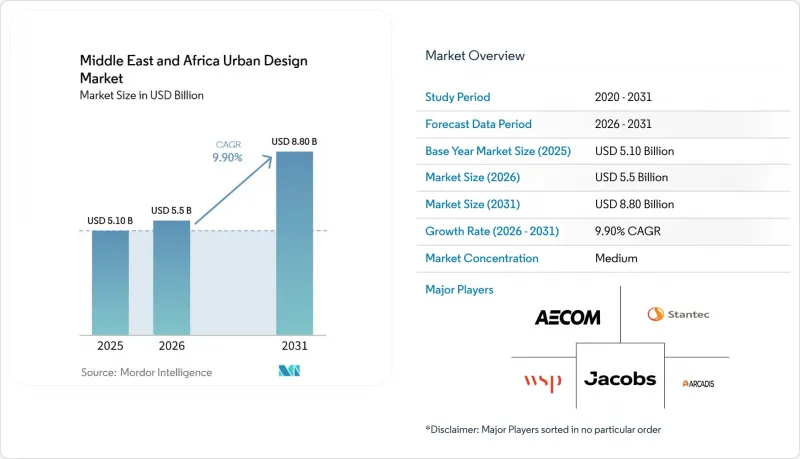
This report is Segmented by Type (Master Planning and Land-Use Planning, Urban Design, Public Realm and Landscape Design, and More), Sector (Mixed-Use and Township Developments, Transportation and Infrastructure, and More), Investor Type (Public, Private), and Coutnry (United Arab Emirates, Saudi Arabia, Turkey, and More). The Market Forecasts are Provided in Terms of Value (USD).
Middle East and Africa Urban Design Market Trends and Insights
Rapid Metropolitan Population Growth
Africa's urban population is projected to double from 700 million to 1.4 billion by 2050, raising the need for housing, services, and connected public spaces. The growth is not limited to large metropolitan areas because many small and medium-sized settlements also need formal land-use plans and basic infrastructure. The United Nations reported that 96% of the world's cities have fewer than 1 million residents, underscoring the need for greater attention in planning programs for smaller cities. Many of these locations have limited local capacity to commission or manage complex design work. UN-Habitat's 2025 to 2035 action plan for Kafr El-Battikh shows how technical assistance can connect local demand with a workable planning framework. The Middle East and Africa urban design market can therefore benefit when firms combine commercial delivery with multilateral and public-sector funding channels.
New-City and New-Town Programs
Saudi Arabia and Egypt continue to use new-city programs to accommodate population growth and concentrate infrastructure investment. Riyadh's preliminary plan for a 456-square-kilometer northeast expansion establishes a phased framework for housing, services, green areas, and valley preservation. Egypt's 2026 to 2027 development plan aims to increase habitable land from 7% to 14% of the country's total land area by 2030. These programs create repeated planning requirements as districts move from land allocation to infrastructure and detailed design. The Middle East and Africa urban design market is moving toward more phased and commercially tested precincts as sponsors refine large development programs. This change raises the importance of firms that can prepare implementation-ready plans and coordinate multiple disciplines. Digital planning tools can also strengthen design review, data sharing, and monitoring as programs become more complex.
Land Acquisition and Resettlement Challenges
Land acquisition can delay urban projects where customary ownership overlaps with formal property systems. Delays are most difficult in locations with incomplete land records or unresolved infrastructure responsibilities. Even in Gulf markets, redevelopment in established districts can require resettlement and changes to project phasing. These issues reduce certainty for master planning teams because design scope often depends on when land becomes available. The constraint is particularly important for Master Planning and Land-Use Planning because this service begins before many later project packages. The Middle East and Africa urban design market therefore needs clearer land coordination and early stakeholder engagement to convert announced investment into delivered projects.
Other drivers and restraints analyzed in the detailed report include:
- Metro, Rail and Urban Infrastructure Expansion
- Affordable Housing and Planned Communities
- Uneven Planning and Regulatory Capacity
For complete list of drivers and restraints, kindly check the Table Of Contents.
Segment Analysis
Master Planning and Land-Use Planning accounted for 35.2% of 2025 revenue, giving it the largest share in the Middle East and Africa urban design market. Large urban districts begin with land-use, infrastructure, public realm, and delivery plans that guide subsequent construction packages. Riyadh's northeast expansion framework demonstrates the scale of work created by long-term city growth programs, while projects released in phases keep planning teams involved as land and infrastructure become available. Zoning, development control, and implementation advisory are becoming more important as planning rules become more formal and developers need support throughout approval and delivery. The category, therefore, benefits from both early project definition and the recurring requirements of phased implementation.
Urban Design, Public Realm, and Landscape Design is the fastest-growing type at a 10.9% CAGR through 2031. Governments and developers increasingly treat public space as a part of residential quality, tourism, and place identity. AtkinsRealis and Futurecity formed the Futurecity Lab in February 2026 to bring cultural foresight and people-centered design into urban development programs. Transportation and mobility planning is also gaining work from station precincts, mobility corridors, and last-mile networks, while other services include urban economics, heritage conservation, and environmental assessment. These smaller fields remain relevant to historic districts and complex mixed-use destinations.
Complete Report Scope:
- By Type
- Master Planning and Land-Use Planning
- Urban Design, Public Realm and Landscape Design
- Transportation and Mobility Planning
- Zoning, Development Control and Implementation Advisory
- Others
- By Sector
- Mixed-Use and Township Developments
- Transportation and Infrastructure
- Public, Civic and Institutional Developments
- Others
- By Investor Type
- Public
- Private
- By Countries
- United Arab Emirates
- Saudi Arabia
- Turkey
- South Africa
- Egypt
- Rest of Middle East
List of Companies Covered in this Report:
- AECOM
- Jacobs Solutions Inc.
- WSP Global Inc.
- Arcadis N.V.
- Stantec Inc.
- HDR, Inc.
- AtkinsRealis Group Inc.
- Ramboll Group A/S
- Arup Group Limited
- Gensler
- HOK
- Perkins&Will
- Sasaki Associates, Inc.
- Gehl People ApS
- Surbana Jurong Private Limited
- Foster + Partners
- Skidmore, Owings & Merrill LLP
- Nikken Sekkei Ltd.
- DP Architects Pte Ltd
- Lendlease Group
Additional Benefits:
- The market estimate (ME) sheet in Excel format
- 3 months of analyst support
TABLE OF CONTENTS
1 INTRODUCTION
- 1.1 Study Assumptions and Market Definition
- 1.2 Scope of the Study
2 RESEARCH METHODOLOGY
3 EXECUTIVE SUMMARY
4 MARKET LANDSCAPE
- 4.1 Market Overview
- 4.2 Market Drivers
- 4.2.1 Rapid Metropolitan Population Growth
- 4.2.2 New-City and New-Town Programs
- 4.2.3 Metro, Rail and Urban Infrastructure Expansion
- 4.2.4 Affordable Housing and Planned Communities
- 4.2.5 Smart-City and Digital Urban Planning Adoption
- 4.3 Market Restraints
- 4.3.1 Land Acquisition and Resettlement Challenges
- 4.3.2 Uneven Planning and Regulatory Capacity
- 4.3.3 Climate and Disaster Exposure
- 4.3.4 Shortage of Qualified Urban Planning Professionals
- 4.4 Value Chain Analysis
- 4.5 Regulatory Landscape
- 4.6 Technological Outlook
- 4.7 Porter's Five Forces Analysis
- 4.7.1 Bargaining Power of Suppliers
- 4.7.2 Bargaining Power of Buyers
- 4.7.3 Threat of New Entrants
- 4.7.4 Threat of Substitutes
- 4.7.5 Competitive Rivalry
5 MARKET SIZE AND GROWTH FORECASTS
- 5.1 By Type
- 5.1.1 Master Planning and Land-Use Planning
- 5.1.2 Urban Design, Public Realm and Landscape Design
- 5.1.3 Transportation and Mobility Planning
- 5.1.4 Zoning, Development Control and Implementation Advisory
- 5.1.5 Others
- 5.2 By Sector
- 5.2.1 Mixed-Use and Township Developments
- 5.2.2 Transportation and Infrastructure
- 5.2.3 Public, Civic and Institutional Developments
- 5.2.4 Others
- 5.3 By Investor Type
- 5.3.1 Public
- 5.3.2 Private
- 5.4 By Countries
- 5.4.1 United Arab Emirates
- 5.4.2 Saudi Arabia
- 5.4.3 Turkey
- 5.4.4 South Africa
- 5.4.5 Egypt
- 5.4.6 Rest of Middle East
6 COMPETITIVE LANDSCAPE
- 6.1 Market Concentration
- 6.2 Strategic Moves
- 6.3 Company Profiles (includes Global Level Overview, Market Level Overview, Core Segments, Financials as available, Strategic Information, Market Rank/Share, Products and Services, Recent Developments)
- 6.3.1 AECOM
- 6.3.2 Jacobs Solutions Inc.
- 6.3.3 WSP Global Inc.
- 6.3.4 Arcadis N.V.
- 6.3.5 Stantec Inc.
- 6.3.6 HDR, Inc.
- 6.3.7 AtkinsRealis Group Inc.
- 6.3.8 Ramboll Group A/S
- 6.3.9 Arup Group Limited
- 6.3.10 Gensler
- 6.3.11 HOK
- 6.3.12 Perkins&Will
- 6.3.13 Sasaki Associates, Inc.
- 6.3.14 Gehl People ApS
- 6.3.15 Surbana Jurong Private Limited
- 6.3.16 Foster + Partners
- 6.3.17 Skidmore, Owings & Merrill LLP
- 6.3.18 Nikken Sekkei Ltd.
- 6.3.19 DP Architects Pte Ltd
- 6.3.20 Lendlease Group
7 MARKET OPPORTUNITIES AND FUTURE OUTLOOK
- 7.1 White-space and Unmet-Need Assessment

