PUBLISHER: Mordor Intelligence | PRODUCT CODE: 2118927

PUBLISHER: Mordor Intelligence | PRODUCT CODE: 2118927
Wolff Parkinson White Syndrome - Market Share Analysis, Industry Trends & Statistics, Growth Forecasts (2026 - 2031)
According to Mordor Intelligence, the wolff parkinson white syndrome market size is projected to be USD 1.27 billion in 2025, USD 1.34 billion in 2026, and reach USD 1.72 billion by 2031, growing at a CAGR of 5.22% from 2026 to 2031.
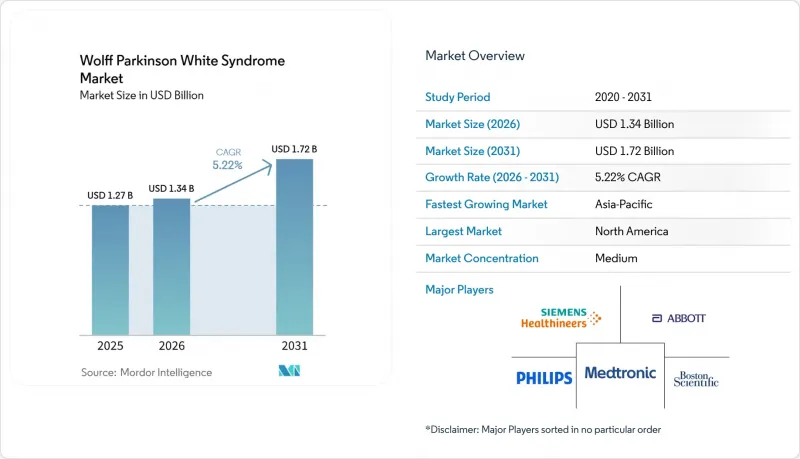
This report is Segmented by Type (Type A, Type B), Diagnosis (Resting ECG, Holter, EP Study, Echocardiography), Treatment (RFA, Cryoablation, Pharmacological, Cardioversion, Surgical, Pacemaker), Patient Demographics (Neonates and Infants, Children, Adults 18-64), End User (Hospitals, and More), and Geography (North America, Europe, Asia-Pacific, MEA, South America). Forecasts in Value (USD).
Global Wolff Parkinson White Syndrome Market Trends and Insights
First-Line Shift Toward Curative Catheter Ablation
Clinicians increasingly use catheter ablation as a first-line curative option for symptomatic patients, rather than reserving it for drug-refractory cases. Clinical guidance supports catheter ablation as a Class I treatment option for symptomatic Wolff-Parkinson-White syndrome, encouraging earlier referrals to electrophysiology specialists. A study of 1,239 patients reported a 94.2% acute procedural success rate, a 0.32% complete atrioventricular block rate, and a 2.42% recurrence rate after radiofrequency ablation. These outcomes strengthen the clinical and economic case for earlier intervention, while the Wolff-Parkinson-White syndrome market benefits as providers consider prophylactic ablation for asymptomatic patients with high-risk accessory pathway features. A systematic review also found that prophylactic catheter ablation reduced arrhythmia recurrence compared with conservative management, with a reported risk ratio of 0.27 and a 95% confidence interval of 0.09 to 0.82.
Broader ECG and Arrhythmia Case Finding
Greater use of ECG screening is increasing the identification of patients with previously undetected Wolff-Parkinson-White patterns. Resting ECG remains the standard entry point because it is widely available, relatively low cost, and can identify the characteristic delta wave. Screening programs among athletes, military personnel, pilots, and professional drivers can detect patients before serious rhythm-related events occur. Wearable devices and mobile ECG tools may support early identification, but clinicians still require formal cardiology assessment and conventional testing to confirm diagnosis, sustaining demand for resting ECG, ambulatory monitoring, exercise testing, echocardiography, and electrophysiology study services.
High Procedure Cost and Uneven Reimbursement
High catheter ablation costs can limit access in regions where reimbursement policies do not clearly cover Wolff-Parkinson-White syndrome as a standalone indication. Procedure costs include mapping-system use, single-use catheters, electrophysiology laboratory staffing, anesthesia, and post-procedure monitoring. In the United States, broader supraventricular tachycardia procedure codes can cover ablation, creating uncertainty for hospitals evaluating expensive mapping platforms. Cryoablation systems often cost more than standard radiofrequency systems, while varied reimbursement practices across Europe affect hospital purchasing decisions and patient access.
Other drivers and restraints analyzed in the detailed report include:
- 3D Mapping, High-Density Mapping, and Fluoroscopy Reduction
- Expansion of Electrophysiology Capacity in Emerging Markets
- Electrophysiologist and EP-Lab Capacity Shortage
For complete list of drivers and restraints, kindly check the Table Of Contents.
Segment Analysis
Type A accounted for 58.88% of the Wolff-Parkinson-White syndrome market share in 2025. Its lead reflected the clinical burden of left-sided accessory pathways, often located along the left lateral and posteroseptal mitral annulus. Clinicians commonly treated these pathways through transseptal or retrograde aortic access. Standard radiofrequency ablation eliminated left-lateral pathways in more than 90% of cases, making Type A a key demand source for catheters and mapping consumables.
Type B is projected to grow at a CAGR of 8.15% from 2026 to 2031. This segment includes right-sided pathways, such as parahisian and posteroseptal forms, which can be more complex due to their proximity to key conduction tissue. Fluoroscopy-free electroanatomical mapping reported a 97% acute success rate for right-sided accessory pathway ablation. Open-window mapping can reduce fluoroscopy time and radiofrequency delivery duration, while cryoablation can improve safety near the His bundle.
Resting electrocardiography represented 44.34% of diagnostic revenue in 2025. It remained the primary diagnostic tool due to wide use in general cardiology, primary care, occupational health, and emergency settings. ECG findings helped identify pre-excitation and guide further assessment, supporting the Wolff-Parkinson-White syndrome market size for diagnostic services. AI-assisted interpretation may support delta-wave detection, but formal clinical review remains necessary.
Electrophysiology study is expected to grow at a CAGR of 6.80% through 2031. Clinicians increasingly use it for risk stratification in athletes, pilots, and other high-risk occupational groups. Prophylactic ablation following electrophysiology assessment reduced arrhythmia recurrence in asymptomatic patients, while reported complications stood at 1%, including pneumothorax and access-site complications. Holter monitoring, stress testing, and echocardiography remain important for additional assessment, including structural conditions such as Ebstein's anomaly.
Complete Report Scope:
- By Type
- Type A
- Type B
- By Diagnosis
- Resting Electrocardiogram
- Ambulatory and Holter Monitoring
- Exercise Stress Testing
- Electrophysiology Study
- Echocardiography and Structural-Heart Assessment
- By Treatment
- Radiofrequency Catheter Ablation
- Cryoablation
- Pharmacological Therapy
- Electrical Cardioversion
- Surgical Ablation and Other Surgery
- Artificial Pacemaker and Adjunctive Rhythm Management
- By Patient Demographics
- Neonates and Infants
- Children and Adolescents
- Adults Aged 18-64 Years
- Adults Aged 65 Years and Older
- Male Patients and Female Patients
- By End User
- Hospitals
- Cardiac Specialty Centers
- Ambulatory Surgical Centers
- Academic and Research Institutions
- Emergency and Acute-Care Facilities
- By Geography
- North America
- United States
- Canada
- Mexico
- Europe
- Germany
- United Kingdom
- France
- Italy
- Spain
- Rest of Europe
- Asia-Pacific
- China
- India
- Japan
- Australia
- South Korea
- Rest of Asia-Pacific
- Middle East and Africa
- GCC
- South Africa
- Rest of Middle East and Africa
- South America
- Brazil
- Argentina
- Rest of South America
- North America
Geography Analysis
North America accounted for 39.89% of the Wolff-Parkinson-White syndrome market share in 2025. The United States led the region, supported by reimbursement coverage, electrophysiology laboratory density, and clinical guideline adoption that sustained procedure volumes. Established cardiology referral pathways included catheter ablation for symptomatic patients. In January 2026, Stereotaxis received FDA approval for its MAGiC catheter for cardiac mapping and endocardial lesion creation, and the first U.S. commercial procedures using the catheter were announced in April 2026. Canada contributed through academic health-sciences centers, while Mexico expanded through private healthcare investment in major cities.
Europe remained an important regional base for electrophysiology care and device adoption. Germany, the United Kingdom, and France recorded high procedure volumes and operated established electrophysiology laboratories, while Italy and Spain contributed through experienced single-center programs. European Medical Device Regulation requirements raised evidence and certification standards for manufacturers, favoring suppliers with strong post-market surveillance and regulatory compliance capabilities. Abbott received CE Mark for the TactiFlex Duo Ablation Catheter, Sensor Enabled, in January 2026, supporting its position in the European electrophysiology device field.
Asia-Pacific is projected to record the fastest regional growth at an 8.58% CAGR through 2031. China is the largest Asia-Pacific country opportunity, supported by domestic catheter producers and wider cardiac-care infrastructure, while India increased electrophysiology capacity through government and private hospital investment. Japan, South Korea, and Australia support the regional total through mature specialist programs and early adoption of advanced mapping tools. The Asia Pacific Heart Rhythm Society's 19th Scientific Session in Busan in October 2026 reflects the region's expanding professional network. The Middle East and Africa show uneven development, with Gulf Cooperation Council countries investing in tertiary cardiac care while access remains limited across much of Sub-Saharan Africa. South America is led by Brazil and Argentina, while referral networks continue to route many patients from secondary cities to established urban electrophysiology centers.
- Abbott Laboratories
- Adagio Medical Holdings, Inc.
- Arga Medtech SA
- AtriCure
- BIOTRONIK
- Boston Scientific
- CardioFocus, Inc.
- CathRx Ltd.
- GE HealthCare Technologies Inc.
- Johnson & Johnson
- Koninklijke Philips
- LivaNova
- Medtronic
- Merit Medical Systems
- MicroPort
- Shanghai MicroPort EP MedTech Co., Ltd.
- Siemens Healthineers
- Stereotaxis, Inc.
- Terumo
- Volta Medical
Additional Benefits:
- The market estimate (ME) sheet in Excel format
- 3 months of analyst support
TABLE OF CONTENTS
1 INTRODUCTION
- 1.1 Study Assumptions and Market Definition
- 1.2 Scope of the Study
2 RESEARCH METHODOLOGY
3 EXECUTIVE SUMMARY
4 MARKET LANDSCAPE
- 4.1 Market Overview
- 4.2 Market Drivers
- 4.2.1 Broader ECG and Arrhythmia Case Finding
- 4.2.2 First-Line Shift Toward Curative Catheter Ablation
- 4.2.3 3D Mapping, High-Density Mapping, and Fluoroscopy Reduction
- 4.2.4 Expansion of Electrophysiology Capacity in Emerging Markets
- 4.2.5 Occupational and Competitive-Sport Risk Screening
- 4.2.6 Earlier Pediatric and Congenital-Heart-Disease Case Finding
- 4.3 Market Restraints
- 4.3.1 High Procedure Cost and Uneven Reimbursement
- 4.3.2 Electrophysiologist and EP-Lab Capacity Shortage
- 4.3.3 Risk-Benefit Uncertainty in Asymptomatic Patients
- 4.3.4 Under-Coding and Low Visibility of WPW-Specific Revenue
- 4.4 Value/Supply-Chain Analysis
- 4.5 Regulatory Landscape
- 4.6 Technological Outlook
- 4.7 Porter's Five Forces Analysis
- 4.7.1 Bargaining Power of Suppliers
- 4.7.2 Bargaining Power of Buyers
- 4.7.3 Threat of New Entrants
- 4.7.4 Threat of Substitutes
- 4.7.5 Competitive Rivalry
5 MARKET SIZE AND GROWTH FORECASTS (VALUE, USD)
- 5.1 By Type
- 5.1.1 Type A
- 5.1.2 Type B
- 5.2 By Diagnosis
- 5.2.1 Resting Electrocardiogram
- 5.2.2 Ambulatory and Holter Monitoring
- 5.2.3 Exercise Stress Testing
- 5.2.4 Electrophysiology Study
- 5.2.5 Echocardiography and Structural-Heart Assessment
- 5.3 By Treatment
- 5.3.1 Radiofrequency Catheter Ablation
- 5.3.2 Cryoablation
- 5.3.3 Pharmacological Therapy
- 5.3.4 Electrical Cardioversion
- 5.3.5 Surgical Ablation and Other Surgery
- 5.3.6 Artificial Pacemaker and Adjunctive Rhythm Management
- 5.4 By Patient Demographics
- 5.4.1 Neonates and Infants
- 5.4.2 Children and Adolescents
- 5.4.3 Adults Aged 18-64 Years
- 5.4.4 Adults Aged 65 Years and Older
- 5.4.5 Male Patients and Female Patients
- 5.5 By End User
- 5.5.1 Hospitals
- 5.5.2 Cardiac Specialty Centers
- 5.5.3 Ambulatory Surgical Centers
- 5.5.4 Academic and Research Institutions
- 5.5.5 Emergency and Acute-Care Facilities
- 5.6 By Geography
- 5.6.1 North America
- 5.6.1.1 United States
- 5.6.1.2 Canada
- 5.6.1.3 Mexico
- 5.6.2 Europe
- 5.6.2.1 Germany
- 5.6.2.2 United Kingdom
- 5.6.2.3 France
- 5.6.2.4 Italy
- 5.6.2.5 Spain
- 5.6.2.6 Rest of Europe
- 5.6.3 Asia-Pacific
- 5.6.3.1 China
- 5.6.3.2 India
- 5.6.3.3 Japan
- 5.6.3.4 Australia
- 5.6.3.5 South Korea
- 5.6.3.6 Rest of Asia-Pacific
- 5.6.4 Middle East and Africa
- 5.6.4.1 GCC
- 5.6.4.2 South Africa
- 5.6.4.3 Rest of Middle East and Africa
- 5.6.5 South America
- 5.6.5.1 Brazil
- 5.6.5.2 Argentina
- 5.6.5.3 Rest of South America
- 5.6.1 North America
6 COMPETITIVE LANDSCAPE
- 6.1 Market Concentration
- 6.2 Market Share Analysis
- 6.3 Company Profiles (includes Global Level Overview, Market Level Overview, Core Segments, Financials as available, Strategic Information, Market Rank/Share, Products and Services, Recent Developments)
- 6.3.1 Abbott Laboratories
- 6.3.2 Adagio Medical Holdings, Inc.
- 6.3.3 Arga Medtech SA
- 6.3.4 AtriCure, Inc.
- 6.3.5 Biotronik SE & Co. KG
- 6.3.6 Boston Scientific Corporation
- 6.3.7 CardioFocus, Inc.
- 6.3.8 CathRx Ltd.
- 6.3.9 GE HealthCare Technologies Inc.
- 6.3.10 Johnson & Johnson
- 6.3.11 Koninklijke Philips N.V.
- 6.3.12 LivaNova PLC
- 6.3.13 Medtronic plc
- 6.3.14 Merit Medical Systems, Inc.
- 6.3.15 MicroPort Scientific Corporation
- 6.3.16 Shanghai MicroPort EP MedTech Co., Ltd.
- 6.3.17 Siemens Healthineers AG
- 6.3.18 Stereotaxis, Inc.
- 6.3.19 Terumo Corporation
- 6.3.20 Volta Medical
7 MARKET OPPORTUNITIES AND FUTURE OUTLOOK
- 7.1 White-Space and Unmet-Need Assessment

