PUBLISHER: Mordor Intelligence | PRODUCT CODE: 2119394

PUBLISHER: Mordor Intelligence | PRODUCT CODE: 2119394
Pericardium Diseases - Market Share Analysis, Industry Trends & Statistics, Growth Forecasts (2026 - 2031)
According to Mordor Intelligence, the pericardium diseases market size is projected to expand from USD 3.20 billion in 2025 and USD 3.41 billion in 2026 to USD 4.67 billion by 2031, registering a CAGR of 6.5% between 2026 to 2031.
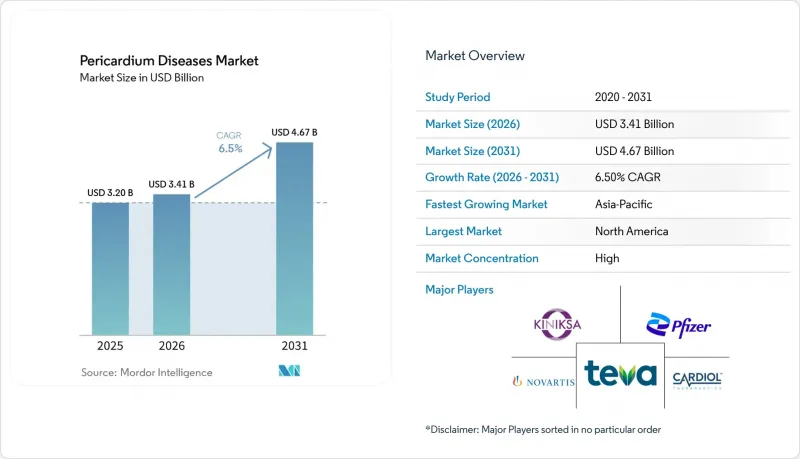
This report is Segmented by Offerings (Drug Class [NSAIDs, Corticosteroids, and More], and Diagnostic Modality [Echocardiography, Computed Tomography, and More]), Disease Type (Acute Pericarditis, Recurrent Pericarditis, Chronic Pericarditis, and More), End User (Hospitals, Specialty Clinics, and More), and Geography (North America, and More). The Market Forecasts are Provided in Terms of Value (USD).
Global Pericardium Diseases Market Trends and Insights
Regulatory Validation of Interleukin-1 Inhibition for Recurrent Pericarditis
Rilonacept had become the first approved therapy for recurrent pericarditis in 2021, establishing a clinical basis for IL-1 pathway inhibition. The change in 2025 was the stronger guideline support behind that mechanism. The ESC guideline and the ACC clinical guidance supported IL-1 inhibitors for patients with recurrent disease, elevated C-reactive protein, and inadequate response to colchicine. This approach moves eligible patients toward biologics before a prolonged corticosteroid pathway. Kiniksa received FDA Orphan Drug Designation for KPL-387 in October 2025, and the company expects Phase 2 data from its Phase 2/3 study in the second half of 2026. The Pericardium diseases market can therefore gain specialty prescribing volume where formulary access and specialist referral support these recommendations.
Rising Detection of Pericardial Inflammation Through Multimodality Imaging
Better detection expands the pool of patients who receive a defined pericarditis diagnosis. A 2024 international position statement described complementary roles for echocardiography, cardiac CT, and CMR across acute, chronic, and constrictive presentations. The 2025 ESC guideline described CMR as decisive in complex evaluation, risk assessment, and monitoring.
Imaging can identify persistent inflammation in patients whose symptoms alone do not clearly distinguish active disease. This supports more timely escalation when conventional treatment does not control inflammation. The Pericardium diseases market benefits as regional hospitals expand access to CMR and move complicated cases toward more structured follow-up.
High Cost and Payer Friction for Biologic Therapy
Payer requirements limit how quickly guideline recommendations translate into biologic use. Kiniksa reported that ARCALYST treated 18% of an estimated 14,000 United States patients with multiple-recurrence pericarditis at the end of 2025. The remaining untreated group shows the difference between clinical eligibility and funded access. The cited ACC guidance discussed hospital costs associated with recurrent disease, but coverage policies have not broadly shifted to hospitalization-offset models.
Specialty treatment also requires authorization processes and supporting clinical documentation. These factors constrain biologic uptake in the Pericardium diseases market, even when patients have recurrent inflammatory disease. Cost pressure remains most visible in the United States and can become more important as European reimbursement reviews consider advanced treatments.
Other drivers and restraints analyzed in the detailed report include:
- Expansion of Guideline-Based Colchicine and Combination Therapy
- Increasing Autoimmune, Infectious, and Post-Cardiac Injury Case Burden
- Diagnostic Misclassification and Delayed Etiology Identification
For complete list of drivers and restraints, kindly check the Table Of Contents.
Segment Analysis
Drug Class held 53.21% of the Pericardium diseases market size in 2025, reflecting the dominance of pharmacological therapies in managing acute and recurrent pericarditis. NSAIDs and colchicine remain the frontline treatments, widely prescribed in emergency and general hospital settings due to their accessibility and cost-effectiveness. Corticosteroids are used in refractory cases, though their long-term side effects limit broader adoption. Interleukin-1 inhibitors, such as rilonacept and anakinra, are gaining traction for recurrent pericarditis, supported by FDA approvals and clinical guideline endorsements. Their higher cost per patient drives revenue growth despite smaller patient volumes. Overall, the drug class segment benefits from established clinical pathways, large patient volumes, and increasing biologic penetration, positioning it as the largest revenue contributor in the offering landscape.
Diagnostic Modality is forecast to grow at a 9.20% CAGR through 2031, driven by advancements in imaging technologies and the rising need for precise disease characterization. Echocardiography remains the most widely used modality, offering rapid, non-invasive assessment of pericardial effusion and inflammation. Computed tomography (CT) and chest X-ray provide complementary insights, particularly in emergency settings. At the same time, cardiac magnetic resonance (CMR) is increasingly adopted for its superior tissue characterization and ability to differentiate constrictive pericarditis from restrictive cardiomyopathy. The growth of diagnostic modalities is supported by expanding access to advanced imaging in emerging markets, integration of AI-based interpretation tools, and guideline-driven recommendations for recurrent and complex pericarditis cases.
Complete Report Scope:
- By Offering
- By Drug Class
- NSAIDs
- Colchicine
- Corticosteroids
- Interleukin-1 Inhibitors
- Other Drug Class (Immunosuppressive Agents and Analgesics, among others)
- By Diagnostic Modality
- Echocardiography
- Computed Tomography
- Chest X-Ray
- Cardiac Magnetic Resonance
- Other Diagnostic Modality (Pericaridial Fluid Analysis and Pericardial Biopsy)
- By Drug Class
- By Disease Type
- Acute Pericarditis
- Recurrent Pericarditis
- Chronic Pericarditis
- Tuberculous Pericarditis
- Other Disease Type (Incessant Pericarditis and Idiopathic Pericarditis, among others)
- By End User
- Hospitals
- Specialty Clinics
- Ambulatory Surgical Centers
- Other End User (Research Institutes and Homecare Centers, among others)
- By Geography
- North America
- United States
- Canada
- Mexico
- Europe
- Germany
- United Kingdom
- France
- Italy
- Spain
- Rest of Europe
- Asia-Pacific
- China
- India
- Japan
- Australia
- South Korea
- Rest of Asia-Pacific
- Middle East and Africa
- GCC
- South Africa
- Rest of Middle East and Africa
- South America
- Brazil
- Argentina
- Rest of South America
- North America
Geography Analysis
North America held 43.51% of the pericardium disease market share in 2025, supported mainly by the United States. The region's position reflects commercial access to ARCALYST, a large insured population, and a dense specialty cardiology network. Kiniksa reported more than 4,150 active prescribers since launch as of full-year 2025. ARCALYST net product revenue rose 62% to USD 677.6 million in 2025, and 2026 guidance is USD 900-920 million. Canada supports specialty biologic use through its reimbursement environment. Mexico remains less developed because formulary access and specialist density are lower. Payer step therapy remains the leading access constraint in the region.
Europe is the second-largest region, with Germany, France, Italy, and the United Kingdom contributing most revenue. The 2025 ESC guideline is central to regional clinical practice because it supports IL-1 inhibitors in C-reactive-protein-positive recurrent disease. Italy and Spain have strong clinical research experience in colchicine treatment. That experience can support earlier adoption of structured escalation pathways. ARCALYST provides a framework for reimbursement discussions. Diagnostic and treatment access will therefore remain uneven across European countries.
Asia-Pacific is forecast to grow at an 8.32% CAGR through 2031, making it the fastest-growing region. Rising cardiovascular disease burden, additional cardiac centers, and attention to rare cardiovascular conditions support demand across the Pericardium diseases market. India's expanding specialty hospital network can raise diagnosis volumes. Japan's Sakigake pathway can support innovative therapies for rare conditions with unmet need. South Korea and Australia have more mature imaging capacity and reimbursement frameworks.
- Abbvie
- Amgen
- AstraZeneca
- Aurobindo Pharma
- Bayer
- Boston Scientific
- Bristol-Myers Squibb
- Cardiol Therapeutics Inc.
- Hikma Pharmaceuticals
- Kiniksa Pharmaceuticals, Ltd.
- Koninklijke Philips
- Novartis
- Pfizer
- Regeneron Pharmaceuticals
- Sanofi
- Sun Pharmaceuticals Industries
- Swedish Orphan Biovitrum AB
- Takeda Pharmaceuticals
- Teva Pharmaceutical Industries
- Zydus Lifesciences Limited
Additional Benefits:
- The market estimate (ME) sheet in Excel format
- 3 months of analyst support
TABLE OF CONTENTS
1 Introduction
- 1.1 Study Assumptions and Market Definition
- 1.2 Scope of the Study
2 Research Methodology
3 Excutive Summary
4 Market Lanscape
- 4.1 Market Overview
- 4.2 Market Drivers
- 4.2.1 Rising Detection of Pericardial Inflammation Through Multimodality Imaging
- 4.2.2 Expansion of Guideline-Based Colchicine and Combination Therapy
- 4.2.3 Regulatory Validation of Interleukin-1 Inhibition for Recurrent Pericarditis
- 4.2.4 Growth of Cardiac Centers and Image-Guided Pericardial Procedures
- 4.2.5 Increasing Autoimmune, Infectious, and Post-Cardiac Injury Case Burden
- 4.2.6 Precision Stratification of Autoinflammatory Phenotypes
- 4.3 Market Restraints
- 4.3.1 High Cost and Payer Friction for Biologic Therapy
- 4.3.2 Diagnostic Misclassification and Delayed Etiology Identification
- 4.3.3 Procedure-Related Bleeding, Arrhythmia, and Organ-Injury Risk
- 4.3.4 Limited Disease-Specific Evidence Outside Specialist Centers
- 4.4 Regulatory Landscape
- 4.5 Technological Outlook
- 4.6 Porter's Five Forces Analysis
- 4.6.1 Bargaining Power of Suppliers
- 4.6.2 Bargaining Power of Buyers
- 4.6.3 Threat of New Entrants
- 4.6.4 Threat of Substitutes
- 4.6.5 Competitive Rivalry
5 Market Size and Growth Forecasts, Value (USD)
- 5.1 By Offering
- 5.1.1 By Drug Class
- 5.1.1.1 NSAIDs
- 5.1.1.2 Colchicine
- 5.1.1.3 Corticosteroids
- 5.1.1.4 Interleukin-1 Inhibitors
- 5.1.1.5 Other Drug Class (Immunosuppressive Agents and Analgesics, among others)
- 5.1.2 By Diagnostic Modality
- 5.1.2.1 Echocardiography
- 5.1.2.2 Computed Tomography
- 5.1.2.3 Chest X-Ray
- 5.1.2.4 Cardiac Magnetic Resonance
- 5.1.2.5 Other Diagnostic Modality (Pericaridial Fluid Analysis and Pericardial Biopsy)
- 5.1.1 By Drug Class
- 5.2 By Disease Type
- 5.2.1 Acute Pericarditis
- 5.2.2 Recurrent Pericarditis
- 5.2.3 Chronic Pericarditis
- 5.2.4 Tuberculous Pericarditis
- 5.2.5 Other Disease Type (Incessant Pericarditis and Idiopathic Pericarditis, among others)
- 5.3 By End User
- 5.3.1 Hospitals
- 5.3.2 Specialty Clinics
- 5.3.3 Ambulatory Surgical Centers
- 5.3.4 Other End User (Research Institutes and Homecare Centers, among others)
- 5.4 By Geography
- 5.4.1 North America
- 5.4.1.1 United States
- 5.4.1.2 Canada
- 5.4.1.3 Mexico
- 5.4.2 Europe
- 5.4.2.1 Germany
- 5.4.2.2 United Kingdom
- 5.4.2.3 France
- 5.4.2.4 Italy
- 5.4.2.5 Spain
- 5.4.2.6 Rest of Europe
- 5.4.3 Asia-Pacific
- 5.4.3.1 China
- 5.4.3.2 India
- 5.4.3.3 Japan
- 5.4.3.4 Australia
- 5.4.3.5 South Korea
- 5.4.3.6 Rest of Asia-Pacific
- 5.4.4 Middle East and Africa
- 5.4.4.1 GCC
- 5.4.4.2 South Africa
- 5.4.4.3 Rest of Middle East and Africa
- 5.4.5 South America
- 5.4.5.1 Brazil
- 5.4.5.2 Argentina
- 5.4.5.3 Rest of South America
- 5.4.1 North America
6 Competitive Landscape
- 6.1 Market Concentration
- 6.2 Market Share Analysis
- 6.3 Company Profiles (includes Global Level Overview, Market Level Overview, Core Segments, Financials as available, Strategic Information, Market Rank/Share, Products and Services, Recent Developments)
- 6.3.1 AbbVie Inc.
- 6.3.2 Amgen Inc.
- 6.3.3 AstraZeneca PLC
- 6.3.4 Aurobindo Pharma Limited
- 6.3.5 Bayer AG
- 6.3.6 Boston Scientific Corporation
- 6.3.7 Bristol-Myers Squibb Company
- 6.3.8 Cardiol Therapeutics Inc.
- 6.3.9 Hikma Pharmaceuticals PLC
- 6.3.10 Kiniksa Pharmaceuticals, Ltd.
- 6.3.11 Koninklijke Philips N.V.
- 6.3.12 Novartis AG
- 6.3.13 Pfizer Inc.
- 6.3.14 Regeneron Pharmaceuticals, Inc.
- 6.3.15 Sanofi
- 6.3.16 Sun Pharmaceutical Industries Limited
- 6.3.17 Swedish Orphan Biovitrum AB
- 6.3.18 Takeda Pharmaceutical Company Limited
- 6.3.19 Teva Pharmaceutical Industries Ltd.
- 6.3.20 Zydus Lifesciences Limited
7 Market Opportunities and Future Outlook
- 7.1 White-Space and Unmet-Need Assessment

