PUBLISHER: Mordor Intelligence | PRODUCT CODE: 2119061

PUBLISHER: Mordor Intelligence | PRODUCT CODE: 2119061
SME marketing-as-a-Service Market - Market Share Analysis, Industry Trends & Statistics, Growth Forecasts (2026 - 2031)
According to Mordor Intelligence, the SME marketing-as-a-Service market size was valued at USD 8.12 billion in 2025 and is estimated to grow from USD 9.21 billion in 2026 to reach USD 18.07 billion by 2031, at a CAGR of 14.43% during the forecast period 2026-2031.
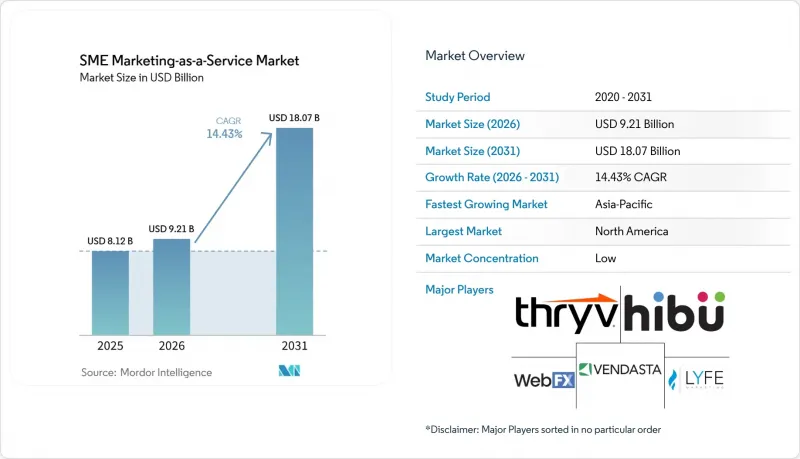
This report is Segmented by Service Type (Demand Generation and Customer Acquisition, Content and Brand Management, and More), Engagement Model (Fully Managed Marketing Services, and More), End User Industry (Retail and E-Commerce, Media and Entertainment, Healthcare and Life Sciences, Travel and Hospitality, and More), and Geography. The Market Forecasts are Provided in Terms of Value (USD).
Global SME Marketing-as-a-Service Market Trends and Insights
Rising SME Need for Senior Marketing Expertise Without Full-Time Headcount
The shortage of experienced marketing talent is increasing interest in managed services. Budget limits add pressure because many firms cannot staff every required specialty internally. Deloitte reported that B2B services companies allocated 12.2% of revenue to marketing in February 2025. The SME Marketing-as-a-Service market provides smaller firms with access to senior-level guidance without a permanent executive hire. Sagefrog found that 22% of outsourcing decisions reflected limited internal bandwidth, and another 22% reflected cost-effectiveness relative to a full internal team, although this survey result is not relied on as an independent market indicator. AI-supported workflows also enable senior specialists to support multiple clients simultaneously. This expands the practical supply of fractional marketing leadership for smaller businesses.
Multi-Channel Customer Acquisition Pressure Favoring Outsourced Execution
SMEs increasingly need coordinated activity across paid social, search, email, and content. A single internal generalist may struggle to maintain current expertise across those channels. The SME Marketing-as-a-Service market, therefore, supports hybrid models in which internal teams retain strategy and external specialists run channel programs. Browser privacy restrictions have also made conversion tracking and consent management more demanding. Infrequently managed accounts can lose the quality signals that platform algorithms use to optimize delivery. Vendasta received TikTok Channel Sales Partner status in July 2026, allowing campaigns to be launched and managed through its MatchCraft workflow. This development reflects the growing role of integrated channel tools in local business advertising.
SME Budget Volatility and Short Contract Cycles
Revenue volatility can make SME contracts less predictable than enterprise outsourcing agreements. Budget or scope misalignment can lead clients to pause work before campaign results become visible. The SME Marketing-as-a-Service market consequently faces a higher need to demonstrate value early in each engagement. Many providers concentrate reporting and early milestones within the first 60 to 90 days. Shorter contract cycles can limit revenue visibility and increase customer acquisition pressure. Modular pricing tied to leads, pipeline value, or revenue attribution can reduce concern about recurring retainers.
Other drivers and restraints analyzed in the detailed report include:
- Strong Shift Toward Social, Search, and Content-Led Demand Generation
- Affordable AI and Automation Expanding Service Scope for SMEs
- Data Privacy, Copyright, and AI Governance Risk
For complete list of drivers and restraints, kindly check the Table Of Contents.
Segment Analysis
Demand Generation and Customer Acquisition held 36.41% of the SME Marketing-as-a-Service market share in 2025. It is the largest service type because coordinated paid search, paid social, and SEO programs have become a central outsourcing need for many SMEs. Meta Advantage+, Google Performance Max, and TikTok reward well-managed accounts with consistent activity and quality signals. This can widen the gap between an always-on program and an intermittently managed campaign. Providers can address the gap through coordinated channel planning, budget management, and tracking. Content and Brand Management is the second-largest service category. It is moving from a focus on publishing volume toward topical authority and content formats suited to AI-supported search. Marketing Analytics and Reporting is also becoming increasingly important because clients expect real-time visibility into performance within their retainers.
Marketing Automation and CRM Management is the fastest-growing service type, with the SME Marketing-as-a-Service market size for this segment projected to expand at a 15.29% CAGR from 2026 to 2031. HubSpot, Salesforce, and Zoho make connected campaign workflows more accessible, but licenses still require skilled implementation. Managed providers can connect customer records, campaign activity, and follow-up processes in a practical workflow. Fractional Marketing Leadership is a separate niche that offers senior strategic direction without a full-time executive role. AI-supported execution enables experienced professionals to serve 4 to 6 SME clients simultaneously. Specialized SEO, paid media, and video production services also remain relevant. These services can be added to a broader program when clients seek fewer vendor relationships. The SME Marketing-as-a-Service market is therefore supporting both broad managed programs and more specialized service engagements.
Complete Report Scope:
- By Service Type
- Demand Generation and Customer Acquisition
- Content and Brand Management
- Marketing Automation and CRM Management
- Marketing Analytics and Reporting
- Fractional Marketing Leadership
- Others
- By Service Type
- Fully Managed Marketing Services
- Project-Based Retainer Services
- Others
- By End User Industry
- Retail and E-commerce
- Media and Entertainment
- Healthcare and Life Sciences
- Travel and Hospitality
- Consumer Goods
- Other End User Industries (BFSI, Education, Automotive, and IT and Telecom amongst Others)
- By Geography
- North America
- United States
- Canada
- Mexico
- South America
- Brazil
- Argentina
- Chile
- Rest of South America
- Europe
- Germany
- United Kingdom
- France
- Italy
- Spain
- Rest of Europe
- Asia-Pacific
- China
- Japan
- India
- South Korea
- Australia
- Rest of Asia-Pacific
- Middle East
- United Arab Emirates
- Saudi Arabia
- Qatar
- Rest of Middle East
- Africa
- South Africa
- Egypt
- Nigeria
- Rest of Africa
- North America
Geography Analysis
North America held 39.21% of the SME Marketing-as-a-Service market in 2025. The region has a high concentration of MaaS platforms and widespread use of technology among smaller businesses. U.S. small businesses' use of generative AI reached 58% in 2025, according to the U.S. Chamber of Commerce. Thryv reported USD 461 million in SaaS revenue for 2025, a 34.2% year-over-year increase. Canada requires English and French content, while Mexico supports Spanish-language programs connected to North American trade.
SME skill gaps and tighter requirements around personal data influence Europe. Weitkamp Marketing launched a Marketing-as-a-Service subscription model for industrial mid-market companies in March 2026. The IPA reported a net budget balance of +7.3% for United Kingdom companies in the first quarter of 2026. GDPR and the EU AI Act favor providers with documented practices for data processing and AI oversight.
Asia-Pacific is the fastest-growing region, with the SME Marketing-as-a-Service market projected to expand at a 14.84% CAGR from 2026 to 2031. China, India, South Korea, and Southeast Asia support growth through e-commerce, social commerce, and SME digital-transformation programs. Businesses in the region need services that address local platforms, languages, and data rules. The Middle East also retains growth potential as Saudi Arabia develops SME-intensive activity in entertainment, sports, and tourism. Africa remains in the early stages overall, while South Africa, Nigeria, and Egypt show initial adoption in urban fintech, consumer goods, and retail clusters.
- Thryv Holdings, Inc.
- Hibu Inc.
- Vendasta Technologies Inc.
- WebFX, Inc.
- LYFE Marketing, LLC
- Ignite Visibility LLC
- Straight North, LLC
- Chief Outsiders, LLC
- yorCMO LLC
- Marketri, LLC
- CMOx, LLC
- SmartSites LLC
- KlientBoost, LLC
- SmartBug Media, LLC
- Ironpaper, Inc.
- Heinz Marketing Inc.
- Red Branch Media, LLC
- Authentic Brand LLC
- Impact Plus, LLC
- Kuno Creative, LLC
Additional Benefits:
- The market estimate (ME) sheet in Excel format
- 3 months of analyst support
TABLE OF CONTENTS
1 INTRODUCTION
- 1.1 Study Assumptions and Market Definition
- 1.2 Scope of the Study
2 RESEARCH METHODOLOGY
3 EXECUTIVE SUMMARY
4 MARKET LANDSCAPE
- 4.1 Market Overview
- 4.2 Market Drivers
- 4.2.1 Rising SME Need for Senior Marketing Expertise Without Full-Time Headcount
- 4.2.2 Multi-Channel Customer Acquisition Pressure Favoring Outsourced Execution
- 4.2.3 Strong Shift Toward Social, Search, and Content-Led Demand Generation
- 4.2.4 Affordable AI and Automation Expanding Service Scope for SMEs
- 4.2.5 First-Party Data and AI Search Readiness Creating New Managed-Service Demand
- 4.2.6 Fragmented MarTech Stacks Driving Subscription-Led Optimization Outsourcing
- 4.3 Market Restraints
- 4.3.1 SME Budget Volatility and Short Contract Cycles
- 4.3.2 Data Privacy, Copyright, and AI Governance Risk
- 4.3.3 Owner-Led Marketing Decision Bottlenecks in Smaller Firms
- 4.3.4 Channel Fragmentation Raising Attribution Complexity and Churn Risk
- 4.4 Impact of Macroeconomic Factors on the Market
- 4.5 Industry Value-Chain Analysis
- 4.6 Technology Outlook
- 4.7 Regulatory Landscape
- 4.8 Porter's Five Forces Analysis
- 4.8.1 Threat of New Entrants
- 4.8.2 Bargaining Power of Suppliers
- 4.8.3 Bargaining Power of Buyers
- 4.8.4 Threat of Substitutes
- 4.8.5 Intensity of Competitive Rivalry
5 MARKET SIZE AND GROWTH FORECASTS (VALUE)
- 5.1 By Service Type
- 5.1.1 Demand Generation and Customer Acquisition
- 5.1.2 Content and Brand Management
- 5.1.3 Marketing Automation and CRM Management
- 5.1.4 Marketing Analytics and Reporting
- 5.1.5 Fractional Marketing Leadership
- 5.1.6 Others
- 5.2 By Service Type
- 5.2.1 Fully Managed Marketing Services
- 5.2.2 Project-Based Retainer Services
- 5.2.3 Others
- 5.3 By End User Industry
- 5.3.1 Retail and E-commerce
- 5.3.2 Media and Entertainment
- 5.3.3 Healthcare and Life Sciences
- 5.3.4 Travel and Hospitality
- 5.3.5 Consumer Goods
- 5.3.6 Other End User Industries (BFSI, Education, Automotive, and IT and Telecom amongst Others)
- 5.4 By Geography
- 5.4.1 North America
- 5.4.1.1 United States
- 5.4.1.2 Canada
- 5.4.1.3 Mexico
- 5.4.2 South America
- 5.4.2.1 Brazil
- 5.4.2.2 Argentina
- 5.4.2.3 Chile
- 5.4.2.4 Rest of South America
- 5.4.3 Europe
- 5.4.3.1 Germany
- 5.4.3.2 United Kingdom
- 5.4.3.3 France
- 5.4.3.4 Italy
- 5.4.3.5 Spain
- 5.4.3.6 Rest of Europe
- 5.4.4 Asia-Pacific
- 5.4.4.1 China
- 5.4.4.2 Japan
- 5.4.4.3 India
- 5.4.4.4 South Korea
- 5.4.4.5 Australia
- 5.4.4.6 Rest of Asia-Pacific
- 5.4.5 Middle East
- 5.4.5.1 United Arab Emirates
- 5.4.5.2 Saudi Arabia
- 5.4.5.3 Qatar
- 5.4.5.4 Rest of Middle East
- 5.4.6 Africa
- 5.4.6.1 South Africa
- 5.4.6.2 Egypt
- 5.4.6.3 Nigeria
- 5.4.6.4 Rest of Africa
- 5.4.1 North America
6 COMPETITIVE LANDSCAPE
- 6.1 Market Concentration
- 6.2 Strategic Moves
- 6.3 Market Share Analysis
- 6.4 Company Profiles (includes Global Level Overview, Market Level Overview, Core Segments, Financials as available, Strategic Information, Market Rank/Share, Products and Services, Recent Developments)
- 6.4.1 Thryv Holdings, Inc.
- 6.4.2 Hibu Inc.
- 6.4.3 Vendasta Technologies Inc.
- 6.4.4 WebFX, Inc.
- 6.4.5 LYFE Marketing, LLC
- 6.4.6 Ignite Visibility LLC
- 6.4.7 Straight North, LLC
- 6.4.8 Chief Outsiders, LLC
- 6.4.9 yorCMO LLC
- 6.4.10 Marketri, LLC
- 6.4.11 CMOx, LLC
- 6.4.12 SmartSites LLC
- 6.4.13 KlientBoost, LLC
- 6.4.14 SmartBug Media, LLC
- 6.4.15 Ironpaper, Inc.
- 6.4.16 Heinz Marketing Inc.
- 6.4.17 Red Branch Media, LLC
- 6.4.18 Authentic Brand LLC
- 6.4.19 Impact Plus, LLC
- 6.4.20 Kuno Creative, LLC
7 MARKET OPPORTUNITIES AND FUTURE OUTLOOK
- 7.1 White-Space and Unmet-Need Assessment

