PUBLISHER: Mordor Intelligence | PRODUCT CODE: 2154877

PUBLISHER: Mordor Intelligence | PRODUCT CODE: 2154877
Real Estate Marketing Services - Market Share Analysis, Industry Trends & Statistics, Growth Forecasts (2026 - 2031)
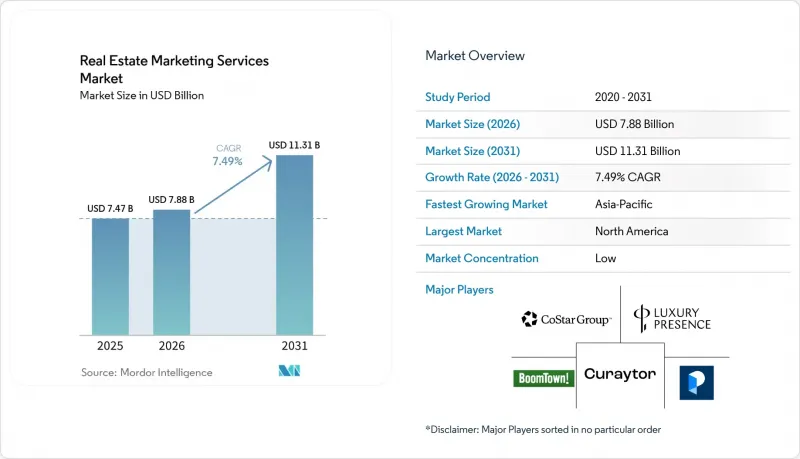
According to Mordor Intelligence, the real estate marketing services market size is projected to expand from USD 7.47 billion in 2025 and USD 7.88 billion in 2026 to USD 11.31 billion by 2031, registering a CAGR of 7.49% between 2026 and 2031.
Global Real Estate Marketing Services Market Trends and Insights
Digital-First Home Search and Online Agent Discovery
The Real estate marketing services market benefits from the nearly universal use of online research by homebuyers and sellers before they enter into a conversation with an agent. The National Association of REALTORS reported that online channels became the primary way consumers found an agent in 2025, ahead of personal referrals. This change makes persistent digital visibility a necessary operating expense for property professionals, rather than a promotional activity that can be paused when conditions become difficult. Reducing visibility during a slow period can leave agents less visible when customer activity improves, because buyers will still compare profiles, listings, and local expertise online. Bank of America reported that prospective buyers increasingly used AI tools for homebuying research, with adoption especially notable among younger buyer groups, including Gen Z respondents and Millennials. The broader discovery process now includes conventional search, property portals, and AI-generated responses, which increases the range of planning, content, and optimization work required from the Real estate marketing services market.
Social Media and CRM-Led Quality Lead Generation
Social media and CRM systems have become central to lead generation in the Real estate marketing services market, as they combine initial customer reach with structured follow-up. The National Association of REALTORS found that REALTORS identified social media as their top lead-generating technology, followed by CRM platforms. Social platforms can generate high inquiry volumes at a lower cost per lead, but these leads often require longer and more carefully organized follow-up than portal or referral contacts. That requirement creates demand for CRM configuration, audience segmentation, message sequencing, and customer journeys that keep potential buyers engaged before they are ready to transact. CallRail reported that surveyed U.S. real estate businesses planned to use AI for lead scoring and attribution measurement. Providers in the Real estate marketing services market that help clients improve lead quality and follow-up processes can serve needs that extend beyond the placement and management of individual campaigns.
Transaction-Volume Volatility and Thin Listing Inventories
Marketing spending is directly linked to listing supply and transaction activity, making service demand sensitive to housing cycles and the number of properties actively marketed. Existing-home sales in the United States improved slightly from the prior year, while inventory and supply remained constrained. The National Association of REALTORS described the recent sales level as historically low, and the latest reading remained below pre-pandemic norms. Bank of America found that many prospective buyers were waiting for prices and rates to improve, while home prices remained elevated. Lower listing availability can reduce active campaigns, limit agent budgets, and shorten the period available for performance marketing teams to test, refine, and optimize campaign activity. This pressure is particularly strong for portal-dependent agents that buy advertising or leads more frequently when transaction activity is higher, which can constrain spending across the Real estate marketing services market.
Other drivers and restraints analyzed in the detailed report include:
- Performance Marketing Adoption by Developers and Brokerages
- Rich-Media Listing Expectations From Sellers and Buyers
- Rising Customer-Acquisition Costs Across Portals and Paid Media
For complete list of drivers and restraints, kindly check the Table Of Contents.
Segment Analysis
Performance Marketing and Lead Acquisition Services accounted for 35.12% of the Real estate marketing services market size in 2025. Its leading position reflected the importance of pay-per-click, paid social, and portal advertising for agents and developers seeking measurable near-term pipeline results. Branding and Creative Services supplied a steady revenue base because professionals need to maintain recognizable identities across changing listings and campaigns. Digital Asset and Listing Management Services also generated recurring demand through photography, video, listing updates, and content distribution. Events and Experiential Marketing Services represented a smaller but durable part of spending, particularly for luxury residential programs and developer pre-sales activity.
Marketing Strategy, Research and Analytics Services is projected to expand at an 8.55% CAGR through 2031, making it the fastest service type in the Real estate marketing services market. The segment reflects a move from optimizing inquiry volumes toward designing campaigns around lead quality and transaction outcomes. Firms are building multi-touch attribution models that follow activity from the first impression to the closing stage. Salesforce introduced autonomous marketing agents in June 2026, including Hunter for identifying leads from behavioral signals and a Marketing Goals Agent for building and optimizing campaigns around defined objectives. Full-service agencies can apply these tools to property-specific strategy, channel selection, performance review, and the interpretation of campaign results.
Complete Report Scope:
- By Service Type
- Performance Marketing and Lead Acquisition Services
- Branding and Creative Services
- Digital Asset and Listing Management Services
- Events and Experiential Marketing Services
- Marketing Strategy, Research and Analytics Services
- By End-User
- Brokerages and Agencies
- Residential Developers
- Commercial Real Estate Firms
- Property Management Companies
- REITs and Institutional Investors
- By Geography
- North America
- United States
- Canada
- Mexico
- South America
- Brazil
- Argentina
- Chile
- Colombia
- Peru
- Rest of South America
- Europe
- United Kingdom
- Germany
- France
- Italy
- Spain
- Russia
- Netherlands
- Poland
- Rest of Europe
- Asia-Pacific
- India
- Japan
- Australia
- South Korea
- Indonesia
- Philippines
- Thailand
- Rest of Asia-Pacific
- Middle East
- Turkey
- Israel
- Saudi Arabia
- United Arab Emirates
- Rest of Middle East
- Africa
- South Africa
- Nigeria
- Kenya
- Egypt
- Rest of Africa
- North America
Geography Analysis
North America accounted for 38.34% share in 2025. The region benefits from a developed digital advertising infrastructure and mature portal and CRM ecosystems in the United States and Canada. High agent-to-listing ratios sustain competition for buyer and seller attention across paid media, listing distribution, CRM management, and content production. The United States is particularly important because changes in transactions can quickly affect brokerage and agent marketing budgets.
Asia-Pacific is projected to expand at an 8.38% CAGR through 2031. Mobile-first buyer groups in India and rapid urbanization in Southeast Asian cities support demand for performance campaigns and developer launch services. Developers are shifting from showroom walk-ins to measurable digital channels, including search, social media, and programmatic advertising, for promoting residential projects. The Real estate marketing services market offers opportunities for campaign teams to adapt messaging, lead handling, and channel allocation to differing national buyer preferences.
Europe has different digital maturity profiles across Germany, the United Kingdom, and France, while the United Kingdom is more advanced in measuring paid, organic, and conversion activity. Middle Eastern markets are becoming more formalized, creating demand for professional services as advertising activity receives greater oversight. The UAE remains the region's most digitally developed property marketing environment, with international buyer campaigns using search, social media, and WhatsApp follow-up. South America is at an earlier stage of adoption, with Brazil offering the largest addressable opportunity because of urbanization and digital advertising infrastructure. African markets led by South Africa, Egypt, and Nigeria are moving from traditional outdoor media toward digital-first property promotion.
- Luxury Presence, Inc.
- BoomTown ROI LLC
- Placester, Inc.
- Curaytor, Inc.
- Real Geeks, LLC
- Agent Image, Inc.
- Chime Technologies, Inc.
- Sierra Interactive, LLC
- MoxiWorks, LLC
- SharpLaunch, Inc.
- Zillow Group, Inc.
- CoStar Group, Inc.
- Move, Inc.
- REA Group Ltd
- Rightmove plc
Additional Benefits:
- The market estimate (ME) sheet in Excel format
- 3 months of analyst support
TABLE OF CONTENTS
1 INTRODUCTION
- 1.1 Study Assumptions and Market Definition
- 1.2 Scope of the Study
2 RESEARCH METHODOLOGY
3 EXECUTIVE SUMMARY
4 MARKET LANDSCAPE
- 4.1 Market Overview
- 4.2 Market Drivers
- 4.2.1 Digital-First Home Search and Online Agent Discovery
- 4.2.2 Rich-Media Listing Expectations from Sellers and Buyers
- 4.2.3 Social Media and CRM-Led Quality Lead Generation
- 4.2.4 Performance Marketing Adoption by Developers and Brokerages
- 4.2.5 AI Search Optimization and Answer-Engine Discovery
- 4.2.6 Pre-Listing Seller Acquisition and Phased Listing Promotion
- 4.3 Market Restraints
- 4.3.1 Transaction-Volume Volatility and Thin Listing Inventories
- 4.3.2 Rising Customer-Acquisition Costs Across Portals and Paid Media
- 4.3.3 AI Visibility Concentrating Demand Around a Small Share of Agents
- 4.3.4 Disclosure and Authenticity Risks in AI-Enhanced Listing Media
- 4.4 Industry Value Chain Analysis
- 4.5 Impact of Macroeconomic Factors on the Market
- 4.6 Regulatory Landscape
- 4.7 Technological Outlook
- 4.8 Porter's Five Forces Analysis
- 4.8.1 Threat of New Entrants
- 4.8.2 Bargaining Power of Buyers
- 4.8.3 Bargaining Power of Suppliers
- 4.8.4 Threat of Substitutes
- 4.8.5 Intensity of Rivalry
5 MARKET SIZE AND GROWTH FORECASTS (VALUE)
- 5.1 By Service Type
- 5.1.1 Performance Marketing and Lead Acquisition Services
- 5.1.2 Branding and Creative Services
- 5.1.3 Digital Asset and Listing Management Services
- 5.1.4 Events and Experiential Marketing Services
- 5.1.5 Marketing Strategy, Research and Analytics Services
- 5.2 By End-User
- 5.2.1 Brokerages and Agencies
- 5.2.2 Residential Developers
- 5.2.3 Commercial Real Estate Firms
- 5.2.4 Property Management Companies
- 5.2.5 REITs and Institutional Investors
- 5.3 By Geography
- 5.3.1 North America
- 5.3.1.1 United States
- 5.3.1.2 Canada
- 5.3.1.3 Mexico
- 5.3.2 South America
- 5.3.2.1 Brazil
- 5.3.2.2 Argentina
- 5.3.2.3 Chile
- 5.3.2.4 Colombia
- 5.3.2.5 Peru
- 5.3.2.6 Rest of South America
- 5.3.3 Europe
- 5.3.3.1 United Kingdom
- 5.3.3.2 Germany
- 5.3.3.3 France
- 5.3.3.4 Italy
- 5.3.3.5 Spain
- 5.3.3.6 Russia
- 5.3.3.7 Netherlands
- 5.3.3.8 Poland
- 5.3.3.9 Rest of Europe
- 5.3.4 Asia-Pacific
- 5.3.4.1 India
- 5.3.4.2 Japan
- 5.3.4.3 Australia
- 5.3.4.4 South Korea
- 5.3.4.5 Indonesia
- 5.3.4.6 Philippines
- 5.3.4.7 Thailand
- 5.3.4.8 Rest of Asia-Pacific
- 5.3.5 Middle East
- 5.3.5.1 Turkey
- 5.3.5.2 Israel
- 5.3.5.3 Saudi Arabia
- 5.3.5.4 United Arab Emirates
- 5.3.5.5 Rest of Middle East
- 5.3.6 Africa
- 5.3.6.1 South Africa
- 5.3.6.2 Nigeria
- 5.3.6.3 Kenya
- 5.3.6.4 Egypt
- 5.3.6.5 Rest of Africa
- 5.3.1 North America
6 COMPETITIVE LANDSCAPE
- 6.1 Market Concentration
- 6.2 Strategic Moves
- 6.3 Market Share Analysis
- 6.4 Company Profiles (includes Global Level Overview, Market Level Overview, Core Segments, Financials as available, Strategic Information, Market Rank/Share, Products and Services, Recent Developments)
- 6.4.1 Luxury Presence, Inc.
- 6.4.2 BoomTown ROI LLC
- 6.4.3 Placester, Inc.
- 6.4.4 Curaytor, Inc.
- 6.4.5 Real Geeks, LLC
- 6.4.6 Agent Image, Inc.
- 6.4.7 Chime Technologies, Inc.
- 6.4.8 Sierra Interactive, LLC
- 6.4.9 MoxiWorks, LLC
- 6.4.10 SharpLaunch, Inc.
- 6.4.11 Zillow Group, Inc.
- 6.4.12 CoStar Group, Inc.
- 6.4.13 Move, Inc.
- 6.4.14 REA Group Ltd
- 6.4.15 Rightmove plc
7 MARKET OPPORTUNITIES AND FUTURE OUTLOOK
- 7.1 White-Space and Unmet-need Assessment

