PUBLISHER: Mordor Intelligence | PRODUCT CODE: 2119155

PUBLISHER: Mordor Intelligence | PRODUCT CODE: 2119155
Europe 5G Core Network - Market Share Analysis, Industry Trends & Statistics, Growth Forecasts (2026 - 2031)
According to Mordor Intelligence, the Europe 5G core network market size is projected to expand from USD 0.89 billion in 2025 and USD 1.05 billion in 2026 to USD 2.51 billion by 2031, registering a CAGR of 19.04% between 2026 to 2031.
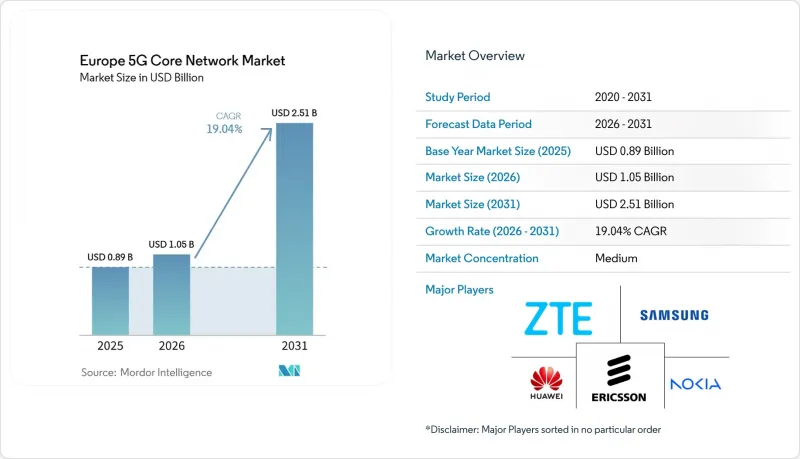
This report is Segmented by Component (Solutions, and Services), Deployment Model (On-Premises/Dedicated, Public Cloud, and Hybrid and Telco Edge Cloud), End-User (Telecom Operators, and Enterprises), Network Function (Network Exposure Function, User Plane Function, Application Function, Unified Data Management, and More), and Country. The Market Forecasts are Provided in Terms of Value (USD).
Europe 5G Core Network Market Trends and Insights
Cloud-Native Standalone Core Migration in Mature European Networks
Cloud-native standalone core migration is the most influential structural driver in the Europe 5G core network market, as operators replace non-standalone overlays built for rapid coverage deployment. A standalone architecture gives operators greater control over service creation, policy management, and network automation. Deutsche Telekom moved standalone traffic through Mavenir's containerized packet core under its Horizontal TelCo Cloud program. Telia completed Nokia's cloud-native 5G standalone core deployment across Finland, Sweden, Norway, Estonia, and Lithuania in 2025. This regional approach supports common operating tools across several national networks. The Europe 5G core network market also benefits because core migration requires concurrent work on charging, policy, and orchestration functions.
Network Slicing Monetization for Enterprise and Private 5G Use Cases
Network slicing is moving from technical testing toward commercial offerings for industrial and enterprise customers. Vodafone Germany introduced the Campus Flex Exclusive and Campus Flex Starter tariffs in 2025, including an exclusive tier priced at EUR 2,000 (USD 2,310.14) per location per month for mission-critical applications. The offering supports use cases such as automated production and autonomous vehicle control. Vodafone also extended service models with service-level commitments to the United Kingdom. Deutsche Telekom implemented commercial network slices, including consumer-scale integration with Apple FaceTime through iOS 26. These actions show how the European 5G core network market can support revenue models distinct from basic mobile connectivity.
High Up-Front Capital Expenditure and Uncertain Payback for Standalone Core Upgrades
Capital intensity remains the immediate constraint on standalone core deployment across Europe. GSMA Europe reported in May 2026 that European mobile operators require EUR 475 billion (USD 548.66 billion) in mobile network investment by 2035, while EUR 270 billion (USD 311.87 billion) is currently expected to materialize. The EUR 205 billion (USD 236.79 billion) gap limits the ability to fund core software migration, hardware refreshes, and spectrum renewal simultaneously. European operators had spent more than EUR 30 billion (USD 34.65 billion) on spectrum since 2020. Capital expenditure per connection stood at EUR 35 (USD 40.43) in Europe in 2024, compared with EUR 70 (USD 80.85) in global connectivity leaders.
Other drivers and restraints analyzed in the detailed report include:
- Regulatory Push for Resilient, Secure, and Sovereign Telecom Infrastructure
- 5G Core Modernization Through Vendor Diversification and Open Architectures
- Integration Complexity With Legacy EPC and Multi-Vendor Environments
For complete list of drivers and restraints, kindly check the Table Of Contents.
Segment Analysis
Solutions are expected to account for 62.59% of the Europe 5G core network market share in 2025. Packet-core software, network functions virtualization infrastructure, and orchestration and management tools form the primary spending layer for standalone network programs. Packet-core software includes functions such as AMF, SMF, UPF, PCF, and related 5G core functions. Operators purchase these functions as virtualized or containerized software bundles under multiyear license agreements. Nokia, Ericsson, and Mavenir are among the suppliers providing these capabilities. Network functions virtualization infrastructure includes commercial off-the-shelf servers and cloud platforms that host virtualized functions. Some large operators use hyperscaler arrangements, while others continue to operate proprietary cloud stacks.
The services segment in the Europe 5G core network services market size is projected to expand at a CAGR of 20.98% through 2031. Integration and deployment services see the highest demand during the initial migration stage. Support and maintenance agreements can extend for 5-8 years in large programs, such as the VodafoneThree modernization. Operators without dedicated cloud engineering teams also require support for containerization, continuous integration, continuous delivery, and Open RAN integration. Standards changes can increase demand for advisory work on exposure APIs and policy control. Release 18 expanded the Network Exposure Function API and policy capabilities within the 5G system. These requirements create recurring work for system integrators and cloud-native specialists.
On-premises and dedicated deployments are expected to account for 55.00% of the market in 2025. Under this model, operators retain physical control over latency-sensitive control-plane functions. Existing dedicated infrastructure remains expensive to replace because it may also support lawful interception and data sovereignty requirements. Security and sovereignty rules in Germany, France, and the United Kingdom reinforce the use of operator-controlled or nationally governed data environments. Operators also use hybrid and telco-edge-cloud models in industrial private-network environments. BMW is expected to begin production of the iX3 at its Debrecen facility in Hungary in October 2025, using a hybrid public-private 5G network operated by Magyar Telekom. The deployment is expected to connect robots, autonomous vehicles, and digital twins across more than 400 hectares.
The public cloud is projected to expand at a CAGR of 23.87% from 2026 to 2031 in the Europe 5G core network market. O2 Telefonica is expected to deploy production-scale 5G core functions on AWS Outposts in its own data center in March 2026 using Nokia technology. The deployment is expected to serve 1 million customers and use Amazon Bedrock models in maintenance workflows. Public-cloud infrastructure can reduce the time required to introduce new functions and limit commitments to dedicated hardware cycles. Hybrid configurations can keep sensitive functions under operator control while placing selected workloads at the edge. ETSI standards provide a common basis for interoperability between edge-hosted user-plane functions and edge application platforms.
Complete Report Scope:
- By Component
- Solutions
- Packet-Core Software
- NFV Infrastructure
- Orchestration and Management
- Services
- Integration and Deployment
- Consulting and Advisory
- Support and Maintenance
- Solutions
- By Deployment Model
- On-Premise/Dedicated
- Public Cloud
- Hybrid and Telco Edge Cloud
- By End-User
- Telecom Operators
- Enterprises
- Manufacturing
- Energy and Utilities
- Transportation and Logistics
- Public Safety and Emergency
- Smart Cities and Municipalities
- By Network Function
- Network Exposure Function (NEF)
- User Plane Function (UPF)
- Application Function (AF)
- Unified Data Management (UDM)
- Session Management Function (SMF)
- Network Slice Selection Function (NSSF)
- Policy Control Function (PCF)
- Network Repository Function (NRF)
- Authentication Server Function (AUSF)
- Access and Mobility Management (AMF)
- By Country
- Germany
- United Kingdom
- France
- Spain
- Russia
- Rest of Europe
List of Companies Covered in this Report:
- Nokia Corporation
- Ericsson
- Huawei Technologies Co., Ltd.
- ZTE Corporation
- Samsung Electronics Co., Ltd.
- Cisco Systems, Inc.
- Mavenir Systems, Inc.
- Ciena Corporation
- Hewlett Packard Enterprise Company
- Oracle Corporation
- Amazon Web Services, Inc.
- Microsoft Corporation
- Google Cloud LLC
- Amdocs Limited
- Broadcom Inc.
- Dell Technologies Inc.
- Red Hat, Inc.
Additional Benefits:
- The market estimate (ME) sheet in Excel format
- 3 months of analyst support
TABLE OF CONTENTS
1 INTRODUCTION
- 1.1 Study Assumptions and Market Definition
- 1.2 Scope of the Study
2 RESEARCH METHODOLOGY
3 EXECUTIVE SUMMARY
4 MARKET LANDSCAPE
- 4.1 Market Overview
- 4.2 Market Drivers
- 4.2.1 Cloud-Native Standalone Core Migration in Mature European Networks
- 4.2.2 Network Slicing Monetization for Enterprise and Private 5G Use Cases
- 4.2.3 5G Core Modernization Linked to Vendor Diversification and Open Architectures
- 4.2.4 Growth in Edge-Enabled Low-Latency Services Across Industrial Hubs
- 4.2.5 Energy-Efficient Core Network Upgrades to Reduce Operating Costs
- 4.2.6 Regulatory Push for Resilient, Secure, and Sovereign Telecom Infrastructure
- 4.3 Market Restraints
- 4.3.1 High Up-Front Capex and Uncertain Payback for SA Core Upgrades
- 4.3.2 Integration Complexity With Legacy EPC and Multi-Vendor Environments
- 4.3.3 Shortage of Cloud-Native Core and Telco DevOps Skills
- 4.3.4 Security and Compliance Burden from Advanced Core Automation and Exposure APIs
- 4.4 Value Chain Analysis
- 4.5 Regulatory Landscape
- 4.6 Technological Outlook
- 4.7 PESTLE Analysis
- 4.8 Porter's Five Forces Analysis
- 4.8.1 Threat of New Entrants
- 4.8.2 Bargaining Power of Buyers
- 4.8.3 Bargaining Power of Suppliers
- 4.8.4 Threat of Substitutes
- 4.8.5 Competitive Rivalry
5 MARKET SIZE AND GROWTH FORECASTS (VALUE)
- 5.1 By Component
- 5.1.1 Solutions
- 5.1.1.1 Packet-Core Software
- 5.1.1.2 NFV Infrastructure
- 5.1.1.3 Orchestration and Management
- 5.1.2 Services
- 5.1.2.1 Integration and Deployment
- 5.1.2.2 Consulting and Advisory
- 5.1.2.3 Support and Maintenance
- 5.1.1 Solutions
- 5.2 By Deployment Model
- 5.2.1 On-Premise/Dedicated
- 5.2.2 Public Cloud
- 5.2.3 Hybrid and Telco Edge Cloud
- 5.3 By End-User
- 5.3.1 Telecom Operators
- 5.3.2 Enterprises
- 5.3.2.1 Manufacturing
- 5.3.2.2 Energy and Utilities
- 5.3.2.3 Transportation and Logistics
- 5.3.2.4 Public Safety and Emergency
- 5.3.2.5 Smart Cities and Municipalities
- 5.4 By Network Function
- 5.4.1 Network Exposure Function (NEF)
- 5.4.2 User Plane Function (UPF)
- 5.4.3 Application Function (AF)
- 5.4.4 Unified Data Management (UDM)
- 5.4.5 Session Management Function (SMF)
- 5.4.6 Network Slice Selection Function (NSSF)
- 5.4.7 Policy Control Function (PCF)
- 5.4.8 Network Repository Function (NRF)
- 5.4.9 Authentication Server Function (AUSF)
- 5.4.10 Access and Mobility Management (AMF)
- 5.5 By Country
- 5.5.1 Germany
- 5.5.2 United Kingdom
- 5.5.3 France
- 5.5.4 Spain
- 5.5.5 Russia
- 5.5.6 Rest of Europe
6 COMPETITIVE LANDSCAPE
- 6.1 Market Concentration
- 6.2 Strategic Moves
- 6.3 Market Share Analysis
- 6.4 Company Profiles (includes Global Level Overview, Market Level Overview, Core Segments, Financials as available, Strategic Information, Market Rank/Share, Products and Services, Recent Developments)
- 6.4.1 Nokia Corporation
- 6.4.2 Ericsson
- 6.4.3 Huawei Technologies Co., Ltd.
- 6.4.4 ZTE Corporation
- 6.4.5 Samsung Electronics Co., Ltd.
- 6.4.6 Cisco Systems, Inc.
- 6.4.7 Mavenir Systems, Inc.
- 6.4.8 Ciena Corporation
- 6.4.9 Hewlett Packard Enterprise Company
- 6.4.10 Oracle Corporation
- 6.4.11 Amazon Web Services, Inc.
- 6.4.12 Microsoft Corporation
- 6.4.13 Google Cloud LLC
- 6.4.14 Amdocs Limited
- 6.4.15 Broadcom Inc.
- 6.4.16 Dell Technologies Inc.
- 6.4.17 Red Hat, Inc.
7 MARKET OPPORTUNITIES AND FUTURE OUTLOOK
- 7.1 White-Space and Unmet-Need Assessment

