PUBLISHER: Mordor Intelligence | PRODUCT CODE: 2119154

PUBLISHER: Mordor Intelligence | PRODUCT CODE: 2119154
South America 5G Core Network - Market Share Analysis, Industry Trends & Statistics, Growth Forecasts (2026 - 2031)
According to Mordor Intelligence, the South America 5G core network market size was valued at USD 310.11 million in 2025 and is estimated to increase from USD 370.14 million in 2026 to reach USD 901.11 million by 2031, at a CAGR of 19.48% during the forecast period (2026-2031).
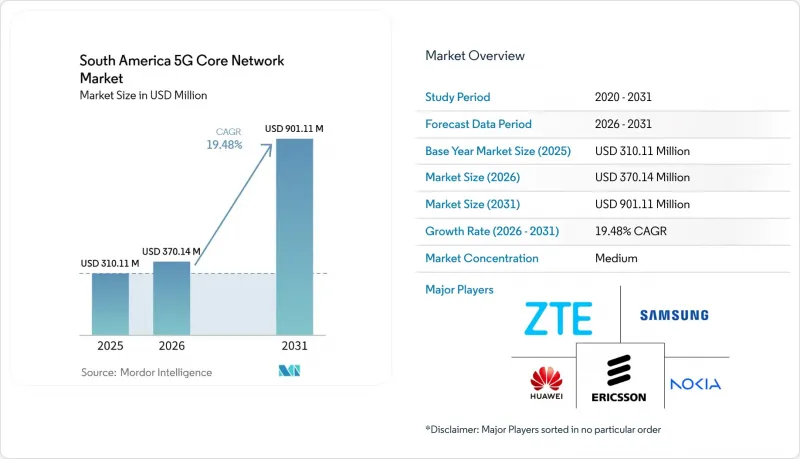
This report is Segmented by Component (Solutions, and Services), Deployment Model (On-Premises/Dedicated, Public Cloud, and Hybrid and Telco Edge Cloud), End-User (Telecom Operators, and Enterprises), Network Function (Network Exposure Function, User Plane Function, Application Function, Unified Data Management, and More), and Country. The Market Forecasts are Provided in Terms of Value (USD).
South America 5G Core Network Market Trends and Insights
Rising 5G Standalone Rollouts Driving South America 5G Core Network Market Demand
Brazil's standalone rollout has put it ahead of the regional deployment cycle and made it the primary source of core network demand. The government stated in March 2026 that 80% of Brazil's population is expected to have 5G access by the end of 2026, with coverage in more than 2,220 municipalities. These coverage commitments require operators to keep adding standalone capacity and related software. The South America 5G core network market, therefore, benefits from procurement that is tied to regulatory milestones, not only to short-term changes in consumer demand. The pace of rollout can also create work for service providers when device availability, certification, and enterprise use cases take longer to develop. This combination supports continued spending on deployment, testing, operations, and maintenance.
Operator Shift from Legacy EPC to Cloud-Native Core Architectures
Operators are moving from older evolved packet core platforms toward cloud-native core systems that can support 5G standalone services. AMD reported that 33% of surveyed operators had already placed most 5G core functions on cloud-native infrastructure in 2025, while another 30% targeted completion by the end of 2026. The change requires new software, virtualized infrastructure, and operating practices capable of handling distributed network functions. Telefonica and AWS demonstrated a 5G standalone core configuration for Vivo that used network functions from Mavenir, Nokia, and Oracle across cloud and operator facilities. This type of multi-vendor model raises the importance of integration skills in the South America 5G core network market. It also allows operators to centralize control functions while keeping performance-sensitive functions closer to users.
Delayed Spectrum Readiness and Uneven 5G Standalone Timelines
Spectrum readiness outside Brazil remains uneven, which slows the start of standalone core investment in several countries. Argentina had around 2,300 5G sites by the end of March 2026, but enterprise monetization of standalone services was still in its early stages. The South America 5G core network market is affected because a core upgrade becomes more difficult to justify when radio deployment, spectrum access, and business demand do not advance together. Bolivia began its 5G spectrum award process in 2026, indicating that its investment cycle is still in its early stages. Some Andean and River Plate markets are also focused on 4G densification before larger standalone programs begin. These differences make regional demand less uniform and concentrate near-term opportunities in countries with clearer spectrum conditions.
Other drivers and restraints analyzed in the detailed report include:
- Network Slicing Demand from Enterprise and Public Sector Use Cases
- Public Sector Digitalization Programs Accelerating 5G Core Investment
- High Integration Complexity with Existing 4G and Legacy OSS/BSS Stacks
For complete list of drivers and restraints, kindly check the Table Of Contents.
Segment Analysis
Solutions are expected to hold 61.45% of the South America 5G core network market share in 2025, reflecting the need to deploy foundational standalone software before operators expand service layers. Packet-core software represents the central value category because it supports the core traffic and control functions required for a standalone architecture. Network function virtualization infrastructure also plays an important role by providing the computing environment for virtualized functions. Orchestration and management tools help operators coordinate these functions across distributed locations. Vivo's cloud deployment demonstration showed that core functions from Mavenir, Nokia, and Oracle could operate across public cloud infrastructure and operator data centers. Such deployments show why solution purchases often involve multiple infrastructure and software suppliers.
Services are projected to expand at a 21.39% CAGR through 2031 as the installed base of standalone networks requires deployment, integration, support, and maintenance. Operators need integration and deployment services when they move functions from legacy platforms to virtualized environments. Support contracts become more important after a core goes live, as operators must maintain availability, security, and performance. Consulting and advisory services also support OSS and BSS alignment, network slice design, and application programming interface monetization. Therefore, the South America 5G core network market can generate recurring service revenue after the initial software implementation. This pattern reduces reliance on a single upfront platform sale and increases the value of local delivery capabilities.
On-premises and dedicated systems are expected to account for 52.21% of revenue in 2025, as operators require data control, low user-plane latency, and compliance with sector-specific requirements. This model remains relevant for energy, public safety, and other applications that require predictable local performance. Operators also commonly use this model when cloud availability remains limited, or data residency requirements discourage full public cloud deployment. Local deployments can keep user plane processing close to the radio network and enterprise applications. The South America 5G core network market size for this model reflects the current priority placed on reliable traffic management and operational control. It also reflects that many operators are gradually introducing cloud-native systems rather than replacing every existing platform at once.
Hybrid and telco edge cloud deployment is projected to expand at a 20.27% CAGR through 2031 in the South America 5G core network market, as it combines centralized cloud functions with edge-based user-plane capacity. Vivo's proof of concept showed that 5G standalone core functions could operate across AWS infrastructure and operator-owned data centers. This approach can keep latency-sensitive processing close to industrial sites while allowing other functions to use centralized cloud resources. Public cloud adoption is also advancing, although operators continue to assess costs for high-volume user-plane workloads. Standards covering edge computing and network slicing provide a common technical basis for these design choices. The deployment model is becoming increasingly important as enterprises seek low-latency, location-sensitive connectivity.
Complete Report Scope:
- By Component
- Solutions
- Packet-Core Software
- NFV Infrastructure
- Orchestration and Management
- Services
- Integration and Deployment
- Consulting and Advisory
- Support and Maintenance
- Solutions
- By Deployment Model
- On-Premise/Dedicated
- Public Cloud
- Hybrid and Telco Edge Cloud
- By End-User
- Telecom Operators
- Enterprises
- Manufacturing
- Energy and Utilities
- Transportation and Logistics
- Public Safety and Emergency
- Smart Cities and Municipalities
- By Network Function
- Network Exposure Function (NEF)
- User Plane Function (UPF)
- Application Function (AF)
- Unified Data Management (UDM)
- Session Management Function (SMF)
- Network Slice Selection Function (NSSF)
- Policy Control Function (PCF)
- Network Repository Function (NRF)
- Authentication Server Function (AUSF)
- Access and Mobility Management (AMF)
- By Country
- Brazil
- Argentina
- Rest of South America
List of Companies Covered in this Report:
- Ericsson
- Nokia
- Huawei Technologies Co., Ltd.
- ZTE Corporation
- Samsung Electronics Co., Ltd.
- Mavenir Systems, Inc.
- Oracle Corporation
- Cisco Systems, Inc.
- Hewlett Packard Enterprise Development LP
- Dell Technologies Inc.
- Red Hat, Inc.
- NEC Corporation
- Juniper Networks, Inc.
- Amdocs Limited
- Comarch SA
- IBM Corporation
- HCLTech
- Tech Mahindra Limited
Additional Benefits:
- The market estimate (ME) sheet in Excel format
- 3 months of analyst support
TABLE OF CONTENTS
1 INTRODUCTION
- 1.1 Study Assumptions and Market Definition
- 1.2 Scope of the Study
2 RESEARCH METHODOLOGY
3 EXECUTIVE SUMMARY
4 MARKET LANDSCAPE
- 4.1 Market Overview
- 4.2 Market Drivers
- 4.2.1 Rising 5G Standalone Rollouts Across Major South American Networks
- 4.2.2 Operator Shift From Legacy EPC to Cloud Native Core Architectures
- 4.2.3 Network Slicing Demand From Enterprise and Public Sector Use Cases
- 4.2.4 Public Sector Digitalization Programs Accelerating 5G Core Investment
- 4.2.5 Multi-Access Edge Integration for Low Latency Industrial Connectivity
- 4.2.6 Vendor Open RAN and Core Modernization Bundling Strategies
- 4.3 Market Restraints
- 4.3.1 Delayed Spectrum Readiness and Uneven 5G Standalone Timelines
- 4.3.2 High Integration Complexity With Existing 4G and Legacy OSS BSS Stacks
- 4.3.3 Currency Volatility Affecting Multi-Year Core Network Procurement
- 4.3.4 Limited Telecom Capex Outside Tier-1 Operators
- 4.4 Value Chain Analysis
- 4.5 Regulatory Landscape
- 4.6 Technological Outlook
- 4.7 PESTLE Analysis
- 4.8 Porter's Five Forces Analysis
- 4.8.1 Threat of New Entrants
- 4.8.2 Bargaining Power of Buyers
- 4.8.3 Bargaining Power of Suppliers
- 4.8.4 Threat of Substitutes
- 4.8.5 Competitive Rivalry
5 MARKET SIZE AND GROWTH FORECASTS (VALUE)
- 5.1 By Component
- 5.1.1 Solutions
- 5.1.1.1 Packet-Core Software
- 5.1.1.2 NFV Infrastructure
- 5.1.1.3 Orchestration and Management
- 5.1.2 Services
- 5.1.2.1 Integration and Deployment
- 5.1.2.2 Consulting and Advisory
- 5.1.2.3 Support and Maintenance
- 5.1.1 Solutions
- 5.2 By Deployment Model
- 5.2.1 On-Premise/Dedicated
- 5.2.2 Public Cloud
- 5.2.3 Hybrid and Telco Edge Cloud
- 5.3 By End-User
- 5.3.1 Telecom Operators
- 5.3.2 Enterprises
- 5.3.2.1 Manufacturing
- 5.3.2.2 Energy and Utilities
- 5.3.2.3 Transportation and Logistics
- 5.3.2.4 Public Safety and Emergency
- 5.3.2.5 Smart Cities and Municipalities
- 5.4 By Network Function
- 5.4.1 Network Exposure Function (NEF)
- 5.4.2 User Plane Function (UPF)
- 5.4.3 Application Function (AF)
- 5.4.4 Unified Data Management (UDM)
- 5.4.5 Session Management Function (SMF)
- 5.4.6 Network Slice Selection Function (NSSF)
- 5.4.7 Policy Control Function (PCF)
- 5.4.8 Network Repository Function (NRF)
- 5.4.9 Authentication Server Function (AUSF)
- 5.4.10 Access and Mobility Management (AMF)
- 5.5 By Country
- 5.5.1 Brazil
- 5.5.2 Argentina
- 5.5.3 Rest of South America
6 COMPETITIVE LANDSCAPE
- 6.1 Market Concentration
- 6.2 Strategic Moves
- 6.3 Market Share Analysis
- 6.4 Company Profiles (includes Global Level Overview, Market Level Overview, Core Segments, Financials as available, Strategic Information, Market Rank/Share, Products and Services, Recent Developments)
- 6.4.1 Ericsson
- 6.4.2 Nokia
- 6.4.3 Huawei Technologies Co., Ltd.
- 6.4.4 ZTE Corporation
- 6.4.5 Samsung Electronics Co., Ltd.
- 6.4.6 Mavenir Systems, Inc.
- 6.4.7 Oracle Corporation
- 6.4.8 Cisco Systems, Inc.
- 6.4.9 Hewlett Packard Enterprise Development LP
- 6.4.10 Dell Technologies Inc.
- 6.4.11 Red Hat, Inc.
- 6.4.12 NEC Corporation
- 6.4.13 Juniper Networks, Inc.
- 6.4.14 Amdocs Limited
- 6.4.15 Comarch SA
- 6.4.16 IBM Corporation
- 6.4.17 HCLTech
- 6.4.18 Tech Mahindra Limited
7 MARKET OPPORTUNITIES AND FUTURE OUTLOOK
- 7.1 White-Space and Unmet-Need Assessment

