PUBLISHER: Mordor Intelligence | PRODUCT CODE: 2119186

PUBLISHER: Mordor Intelligence | PRODUCT CODE: 2119186
Middle East 5G Core Network - Market Share Analysis, Industry Trends & Statistics, Growth Forecasts (2026 - 2031)
According to Mordor Intelligence, the Middle East 5G core network market size was valued at USD 0.39 billion in 2025 and estimated to expand from USD 0.48 billion in 2026 to reach USD 1.25 billion by 2031, at a CAGR of 21.10% during the forecast period (2026-2031).
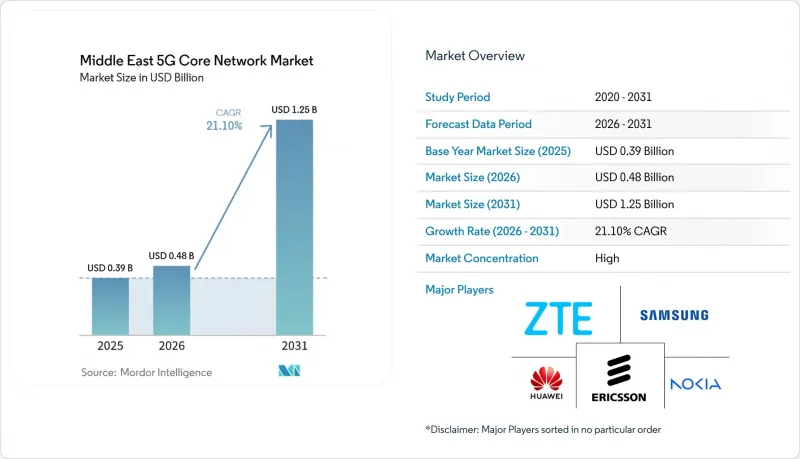
This report is Segmented by Component (Solutions, and Services), Deployment Model (On-Premises/Dedicated, Public Cloud, and Hybrid and Telco Edge Cloud), End-User (Telecom Operators, and Enterprises), Network Function (Network Exposure Function, User Plane Function, Application Function, Unified Data Management, and More), and Country. The Market Forecasts are Provided in Terms of Value (USD).
Middle East 5G Core Network Market Trends and Insights
Accelerated 5G Standalone Core Deployments Across Gulf Operator Networks
Gulf operators have moved standalone 5G from limited trials to wider commercial deployments. This shift requires investment in packet core software, subscriber data management, automation, and cloud infrastructure. The Middle East 5G Core Network Market benefits from a standalone architecture, which supports capabilities that non-standalone networks cannot provide in the same way. These include network slicing, voice over new radio, and more direct service differentiation for enterprise customers. The five-year agreement signed by stc Group and Ericsson in December 2025 covered 5G standalone, 5G Advanced, massive MIMO, cloud-native platforms, managed services, and third-party integration. The agreement shows that core modernization is being treated as a multiyear operating priority rather than a short equipment refresh.
Rising Demand for Network Slicing in Enterprise and Government Use Cases
Network slicing allows operators to offer dedicated connectivity characteristics to users with different operational needs. Manufacturing sites, ports, public safety agencies, and energy operations can require predictable performance rather than best-effort mobile access. This requirement supports the Middle East 5G Core Network Market because slicing depends on standalone core functions and automated policy control. Nokia and Ooredoo Qatar agreed in February 2025 to modernize a full standalone core with slicing and AI-ML integration for ports, mining, and natural gas applications. The deployment connects core investment to sectors that already have large operational footprints across Gulf economies. The commercial case becomes stronger when a single network can support distinct service requirements for industrial, public, and consumer users.
High Complexity of Multi-Vendor Core Integration and Interoperability
A multi-vendor architecture can reduce dependence on a single supplier, but it also adds testing and operational overhead. Operators must verify that core functions, radio networks, orchestration platforms, and security controls work together in live conditions. Standards provide a common framework, yet interface differences can still require extensive bilateral validation. This extends deployment schedules and raises the cost of each new supplier relationship. The Middle East 5G Core Network Market may therefore favor vendors with existing local integration records and established operator teams. This preference can reinforce incumbent positions when operators prioritize a tested delivery model over an unproven integration path. Smaller operators face a greater burden because they have fewer specialized engineering resources for complex verification work.
Other drivers and restraints analyzed in the detailed report include:
- Government-Led Digital Transformation and National 5G Sovereignty Programs
- Expansion of Cloud-Native Core Architectures for Agile Service Launches
- Dependence on Skilled 5G Core Engineering and Cybersecurity Talent
For complete list of drivers and restraints, kindly check the Table Of Contents.
Segment Analysis
Solutions are expected to capture 61.59% of component revenue in the Middle East 5G core network market in 2025. This position reflects spending on packet-core software, network function virtualization infrastructure, and orchestration platforms. Operators require these capabilities as they shift from radio-led 5G rollouts to standalone service delivery. The Middle East 5G Core Network Market reflects this transition, as solutions enable the practical delivery of standalone services. Packet-core software remains central because it supports the shift from hardware-bound functions to containerized network services. Orchestration platforms are also gaining importance as operators manage distributed functions and multiple suppliers.
Services are projected to expand at a 22.90% CAGR through 2031. Operators need integration and deployment services when they introduce standalone cores into existing multi-vendor environments. Consulting, support, and maintenance can become recurring requirements after the initial implementation. The stc Group agreement with Ericsson included advanced managed services and third-party integration, illustrating the shift toward longer commercial relationships. Demand for integration services is especially important in the Rest of the Middle East, where operators may lack large in-house teams for core verification. Services, therefore, support implementation continuity, while solutions remain the larger revenue base.
On-premises and dedicated deployments are expected to account for 50.32% of the Middle East 5G Core Network Market size in 2025. Operators use this model to address data residency requirements and maintain control over critical network functions. Mission-critical enterprise users also require low latency and locally managed data paths. A dedicated model can place user-plane processing closer to an enterprise site or an operator edge location. This design supports local processing without requiring operators to distribute every control function.
Hybrid and telco edge cloud is projected to expand at a 25.89% CAGR through 2031. The model allows operators to retain core control functions onshore while distributing user plane functions where workloads require shorter response times. It is particularly relevant to ports, industrial zones, logistics facilities, and smart-city projects. Ericsson and e& UAE agreed in October 2025 to modernize the operator's core using a cloud-native dual-mode solution in a hybrid configuration. Hybrid architecture offers a practical balance between local compliance requirements and the operational advantages of distributed cloud functions.
Complete Report Scope:
- By Component
- Solutions
- Packet-Core Software
- NFV Infrastructure
- Orchestration and Management
- Services
- Integration and Deployment
- Consulting and Advisory
- Support and Maintenance
- Solutions
- By Deployment Model
- On-Premise/Dedicated
- Public Cloud
- Hybrid and Telco Edge Cloud
- By End-User
- Telecom Operators
- Enterprises
- Manufacturing
- Energy and Utilities
- Transportation and Logistics
- Public Safety and Emergency
- Smart Cities and Municipalities
- By Network Function
- Network Exposure Function (NEF)
- User Plane Function (UPF)
- Application Function (AF)
- Unified Data Management (UDM)
- Session Management Function (SMF)
- Network Slice Selection Function (NSSF)
- Policy Control Function (PCF)
- Network Repository Function (NRF)
- Authentication Server Function (AUSF)
- Access and Mobility Management Function (AMF)
- By Country
- Saudi Arabia
- United Arab Emirates
- Rest of Middle East
List of Companies Covered in this Report:
- Nokia Corporation
- Telefonaktiebolaget LM Ericsson (publ)
- Huawei Technologies Co., Ltd.
- Samsung Electronics Co., Ltd.
- ZTE Corporation
- Cisco Systems, Inc.
- Amdocs Limited
- Hewlett Packard Enterprise Company
- Intel Corporation
- Oracle Corporation
- Red Hat, Inc.
- Mavenir Systems, Inc.
- Athonet S.r.l.
- NEC Corporation
- Juniper Networks, Inc.
- Dell Technologies Inc.
- Parallel Wireless, Inc.
Additional Benefits:
- The market estimate (ME) sheet in Excel format
- 3 months of analyst support
TABLE OF CONTENTS
1 INTRODUCTION
- 1.1 Study Assumptions and Market Definition
- 1.2 Scope of the Study
2 RESEARCH METHODOLOGY
3 EXECUTIVE SUMMARY
4 MARKET LANDSCAPE
- 4.1 Market Overview
- 4.2 Market Drivers
- 4.2.1 Accelerated 5G Standalone Core Deployments Across Gulf Operator Networks
- 4.2.2 Rising Demand for Network Slicing in Enterprise and Government Use Cases
- 4.2.3 Government-Led Digital Transformation and National 5G Sovereignty Programs
- 4.2.4 Expansion of Cloud-Native Core Architectures for Agile Service Launches
- 4.2.5 Private 5G Adoption in Industrial Zones, Ports, and Smart City Projects
- 4.2.6 Increasing Voice Over New Radio and Low-Latency Service Requirements
- 4.3 Market Restraints
- 4.3.1 High Complexity of Multi-Vendor Core Integration and Interoperability
- 4.3.2 Dependence on Skilled 5G Core Engineering and Cybersecurity Talent
- 4.3.3 Delayed Monetization of Standalone 5G Use Cases in Price-Sensitive Markets
- 4.3.4 Stringent Data Residency and Telecom Sovereignty Requirements
- 4.4 Value Chain Analysis
- 4.5 Regulatory Landscape
- 4.6 Technological Outlook
- 4.7 PESTLE Analysis
- 4.8 Porter's Five Forces Analysis
- 4.8.1 Threat of New Entrants
- 4.8.2 Bargaining Power of Buyers
- 4.8.3 Bargaining Power of Suppliers
- 4.8.4 Threat of Substitutes
- 4.8.5 Competitive Rivalry
5 MARKET SIZE AND GROWTH FORECASTS (VALUE)
- 5.1 By Component
- 5.1.1 Solutions
- 5.1.1.1 Packet-Core Software
- 5.1.1.2 NFV Infrastructure
- 5.1.1.3 Orchestration and Management
- 5.1.2 Services
- 5.1.2.1 Integration and Deployment
- 5.1.2.2 Consulting and Advisory
- 5.1.2.3 Support and Maintenance
- 5.1.1 Solutions
- 5.2 By Deployment Model
- 5.2.1 On-Premise/Dedicated
- 5.2.2 Public Cloud
- 5.2.3 Hybrid and Telco Edge Cloud
- 5.3 By End-User
- 5.3.1 Telecom Operators
- 5.3.2 Enterprises
- 5.3.2.1 Manufacturing
- 5.3.2.2 Energy and Utilities
- 5.3.2.3 Transportation and Logistics
- 5.3.2.4 Public Safety and Emergency
- 5.3.2.5 Smart Cities and Municipalities
- 5.4 By Network Function
- 5.4.1 Network Exposure Function (NEF)
- 5.4.2 User Plane Function (UPF)
- 5.4.3 Application Function (AF)
- 5.4.4 Unified Data Management (UDM)
- 5.4.5 Session Management Function (SMF)
- 5.4.6 Network Slice Selection Function (NSSF)
- 5.4.7 Policy Control Function (PCF)
- 5.4.8 Network Repository Function (NRF)
- 5.4.9 Authentication Server Function (AUSF)
- 5.4.10 Access and Mobility Management Function (AMF)
- 5.5 By Country
- 5.5.1 Saudi Arabia
- 5.5.2 United Arab Emirates
- 5.5.3 Rest of Middle East
6 COMPETITIVE LANDSCAPE
- 6.1 Market Concentration
- 6.2 Strategic Moves
- 6.3 Market Share Analysis
- 6.4 Company Profiles (includes Global Level Overview, Market Level Overview, Core Segments, Financials as available, Strategic Information, Market Rank/Share, Products and Services, Recent Developments)
- 6.4.1 Nokia Corporation
- 6.4.2 Telefonaktiebolaget LM Ericsson (publ)
- 6.4.3 Huawei Technologies Co., Ltd.
- 6.4.4 Samsung Electronics Co., Ltd.
- 6.4.5 ZTE Corporation
- 6.4.6 Cisco Systems, Inc.
- 6.4.7 Amdocs Limited
- 6.4.8 Hewlett Packard Enterprise Company
- 6.4.9 Intel Corporation
- 6.4.10 Oracle Corporation
- 6.4.11 Red Hat, Inc.
- 6.4.12 Mavenir Systems, Inc.
- 6.4.13 Athonet S.r.l.
- 6.4.14 NEC Corporation
- 6.4.15 Juniper Networks, Inc.
- 6.4.16 Dell Technologies Inc.
- 6.4.17 Parallel Wireless, Inc.
7 MARKET OPPORTUNITIES AND FUTURE OUTLOOK
- 7.1 White-Space and Unmet-Need Assessment

