PUBLISHER: Mordor Intelligence | PRODUCT CODE: 2119304

PUBLISHER: Mordor Intelligence | PRODUCT CODE: 2119304
Canned Wines - Market Share Analysis, Industry Trends & Statistics, Growth Forecasts (2026 - 2031)
According to Mordor Intelligence, the canned wines market size was valued at USD 546.48 million in 2025 and estimated to grow from USD 605.42 million in 2026 to reach USD 923.41 million by 2031, at a CAGR of 11.63% during the forecast period (2026-2031).
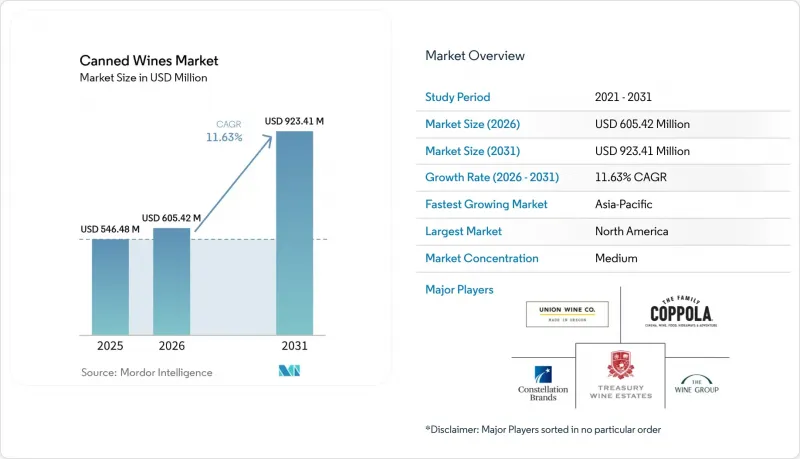
This report is Segmented by Product Type (Still Wine, Sparkling Wine, and Fortified Wine), Form (Red Wine and White Wine), Distribution Channel (On-Trade and Off-Trade), and Geography (North America, Europe, Asia-Pacific, South America, and Middle East and Africa). The Market Forecasts are Provided in Terms of Value (USD).
Global Canned Wines Market Trends and Insights
Growing Demand for Convenient Drinks Packaging
Convenient packaging is expanding wine consumption into outdoor events, cinemas, flights, stadiums, and other venues where glass bottles are less practical. Single-serve cans reduce breakage, handling, waste, and portion-control challenges while offering consumers a lower-commitment way to try wine. Strong demand in entertainment settings, such as Archer Roose Wines supplying 2,400 cases to Regal Cinemas within six months, demonstrates the potential of these occasions. Cans also benefit from retail placement alongside ready-to-drink beverages, helping brands reach younger and occasion-driven consumers. The format complements rather than replaces bottled wine, serving individual consumption, travel, picnics, and casual gatherings. As distribution expands across retail, hospitality, travel, and entertainment, convenience-led consumption is expected to support the growth of the canned wines market.
Rising Premiumization of Ready-to-Drink Alcoholic Beverages
Premiumization is expanding the role of cans in wine, with producers using single-vineyard sourcing, vintage information, organic credentials, and lower-additive claims to justify higher price points. Archer Roose Wines' launch of an Australian Pinot Noir at USD 19 per 4-pack demonstrates how premium wine attributes can be communicated through canned formats. Fortified products such as Sogrape's Offley Clink Portonic Rose further show how cans can introduce established wine styles to new leisure and social occasions. Provenance, transparent labeling, recognizable varietals, and consistent quality are essential for building consumer trust and sustaining premium pricing. Four-packs also combine premium positioning with single-serve convenience, creating opportunities across retail, hospitality, and outdoor consumption occasions. As wine companies increasingly focus on differentiated, higher-margin products, premium canned wines can benefit from stronger branding and clearer quality credentials.
Strict Alcohol Packaging and Labeling Regulations
Alcohol regulation creates costs for canned wine producers, especially when they sell across several countries. The U.S. Alcohol and Tobacco Tax and Trade Bureau proposed mandatory Alcohol Facts statements for wines and other regulated alcohol products on January 17, 2025. The proposal covers per-serving calorie, alcohol, and nutrient disclosures. Smaller companies may find it harder to manage label updates and approvals. The Canned wines market can face longer launch timelines when packaging requirements change. Producers need compliance planning before they commit to design and inventory. TTB added 13 standards of fill for wine in its January 2025 final rule. The approved sizes include 330 ml, 360 ml, 473 ml, and 568 ml formats that are relevant to canned wine. The change gives producers more flexibility in pack design. It also requires companies to consider new Certificate of Label Approval filings when they adopt a new size. This means flexibility comes with an administrative requirement. Brands with established compliance teams may respond more easily than small entrants.
Other drivers and restraints analyzed in the detailed report include:
- Sustainability Advantages of Lightweight Aluminum Packaging
- E-Commerce and Direct-to-Consumer Brand Discovery
- Taste Stability and Product Compatibility Challenges
For complete list of drivers and restraints, kindly check the Table Of Contents.
Segment Analysis
Sparkling Wine held 62.38% of the category share in 2025. Its position reflects a close fit with individual servings at outdoor events, gifting occasions, and entertainment venues. The container can prevent an opened bottle from losing effervescence when only 1 serving is needed. Still Wine remained the secondary product type and supported a broad range of price points. It gives producers a route to everyday consumption across different geographies. Sparkling products are likely to retain an advantage where the occasion requires portable, chilled, and simple service.
Fortified Wine is forecast to grow at a 13.45% CAGR through 2031, the highest among product types. The Canned wines market size for fortified formats can expand as Port and sherry-based drinks are positioned for leisure rather than formal dining. Sogrape's Offley Clink Portonic Rose offers an example through its canned Port and tonic format. The product addresses consumers who may not choose a conventional bottle of fortified wine. Premium sourcing and clear product stories remain important across all product types. Cans can extend the reach of wine without requiring producers to compromise on recognizable styles.
Complete Report Scope:
- Product Type
- Still Wine
- Sparkling Wine
- Fortified Wine
- Form
- Red Wine
- White Wine
- Distribution Channels
- On-Trade
- Off-Trade
- Supermarkets/Hypermarkets
- Specialty Stores
- Online Retail Channels
- Other Distribution Channels
- By Geography
- North America
- United States
- Canada
- Mexico
- Rest of North America
- Europe
- Germany
- United Kingdom
- France
- Italy
- Spain
- Netherlands
- Sweden
- Poland
- Belgium
- Rest of Europe
- Asia-Pacific
- China
- India
- Japan
- Australia
- South Korea
- Vietnam
- Indonesia
- Thailand
- Singapore
- Rest of Asia-Pacific
- South America
- Brazil
- Argentina
- Chile
- Peru
- Colombia
- Rest of South America
- Middle East and Africa
- United Arab Emirates
- Saudi Arabia
- South Africa
- Nigeria
- Egypt
- Morocco
- Turkey
- Rest of Middle East and Africa
- North America
Geography Analysis
North America held 52.38% of the category share in 2025. The United States has established ready-to-drink distribution and a retail environment where single-serve alcohol is a familiar category. TTB's 2025 standards of fill rule added 330 ml, 360 ml, 473 ml, and 568 ml options for wine. These sizes can give brands more flexibility in packaging and service design. Canada's outdoor and ski-tourism occasions also fit the product. Mexico's urban middle class can add to regional demand as availability broadens.
Asia-Pacific is forecast to grow at a 12.67% CAGR through 2031. India has a developing premium canned wine opportunity. Sula Vineyards reported that premium canned wines outsold bottled wine at SulaFest 2025 and expanded its canned offering to IndiGo international business-class flights in March 2025. The flight placement introduced Indian canned wine to international aviation distribution. Japan has strong consumer familiarity with single-serve packaged beverages. China's Tier 1 and Tier 2 cities offer a longer-term opportunity among consumers interested in lifestyle beverages.
Europe has differentiated demand across its wine markets. In the United Kingdom, Ocado Retail reported that Canned Wine Co. Gamay sales rose 212% year over year and M&S California Rose tins rose 541% in the 12 months to July 2025. Germany, France, and the Benelux countries have stronger bottle-based wine traditions. South America has production assets that can support domestic canned formats, especially in Argentina and Chile. The Middle East and Africa remain early-stage markets because alcohol regulations constrain access in many Gulf Cooperation Council markets. South Africa and selected North African markets may offer future demand as licensed hospitality infrastructure expands.
- Union Wine Company
- Treasury Wine Estates Ltd.
- Constellation Brands, Inc.
- The Wine Group LLC
- The Family Coppola
- Integrated Beverage Group LLC
- Sula Vineyards Pvt. Ltd.
- Accolade Wines
- Suntory Holdings Limited
- Pernod Ricard
- Diageo plc
- Brown-Forman Corporation
- Anheuser-Busch InBev
- Molson Coors Beverage Company
- Canned Wine Co.
- SANS Wine Co.
- Maker Wine Company
- Archer Roose Wines
- Nomadica
- The Infinite Monkey Theorem
Additional Benefits:
- The market estimate (ME) sheet in Excel format
- 3 months of analyst support
TABLE OF CONTENTS
1 INTRODUCTION
- 1.1 Study Assumptions and Market Definition
- 1.2 Scope of the Study
2 RESEARCH METHODOLOGY
3 EXECUTIVE SUMMARY
4 MARKET LANDSCAPE
- 4.1 Market Overview
- 4.2 Market Drivers
- 4.2.1 Growing Demand for Convenient Drinks Packaging
- 4.2.2 Rising Premiumization of Ready-to-Drink Alcoholic Beverages
- 4.2.3 Rising Outdoor, Festival, Travel, and Event Consumption
- 4.2.4 Sustainability Advantages of Lightweight Aluminum Packaging
- 4.2.5 E-Commerce and Direct-to-Consumer Brand Discovery
- 4.2.6 Increasing Product Innovation and Flavor Diversification
- 4.3 Market Restraints
- 4.3.1 Strict Alcohol Packaging and Labeling Regulations
- 4.3.2 High Competition from Other RTD Alcoholic Beverages
- 4.3.3 Taste Stability and Product Compatibility Challenges
- 4.3.4 Limited Shelf Space in Traditional Wine Sections
- 4.4 Consumer Behavior Analysis
- 4.5 Regulatory Landscape
- 4.6 Technological Outlook
- 4.7 Porter's Five Forces
- 4.7.1 Threat of New Entrants
- 4.7.2 Bargaining Power of Buyers/Consumers
- 4.7.3 Bargaining Power of Suppliers
- 4.7.4 Threat of Substitute Products
- 4.7.5 Intensity of Competitive Rivalry
5 MARKET SIZE AND GROWTH FORECASTS (VALUE)
- 5.1 Product Type
- 5.1.1 Still Wine
- 5.1.2 Sparkling Wine
- 5.1.3 Fortified Wine
- 5.2 Form
- 5.2.1 Red Wine
- 5.2.2 White Wine
- 5.3 Distribution Channels
- 5.3.1 On-Trade
- 5.3.2 Off-Trade
- 5.3.2.1 Supermarkets/Hypermarkets
- 5.3.2.2 Specialty Stores
- 5.3.2.3 Online Retail Channels
- 5.3.2.4 Other Distribution Channels
- 5.4 By Geography
- 5.4.1 North America
- 5.4.1.1 United States
- 5.4.1.2 Canada
- 5.4.1.3 Mexico
- 5.4.1.4 Rest of North America
- 5.4.2 Europe
- 5.4.2.1 Germany
- 5.4.2.2 United Kingdom
- 5.4.2.3 France
- 5.4.2.4 Italy
- 5.4.2.5 Spain
- 5.4.2.6 Netherlands
- 5.4.2.7 Sweden
- 5.4.2.8 Poland
- 5.4.2.9 Belgium
- 5.4.2.10 Rest of Europe
- 5.4.3 Asia-Pacific
- 5.4.3.1 China
- 5.4.3.2 India
- 5.4.3.3 Japan
- 5.4.3.4 Australia
- 5.4.3.5 South Korea
- 5.4.3.6 Vietnam
- 5.4.3.7 Indonesia
- 5.4.3.8 Thailand
- 5.4.3.9 Singapore
- 5.4.3.10 Rest of Asia-Pacific
- 5.4.4 South America
- 5.4.4.1 Brazil
- 5.4.4.2 Argentina
- 5.4.4.3 Chile
- 5.4.4.4 Peru
- 5.4.4.5 Colombia
- 5.4.4.6 Rest of South America
- 5.4.5 Middle East and Africa
- 5.4.5.1 United Arab Emirates
- 5.4.5.2 Saudi Arabia
- 5.4.5.3 South Africa
- 5.4.5.4 Nigeria
- 5.4.5.5 Egypt
- 5.4.5.6 Morocco
- 5.4.5.7 Turkey
- 5.4.5.8 Rest of Middle East and Africa
- 5.4.1 North America
6 COMPETITIVE LANDSCAPE
- 6.1 Market Concentration
- 6.2 Strategic Moves
- 6.3 Market Ranking Analysis
- 6.4 Company Profiles (includes Global level Overview, Market level overview, Core Segments, Financials as available, Strategic Information, Market Rank/Share for key companies, Products & Services, and Recent Developments)
- 6.4.1 Union Wine Company
- 6.4.2 Treasury Wine Estates Ltd.
- 6.4.3 Constellation Brands, Inc.
- 6.4.4 The Wine Group LLC
- 6.4.5 The Family Coppola
- 6.4.6 Integrated Beverage Group LLC
- 6.4.7 Sula Vineyards Pvt. Ltd.
- 6.4.8 Accolade Wines
- 6.4.9 Suntory Holdings Limited
- 6.4.10 Pernod Ricard
- 6.4.11 Diageo plc
- 6.4.12 Brown-Forman Corporation
- 6.4.13 Anheuser-Busch InBev
- 6.4.14 Molson Coors Beverage Company
- 6.4.15 Canned Wine Co.
- 6.4.16 SANS Wine Co.
- 6.4.17 Maker Wine Company
- 6.4.18 Archer Roose Wines
- 6.4.19 Nomadica
- 6.4.20 The Infinite Monkey Theorem
7 MARKET OPPORTUNITIES AND FUTURE OUTLOOK

