PUBLISHER: Mordor Intelligence | PRODUCT CODE: 2119614

PUBLISHER: Mordor Intelligence | PRODUCT CODE: 2119614
Japan Flash Memory - Market Share Analysis, Industry Trends & Statistics, Growth Forecasts (2026 - 2031)
According to Mordor Intelligence, Japan flash memory market size in 2026 is estimated at USD 3.25 billion, growing from 2025 value of USD 3.16 billion with 2031 projections showing USD 3.75 billion, growing at 2.90% CAGR over 2026-2031.
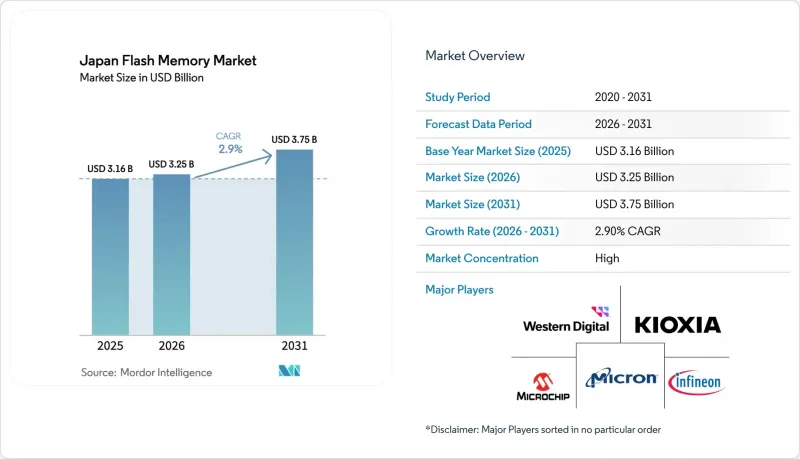
This report is Segmented by Memory Type (3D NAND, 2D NAND, NOR Flash, and More), Density (Up To 256 Mb, 512 Mb-2 Gb, and More), Interface/Form Factor (eMMC, UFS, SATA SSD, and More), End User Application (Data Center and Enterprise Servers, Mobile and Tablets, Automotive, Industrial and IoT Devices, and More), and Geography. The Market Forecasts are Provided in Terms of Value (USD).
Japan Flash Memory Market Trends and Insights
Surging Adoption of SSDs in Consumer and Enterprise PCs
Enterprise refresh cycles are shifting decisively toward NVMe storage, which delivers single-digit microsecond latency, thereby reducing rack footprints and power draw in data center clusters located in Tokyo and Osaka. Notebook makers are mirroring this shift as PCIe Gen4 drives become mainstream in mid-range systems. Western Digital's 218-layer BiCS devices now ship in volume, providing 3 drive writes per day endurance for finance and public-sector workloads. Consumer adoption is accelerating as the 5G rollout drives the need for local caching in routers and base stations. Together, these factors add 0.6 percentage points to overall growth, with peak influence expected between 2026 and 2028.
Expanding Smartphone Production with Higher On-Board Storage
Premium handsets from Sony, Sharp, and Kyocera feature 256 GB and 512 GB storage, enabling 4K video capture and AI-driven imaging. Apple retains a commanding share, but local brands keep niche segments that value ruggedization and high-resolution cameras. Fifth-generation wireless penetration already covers more than half the subscriber base, driving photo and video file sizes higher. These trends deliver a 0.5 percentage-point uplift to the long-term CAGR.
Cyclical NAND Price Volatility and Inventory Gluts
Contract prices fell 6.2% quarter on quarter in 4Q 2024 and are forecast to dip another 10-15% in 1Q 2025 before a modest rebound. Fab operators face margin compression just as new capacity ramps. Kioxia flagged 90 days of inventory in its IPO prospectus, exposing it to further markdowns. This pricing whiplash subtracts 0.5 percentage points from the projected CAGR and complicates cash-flow planning through 2026.
Other drivers and restraints analyzed in the detailed report include:
- Rapid Growth of Automotive ADAS and In-Vehicle Infotainment
- Government Incentives for Domestic Advanced-Flash Fabs
- High Domestic Energy Costs Pressuring Fab Economics
For complete list of drivers and restraints, kindly check the Table Of Contents.
Segment Analysis
3D NAND captured 48.45% revenue in 2025 on the back of data-center conversions to all-flash arrays and automotive adoption of UFS 4.0 modules. This share anchors the Japan flash memory market through the forecast, with density scaling beyond 218 layers keeping average selling prices competitive. Samsung and SK hynix push toward 300-layer devices, putting cost pressure on incumbents yet widening the total addressable pool as terabyte-class packages proliferate.
Other non-volatile technologies, chiefly MRAM and ReRAM, are forecast to expand at a 4.05% CAGR as automotive and industrial equipment require instant-on capability and million-cycle endurance. Kioxia's OCTRAM crosspoint design, co-developed with SK hynix, underpins this surge. NOR and planar NAND linger in legacy designs but cede ground as vertical stacking shrinks die costs. These dynamics keep the Japan flash memory market diversified yet tilted toward 3D structures over the forecast window.
The 64 Gb-256 Gb class held 37.15% revenue in 2025, tied to smartphone bills of materials that favor 128 GB and 256 GB capacities. Rising photo and video file sizes, combined with carrier bundling of unlimited data, nudge consumers toward higher SKUs.
The 512 Gb-and-above bracket is projected to grow at a 3.62% CAGR, lifting the Japan flash memory market size for this density group as AI edge devices and ADAS platforms embed 1 TB storage modules. Kioxia's new 2 Tb QLC die enables single-package 1 TB UFS parts, accelerating the migration. Lower-density tiers remain vital for microcontrollers and IoT sensors where energy efficiency and tiny footprints outweigh raw capacity.
Complete Report Scope:
- By Memory Type
- 3D NAND
- 2D NAND (Planar)
- NOR Flash
- Other Memory Type
- By Density
- Up to 256 Mb
- 512 Mb - 2 Gb
- 4 Gb - 32 Gb
- 64 Gb - 256 Gb
- 512 Gb and Above
- By Interface / Form Factor
- eMMC
- UFS
- SATA SSD
- PCIe / NVMe SSD
- SPI NOR
- USB Flash and Removables
- By End User Application
- Data Center and Enterprise Servers
- Mobile and Tablets
- Automotive (ADAS, Infotainment)
- Industrial and IoT Devices
- Client Computing (PC, Laptop, Client SSD)
- Consumer Electronics (Gaming, Wearables)
- Other End User Application
List of Companies Covered in this Report:
- Infineon Technologies AG
- Micron Technology, Inc.
- Kioxia Holdings Corporation
- Western Digital Corporation
- Microchip Technology Incorporated
- Transcend Information, Inc.
- Renesas Electronics Corporation
- Winbond Electronics Corporation
- GigaDevice Semiconductor Inc.
- Samsung Electronics Co., Ltd.
- SK hynix Inc.
- Sony Semiconductor Solutions Corporation
- Panasonic Holdings Corporation
- Toshiba Electronic Devices and Storage Corporation
- Rohm Co., Ltd.
- Macronix International Co., Ltd.
- Integrated Silicon Solution, Inc. (ISSI)
- Silicon Motion Technology Corporation
- ATP Electronics, Inc.
- Kingston Technology Company, Inc.
- Phison Electronics Corporation
- Cypress Semiconductor Corporation
Additional Benefits:
- The market estimate (ME) sheet in Excel format
- 3 months of analyst support
TABLE OF CONTENTS
1 INTRODUCTION
- 1.1 Study Assumptions and Market Definition
- 1.2 Scope of the Study
2 RESEARCH METHODOLOGY
3 EXECUTIVE SUMMARY
4 MARKET LANDSCAPE
- 4.1 Market Overview
- 4.2 Impact of Macro Trends
- 4.3 Market Drivers
- 4.3.1 Surging Adoption Of SSDs In Consumer And Enterprise PCs
- 4.3.2 Expanding Smartphone Production With Higher On-Board Storage
- 4.3.3 Rapid Growth Of Automotive ADAS And In-Vehicle Infotainment
- 4.3.4 Proliferation Of IoT Edge Devices Needing Local Flash Storage
- 4.3.5 Government Incentives For Domestic Advanced-Flash Fabs
- 4.3.6 3D NAND Use in Metaverse-Related Japanese Wearables
- 4.4 Market Restraints
- 4.4.1 Cyclical NAND Price Volatility And Inventory Gluts
- 4.4.2 Reliability Challenges At Sub-1z-Nm Nodes
- 4.4.3 High Domestic Energy Costs Pressuring Fab Economics
- 4.4.4 Supply Risk Of High-Purity HF And Photo-Resist Chemicals
- 4.5 Regulatory Landscape
- 4.6 Industry Value Chain Analysis
- 4.7 Technological Outlook
- 4.8 Porter's Five Forces Analysis
- 4.8.1 Threat of New Entrants
- 4.8.2 Bargaining Power of Buyers
- 4.8.3 Bargaining Power of Suppliers
- 4.8.4 Threat of Substitutes
- 4.8.5 Intensity of Competitive Rivalry
5 MARKET SIZE AND GROWTH FORECASTS (VALUE)
- 5.1 By Memory Type
- 5.1.1 3D NAND
- 5.1.2 2D NAND (Planar)
- 5.1.3 NOR Flash
- 5.1.4 Other Memory Type
- 5.2 By Density
- 5.2.1 Up to 256 Mb
- 5.2.2 512 Mb - 2 Gb
- 5.2.3 4 Gb - 32 Gb
- 5.2.4 64 Gb - 256 Gb
- 5.2.5 512 Gb and Above
- 5.3 By Interface / Form Factor
- 5.3.1 eMMC
- 5.3.2 UFS
- 5.3.3 SATA SSD
- 5.3.4 PCIe / NVMe SSD
- 5.3.5 SPI NOR
- 5.3.6 USB Flash and Removables
- 5.4 By End User Application
- 5.4.1 Data Center and Enterprise Servers
- 5.4.2 Mobile and Tablets
- 5.4.3 Automotive (ADAS, Infotainment)
- 5.4.4 Industrial and IoT Devices
- 5.4.5 Client Computing (PC, Laptop, Client SSD)
- 5.4.6 Consumer Electronics (Gaming, Wearables)
- 5.4.7 Other End User Application
6 COMPETITIVE LANDSCAPE
- 6.1 Market Concentration
- 6.2 Strategic Moves
- 6.3 Market Share Analysis
- 6.4 Company Profiles (includes Global-level Overview, Market-level Overview, Core Segments, Financials as available, Strategic Information, Market Rank/Share for key companies, Products and Services, Recent Developments)
- 6.4.1 Infineon Technologies AG
- 6.4.2 Micron Technology, Inc.
- 6.4.3 Kioxia Holdings Corporation
- 6.4.4 Western Digital Corporation
- 6.4.5 Microchip Technology Incorporated
- 6.4.6 Transcend Information, Inc.
- 6.4.7 Renesas Electronics Corporation
- 6.4.8 Winbond Electronics Corporation
- 6.4.9 GigaDevice Semiconductor Inc.
- 6.4.10 Samsung Electronics Co., Ltd.
- 6.4.11 SK hynix Inc.
- 6.4.12 Sony Semiconductor Solutions Corporation
- 6.4.13 Panasonic Holdings Corporation
- 6.4.14 Toshiba Electronic Devices and Storage Corporation
- 6.4.15 Rohm Co., Ltd.
- 6.4.16 Macronix International Co., Ltd.
- 6.4.17 Integrated Silicon Solution, Inc. (ISSI)
- 6.4.18 Silicon Motion Technology Corporation
- 6.4.19 ATP Electronics, Inc.
- 6.4.20 Kingston Technology Company, Inc.
- 6.4.21 Phison Electronics Corporation
- 6.4.22 Cypress Semiconductor Corporation
7 MARKET OPPORTUNITIES AND FUTURE OUTLOOK
- 7.1 White-space and Unmet-need Assessment

