PUBLISHER: Mordor Intelligence | PRODUCT CODE: 2099810

PUBLISHER: Mordor Intelligence | PRODUCT CODE: 2099810
AI Memory - Market Share Analysis, Industry Trends & Statistics, Growth Forecasts (2026 - 2031)
According to Mordor Intelligence, the AI memory market size is expected to grow from USD 21.72 billion in 2025 to USD 27.93 billion in 2026 and is forecast to reach USD 98.28 billion by 2031 at 28.61% CAGR over 2026-2031.
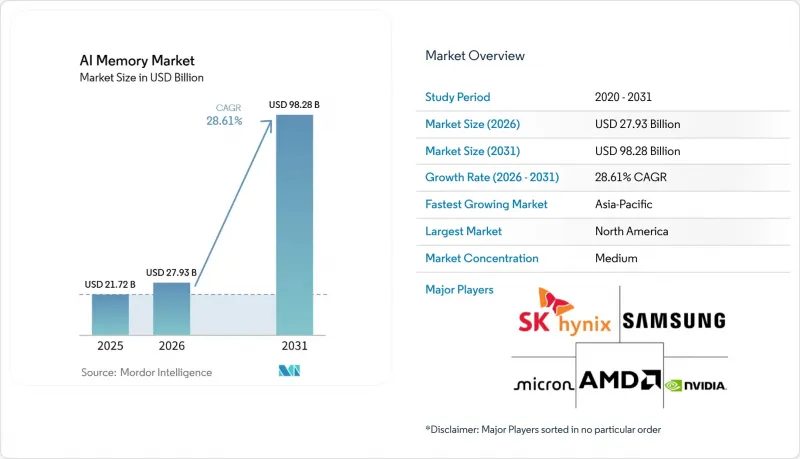
This report is Segmented by Memory Technology (HBM, AI Server DRAM, GDDR, AI Edge Memory LPDDR, and More), AI Application (AI Training and Model Development, AI Inference, and AI Inference, and HPC and Scientific AI), Computing Platform (AI Servers, AI Compute Accelerators, AI Networking Infrastructure, Edge AI Systems, and More), and Geography. The Market Forecasts are Provided in Terms of Value (USD).
Global AI Memory Market Trends and Insights
Growing Adoption of HBM3E And HBM4 in AI Accelerators
The move from HBM3E to HBM4 is progressing quickly as accelerator vendors push for more bandwidth and better power efficiency in each new platform generation. NVIDIA stated in May 2026 that the Vera Rubin platform was ramping into full production, which confirms that next-generation memory demand is now tied directly to production deployments rather than early sampling activity. This matters because HBM is no longer a premium option inside leading AI systems and has become a required part of the compute stack. As buyers align hardware roadmaps with more capable accelerators, memory planning starts earlier and stays locked in for longer periods. That shifts procurement from short-cycle component buying toward platform-level commitment. For the AI memory market, this keeps HBM at the center of revenue growth and strategic supplier positioning.
Expansion of Hyperscale AI Server Fleets
Large AI server programs are moving from staged pilots to committed deployment cycles across cloud infrastructure. AMD and Meta Platforms announced in February 2026 an expanded partnership to deploy 6 gigawatts of AMD GPU infrastructure, with shipments for the first-gigawatt phase beginning in the second half of 2026. Each rollout of that scale pulls in HBM, server DRAM, storage memory, and networking memory at the same time. That means growth is not confined to a single memory type and instead spreads across the full stack that supports AI clusters. It also favors suppliers that can offer dependable qualification, stable output, and roadmap continuity. The AI memory market is therefore benefiting from both larger fleet counts and higher memory content inside each deployed system.
High Package-Level Thermal and Yield Constraints
Advanced stacked memory is harder to scale than conventional memory because more layers have to perform together inside a tighter thermal envelope. This is especially important in HBM, where finished output depends on packaging quality as much as wafer supply. If packaging performance slips, accelerator deliveries can slow even when end demand stays firm. Validation also takes time because each generation has to clear thermal, reliability, and platform-level requirements before volume shipment. That can narrow the usable ramp window for a new product generation. The AI memory market therefore stays exposed to package-level execution risk even when demand conditions remain strong.
Other drivers and restraints analyzed in the detailed report include:
- Rising AI Training and Inference Compute Density
- Memory Content Inflation in AI Servers and Racks
- Limited Qualified Supply Base for Advanced HBM
For complete list of drivers and restraints, kindly check the Table Of Contents.
Segment Analysis
HBM held 55.60% of AI memory market share in 2025, which shows how strongly hyperscale training infrastructure shaped revenue during the year. Its lead came from the fact that leading AI accelerators depend on very high bandwidth memory and cannot sustain expected throughput without it. NVIDIA said in May 2026 that Vera Rubin was ramping into full production, which supports continued HBM demand as next-generation systems move into active deployment. AI Server DRAM remained the second-largest technology layer because large AI systems still need substantial main memory around the accelerator complex.
GDDR is projected to record the fastest AI memory market size growth at 29.44% CAGR through 2031, supported by the commercial rollout of GDDR7. Rambus noted that GDDR7 was standardized by JEDEC in March 2024 and brought a higher-performance path for graphics and accelerator applications. Within the AI memory industry, that gives GDDR a stronger position in GPUs and edge accelerators that need higher bandwidth but do not always require HBM-class packaging. AI Edge Memory LPDDR is also set to expand as inference systems and edge devices need better bandwidth per watt under tight thermal limits. Other memory technology, including CXL-based expansion, adds a longer runway because Penguin Solutions introduced a production-ready CXL-based KV cache server with up to 11TB of memory for enterprise inference in March 2026.
Complete Report Scope:
- By Memory Technology
- HBM
- AI Server DRAM
- GDDR
- AI Edge Memory LPDDR
- Other Memory Technologies (CXL Memory and Other Emerging Memory Types)
- By AI Application
- AI Training and Model Development
- AI Inference
- HPC and Scientific AI
- By Computing Platform
- AI Servers
- AI Compute Accelerators
- AI Networking Infrastructure
- Edge AI Systems
- Other Computing Platforms (Specialized AI Computing Platforms and AI Workstations)
- By Geography
- North America
- United States
- Canada
- Mexico
- Europe
- United Kingdom
- Germany
- France
- Italy
- Rest of Europe
- Asia-Pacific
- China
- Japan
- South Korea
- India
- Rest of Asia-Pacific
- South America
- Middle East and Africa
- North America
Geography Analysis
North America held 38.41% of AI memory market share in 2025, which made it the largest regional demand center. Its lead came from hyperscaler AI infrastructure buildouts that turned memory into a strategic procurement item instead of a routine server component. The region also benefits from the concentration of major cloud and accelerator platform buyers, which gives it strong pull on qualified supply. This keeps North America central to both near-term allocation decisions and longer-term platform planning in the AI memory market.
Asia-Pacific is projected to grow at a 29.48% CAGR through 2031, making it the fastest-growing region in the AI memory market. The region matters on both the demand side and the production side because it houses the main HBM manufacturing base and much of the supporting packaging ecosystem. South Korea remains the core production center for advanced AI memory, while Japan is strengthening its role as an additional manufacturing node through new investment in HBM capacity. China adds another layer of demand through rising domestic AI model development, even as technology restrictions shape the type of memory infrastructure that can be deployed. India is emerging more as a consumption market during the forecast period, supported by cloud expansion and a growing AI startup base.
Europe and the remaining regions represented a smaller share of the AI memory market in 2025, but their demand pattern is strategically distinct. In Europe, demand is centered on industrial AI, financial services, life sciences, and sovereign computing programs that place a premium on traceability and energy efficiency. South America, the Middle East, and Africa remain earlier-stage markets, yet they are developing additional AI inference demand through sovereign cloud programs and wider regional data center investment. This means the global footprint of the AI memory market is broadening even though revenue concentration remains highest in North America and production concentration remains strongest in Asia-Pacific.
- SK hynix Inc.
- Samsung Electronics Co., Ltd.
- Micron Technology, Inc.
- NVIDIA Corporation
- Advanced Micro Devices, Inc.
- Intel Corporation
- Broadcom Inc.
- Marvell Technology, Inc.
- Taiwan Semiconductor Manufacturing Company Limited
- ASML Holding N.V.
- Applied Materials, Inc.
- Lam Research Corporation
- KLA Corporation
- Tokyo Electron Limited
- Amkor Technology, Inc.
- ASE Technology Holding Co., Ltd.
- JCET Group Co., Ltd.
- Powertech Technology Inc.
- Google LLC
- Amazon.com, Inc.
- Meta Platforms, Inc.
Additional Benefits:
- The market estimate (ME) sheet in Excel format
- 3 months of analyst support
TABLE OF CONTENTS
1 INTRODUCTION
- 1.1 Study Assumptions and Market Definition
- 1.2 Scope of the Study
2 RESEARCH METHODOLOGY
3 EXECUTIVE SUMMARY
4 MARKET LANDSCAPE
- 4.1 Market Overview
- 4.2 Market Drivers
- 4.2.1 Growing Adoption of HBM3E and HBM4 in AI Accelerators
- 4.2.2 Rising AI Training and Inference Compute Density
- 4.2.3 Expansion of Hyperscale AI Server Fleets
- 4.2.4 Higher Bandwidth Demand Per Watt in Advanced GPUs and ASICs
- 4.2.5 Persistent KV Cache Growth in Long-Context Agentic AI Workloads
- 4.2.6 Memory Content Inflation in AI Servers and Racks
- 4.3 Market Restraints
- 4.3.1 High Package-Level Thermal and Yield Constraints
- 4.3.2 Limited Qualified Supply Base for Advanced HBM
- 4.3.3 Heavy Dependence on Advanced Packaging Capacity
- 4.3.4 Rapid Obsolescence Risk Across HBM Generations
- 4.4 Industry Value Chain Analysis
- 4.5 Industry Supply Chain Analysis
- 4.6 Impact of Macroeconomic Factors on the Market
- 4.7 Regulatory Landscape
- 4.8 Technological Outlook
- 4.9 Porter's Five Forces Analysis
- 4.9.1 Bargaining Power of Suppliers
- 4.9.2 Bargaining Power of Buyers
- 4.9.3 Threat of New Entrants
- 4.9.4 Threat of Substitutes
- 4.9.5 Competitive Rivalry
5 MARKET SIZE AND GROWTH FORECASTS (VALUE)
- 5.1 By Memory Technology
- 5.1.1 HBM
- 5.1.2 AI Server DRAM
- 5.1.3 GDDR
- 5.1.4 AI Edge Memory LPDDR
- 5.1.5 Other Memory Technologies (CXL Memory and Other Emerging Memory Types)
- 5.2 By AI Application
- 5.2.1 AI Training and Model Development
- 5.2.2 AI Inference
- 5.2.3 HPC and Scientific AI
- 5.3 By Computing Platform
- 5.3.1 AI Servers
- 5.3.2 AI Compute Accelerators
- 5.3.3 AI Networking Infrastructure
- 5.3.4 Edge AI Systems
- 5.3.5 Other Computing Platforms (Specialized AI Computing Platforms and AI Workstations)
- 5.4 By Geography
- 5.4.1 North America
- 5.4.1.1 United States
- 5.4.1.2 Canada
- 5.4.1.3 Mexico
- 5.4.2 Europe
- 5.4.2.1 United Kingdom
- 5.4.2.2 Germany
- 5.4.2.3 France
- 5.4.2.4 Italy
- 5.4.2.5 Rest of Europe
- 5.4.3 Asia-Pacific
- 5.4.3.1 China
- 5.4.3.2 Japan
- 5.4.3.3 South Korea
- 5.4.3.4 India
- 5.4.3.5 Rest of Asia-Pacific
- 5.4.4 South America
- 5.4.5 Middle East and Africa
- 5.4.1 North America
6 COMPETITIVE LANDSCAPE
- 6.1 Market Concentration
- 6.2 Strategic Moves
- 6.3 Market Share Analysis
- 6.4 Company Profiles (includes Global Level Overview, Market Level Overview, Core Segments, Financials as available, Strategic Information, Market Rank/Share, Products and Services, Recent Developments)
- 6.4.1 SK hynix Inc.
- 6.4.2 Samsung Electronics Co., Ltd.
- 6.4.3 Micron Technology, Inc.
- 6.4.4 NVIDIA Corporation
- 6.4.5 Advanced Micro Devices, Inc.
- 6.4.6 Intel Corporation
- 6.4.7 Broadcom Inc.
- 6.4.8 Marvell Technology, Inc.
- 6.4.9 Taiwan Semiconductor Manufacturing Company Limited
- 6.4.10 ASML Holding N.V.
- 6.4.11 Applied Materials, Inc.
- 6.4.12 Lam Research Corporation
- 6.4.13 KLA Corporation
- 6.4.14 Tokyo Electron Limited
- 6.4.15 Amkor Technology, Inc.
- 6.4.16 ASE Technology Holding Co., Ltd.
- 6.4.17 JCET Group Co., Ltd.
- 6.4.18 Powertech Technology Inc.
- 6.4.19 Google LLC
- 6.4.20 Amazon.com, Inc.
- 6.4.21 Meta Platforms, Inc.
7 MARKET OPPORTUNITIES AND FUTURE OUTLOOK
- 7.1 White-Space and Unmet-Need Assessment

