PUBLISHER: Mordor Intelligence | PRODUCT CODE: 2100758

PUBLISHER: Mordor Intelligence | PRODUCT CODE: 2100758
NOR Flash Memory for the Automotive Industry - Market Share Analysis, Industry Trends & Statistics, Growth Forecasts (2026 - 2031)
According to Mordor Intelligence, NOR flash memory market size for the automotive industry market size in 2026 is estimated at USD 615.66 million, growing from 2025 value of USD 575.16 million with 2031 projections showing USD 865.21 million, growing at 7.04% CAGR over 2026-2031.
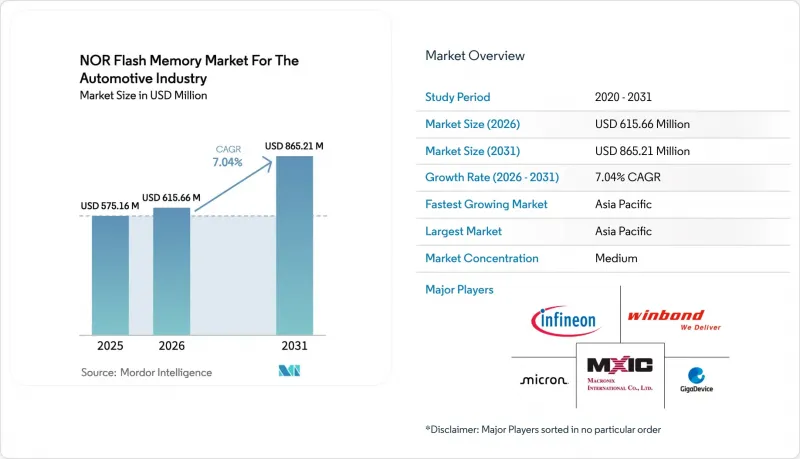
This report is Segmented by Type (Serial, Parallel), Interface (SPI Single/Dual, and More), Density (2 Mb and Less NOR, and More), Voltage (3V Class, 1. 8V Class, and More), Process Technology Node (90 Nm and Older, and More), Packaging Type (WLCSP/CSP, QFN / SOIC, and More), and Geography. The Market Forecasts are Provided in Terms of Value (USD) and Volume (Units).
Insights and Trends of NOR Flash Memory Market for the Automotive Industry
ADAS and Domain-Controller Code Size Explosion Elevating Automotive-grade Serial NOR Demand
Modern vehicle software now exceeds one billion lines of code, pushing firmware footprints well beyond legacy storage limits. ADAS modules already account for a significant share of application demand and require up to four times more code than distributed ECU designs. Micron projects total memory per vehicle to triple by 2026, with high-end models soaring toward 4 TB by 2030. This trajectory positions Serial NOR as the de facto instant-boot store for safety-critical logic, creating a measurable uplift in the NOR flash memory market for the automotive industry.
Zonal/Service-Oriented E/E Architectures Requiring Instant-On Boot Memories
Zonal architectures cluster functions by physical domain, obliging memories to wake core subsystems in under 100 milliseconds. Execute-in-place (XIP) ability makes Serial NOR the preferred boot medium, and when coupled with Octal interfaces, read throughput reaches 400 MB/s. Micron's functional-safety roadmap aligns with this pivot by embedding ASIL mechanisms that address autonomy, electrification, and connectivity in one device suite.OEM migration from distributed to zonal topologies is forecast to cover a majority of new platforms by 2030, cementing demand for low-latency NOR.
Cost Premium over QSPI NAND Beyond 256 Mb Limiting Infotainment Deployments
NOR maintains roughly a 35% price delta versus QSPI NAND at greater than 256 Mb densities, discouraging adoption in cost-sensitive infotainment head units. GigaDevice's hybrid GD5F1GM9 aims to replicate NOR-like reads at NAND-like cost, eroding NOR's incumbency in non-safety domains. Mid-segment OEMs are therefore deferring high-density NOR design-ins, which tempers the overall NOR flash memory market for the automotive industry trajectory.
Other drivers and restraints analyzed in the detailed report include:
- Octal and xSPI Proliferation Enabling Less Than 20 ms Secure Boot for Software-Defined Vehicles
- China's 55 nm/40 nm Automotive NOR Capacity Build-Out Supporting OEM Localization
- Scaling Wall at <= 40 nm Steering Roadmaps Toward MRAM/ReRAM for Greater Than 1 Gb Code
For complete list of drivers and restraints, kindly check the Table Of Contents.
Segment Analysis
Serial NOR captured 80.65% of the 2025 NOR flash memory market for the automotive industry, benefiting from lower pin count and superior electromagnetic compatibility versus parallel devices. The technology's execute-in-place capability allows direct code execution, which minimizes boot latency, an imperative for ADAS and domain controllers. This dominance is expected to hold as Octal interfaces close the bandwidth gap with parallel variants, preserving Serial NOR's board-space advantage. Parallel NOR persists chiefly in legacy or bandwidth-saturated infotainment modules, yet its share is projected to decline steadily.
The segment's momentum hinges on innovations such as Microchip's split-gate SuperFlash architecture that slashes erase time below 25 ms. As carmakers shift toward centralized and zonal platforms, firmware volume rises, but the preference remains for pin-efficient packages. Consequently, Serial NOR's share of the NOR flash memory market for the automotive industry size is forecast to edge higher even while absolute capacity per socket grows.
Quad SPI delivered 40.62% revenue share in 2025, but Octal SPI is advancing at 7.12% CAGR through 2031, propelled by its 400 MB/s read ceiling. The interface enables sub-20 ms cryptographically secure boot, meeting regulatory as well as end-user expectations for instantaneous start-up. Micron's Xccela family exemplifies this leap by coupling high bandwidth with AEC-Q100 Grade 1 reliability. As JEDEC's xSPI creates vendor interchangeability, system designers favor Octal to future-proof platforms.
Single/Dual SPI retains a cost niche in basic body-electronics modules but is unlikely to reclaim lost ground. NOR flash memory market for the automotive industry size for Octal solutions is forecast to grow significantly by 2031, while the demand for Quad is anticipated to gradually migrate upward in pursuit of OTA throughput parity.
Complete Report Scope:
- By Type
- Serial NOR Flash
- Parallel NOR Flash
- By Interface
- SPI Single / Dual
- Quad SPI
- Octal and xSPI
- By Density
- Less than or equal to 2 Mb
- Greater than 2 Mb - 4 Mb
- Greater than 4 Mb - 8 Mb
- Greater than 8 Mb - 16 Mb
- Greater than 16 Mb - 32 Mb
- Greater than 32 Mb - 64 Mb
- Greater than 64 Mb - 128 Mb
- Greater than 128 Mb - 256 Mb
- Greater than 256 Mb
- By Voltage
- 3 V Class
- 1.8 V Class
- Wide-Voltage (1.65-3.6 V)
- Other Voltage
- By Process Technology Node
- 90 nm and Older
- 65 nm
- 55 nm (incl. 58 nm)
- 45 nm
- 28 nm and Below
- By Packaging Type
- WLCSP / CSP
- QFN / SOIC
- BGA / FBGA
- Other Packaging Type
- By Geography
- North America
- United States
- Canada
- Mexico
- Europe
- Germany
- France
- United Kingdom
- Italy
- Rest of Europe
- Asia-Pacific
- China
- Japan
- South Korea
- Taiwan
- India
- South East Asia
- Rest of Asia-Pacific
- Middle East and Africa
- Middle East
- Saudi Arabia
- United Arab Emirates
- Rest of Middle East
- Africa
- South Africa
- Egypt
- Rest of Africa
- Middle East
- South America
- Brazil
- Argentina
- Rest of South America
- North America
Geography Analysis
North America contributed a substantial share of the Automotive NOR flash shipments in 2025 as Detroit and Silicon Valley allies accelerated software-defined vehicle programs. Regulatory focus on cybersecurity pushes adoption of secure-boot, authenticated update memory. Policy incentives under the CHIPS Act aim to localize crucial semiconductors, which could gradually derisk trans-Pacific logistics.
Europe remains pivotal because premium marques embed zonal architectures first, pulling through high-bandwidth NOR. Stringent ISO 26262 compliance norms continue to shape procurement toward ASIL-certified devices. The European Union's plan to double chip manufacturing capacity by 2030 concentrates on larger-node automotive flows, a strategic hedge against Far-East disruptions.
Asia-Pacific is the volume engine of the NOR flash memory market for the automotive industry; China's aggressive fabrication build-out at 55 nm/40 nm unlocks supply for its surging EV sector while exerting downward price pressure globally. Japan and South Korea rely on established IDM ecosystems for consistent automotive-grade quality, whereas Taiwan's centrality to advanced lithography introduces systemic geopolitical risk. The ASEAN+3 bloc forecasts steady macroeconomic growth through 2026, sustaining electronics export momentum.
- Winbond Electronics Corporation
- Macronix International Co. Ltd.
- GigaDevice Semiconductor Inc.
- Infineon Technologies AG
- Micron Technology Inc.
- Integrated Silicon Solution Inc.
- Microchip Technology Inc.
- Renesas Electronics Corporation
- Elite Semiconductor Microelectronics Technology Inc.
- Wuhan XMC
- Puya Semiconductor (Shanghai) Co. Ltd.
- Zbit Semiconductor
- YMTC-Xian Longsys
- Giantec Semiconductor
- Longsys
Additional Benefits:
- The market estimate (ME) sheet in Excel format
- 3 months of analyst support
TABLE OF CONTENTS
1 INTRODUCTION
- 1.1 Study Assumptions and Market Definition
- 1.2 Scope of the Study
2 RESEARCH METHODOLOGY
3 EXECUTIVE SUMMARY
4 MARKET LANDSCAPE
- 4.1 Market Overview
- 4.2 Market Drivers
- 4.2.1 ADAS and Domain-Controller Code Size Explosion Elevating Automotive-grade Serial NOR Demand
- 4.2.2 Zonal/Service-Oriented E/E Architectures Requiring Instant-On Boot Memories
- 4.2.3 Octal and xSPI Proliferation Enabling less than 20 ms Secure Boot for Software-Defined Vehicles
- 4.2.4 China's 55 nm/40 nm Automotive NOR Capacity Build-out Supporting OEM Localisation
- 4.2.5 EV Power-Train Electrification Driving Greater Than 256 Mb High-Density NOR Adoption per ECU
- 4.3 Market Restraints
- 4.3.1 Cost Premium over Qspi NAND Beyond 256 Mb Limiting Infotainment Deployments
- 4.3.2 Scaling Wall at more than 40 nm Steering Roadmaps Towards MRAM/ReRAM for Greater Than 1 Gb Code
- 4.3.3 Foundry Concentration in Taiwan and PRC Increasing Geopolitical Supply-Risk
- 4.3.4 ASP Compression from New Chinese Entrants Squeezing R&D Budgets
- 4.4 Industry Value Chain Analysis
- 4.5 Macro Trend Impact Analysis
- 4.6 Regulatory and Technological Outlook
- 4.7 Porter's Five Forces Analysis
- 4.7.1 Bargaining Power of Suppliers
- 4.7.2 Bargaining Power of Buyers
- 4.7.3 Threat of New Entrants
- 4.7.4 Threat of Substitute Products
- 4.7.5 Intensity of Competitive Rivalry
- 4.8 Pricing Analysis
5 MARKET SIZE AND GROWTH FORECASTS (VALUE)
- 5.1 By Type
- 5.1.1 Serial NOR Flash
- 5.1.2 Parallel NOR Flash
- 5.2 By Interface
- 5.2.1 SPI Single / Dual
- 5.2.2 Quad SPI
- 5.2.3 Octal and xSPI
- 5.3 By Density
- 5.3.1 Less than or equal to 2 Mb
- 5.3.2 Greater than 2 Mb - 4 Mb
- 5.3.3 Greater than 4 Mb - 8 Mb
- 5.3.4 Greater than 8 Mb - 16 Mb
- 5.3.5 Greater than 16 Mb - 32 Mb
- 5.3.6 Greater than 32 Mb - 64 Mb
- 5.3.7 Greater than 64 Mb - 128 Mb
- 5.3.8 Greater than 128 Mb - 256 Mb
- 5.3.9 Greater than 256 Mb
- 5.4 By Voltage
- 5.4.1 3 V Class
- 5.4.2 1.8 V Class
- 5.4.3 Wide-Voltage (1.65-3.6 V)
- 5.4.4 Other Voltage
- 5.5 By Process Technology Node
- 5.5.1 90 nm and Older
- 5.5.2 65 nm
- 5.5.3 55 nm (incl. 58 nm)
- 5.5.4 45 nm
- 5.5.5 28 nm and Below
- 5.6 By Packaging Type
- 5.6.1 WLCSP / CSP
- 5.6.2 QFN / SOIC
- 5.6.3 BGA / FBGA
- 5.6.4 Other Packaging Type
- 5.7 By Geography
- 5.7.1 North America
- 5.7.1.1 United States
- 5.7.1.2 Canada
- 5.7.1.3 Mexico
- 5.7.2 Europe
- 5.7.2.1 Germany
- 5.7.2.2 France
- 5.7.2.3 United Kingdom
- 5.7.2.4 Italy
- 5.7.2.5 Rest of Europe
- 5.7.3 Asia-Pacific
- 5.7.3.1 China
- 5.7.3.2 Japan
- 5.7.3.3 South Korea
- 5.7.3.4 Taiwan
- 5.7.3.5 India
- 5.7.3.6 South East Asia
- 5.7.3.7 Rest of Asia-Pacific
- 5.7.4 Middle East and Africa
- 5.7.4.1 Middle East
- 5.7.4.1.1 Saudi Arabia
- 5.7.4.1.2 United Arab Emirates
- 5.7.4.1.3 Rest of Middle East
- 5.7.4.2 Africa
- 5.7.4.2.1 South Africa
- 5.7.4.2.2 Egypt
- 5.7.4.2.3 Rest of Africa
- 5.7.4.1 Middle East
- 5.7.5 South America
- 5.7.5.1 Brazil
- 5.7.5.2 Argentina
- 5.7.5.3 Rest of South America
- 5.7.1 North America
6 COMPETITIVE LANDSCAPE
- 6.1 Market Concentration
- 6.2 Strategic Moves
- 6.3 Vendor Positioning Analysis
- 6.4 Company Profiles (includes Global level Overview, Market level overview, Core Segments, Financials as available, Strategic Information, Market Rank/Share for key companies, Products and Services, and Recent Developments)
- 6.4.1 Winbond Electronics Corporation
- 6.4.2 Macronix International Co. Ltd.
- 6.4.3 GigaDevice Semiconductor Inc.
- 6.4.4 Infineon Technologies AG
- 6.4.5 Micron Technology Inc.
- 6.4.6 Integrated Silicon Solution Inc.
- 6.4.7 Microchip Technology Inc.
- 6.4.8 Renesas Electronics Corporation
- 6.4.9 Elite Semiconductor Microelectronics Technology Inc.
- 6.4.10 Wuhan XMC
- 6.4.11 Puya Semiconductor (Shanghai) Co. Ltd.
- 6.4.12 Zbit Semiconductor
- 6.4.13 YMTC-Xian Longsys
- 6.4.14 Giantec Semiconductor
- 6.4.15 Longsys
7 INVESTMENT ANALYSIS
8 MARKET OPPORTUNITIES AND FUTURE OUTLOOK

