PUBLISHER: Mordor Intelligence | PRODUCT CODE: 2119624

PUBLISHER: Mordor Intelligence | PRODUCT CODE: 2119624
North America Outdoor Lighting - Market Share Analysis, Industry Trends & Statistics, Growth Forecasts (2026 - 2031)
According to Mordor Intelligence, the North America outdoor lighting market size is expected to grow from USD 5.93 billion in 2025 to USD 6.28 billion in 2026 and is forecast to reach USD 8.36 billion by 2031 at 5.91% CAGR over 2026-2031.
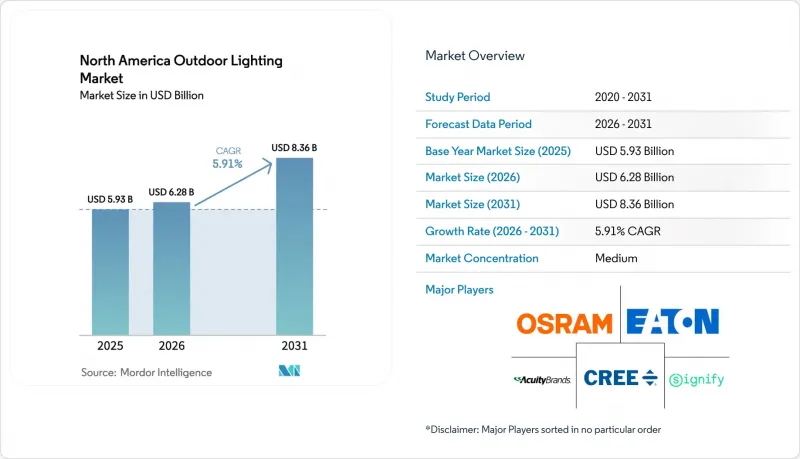
This report is Segmented by Type of Application (Residential Outdoor, Commercial Outdoor, Public and Street Lighting, and More), Type of Lighting (Traditional and LED), Installation Mode (Conventional Stand-Alone and Connected/Smart), and Country (United States, Canada, Mexico). The Market Forecasts are Provided in Terms of Value (USD).
North America Outdoor Lighting Market Trends and Insights
Energy-efficient retrofits in municipal streetlighting
Large-scale LED conversions deliver 50-70% energy savings and swift paybacks for cities across the region. The City of Placentia saves USD 158,120 each year from a 3,400-fixture project and expects USD 3.1 million in lifetime benefits. Edmonton completed 46,000 LED retrofits that cut greenhouse-gas emissions by 5,500 tonnes and reduced annual operating costs by USD 1.2 million. The American Council for an Energy-Efficient Economy estimates that nationwide conversion of U.S. streetlights could save 20,200 GWh annually and reduce municipal spending by USD 1 billion.Energy-service contracts and volume-purchase alliances shorten payback windows for smaller jurisdictions, while advanced dimming pilots in Colorado Springs reveal incremental energy reductions of 1-51% through adaptive scheduling. These robust outcomes reinforce LED retrofits as the market's strongest growth engine through mid-decade.
Federal and state rebates accelerating LED adoption
Utility and state rebate programs offset upfront capital, enabling municipalities to deploy LED projects within constrained budget cycles. Roughly 77% of U.S. zip codes qualify for some form of lighting rebate, which lowers effective project costs and compresses payback periods to below five years in many cases. Maryland directed USD 1 million in FY 2024 grants to its Streetlight and Outdoor Lighting Efficiency initiative, while New York and Massachusetts offer tiered incentives for Clean-Energy-Community participants. National Grid finances conversions through on-bill repayment mechanisms that align debt service with realized energy savings. Oregon updated its incentive schedules in 2025, underscoring the state's continued policy support. These financial levers expedite procurement decisions, particularly in small and mid-sized cities that struggle with capital budget constraints.
High upfront CAPEX versus budget cycles
Despite favorable total-cost-of-ownership metrics, LED streetlight projects can stall when annual municipal budgets are unable to absorb large capital outlays. The U.S. Department of Energy identifies financing gaps as the top hurdle to comprehensive conversions, especially in towns with populations under 25,000. Performance contracts and vendor-backed leases align payments with energy savings, yet council approvals often prolong deal closures. Public-power utilities offer low-interest loans, though fiscal-year timing may still delay project mobilization. Volume-purchase alliances reduce fixture prices by as much as 15%, but procurement rules vary by state, adding complexity to already stretched administrative staff. These headwinds slow short-term uptake even when life-cycle economics remain compelling.
Other drivers and restraints analyzed in the detailed report include:
- Smart-city mandates and IIoT integration of luminaires
- Surge in outdoor e-mobility charging-infrastructure lighting
- Persistent supply-chain volatility in driver ICs
For complete list of drivers and restraints, kindly check the Table Of Contents.
Segment Analysis
The residential segment led the North America outdoor lighting market with 35.12% revenue share in 2025 as homeowners invested in motion-sensing security lights, landscape accents, and architectural uplighting. Commercial venues, however, are scaling fastest and are projected to register a 7.32% CAGR through 2031, as retailers, hotels, and mixed-use developers utilize dynamic facade lighting to enhance brand appeal and customer safety. Retail chains are installing connected luminaires in parking lots to integrate surveillance cameras and license-plate readers, while hospitality operators are upgrading pool-deck and pathway fixtures to meet evolving guest-experience standards. Industrial facilities embrace high-output LEDs that resist vibration and extreme temperatures, reducing maintenance downtime in continuous-operation environments. Stadiums and large arenas are adopting tunable-white floodlights that meet broadcasting requirements and enable color-themed spectacles for concerts and special events.
Demand diversification underpins the North America outdoor lighting market, encouraging suppliers to tailor photometric distributions and control protocols for specific verticals. Landscape designers favor low-voltage LED bollards to accent native flora, whereas logistics campuses require high-mast poles with glare shields to comply with local ordinances. As commercial property owners pursue sustainability certifications, networked controls that provide energy dashboards become procurement differentiators. The interoperable D4i standard enables asset managers to mix and match drivers and nodes across multi-site portfolios, thereby simplifying spare parts logistics. By 2030, commercial adoption of adaptive dimming and occupancy sensing is expected to set new benchmarks that spill over into the still-dominant residential category.
Complete Report Scope:
- By Type of Application
- Residential Outdoor
- Commercial Outdoor
- Retail and Hospitality
- Offices and Business Parks
- Industrial and Logistics
- Parking Spaces
- Public and Street Lighting
- Sports and Large Area Lighting
- Other Type of Applications (Architectural and Landscape, Events, Galleries)
- By Type of Lighting
- Traditional
- LED
- By Installation Mode
- Conventional Stand-alone
- Connected / Smart
- By Country
- United States
- Canada
- Mexico
List of Companies Covered in this Report:
- Signify N.V.
- Acuity Brands Lighting Inc.
- Cree LED Lighting Solutions
- Eaton Intelligent Lighting (Cooper)
- Zumtobel Group AG
- OSRAM GmbH
- Dialight plc
- Ideal Industries Inc.
- TCP International Holdings Ltd.
- Circadian Light Inc.
- SLV Lighting Group
- Schreder Group GIE
- Valmont Industries Inc.
- LSI Industries Inc.
- Kenall Manufacturing
- Nichia Corporation
- Seoul Semiconductor Co. Ltd.
- Leotek Electronics USA Corp.
- Flashnet S.A.
- DimOnOff Inc.
- Echelon (by Adesto)
- Telensa Ltd.
- Cimcon Lighting Inc.
- Fagerhult AB
Additional Benefits:
- The market estimate (ME) sheet in Excel format
- 3 months of analyst support
TABLE OF CONTENTS
1 INTRODUCTION
- 1.1 Study Assumptions and Market Definition
- 1.2 Scope of the Study
2 RESEARCH METHODOLOGY
3 EXECUTIVE SUMMARY
4 MARKET LANDSCAPE
- 4.1 Market Overview
- 4.2 Market Drivers
- 4.2.1 Energy-efficient retrofits in municipal streetlighting
- 4.2.2 Federal and state rebates accelerating LED adoption
- 4.2.3 Smart-city mandates and IIoT integration of luminaires
- 4.2.4 Surge in outdoor e-mobility charging infrastructure lighting
- 4.2.5 Micro-grid and resilience projects in climate-vulnerable zones
- 4.2.6 AI-enabled adaptive dimming for dark-sky compliance
- 4.3 Market Restraints
- 4.3.1 High upfront CAPEX vs. budget cycles
- 4.3.2 Persistent supply-chain volatility in driver ICs
- 4.3.3 Community opposition on light-pollution grounds
- 4.3.4 Cyber-security risks in connected street-lights
- 4.4 Impact of Macroeconomic Factors on the Market
- 4.5 Technological Advances
- 4.6 Industry Value Chain Analysis
- 4.7 Regulatory Landscape
- 4.8 Porter's Five Forces Analysis
- 4.8.1 Bargaining Power of Suppliers
- 4.8.2 Bargaining Power of Consumers
- 4.8.3 Threat of New Entrants
- 4.8.4 Threat of Substitute Products
- 4.8.5 Intensity of Competitive Rivalry
5 MARKET SIZE AND GROWTH FORECASTS (VALUE)
- 5.1 By Type of Application
- 5.1.1 Residential Outdoor
- 5.1.2 Commercial Outdoor
- 5.1.2.1 Retail and Hospitality
- 5.1.2.2 Offices and Business Parks
- 5.1.2.3 Industrial and Logistics
- 5.1.2.4 Parking Spaces
- 5.1.3 Public and Street Lighting
- 5.1.4 Sports and Large Area Lighting
- 5.1.5 Other Type of Applications (Architectural and Landscape, Events, Galleries)
- 5.2 By Type of Lighting
- 5.2.1 Traditional
- 5.2.2 LED
- 5.3 By Installation Mode
- 5.3.1 Conventional Stand-alone
- 5.3.2 Connected / Smart
- 5.4 By Country
- 5.4.1 United States
- 5.4.2 Canada
- 5.4.3 Mexico
6 COMPETITIVE LANDSCAPE
- 6.1 Market Concentration
- 6.2 Strategic Moves
- 6.3 Market Share Analysis
- 6.4 Company Profiles (includes Global level Overview, Market level overview, Core Segments, Financials as available, Strategic Information, Market Rank/Share for key companies, Products and Services, and Recent Developments)
- 6.4.1 Signify N.V.
- 6.4.2 Acuity Brands Lighting Inc.
- 6.4.3 Cree LED Lighting Solutions
- 6.4.4 Eaton Intelligent Lighting (Cooper)
- 6.4.5 Zumtobel Group AG
- 6.4.6 OSRAM GmbH
- 6.4.7 Dialight plc
- 6.4.8 Ideal Industries Inc.
- 6.4.9 TCP International Holdings Ltd.
- 6.4.10 Circadian Light Inc.
- 6.4.11 SLV Lighting Group
- 6.4.12 Schreder Group GIE
- 6.4.13 Valmont Industries Inc.
- 6.4.14 LSI Industries Inc.
- 6.4.15 Kenall Manufacturing
- 6.4.16 Nichia Corporation
- 6.4.17 Seoul Semiconductor Co. Ltd.
- 6.4.18 Leotek Electronics USA Corp.
- 6.4.19 Flashnet S.A.
- 6.4.20 DimOnOff Inc.
- 6.4.21 Echelon (by Adesto)
- 6.4.22 Telensa Ltd.
- 6.4.23 Cimcon Lighting Inc.
- 6.4.24 Fagerhult AB
7 MARKET OPPORTUNITIES AND FUTURE OUTLOOK
- 7.1 White-space and Unmet-need Assessment

