PUBLISHER: Mordor Intelligence | PRODUCT CODE: 2119635

PUBLISHER: Mordor Intelligence | PRODUCT CODE: 2119635
India Precipitated Silica - Market Share Analysis, Industry Trends & Statistics, Growth Forecasts (2026 - 2031)
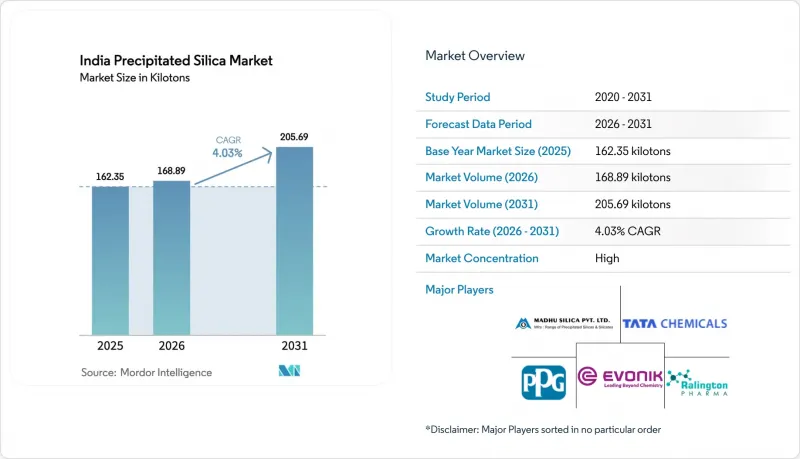
According to Mordor Intelligence, the India precipitated silica market size was valued at 162.35 kilotons in 2025 and estimated to grow from 168.89 kilotons in 2026 to reach 205.69 kilotons by 2031, at a CAGR of 4.03% during the forecast period (2026-2031).
This report is Segmented by End-User Industry (Agriculture, Oral Care and Cosmetics, Agrochemicals, Tire, Electronics, and More), Production Process (Wet-Process, Dry-Process), Product Form (Powder, Beads, Micro-Pearls, Granules), Grade (Rubber Grade, Food Grade, Dental/Oral-Care Grade, Feed Grade, Others), and Geography (North India, West India, South India, East and North-East India).
India Precipitated Silica Market Trends and Insights
Tyre-Grade Silica Demand from Domestic OEM-Focused Rubber Industry
Domestic tire manufacturers now integrate higher silica loadings to meet stringent fuel-efficiency and emission norms, positioning precipitated silica as a performance-critical additive rather than a commodity input. CEAT's ramp-up from 105 tons per day to 160 tons per day in its off-highway tire unit, along with its 25% export revenue target, illustrates how scale and global diversification underpin demand resilience. Import restrictions that reclassified several tire categories from "Free" to "Restricted" in 2020 cut foreign inflows by more than 80%, effectively channeling silica demand to domestic supply chains. Growing SUV sales and the radialization wave translate into larger tire dimensions and greater silica dosage, further anchoring consumption. The India precipitated silica market benefits directly as high-performance mixes offer pricing latitude that preserves manufacturer margins amid feedstock volatility. These interlinked automotive trends provide a multi-year volume corridor sustaining a progressive upswing in specialty rubber grades.
Rapid Shift Toward Low-VOC Toothpastes by FMCG Majors
FMCG players are reformulating oral-care lines to eliminate volatile organic solvents, incentivizing the use of precipitated silica as both an abrasive and rheology modifier. Colgate Palmolive India aims to triple premium-segment revenues, where margins are 5-8 percentage points higher, and mandates silica grades that deliver enhanced whitening and mouth-feel properties. Rural hygiene penetration remains low, with only 20% of urban consumers brushing their teeth twice daily, indicating untapped volume upside as awareness increases. BIS standard IS 6356:2001 formally lists precipitated silica among accepted polishing agents, providing regulatory certainty for formulators. Combining premiumization and compliance unlocks a new value pool for the India precipitated silica market, even before considering spillovers into cosmetics and personal-care categories.
Tightening Effluent Norms on Sodium Silicate Effluents
Regulatory scrutiny over liquid discharges is escalating capital requirements for wet-process units, which account for more than 70% of domestic capacity. Draft CPCB guidelines mandate zero-liquid-discharge systems, dust suppression, and water recycling across the silica value chain, inflating compliance costs. The May 2024 fire at Aksharchem's Gujarat plant illustrates operational vulnerabilities faced during modernization. Smaller players lacking financial muscle may exit or delay upgrades, consolidating volume among large, compliant manufacturers. The India precipitated silica market, therefore, navigates a near-term supply tightening that offsets part of the demand gains while reinforcing competitive barriers.
Other drivers and restraints analyzed in the detailed report include:
- Government Push for Solar PV Glass Fabs (Greenfield)
- Mandatory BIS Compliance for Agrochemical Wettable Powders
- Import Penetration of Low-Cost Chinese Grades
For complete list of drivers and restraints, kindly check the Table Of Contents.
Segment Analysis
The tire segment captured 36.30% of the India precipitated silica market share in 2025, reflecting the automotive sector's entrenched role in filler demand. Volume visibility remains high as OEMs integrate silica-reinforced compounds to hit rolling-resistance targets and emission standards. Concurrently, oral care and cosmetics, while having a smaller base, are forecast to post a 5.12% CAGR through 2031, evidencing diversification and premiumization in fast-moving consumer goods.
Tire-makers are regionalizing production; CEAT's export-oriented capacity expansion and Apollo's plans for greenfield off-the-road units highlight the global positioning of domestic brands. Meanwhile, agrochemical formulators adopt precipitated silica for wettable powder compliance, creating ancillary demand insulated from automotive swings. Electronics applications, though nascent, align with national semiconductor and battery programs, hinting at future pull for high-purity grades. This mosaic of use-cases nudges the India precipitated silica market toward specialized product lines, mitigating risk concentration in a single end-use.
Wet-process technology retained 71.80% dominance in 2025 as installed units leverage sunk costs and broad formulation acceptance. Yet environmental mandates and water-usage restrictions accelerate the dry-process CAGR to 4.19%, signaling gradual realignment toward lower-effluent routes.
Wet-process producers are retrofitting effluent-treatment plants to comply with tightened norms, which lifts capex per ton and may erode cost advantages. Dry-process adopters pitch energy savings and tighter morphology control, finding traction in oral-care and micro-pearl niches. Over the forecast horizon, the India precipitated silica market expects coexistence: wet processes serving large-volume, price-sensitive rubber applications, and dry processes capturing specialty and export-oriented segments.
Complete Report Scope:
- By End-user Industry
- Agriculture
- Oral Care and Cosmetics
- Agrochemicals
- Tire
- Electronics
- Other End-User Industries
- By Production Process
- Wet-Process
- Dry-Process
- By Product Form
- Powder
- Beads
- Micro-pearls
- Granules
- By Grade
- Rubber Grade
- Food Grade
- Dental/Oral-Care Grade
- Feed Grade
- Others (Battery-Separator Grade, Technical/Industrial Grade)
List of Companies Covered in this Report:
- AksharChem (India) Ltd.
- Evonik Industries AG
- Gujarat Multi Gas Base Chemicals
- Huber Engineered Materials
- JAY DINESH CHEMICALS
- Madhu Silica Pvt. Ltd.
- MLA Group of Industries
- PCIPL
- PPG Industries Inc.
- Ralington Pharma
- Regoj Chemical Industries
- Solvay SA
- Supersil Chemicals (I) Pvt. Ltd.
- Tata Chemicals Ltd.
- Tirupati Chemical Corporation
- Wacker Chemie AG
Additional Benefits:
- The market estimate (ME) sheet in Excel format
- 3 months of analyst support
TABLE OF CONTENTS
1 Introduction
- 1.1 Study Assumptions and Market Definition
- 1.2 Scope of the Study
2 Research Methodology
3 Executive Summary
4 Market Landscape
- 4.1 Market Overview
- 4.2 Market Drivers
- 4.2.1 Tyre-grade silica demand from domestic OEM-focused rubber industry
- 4.2.2 Rapid shift toward low-VOC toothpastes by FMCG majors
- 4.2.3 Government push for solar PV glass fabs (greenfield)
- 4.2.4 Mandatory BIS compliance for agrochemical wettable powders
- 4.2.5 Start-up led silica-based battery anode R&D
- 4.3 Market Restraints
- 4.3.1 Tightening effluent norms on sodium silicate effluents
- 4.3.2 Volatility in soda-ash prices
- 4.3.3 Import penetration of low-cost Chinese grades
- 4.4 Value Chain Analysis
- 4.5 Porter's Five Forces
- 4.5.1 Bargaining Power of Suppliers
- 4.5.2 Bargaining Power of Buyers
- 4.5.3 Threat of New Entrants
- 4.5.4 Threat of Substitutes
- 4.5.5 Degree of Competition
5 Market Size and Growth Forecasts (Volume)
- 5.1 By End-user Industry
- 5.1.1 Agriculture
- 5.1.2 Oral Care and Cosmetics
- 5.1.3 Agrochemicals
- 5.1.4 Tire
- 5.1.5 Electronics
- 5.1.6 Other End-User Industries
- 5.2 By Production Process
- 5.2.1 Wet-Process
- 5.2.2 Dry-Process
- 5.3 By Product Form
- 5.3.1 Powder
- 5.3.2 Beads
- 5.3.3 Micro-pearls
- 5.3.4 Granules
- 5.4 By Grade
- 5.4.1 Rubber Grade
- 5.4.2 Food Grade
- 5.4.3 Dental/Oral-Care Grade
- 5.4.4 Feed Grade
- 5.4.5 Others (Battery-Separator Grade, Technical/Industrial Grade)
6 Competitive Landscape
- 6.1 Market Concentration
- 6.2 Strategic Moves
- 6.3 Market Share**/Ranking Analysis
- 6.4 Company Profiles (includes Global level Overview, Market level overview, Core Segments, Financials as available, Strategic Information, Market Rank/Share for key companies, Products and Services, and Recent Developments)
- 6.4.1 AksharChem (India) Ltd.
- 6.4.2 Evonik Industries AG
- 6.4.3 Gujarat Multi Gas Base Chemicals
- 6.4.4 Huber Engineered Materials
- 6.4.5 JAY DINESH CHEMICALS
- 6.4.6 Madhu Silica Pvt. Ltd.
- 6.4.7 MLA Group of Industries
- 6.4.8 PCIPL
- 6.4.9 PPG Industries Inc.
- 6.4.10 Ralington Pharma
- 6.4.11 Regoj Chemical Industries
- 6.4.12 Solvay SA
- 6.4.13 Supersil Chemicals (I) Pvt. Ltd.
- 6.4.14 Tata Chemicals Ltd.
- 6.4.15 Tirupati Chemical Corporation
- 6.4.16 Wacker Chemie AG
7 Market Opportunities and Future Outlook
- 7.1 White-space and Unmet-need Assessment

