PUBLISHER: Mordor Intelligence | PRODUCT CODE: 2125337

PUBLISHER: Mordor Intelligence | PRODUCT CODE: 2125337
Precipitated Silica - Market Share Analysis, Industry Trends & Statistics, Growth Forecasts (2026 - 2031)
According to Mordor Intelligence, the precipitated silica market size is expected to increase from 3.25 Million tons in 2025 to 3.38 Million tons in 2026 and reach 4.08 Million tons by 2031, growing at a CAGR of 3.86% over 2026-2031.
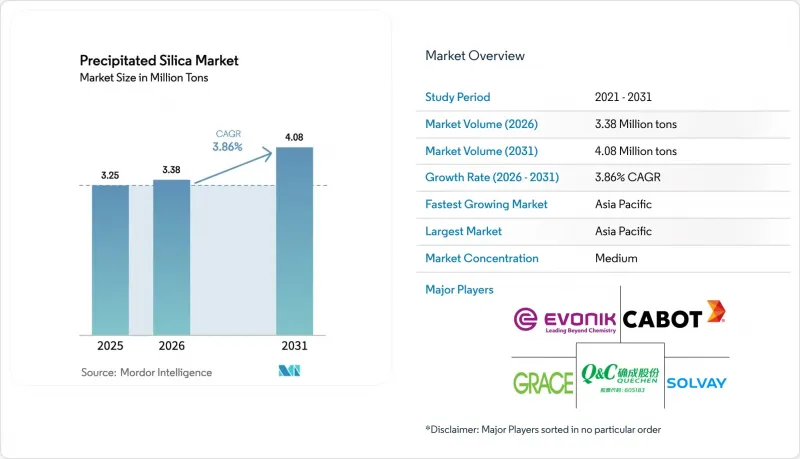
This report is Segmented by Grade (Rubber, Food, Feed, and Others), Form (Powder, Beads, Micro-Pearls, and Granules), Production Process (Wet and Dry), End-Use Industry (Agriculture, Oral Care and Cosmetics, Tire, Electronics, and More), and Geography (Asia-Pacific, North America, Europe, South America, and the Middle East and Africa). The Market Forecasts are Provided in Terms of Volume (Tons).
Global Precipitated Silica Market Trends and Insights
Electrification-Driven Demand for Silica-Enhanced EV Tires
Instant torque and heavier battery packs make EV tires wear faster, yet range targets force automakers to curb rolling resistance. Raising precipitated silica loadings from 10-15 phr to 20-30 phr cuts hysteresis by up to 25% while preserving grip. China built 9.5 million battery-electric and plug-in hybrid vehicles in 2025, each consuming four to five tires with silica content 40-60% higher than combustion models, equating to roughly 50,000-70,000 t of incremental annual demand locally. Tightened EU tire-labeling thresholds that took effect mid-2024 reinforce the shift, and North American OEMs have adopted similar procurement specs, embedding silica into baseline tire designs irrespective of oil-price swings. The trend locks in structural growth for the precipitated silica market, encouraging producers to invest in dedicated EV-grade capacity across all regions.
Regulatory Push for Low-Rolling-Resistance Green Tires
Corporate Average Fuel Economy rules set 49 mpg targets for model-year 2026 passenger cars in the United States, compelling automakers to mandate low-rolling-resistance tires that can deliver 3-5% fuel savings. ASTM F2493 test procedures and ISO 28580 harmonization let tire makers validate silica formulations consistently worldwide. Japan and South Korea award top tire-label grades only for rolling-resistance coefficients under 9.0, a level nearly unreachable without silica reinforcement, and both markets exceeded 70% silica penetration in passenger-car tires during 2025. These synchronized policies form a compliance floor that shields the precipitated silica market from short-term price cycles, thereby sustaining capacity-expansion pipelines.
Tight Sulfuric-Acid Supply Inflating Costs
Precipitated silica synthesis needs 0.3-0.4 t of sulfuric acid per tonne of product. US elemental sulfur output slid 5% to 8.2 million t in 2024, driving Tampa contract acid prices from USD 69/t in Q1 2024 to USD 116/t by year-end, a 68% surge. Chinese spot prices climbed even faster due to smelter shutdowns and export curbs. Producers weigh backward integration into sulfur recovery, yet regeneration plants cost more than USD 50 million, and paybacks stretch past five years. These cost spikes compress gross margins, particularly for commodity powder grades, and temper near-term investment appetite in the precipitated silica market.
Other drivers and restraints analyzed in the detailed report include:
- Food-Grade Silica Uptake in Clean-Label Formulations
- Rice-Husk-Ash Circular-Economy Silica Scale-Up
- Automotive OEM Production-Cycle Volatility
For complete list of drivers and restraints, kindly check the Table Of Contents.
Segment Analysis
Rubber-grade silica held 55.12% of volume in 2025, reflecting entrenched use in low-rolling-resistance tire tread. Food-grade volumes, though smaller, are growing at 4.56% CAGR through 2031, the fastest among all grades, as global brand owners adopt clean-label anti-caking agents. Dental-silica abrasives reached about USD 500 million in 2025, backed by rising toothpaste penetration in emerging economies. These dynamics keep rubber volumes high, yet incremental growth increasingly stems from food and oral-care niches, diversifying revenue streams inside the precipitated silica market.
Steady regulatory frameworks, the FDA's GRAS rule 21 CFR 172.480, and EFSA's 2018 opinion, lower reformulation risk for food processors, underpinning the grade's expansion. Meanwhile, rice-husk-ash feedstock demonstrates that biomass routes can deliver tire-grade surface areas, narrowing cost gaps with wet-process incumbents. By 2031, food and oral-care grades together could approach one-third of the precipitated silica market size for specialty applications, challenging the traditional dominance of rubber compounds.
Powder accounted for 48.31% of 2025 shipments because it disperses easily into rubber and plastics. Beads, however, are advancing at 6.34% CAGR on the back of toothpaste and cosmetic gel demand, where uniform spheres prevent grit and maintain flow. Spray-drying investments of USD 5-10 million per line have lifted bead capacity across Taiwan, Japan, and India, trimming supply-chain lead times. Powder will remain the workhorse, yet beads are set to carve a premium sub-segment of the precipitated silica market, bolstered by microplastics regulations that exclude inorganic silica from polymer restrictions.
Consistent particle morphology allows beads to meet European microbead replacements, and oral-care brands capitalize on marketing claims around faster dissolution. Granules continue serving agricultural blends, while micro-pearls hold niche cosmetic and coating positions. As a result, beads could exceed 20% of form sales by 2031, shifting revenue mix and raising average selling prices across the precipitated silica market.
Complete Report Scope:
- By Grade
- Rubber Grade
- Food Grade
- Dental/Oral-Care Grade
- Feed Grade
- Others (Battery-Separator Grade and Technical/Industrial Grade)
- By Form
- Powder
- Beads
- Micro-pearls
- Granules
- By Production Process
- Wet Process
- Dry Process
- By End-use Industry
- Agriculture
- Oral Care and Cosmetics
- Tire
- Electronics
- Other End-user Industries
- By Geography
- Asia-Pacific
- China
- India
- Japan
- South Korea
- Rest of Asia-Pacific
- North America
- United States
- Canada
- Mexico
- Europe
- Germany
- United Kingdom
- Italy
- France
- Rest of Europe
- South America
- Brazil
- Argentina
- Rest of South America
- Middle-East and Africa
- Saudi Arabia
- South Africa
- Rest of Middle-East and Africa
- Asia-Pacific
Geography Analysis
Asia-Pacific retained 50.24% of 2025 volume and is set for 3.95% CAGR through 2031. China's 9.5 million EV output in 2025 underpins local tire-grade silica demand, while rice-husk-ash projects across China, India, and Thailand unlock low-cost supply. Japan and South Korea enforce stringent tire-label grades that require silica reinforcement, pushing regional penetration above 70%. Thai biomass tie-ups, such as Evonik's Map Ta Phut venture, enhance feedstock security and carbon credentials. This momentum keeps Asia at the core of the precipitated silica market investment cycle.
In North America and Europe, Evonik's Charleston expansion, operational in January 2026, boosts wet-process capacity by 50% to serve rising EV-tire orders, while Qemetica's purchase of PPG's assets added 200,000 t pa across Lake Charles and Delfzijl. EU tire-label tightening and microplastics bans accelerate silica substitution in both automotive and personal-care channels. However, sulfuric-acid price inflation weighs on European and US producers, highlighting cost-structure disparities across the precipitated silica market.
South America and the Middle East & Africa show selective growth pockets. Brazil's tire industry recovered alongside 2.1 million vehicle sales in 2024, spurring local demand. Argentina's fertilizer blenders employ silica as a flow agent, while Gulf Cooperation Council nations aim to backward-integrate specialty silica into downstream petrochemicals clusters. Logistics costs from Asia often add USD 100-150/t, protecting entrenched wet-process suppliers. These regions thus remain strategic second-tier opportunities within the precipitated silica market landscape.
- Antenchem
- Cabot Corporation
- Denka Company Limited
- Evonik Industries AG
- FUJI SILYSIA CHEMICAL LTD.
- Huber Engineered Materials
- Jinsha Precipitated Silica Manufacturing Co., Ltd.
- Kadvani Chemicals Pvt. Ltd.
- Madhu Silica Pvt. Ltd.
- Oriental Silicas Corporation
- Qemetica
- Quechen Silicon Chemical
- Solvay
- Sunshine Industries
- Tata Chemicals Ltd.
- Tokuyama Corporation
- Tosoh Silica Corporation
- W. R. Grace & Co.
Additional Benefits:
- The market estimate (ME) sheet in Excel format
- 3 months of analyst support
TABLE OF CONTENTS
1 Introduction
- 1.1 Study Assumptions and Market Definition
- 1.2 Scope of the Study
2 Research Methodology
3 Executive Summary
4 Market Landscape
- 4.1 Market Overview
- 4.2 Market Drivers
- 4.2.1 Electrification-driven demand for silica-enhanced EV tyres
- 4.2.2 Regulatory push for low-rolling-resistance "green" tyres
- 4.2.3 Food-grade silica uptake in clean-label formulations
- 4.2.4 Rice-husk-ash circular-economy silica scale-up (Asia)
- 4.2.5 High-purity silica for Li-ion battery separators
- 4.3 Market Restraints
- 4.3.1 Tight sulphuric-acid supply inflating costs
- 4.3.2 Automotive OEM production-cycle volatility
- 4.3.3 Consumer backlash on silica micro-plastics (personal care)
- 4.4 Value Chain Analysis
- 4.5 Porter's Five Forces
- 4.5.1 Bargaining Power of Suppliers
- 4.5.2 Bargaining Power of Buyers
- 4.5.3 Threat of New Entrants
- 4.5.4 Threat of Substitutes
- 4.5.5 Degree of Competition
5 Market Size and Growth Forecasts (Volume)
- 5.1 By Grade
- 5.1.1 Rubber Grade
- 5.1.2 Food Grade
- 5.1.3 Dental/Oral-Care Grade
- 5.1.4 Feed Grade
- 5.1.5 Others (Battery-Separator Grade and Technical/Industrial Grade)
- 5.2 By Form
- 5.2.1 Powder
- 5.2.2 Beads
- 5.2.3 Micro-pearls
- 5.2.4 Granules
- 5.3 By Production Process
- 5.3.1 Wet Process
- 5.3.2 Dry Process
- 5.4 By End-use Industry
- 5.4.1 Agriculture
- 5.4.2 Oral Care and Cosmetics
- 5.4.3 Tire
- 5.4.4 Electronics
- 5.4.5 Other End-user Industries
- 5.5 By Geography
- 5.5.1 Asia-Pacific
- 5.5.1.1 China
- 5.5.1.2 India
- 5.5.1.3 Japan
- 5.5.1.4 South Korea
- 5.5.1.5 Rest of Asia-Pacific
- 5.5.2 North America
- 5.5.2.1 United States
- 5.5.2.2 Canada
- 5.5.2.3 Mexico
- 5.5.3 Europe
- 5.5.3.1 Germany
- 5.5.3.2 United Kingdom
- 5.5.3.3 Italy
- 5.5.3.4 France
- 5.5.3.5 Rest of Europe
- 5.5.4 South America
- 5.5.4.1 Brazil
- 5.5.4.2 Argentina
- 5.5.4.3 Rest of South America
- 5.5.5 Middle-East and Africa
- 5.5.5.1 Saudi Arabia
- 5.5.5.2 South Africa
- 5.5.5.3 Rest of Middle-East and Africa
- 5.5.1 Asia-Pacific
6 Competitive Landscape
- 6.1 Market Concentration
- 6.2 Strategic Moves
- 6.3 Market Share(%)/Ranking Analysis
- 6.4 Company Profiles (includes Global level Overview, Market level overview, Core Segments, Financials as available, Strategic Information, Products and Services, and Recent Developments)
- 6.4.1 Antenchem
- 6.4.2 Cabot Corporation
- 6.4.3 Denka Company Limited
- 6.4.4 Evonik Industries AG
- 6.4.5 FUJI SILYSIA CHEMICAL LTD.
- 6.4.6 Huber Engineered Materials
- 6.4.7 Jinsha Precipitated Silica Manufacturing Co., Ltd.
- 6.4.8 Kadvani Chemicals Pvt. Ltd.
- 6.4.9 Madhu Silica Pvt. Ltd.
- 6.4.10 Oriental Silicas Corporation
- 6.4.11 Qemetica
- 6.4.12 Quechen Silicon Chemical
- 6.4.13 Solvay
- 6.4.14 Sunshine Industries
- 6.4.15 Tata Chemicals Ltd.
- 6.4.16 Tokuyama Corporation
- 6.4.17 Tosoh Silica Corporation
- 6.4.18 W. R. Grace & Co.
7 Market Opportunities and Future Outlook
- 7.1 White-Space and Unmet-Need Assessment

