PUBLISHER: Mordor Intelligence | PRODUCT CODE: 2119714

PUBLISHER: Mordor Intelligence | PRODUCT CODE: 2119714
Germany Data Center Rack - Market Share Analysis, Industry Trends & Statistics, Growth Forecasts (2026 - 2031)
According to Mordor Intelligence, Germany data center rack market size in 2026 is estimated at USD 131.62 million, growing from 2025 value of USD 115.6 million with 2031 projections showing USD 251.75 million, growing at 13.86% CAGR over 2026-2031.
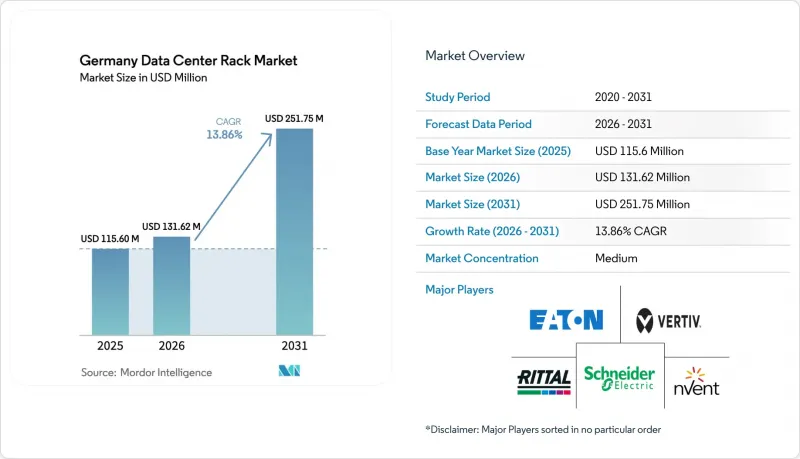
This report is Segmented by Rack Size (Quarter Rack, Half Rack, Full Rack), by Rack Height (42U, 45U, 48U), Other Heights (>=52U and Custom), Rack Type (Cabinet (Closed) Racks, Open-Frame Racks, Wall-Mount Rack), Data Center Type (Colocation Facilities and More), Material (Steel and More). The Market Sizes and Forecasts are Provided in Terms of Value (USD) for all the Segments.
Germany Data Center Rack Market Trends and Insights
Surging Hyperscale Cloud Investments in Frankfurt Region
Frankfurt's role as Europe's main interconnection hub fuels an aggressive build-out that commits more than EUR24 billion in capacity between 2024 and 2029. Microsoft has pledged EUR3.2 billion and Amazon Web Services EUR16.6 billion to enlarge regional footprints, pulling the Germany data center rack market toward taller 48U cabinets that can host AI GPU sleds. Digital Realty's FRA18 site, installed inside a listed building, shows how land scarcity pushes innovative layouts that still require full-depth, liquid-ready racks datacenterknowledge.com. Seismic-rated frames also see greater adoption because German insurers link lower premiums to robust cabinet construction. Overall, hyperscale capex concentrates demand, shortens replacement cycles, and locks in volume contracts that favor suppliers with local assembly plants and fast lead times.
Rapid Growth in Edge Computing Deployments by Telecom Operators
Telecom carriers introduce distributed mini-hubs to support 5G network slicing and low-latency industrial IoT, which broadens the geographic spread of the Germany data center rack market. Deutsche Telekom's involvement in the EU-funded AI Gigafactory positions dozens of micro installations across manufacturing corridors, creating steady orders for quarter- and half-racks that can be installed by a two-person crew. Cisco's reference design for telco edge nodes calls for unified, remotely managed, standards-based cabinets that simplify unmanned site operations. Edge nodes stimulate incremental demand because every 5G region needs its own micro-facility, yet operators insist on TUV-certified frames that meet German safety codes, allowing local vendors such as Rittal to capitalize on proximity and fast service response.
Lengthy Permitting Under Federal Immission Control Act
Projects that install more than 2 MW of diesel backup must obtain a Federal Immission Control Act license, lengthening timelines by 12-18 months because of public consultations and environmental reviews. Each new requirement-waste-heat capture plans, energy-management audits, biodiversity reports-adds engineering scope, which then delays the rack procurement stage. International entrants without established local partners struggle to navigate separate city and state approval layers, occasionally abandoning purchase intentions or shifting capacity to the Netherlands. For the Germany data center rack market, the biggest impact is a stop-start order pattern that complicates factory planning and inventory management for domestic suppliers.
Other drivers and restraints analyzed in the detailed report include:
- Government Support for Digitalization (GAIA-X Initiative)
- Adoption of High-Density Servers and Liquid Cooling Drives Rack Refresh Cycles
- Escalating Land and Power Costs in Major Colo Clusters
For complete list of drivers and restraints, kindly check the Table Of Contents.
Segment Analysis
Full racks held 70.85% of Germany data center rack market share in 2025, progressing at a 15.91% CAGR through 2031 as hyperscale halls standardize on 42U and taller footprints for GPU clusters. This dominance reflects economies of scale, uniform cable management layouts, and easier hot-aisle containment integration. Quarter racks and half racks serve niche edge locations or retrofitted office basements where depth or ceiling limits prevail, but their combined revenue remains below one-third of the Germany data center rack market size. The preference for full racks also aligns with the EnEfG waste-heat clause, because contiguous rows improve airflow modeling and enable rear-door exchanger retrofits that capture thermal output for district heating loops. As more AI inference nodes migrate to factories and logistics warehouses, compact variants will grow, yet standardized full racks should retain the top position given hyperscalers' sizeable forward purchase contracts.
German engineering groups have responded by developing prefabricated modules where full racks leave the factory pre-wired, reducing site work from weeks to days. Siemens and Cadolto promote an ISO-container design that includes twelve 42U enclosures, in-line cooling, and a dedicated battery pod, lowering total installed cost for multiregional edge fleets. Local fabricators also secure a logistics edge; proximity to Frankfurt permits next-day delivery of spare parts, which remains a critical factor for colocation tenants bound by stringent service-level agreements. As Germany data center rack market demand broadens to secondary cities, flexible service coverage and rapid replacement options will strengthen full-rack adoption further.
42U frameworks, the global benchmark, retained 55.12% share of the Germany data center rack market size in 2025. Operators nonetheless upgrade to taller 48U units to squeeze additional servers into unchanged footprints, achieving up to 14% space savings on a per-rack basis. This trend produces the segment's highest 17.08% CAGR through 2031. Taller layouts offer the headroom to mount liquid distribution manifolds above the server area, which keeps servicing clear of live power rails. They also allow operators to install two cable trays-one for fiber, one for power-improving fault isolation.
A smaller yet visible share of buyers select 45U or 52U custom heights for research labs and automotive test cells that host experimental compute clusters. Rittal's 400 kW specimen, effectively a custom 52U chassis with reinforced uprights, demonstrates how design boundaries are being pushed to accommodate AI accelerators that draw more than 130 kW per cabinet. Ceiling clearance in urban Frankfurt remains the practical governor; most new builds retain a 3.6 m raised-floor height, which imposes a physical cap on rack height. Consequently, the Germany data center rack market will continue to record a migration from 42U toward 48U without fully displacing the legacy form factor.
Complete Report Scope:
- By Rack Size
- Quarter Rack
- Half Rack
- Full Rack
- By Rack Height
- 42U
- 45U
- 48U
- Other Heights (52U and Custom)
- By Rack Type
- Cabinet (Closed) Racks
- Open-Frame Racks
- Wall-Mount Racks
- By Data Center Type
- Colocation Facilities
- Hyperscale and Cloud Service Provider DCs
- Enterprise and Edge
- By Material
- Steel
- Aluminum
- Other Alloys and Composites
List of Companies Covered in this Report:
- Eaton Corporation plc
- Black Box Corporation
- Rittal GmbH and Co. KG
- Schneider Electric SE
- Vertiv Holdings Co
- Dell Technologies Inc.
- nVent Electric plc
- Hewlett Packard Enterprise Co.
- Econnex Systems Pty Ltd
- Legrand SA
- Panduit Corp.
- Chatsworth Products Inc.
- Cisco Systems Inc.
- IBM Corp.
- Huawei Technologies Co. Ltd.
- Minkels B.V.
- Siemon Company
- Subzero Engineering
- Cannon Technologies Ltd.
- Knrr GmbH
Additional Benefits:
- The market estimate (ME) sheet in Excel format
- 3 months of analyst support
TABLE OF CONTENTS
1 INTRODUCTION
- 1.1 Study Assumptions and Market Definition
- 1.2 Scope of the Study
2 RESEARCH METHODOLOGY
3 EXECUTIVE SUMMARY
4 MARKET LANDSCAPE
- 4.1 Market Overview
- 4.2 Market Drivers
- 4.2.1 Surging hyperscale cloud investments in Frankfurt region
- 4.2.2 Rapid growth in edge computing deployments by telecom operators
- 4.2.3 Government support for digitalization (GAIA-X initiative)
- 4.2.4 Adoption of high-density servers and liquid cooling drives rack refresh cycles
- 4.2.5 Demand for seismic-rated racks to meet German insurance standards
- 4.2.6 Retrofit of brownfield industrial sites into micro data centers
- 4.3 Market Restraints
- 4.3.1 Escalating land and power costs in major colo clusters
- 4.3.2 Data security breaches and compliance cost escalation
- 4.3.3 Lengthy permitting under Federal Immission Control Act
- 4.3.4 Shortage of TV-certified installers for advanced containment
- 4.4 Value / Supply-Chain Analysis
- 4.5 Regulatory Landscape (BNetzA, EU Code of Conduct for DCs)
- 4.6 Technological Outlook (liquid-cool ready, 48U+ tall racks)
- 4.7 Porters Five Forces
- 4.7.1 Threat of New Entrants
- 4.7.2 Bargaining Power of Suppliers
- 4.7.3 Bargaining Power of Buyers
- 4.7.4 Threat of Substitutes
- 4.7.5 Intensity of Competitive Rivalry
- 4.8 Assessment of Macro Economic Trends on the Market
5 MARKET SIZE AND GROWTH FORECASTS (VALUE)
- 5.1 By Rack Size
- 5.1.1 Quarter Rack
- 5.1.2 Half Rack
- 5.1.3 Full Rack
- 5.2 By Rack Height
- 5.2.1 42U
- 5.2.2 45U
- 5.2.3 48U
- 5.2.4 Other Heights (52U and Custom)
- 5.3 By Rack Type
- 5.3.1 Cabinet (Closed) Racks
- 5.3.2 Open-Frame Racks
- 5.3.3 Wall-Mount Racks
- 5.4 By Data Center Type
- 5.4.1 Colocation Facilities
- 5.4.2 Hyperscale and Cloud Service Provider DCs
- 5.4.3 Enterprise and Edge
- 5.5 By Material
- 5.5.1 Steel
- 5.5.2 Aluminum
- 5.5.3 Other Alloys and Composites
6 COMPETITIVE LANDSCAPE
- 6.1 Market Concentration
- 6.2 Strategic Moves
- 6.3 Market Share Analysis
- 6.4 Company Profiles (includes Global level Overview, Market level overview, Core Segments, Financials as available, Strategic Information, Market Rank/Share, Products and Services, Recent Developments)
- 6.4.1 Eaton Corporation plc
- 6.4.2 Black Box Corporation
- 6.4.3 Rittal GmbH and Co. KG
- 6.4.4 Schneider Electric SE
- 6.4.5 Vertiv Holdings Co
- 6.4.6 Dell Technologies Inc.
- 6.4.7 nVent Electric plc
- 6.4.8 Hewlett Packard Enterprise Co.
- 6.4.9 Econnex Systems Pty Ltd
- 6.4.10 Legrand SA
- 6.4.11 Panduit Corp.
- 6.4.12 Chatsworth Products Inc.
- 6.4.13 Cisco Systems Inc.
- 6.4.14 IBM Corp.
- 6.4.15 Huawei Technologies Co. Ltd.
- 6.4.16 Minkels B.V.
- 6.4.17 Siemon Company
- 6.4.18 Subzero Engineering
- 6.4.19 Cannon Technologies Ltd.
- 6.4.20 Knrr GmbH
7 MARKET OPPORTUNITIES and FUTURE OUTLOOK
- 7.1 White-space and Unmet-need Assessment

