PUBLISHER: Mordor Intelligence | PRODUCT CODE: 2119722

PUBLISHER: Mordor Intelligence | PRODUCT CODE: 2119722
UK Data Center Rack - Market Share Analysis, Industry Trends & Statistics, Growth Forecasts (2026 - 2031)
According to Mordor Intelligence, the United Kingdom data center rack market size is expected to grow from USD 118.75 million in 2025 to USD 135.46 million in 2026 and is forecast to reach USD 261.77 million by 2031 at 14.07% CAGR over 2026-2031.
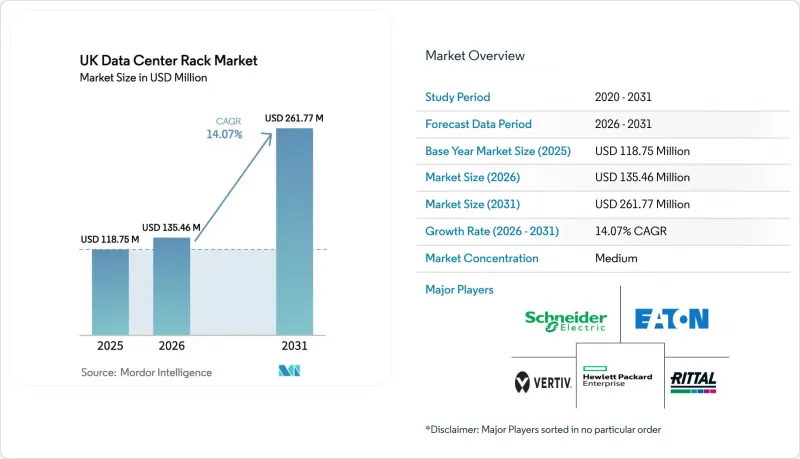
This report is Segmented by Rack Size (Quarter Rack, Half Rack, Full Rack), by Rack Height (42U, 45U, 48U), Other Heights (>=52U and Custom), Rack Type (Cabinet (Closed) Racks, Open-Frame Racks, Wall-Mount Rack), Data Center Type (Colocation Facilities and More), Material (Steel and More). The Market Sizes and Forecasts are Provided in Terms of Value (USD) for all the Segments.
UK Data Center Rack Market Trends and Insights
Rapid Adoption of Sovereign and Hybrid Cloud Zones
The sovereign-cloud agenda is redrawing rack-deployment patterns as enterprises seek local data-residency compliance. AI Growth Zones streamline approvals, enabling faster cabinet installations with enhanced locking mechanisms that meet financial-sector audit trails. Hybrid architectures also mitigate vendor lock-in risk highlighted by the ongoing cloud-market investigation, spurring demand for racks with integrated cabling and power-distribution units that support multi-cloud switching. Financial institutions further accelerate deployments by specifying British-hosted racks that satisfy open-banking regulations.
AI/ML Rack-Density Upgrades Across Hyperscale and Colocation
AI training clusters are pushing per-rack loads above 90 kW, forcing operators to adopt 48U and custom heights to accommodate immersion trays, rear-door heat exchangers, and high-capacity busbars. Partnerships such as Telehouse's liquid-cooling laboratory illustrate the convergence of rack, cooling, and monitoring domains, opening opportunities for suppliers able to offer pre-engineered, liquid-ready cabinets. Hyperscalers standardize on taller frames to optimize compute-per-square-meter, strengthening volume demand for the United Kingdom data center rack market.
Power-Grid Connection Queues (>= 24-Month Delays)
Backlogs totaling 400 GW in the London region force developers to wait two years or more for grid hookups. Many operators redirect capital to Manchester or Cardiff, while others install on-site gas turbines, battery storage, or explore small modular reactors. The AI Energy Council's formation underscores official urgency; however, long approval cycles still curb near-term rack deployments.
Other drivers and restraints analyzed in the detailed report include:
- Accelerated 5G Edge Build-Outs Needing Micro-Racks
- Government Carbon-Neutral Mandates Driving Liquid-Cool Ready Racks
- Tight Labour Pool for Tier 3/Tier 4 Installers
For complete list of drivers and restraints, kindly check the Table Of Contents.
Segment Analysis
Full racks held 71.58% of the United Kingdom data center rack market share in 2025, reflecting the preference for standardized 600 mm X 1,200 mm footprints that streamline airflow and cable management. The segment is projected to expand at 15.86% CAGR as hyperscalers and colocation landlords chase economies of scale. Quarter racks will persist in edge pods, but volume remains modest in the overall United Kingdom data center rack market.
Rising AI compute clusters further cement full-rack popularity because clustered GPU trays consume contiguous vertical and horizontal space, making partial frames inefficient for power and cooling loops. Therefore, suppliers concentrate R&D on strengthening frame rigidity, vibration isolation, and built-in coolant manifolds that serve rack-wide cold-plate grids-features easier to integrate when designing full-height enclosures.
The 42U format still accounts for 55.82% of the United Kingdom data center rack market size, but its dominance is eroding as 48U systems grow 14.92% per year. Taller frames provide an extra 6U that operators allocate to in-rack UPS drawers, top-of-rack switches, or manifold headers for liquid loops. Taller enclosures also raise center-of-gravity considerations, prompting vendors to switch from mild steel to lighter aluminum frames that meet seismic standards without adding floor anchoring.
GPU clusters like NVIDIA DGX SuperPOD occupy multiple rack units per server sled, accelerating the shift to 48U and custom 52U configurations so operators can maximize nodes per kilowatt. Legacy 42U sites in London's Docklands are therefore retrofitting with rear-door heat exchangers to squeeze incremental capacity until grid upgrades arrive
Complete Report Scope:
- By Rack Size
- Quarter Rack
- Half Rack
- Full Rack
- By Rack Height
- 42U
- 45U
- 48U
- Other Heights (?52U and Custom)
- By Rack Type
- Cabinet (Closed) Racks
- Open-Frame Racks
- Wall-Mount Racks
- By Data Center Type
- Colocation Facilities
- Hyperscale and Cloud Service Provider DCs
- Enterprise and Edge
- By Material
- Steel
- Aluminum
- Other Alloys and Composites
List of Companies Covered in this Report:
- Schneider Electric SE
- Vertiv Group Corp.
- Eaton Corporation plc
- Rittal GmbH and Co. KG
- Hewlett Packard Enterprise Co.
- Black Box (BB Technologies Inc.)
- Cannon Technologies Ltd
- Dataracks (Stagwood Industries Ltd)
- Rainford Solutions Ltd
- Orion Rack Cabinets Ltd
- Chatsworth Products Inc.
- Legrand Data Center Solutions
- Subzero Engineering (PDU Cabling)
- Panduit Corp.
- Dell Technologies Inc.
- IBM Corp. (iDataPlex Racks)
- Huawei Technologies Co., Ltd.
- Cisco Systems Inc.
- Tripp Lite by Eaton
- Great Lakes Case and Cabinet
Additional Benefits:
- The market estimate (ME) sheet in Excel format
- 3 months of analyst support
TABLE OF CONTENTS
1 INTRODUCTION
- 1.1 Study Assumptions and Market Definition
- 1.2 Scope of the Study
2 RESEARCH METHODOLOGY
3 EXECUTIVE SUMMARY
4 MARKET LANDSCAPE
- 4.1 Market Overview
- 4.2 Market Drivers
- 4.2.1 Rapid adoption of sovereign and hybrid cloud zones
- 4.2.2 AI/ML rack-density upgrades across hyperscale and colocation
- 4.2.3 Accelerated 5G edge build-outs needing micro-racks
- 4.2.4 Government carbon-neutral mandates driving liquid-cool ready racks
- 4.2.5 Surge in fintech and Open-Banking transactions
- 4.2.6 Modular data-hall retrofits in listed U.K. real-estate trusts
- 4.3 Market Restraints
- 4.3.1 Power-grid connection queues (24-month delays)
- 4.3.2 Tight labour pool for Tier 3/Tier 4 installers
- 4.3.3 In-rack thermal hotspots above 70 kW challenging legacy sites
- 4.3.4 Rising insurance premiums on high-density halls
- 4.4 Supply-Chain Analysis
- 4.5 Regulatory Landscape (NIS 2, Ofgem, DSIT consultation)
- 4.6 Technological Outlook (liquid cooling, busbar DC power)
- 4.7 Porters Five Forces Analysis
- 4.7.1 Bargaining Power of Buyers
- 4.7.2 Bargaining Power of Suppliers
- 4.7.3 Threat of New Entrants
- 4.7.4 Threat of Substitutes
- 4.7.5 Intensity of Competitive Rivalry
- 4.8 Assessment of Macro Economic Trends on the Market
5 MARKET SIZE AND GROWTH FORECASTS (VALUE)
- 5.1 By Rack Size
- 5.1.1 Quarter Rack
- 5.1.2 Half Rack
- 5.1.3 Full Rack
- 5.2 By Rack Height
- 5.2.1 42U
- 5.2.2 45U
- 5.2.3 48U
- 5.2.4 Other Heights (?52U and Custom)
- 5.3 By Rack Type
- 5.3.1 Cabinet (Closed) Racks
- 5.3.2 Open-Frame Racks
- 5.3.3 Wall-Mount Racks
- 5.4 By Data Center Type
- 5.4.1 Colocation Facilities
- 5.4.2 Hyperscale and Cloud Service Provider DCs
- 5.4.3 Enterprise and Edge
- 5.5 By Material
- 5.5.1 Steel
- 5.5.2 Aluminum
- 5.5.3 Other Alloys and Composites
6 COMPETITIVE LANDSCAPE
- 6.1 Market Concentration
- 6.2 Strategic Moves (MandA, facility launches, green-power PPAs)
- 6.3 Market Share Analysis
- 6.4 Company Profiles (includes Global level Overview, Market level overview, Core Segments, Financials as available, Strategic Information, Market Rank/Share, Products and Services, Recent Developments)
- 6.4.1 Schneider Electric SE
- 6.4.2 Vertiv Group Corp.
- 6.4.3 Eaton Corporation plc
- 6.4.4 Rittal GmbH and Co. KG
- 6.4.5 Hewlett Packard Enterprise Co.
- 6.4.6 Black Box (BB Technologies Inc.)
- 6.4.7 Cannon Technologies Ltd
- 6.4.8 Dataracks (Stagwood Industries Ltd)
- 6.4.9 Rainford Solutions Ltd
- 6.4.10 Orion Rack Cabinets Ltd
- 6.4.11 Chatsworth Products Inc.
- 6.4.12 Legrand Data Center Solutions
- 6.4.13 Subzero Engineering (PDU Cabling)
- 6.4.14 Panduit Corp.
- 6.4.15 Dell Technologies Inc.
- 6.4.16 IBM Corp. (iDataPlex Racks)
- 6.4.17 Huawei Technologies Co., Ltd.
- 6.4.18 Cisco Systems Inc.
- 6.4.19 Tripp Lite by Eaton
- 6.4.20 Great Lakes Case and Cabinet
7 MARKET OPPORTUNITIES and FUTURE OUTLOOK
- 7.1 White-space and Unmet-Need Assessment (edge colocation pods, SMR-powered campuses)

