PUBLISHER: Mordor Intelligence | PRODUCT CODE: 2123014

PUBLISHER: Mordor Intelligence | PRODUCT CODE: 2123014
Data Center Rack Power Distribution Unit (PDU) - Market Share Analysis, Industry Trends & Statistics, Growth Forecasts (2026 - 2031)
According to Mordor Intelligence, the data center rack power distribution unit (PDU) market size is expected to increase from USD 2.78 billion in 2025 to USD 3.01 billion in 2026 and reach USD 4.62 billion by 2031, growing at a CAGR of 8.96% over 2026-2031.
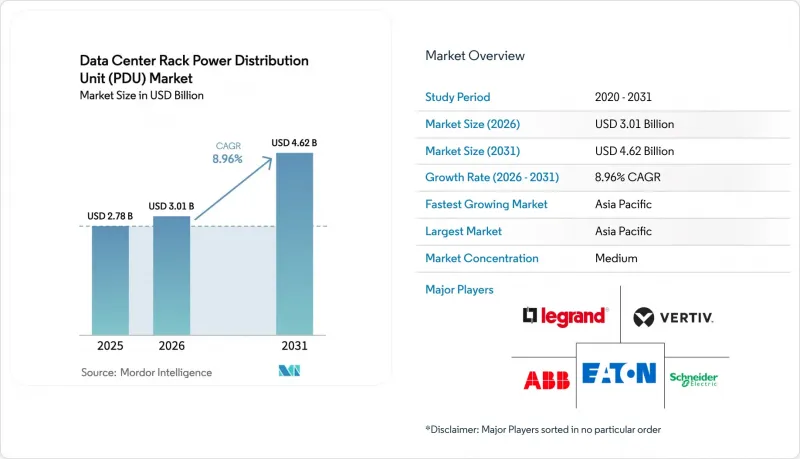
This report is Segmented by Construction (Smart PDU, and Basic PDU), Phase (Single-Phase, and Three-Phase), Tier Type (Tier 1 and 2, Tier 3, and Tier 4), Data Center Size (Small, Medium, Large, and Hyperscale), Data Center Type (Colocation, and More), Rack Density (Up To 10 KW, 10-20 KW, and Above 20 KW), and Geography. The Market Forecasts are Provided in Terms of Value (USD).
Global Data Center Rack Power Distribution Unit (PDU) Market Trends and Insights
Investments in Hyperscale Data Centers Continuing to Spur Demand for Smart PDU Installations
Hyperscale operators have accelerated capital plans, with single-campus builds now topping 1 GW. Each site deploys thousands of intelligent PDUs that stream high-resolution telemetry into cloud analytics platforms, letting operators balance phase load, enforce green-energy scheduling, and monetize power data within usage-based billing models. Price premiums on three-phase outlet-level switching hardware average 40-60% over basic units, yet total cost of ownership falls as remote firmware updates eliminate technician truck rolls. Adoption permeates established clusters in Virginia, Tokyo, and Frankfurt, and is spreading to Abu Dhabi and Kuala Lumpur, where sovereign-cloud rules require in-country infrastructure.
Integration of AI-Driven Energy Management for Rack-Level Distribution
Edge AI chips embedded inside next-generation PDUs process voltage, harmonic, and thermal readings locally, issuing commands in microseconds to curtail non-critical loads or route power to healthier phases. This closes the loop between compute orchestration and electrical distribution, allowing container platforms to incorporate energy as a real-time scheduling constraint. Colocation providers capitalize on sub-rack metering within +-1% accuracy, enabling transparent tenant billing and supporting greener portfolio financing.
Rising Rack Power Densities Exceeding Legacy Data Center Floor Ratings
Facilities built before 2020 feature 5-8 kW design envelopes and floor loading below 200 W per square foot; they now confront 20-30 kW demands that require structural reinforcement, busway replacement, and utility transformer upgrades. Retrofit budgets often reach USD 500-800 per square foot, extend over 6-12 months, and interrupt revenue-generating operations. Operators in land-constrained metros such as Singapore and London weigh the cost of upgrades against edge or greenfield deployment, delaying PDU revamps and suppressing overall unit volume.
Other drivers and restraints analyzed in the detailed report include:
- Increasing Adoption of High-Density Compute Accelerators Demanding Advanced PDUs
- Shift to Liquid Cooling Requiring PDU Redesign for Hybrid Power and Cooling Delivery
- Cybersecurity Concerns Around Networked PDUs
For complete list of drivers and restraints, kindly check the Table Of Contents.
Segment Analysis
Smart units already command with 61.42% market share in 2025, and their higher average selling price continues to lift the data center rack power distribution unit market size for this segment. Intelligent strips enable granular kilowatt-hour tracking, outlet-level switching, and predictive maintenance, capabilities that underpin usage-based colocation pricing and hybrid-cloud orchestration. Service providers report revenue-per-cabinet gains of 12-18% after enabling sub-rack billing. Basic PDUs forecast to advance at a 9.43% CAGR to 2031, viable in low-density and cost-sensitive sites, yet their share erodes as cloud-hosted management portals reduce the total cost of ownership for smart options. Over the forecast horizon, smart units accrue incremental share each year as firmware subscription models make them financially attractive even for small enterprises.
PDUs now integrate with orchestration tools such as VMware vRealize and Red Hat Ansible, creating a feedback loop between IT workloads and electrical capacity. By controlling server spin-up based on real-time power data, operators lower stranded capacity and defer transformer upgrades, a major incentive when utility lead times stretch to 18-24 months. The convergence of AI analytics, secure connectivity, and regulatory push toward PUE transparency further locks in the smart trajectory, ensuring that the data center rack power distribution unit (PDU) market retains this premium profile.
In 2025, three-phase equipment held a 58.32% share of the data center rack power distribution unit market and is set to achieve a 9.26% CAGR through 2031. Three-phase architectures satisfy modern rack power needs by distributing load across multiple conductors and elevating the supply voltage to 415 V or 480 V, which halves resistive losses relative to single-phase 208 V. Hyperscale clouds standardized on this topology in 2025 to achieve densities beyond 15 kW and maintain headroom for future liquid-cooled AI servers. Incentive programs in California, New York, and Germany further accelerate transition by rewarding sites that meet sub-1.2 PUE thresholds, which typically require three-phase distribution. Consequently, three-phase remains the cornerstone of capacity expansions and greenfield builds, solidifying its majority position in the data center rack power distribution unit (PDU) market.
Single-phase remains relevant at the edge and in small enterprise rooms because electricians may lack three-phase expertise, and local codes sometimes restrict high-voltage feeders. Vendor roadmaps now include single- and three-phase variants within common firmware and management frameworks, helping operators manage mixed estates. Yet as AI adoption pushes even branch offices beyond 10 kW per rack, demand will continue to tilt toward three-phase, inevitably shrinking single-phase share in total shipment terms.
Complete Report Scope:
- By Construction
- Smart PDU
- Basic PDU
- By Phase
- Single-Phase
- Three-Phase
- By Tier Type
- Tier 1 and 2
- Tier 3
- Tier 4
- By Data Center Size
- Small Data Center
- Medium Data Center
- Large Data Center
- Hyperscale Data Center
- By Data Center Type
- Colocation Data Center
- Hyperscalers Data Center/CSPs
- Enterprise and Edge Data Center
- By Rack Density (kW per Rack)
- Up to 10 kW
- 10-20 kW
- Above 20 kW
- By Geography
- North America
- United States
- Canada
- Mexico
- South America
- Brazil
- Argentina
- Rest of South America
- Europe
- Germany
- United Kingdom
- France
- Italy
- Spain
- Rest of Europe
- Asia-Pacific
- China
- India
- Japan
- South Korea
- Australia and New Zealand
- Rest of Asia-Pacific
- Middle East
- Saudi Arabia
- United Arab Emirates
- Turkey
- Rest of Middle East
- Africa
- South Africa
- Nigeria
- Egypt
- Rest of Africa
- North America
Geography Analysis
Asia-Pacific accounted for 40.13% of the market share in 2025, helped by national cloud programs and renewable-energy strategies that funnel hyperscale builds to inland provinces where land and clean power are abundant. China's Eastern Data Western Computing policy alone drives PDU shipments into double-digit gigawatt projects, while India's 1,000 MW pipeline supports domestic SaaS and multinational captives. Japan adds incremental volume through automotive test tracks and smart-manufacturing edge nodes, particularly around Aichi and Kanagawa prefectures, where automakers feed sensor data into real-time analytics clusters. These dynamics underpin the region's 10.14% CAGR and reinforce its lead in the data center rack power distribution unit market size.
North America follows, supported by USD 100 billion-plus hyperscale capex commitments in 2024-2025. Virginia's Loudoun County continues to absorb record-setting builds, and Oregon's renewable-heavy grid attracts GPU farms that target green cloud credits. Because local utility lead times stretch beyond two years, hyperscalers pre-purchase transformers and contract PDUs in bulk, securing unit allocations through 2027. While growth moderates relative to Asia-Pacific, sheer scale keeps volume robust in the data center rack power distribution unit (PDU) market.
Europe lags on account of energy-cost inflation and strict efficiency mandates under the EU Energy Efficiency Directive, which press operators to demonstrate sub-1.3 PUE performance and quarterly consumption reporting. Investment shifts toward retrofit efficiency rather than capacity addition, favoring intelligent PDUs with granular telemetry but tempering overall shipment growth. Middle East and Africa, meanwhile, emerge as intercontinental connectivity hubs. Sovereign-cloud policies in the United Arab Emirates and Saudi Arabia spur local hyperscale builds, and greenfield smart-city initiatives such as NEOM incorporate fully renewable 5 GW data centers, adding a fresh vector of demand for high-capacity three-phase units. South America rounds out the picture as Brazil enforces in-country data localization, motivating cloud entrants to establish regional facilities that push PDU demand upward despite macro volatility.
- ABB Ltd.
- Schneider Electric SE
- Vertiv Group Corp.
- Eaton Corporation plc
- Legrand SA
- nVent Electric plc (Enlogic)
- Rittal GmbH & Co. KG
- Cyber Power Systems Inc.
- Aten International Co. Ltd.
- Conteg spol. s r.o.
- Server Technology Inc.
- Geist Global
- Tripp Lite
- Huawei Technologies Co., Ltd.
- Panduit Corp.
- PDU eXpert
- The Siemon Company
- Starline
- Leviton Manufacturing Co., Inc.
Additional Benefits:
- The market estimate (ME) sheet in Excel format
- 3 months of analyst support
TABLE OF CONTENTS
1 INTRODUCTION
- 1.1 Study Assumptions and Market Definition
- 1.2 Scope of the Study
2 RESEARCH METHODOLOGY
3 EXECUTIVE SUMMARY
4 MARKET LANDSCAPE
- 4.1 Market Overview
- 4.2 Market Drivers
- 4.2.1 Investments in Hyperscale Data Centers Continuing to Spur Demand for Smart PDU Installations
- 4.2.2 Industry Mandates for Power Availability and Demand for Software-Defined Data Centers
- 4.2.3 Rising Deployment of Edge Data Centers
- 4.2.4 Integration of AI-Driven Energy Management for Rack-Level Distribution
- 4.2.5 Increasing Adoption of High-Density Compute Accelerators Demanding Advanced PDUs
- 4.2.6 Shift to Liquid Cooling Requiring PDU Redesign for Hybrid Power and Cooling Delivery
- 4.3 Market Restraints
- 4.3.1 Faster Refresh Life Cycle than Data Center Profitable Life Expectancy
- 4.3.2 Supply Chain Volatility for Semiconductor Components in Intelligent PDUs
- 4.3.3 Rising Rack Power Densities Exceeding Legacy Data Center Floor Ratings
- 4.3.4 Cybersecurity Concerns Around Networked PDUs
- 4.4 Industry Value Chain Analysis
- 4.5 Regulatory Landscape
- 4.6 Technological Outlook
- 4.7 Impact of Macroeconomic Factors
- 4.8 Porter's Five Forces Analysis
- 4.8.1 Threat of New Entrants
- 4.8.2 Bargaining Power of Suppliers
- 4.8.3 Bargaining Power of Buyers
- 4.8.4 Threat of Substitutes
- 4.8.5 Competitive Rivalry
5 MARKET SIZE AND GROWTH FORECASTS (VALUE)
- 5.1 By Construction
- 5.1.1 Smart PDU
- 5.1.2 Basic PDU
- 5.2 By Phase
- 5.2.1 Single-Phase
- 5.2.2 Three-Phase
- 5.3 By Tier Type
- 5.3.1 Tier 1 and 2
- 5.3.2 Tier 3
- 5.3.3 Tier 4
- 5.4 By Data Center Size
- 5.4.1 Small Data Center
- 5.4.2 Medium Data Center
- 5.4.3 Large Data Center
- 5.4.4 Hyperscale Data Center
- 5.5 By Data Center Type
- 5.5.1 Colocation Data Center
- 5.5.2 Hyperscalers Data Center/CSPs
- 5.5.3 Enterprise and Edge Data Center
- 5.6 By Rack Density (kW per Rack)
- 5.6.1 Up to 10 kW
- 5.6.2 10-20 kW
- 5.6.3 Above 20 kW
- 5.7 By Geography
- 5.7.1 North America
- 5.7.1.1 United States
- 5.7.1.2 Canada
- 5.7.1.3 Mexico
- 5.7.2 South America
- 5.7.2.1 Brazil
- 5.7.2.2 Argentina
- 5.7.2.3 Rest of South America
- 5.7.3 Europe
- 5.7.3.1 Germany
- 5.7.3.2 United Kingdom
- 5.7.3.3 France
- 5.7.3.4 Italy
- 5.7.3.5 Spain
- 5.7.3.6 Rest of Europe
- 5.7.4 Asia-Pacific
- 5.7.4.1 China
- 5.7.4.2 India
- 5.7.4.3 Japan
- 5.7.4.4 South Korea
- 5.7.4.5 Australia and New Zealand
- 5.7.4.6 Rest of Asia-Pacific
- 5.7.5 Middle East
- 5.7.5.1 Saudi Arabia
- 5.7.5.2 United Arab Emirates
- 5.7.5.3 Turkey
- 5.7.5.4 Rest of Middle East
- 5.7.6 Africa
- 5.7.6.1 South Africa
- 5.7.6.2 Nigeria
- 5.7.6.3 Egypt
- 5.7.6.4 Rest of Africa
- 5.7.1 North America
6 COMPETITIVE LANDSCAPE
- 6.1 Market Concentration
- 6.2 Strategic Moves
- 6.3 Market Share Analysis
- 6.4 Company Profiles (Includes Global Level Overview, Market Level Overview, Core Segments, Financials as Available, Strategic Information, Market Rank/Share, Products and Services, and Recent Developments)
- 6.4.1 ABB Ltd.
- 6.4.2 Schneider Electric SE
- 6.4.3 Vertiv Group Corp.
- 6.4.4 Eaton Corporation plc
- 6.4.5 Legrand SA
- 6.4.6 nVent Electric plc (Enlogic)
- 6.4.7 Rittal GmbH & Co. KG
- 6.4.8 Cyber Power Systems Inc.
- 6.4.9 Aten International Co. Ltd.
- 6.4.10 Conteg spol. s r.o.
- 6.4.11 Server Technology Inc.
- 6.4.12 Geist Global
- 6.4.13 Tripp Lite
- 6.4.14 Huawei Technologies Co., Ltd.
- 6.4.15 Panduit Corp.
- 6.4.16 PDU eXpert
- 6.4.17 The Siemon Company
- 6.4.18 Starline
- 6.4.19 Leviton Manufacturing Co., Inc.
7 MARKET OPPORTUNITIES AND FUTURE OUTLOOK
- 7.1 White-Space and Unmet-Need Assessment

