PUBLISHER: Mordor Intelligence | PRODUCT CODE: 2119753

PUBLISHER: Mordor Intelligence | PRODUCT CODE: 2119753
North America Rigid Plastic Packaging - Market Share Analysis, Industry Trends & Statistics, Growth Forecasts (2026 - 2031)
According to Mordor Intelligence, the North America rigid plastic packaging market size is expected to grow from 15.51 million tonnes in 2025 to 15.84 million tonnes in 2026 and is forecast to reach 17.58 million tonnes by 2031 at 2.10% CAGR over 2026-2031.
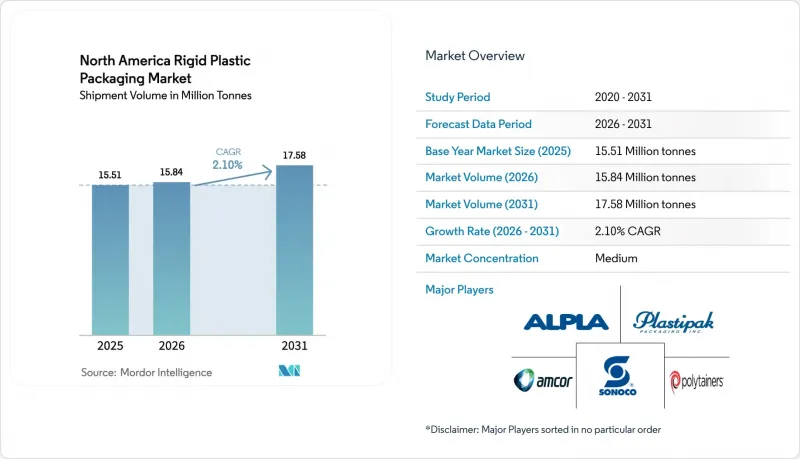
This report is Segmented by Resin Type (Polyethylene, PET, Polypropylene, and More), Product Type (Bottles/Jars, Trays/Containers, Caps/Closures, Drums, and More), End-User Industry (Food, Beverage, Healthcare, Cosmetics, and More), Manufacturing Process (Injection Molding, Blow Molding, and More), and Country. The Market Forecasts are Provided in Terms of Volume (Tonnes).
North America Rigid Plastic Packaging Market Trends and Insights
Growing FMCG Penetration Drives Volume Expansion
Rising disposable income and urbanization in Mexico and the US South are broadening modern retail footprints and lifting demand for packaged food and beverages. National convenience-store chains drive high product turnover, requiring rigid containers that protect freshness during longer shelf cycles. Brand owners favor polyethylene and polypropylene bottles for oil, sauces, and household goods because material cost stability supports predictable unit economics. Large retailers also promote private-label ranges, stimulating smaller production runs that benefit from flexible injection and blow-molding equipment. The combined effect of more SKUs and higher per-capita consumption underpins baseline growth in the North America rigid plastic packaging market. FMCG penetration therefore offsets sluggish demand in mature categories such as carbonated soft drinks.
PET Bottle Sustainability Programs Accelerate rPET Procurement
Major beverage companies have pledged minimum recycled content thresholds often 25% or higher by 2030, catalyzing investment in food-grade rPET capacity. Collection systems improved, lifting the regional PET bottle recycling rate to 27.9% in 2024. Producers such as Plastipak and ALPLA responded by expanding depolymerization and purification lines, helping brand owners meet voluntary and legislative targets. Recycled resin trades at a premium to virgin PET, but volume commitments enable long-term offtake contracts that de-risk capital spending. As rPET adoption grows, converters differentiate through contamination control and traceability audits demanded by beverage clients. These sustainability programs are now a structural driver of the North America rigid plastic packaging market
Flexible and Paper-Based Format Competition Intensifies
Environment-conscious consumers perceive single-use rigid plastics as less sustainable than lightweight pouches or emerging fiber-based solutions. Brand owners responding to retailer scorecards convert selected SKUs such as dry snack packs and seasoning mixes to laminates or coated paperboard. Packaging machinery suppliers now offer multimodal filling lines, lowering switching costs between rigid and flexible formats. Nevertheless, rigid packaging retains functional advantages where impact resistance, stack strength, or tamper evidence is critical, limiting share erosion to specific categories. The competitive tension suppresses price-increase headroom for converters in the North America rigid plastic packaging market.
Other drivers and restraints analyzed in the detailed report include:
- E-Commerce Growth Intensifies Protective-Packaging Requirements
- FDA Migration-Limit Revisions Drive Barrier Technology Investment
- Feedstock Price Volatility Creates Cost Pressures
For complete list of drivers and restraints, kindly check the Table Of Contents.
Segment Analysis
Polyethylene commanded the largest 29.10% share in 2025, reflecting entrenched processing infrastructure and versatile performance. Beverage, household, and industrial chemical producers rely on high-density grades for chemical resistance and rigidity. The North America rigid plastic packaging market size for polyethylene reached 4.51 million tonnes in 2025, yet its forward CAGR trails that of PET. PET's 3.72% CAGR benefits from recyclability credentials and clarity prized by beverage brands. Recycled-content mandates accelerate food-grade rPET use, creating premium niches for suppliers with advanced decontamination reactors. Polypropylene retains specialized roles in hot-fill and microwaveable containers, while polystyrene's decline continues due to municipal bans. Emerging bio-based resins appear in pilot volumes, appealing to premium cosmetic lines. Overall, resin diversification is rising but polyolefins and PET will remain core pillars of the North America rigid plastic packaging market.
Ongoing R&D focuses on barrier additives and chain-extension chemistries that enable higher recycled content without compromising mechanical properties. Converters collaborate with resin producers to qualify new grades under FDA 21 CFR regulations for food contact, shortening commercialization timelines. Such partnerships embed resin suppliers deeper into customer value chains, supporting stable demand even as material circularity expectations climb
Bottles and jars represented 45.10% of 2025 shipments, aligned with long-standing filling and distribution systems across beverages, sauces, and personal care. Their entrenched tooling bases and compatibility with existing labeling lines safeguard share within the North America rigid plastic packaging market. Trays and tubs serve ready-meal and dairy applications that demand rigidity to prevent deformation during microwave heating. Intermediate bulk containers support chemicals and lubricants thanks to stack strength, while drums cater to bulk transport.
Caps and closures exhibit the fastest 3.1% CAGR, propelled by heightened safety and convenience needs. Child-resistant mechanisms, dose-control droppers, and tethered closures to meet single-use-plastic directives drive design complexity and raise average unit revenue. Smart closures integrating NFC chips enter pilot scale in premium spirits, providing authenticity verification. Converters invest in multi-component molding and post-mold assembly automation to capture this high-value segment. As a result, caps and closures gain strategic prominence inside the North America rigid plastic packaging market.
Complete Report Scope:
- By Resin Type
- Polyethylene
- High-Density Polyethylene (HDPE)
- Low-Density Polyethylene (LDPE)
- Linear Low-Density Polyethylene (LLDPE)
- Polyethylene Terephthalate
- Polypropylene
- Polystyrene and EPS
- Other Resin Type
- Polyethylene
- By Product Type
- Bottles and Jars
- Trays and Containers
- Caps and Closures
- Intermediate Bulk Containers (IBCs)
- Drums
- Other Product Types
- By End-user Industry
- Food
- Candy and Confectionery
- Dairy and Frozen
- Meat, Poultry and Seafood
- Other Food Types
- Beverage
- Healthcare and Pharmaceuticals
- Cosmetics and Personal Care
- Industrial Chemicals
- Building and Construction
- Other End-user Industry
- Food
- By Manufacturing Process
- Injection Moulding
- Blow Moulding
- Thermoforming
- Compression Moulding
- Extrusion
- Other End-user Industries
- By Country
- United States
- Canada
- Mexico
List of Companies Covered in this Report:
- Amcor plc
- ALPLA Group GmbH
- Gerresheimer AG
- Plastipak Holdings Inc.
- Sonoco Products Company
- Polytainers Inc.
- Graham Packaging Company LP
- Greif Inc.
- Altium Packaging LLC
- Silgan Holdings Inc.
- Pactiv Evergreen Inc.
- Winpak Ltd.
- CCL Industries Inc.
- Consolidated Container Company LLC
- Sealed Air Corporation
- Huhtamaki Oyj
- Reynolds Group Holdings Ltd.
- International Paper Company
- Smurfit WestRock
Additional Benefits:
- The market estimate (ME) sheet in Excel format
- 3 months of analyst support
TABLE OF CONTENTS
1 INTRODUCTION
- 1.1 Study Assumptions and Market Definition
- 1.2 Scope of the Study
2 RESEARCH METHODOLOGY
3 EXECUTIVE SUMMARY
4 MARKET LANDSCAPE
- 4.1 Market Overview
- 4.2 Market Drivers
- 4.2.1 Growing FMCG penetration boosts demand
- 4.2.2 PET bottle sustainability programs accelerate rPET procurement
- 4.2.3 Expansion of e-commerce and D2C channels raises protective-packaging needs
- 4.2.4 FDA migration-limit revisions spur barrier-coating investments
- 4.2.5 AI-enabled defect-detection lowers scrap rates and widens profit pools
- 4.2.6 NA petro-chemical capacity shift from fuels to polymers keeps resin prices competitive
- 4.3 Market Restraints
- 4.3.1 Shift toward flexible and paper-based formats
- 4.3.2 Volatile virgin-resin feedstock prices
- 4.3.3 Shortfall of food-grade PCR supply caps recycled-content adoption
- 4.3.4 State-level EPR fees squeeze low-margin rigid formats
- 4.4 Industry Value Chain Analysis
- 4.5 Porter's Five Forces Analysis
- 4.5.1 Bargaining Power of Suppliers
- 4.5.2 Bargaining Power of Buyers/Consumers
- 4.5.3 Threat of New Entrants
- 4.5.4 Threat of Substitutes
- 4.5.5 Intensity of Competitive Rivalry
- 4.6 Impact of Macroeconomic Factors on the Market
5 MARKET SIZE AND GROWTH FORECASTS (VOLUME)
- 5.1 By Resin Type
- 5.1.1 Polyethylene
- 5.1.1.1 High-Density Polyethylene (HDPE)
- 5.1.1.2 Low-Density Polyethylene (LDPE)
- 5.1.1.3 Linear Low-Density Polyethylene (LLDPE)
- 5.1.2 Polyethylene Terephthalate
- 5.1.3 Polypropylene
- 5.1.4 Polystyrene and EPS
- 5.1.5 Other Resin Type
- 5.1.1 Polyethylene
- 5.2 By Product Type
- 5.2.1 Bottles and Jars
- 5.2.2 Trays and Containers
- 5.2.3 Caps and Closures
- 5.2.4 Intermediate Bulk Containers (IBCs)
- 5.2.5 Drums
- 5.2.6 Other Product Types
- 5.3 By End-user Industry
- 5.3.1 Food
- 5.3.1.1 Candy and Confectionery
- 5.3.1.2 Dairy and Frozen
- 5.3.1.3 Meat, Poultry and Seafood
- 5.3.1.4 Other Food Types
- 5.3.2 Beverage
- 5.3.3 Healthcare and Pharmaceuticals
- 5.3.4 Cosmetics and Personal Care
- 5.3.5 Industrial Chemicals
- 5.3.6 Building and Construction
- 5.3.7 Other End-user Industry
- 5.3.1 Food
- 5.4 By Manufacturing Process
- 5.4.1 Injection Moulding
- 5.4.2 Blow Moulding
- 5.4.3 Thermoforming
- 5.4.4 Compression Moulding
- 5.4.5 Extrusion
- 5.4.6 Other End-user Industries
- 5.5 By Country
- 5.5.1 United States
- 5.5.2 Canada
- 5.5.3 Mexico
6 COMPETITIVE LANDSCAPE
- 6.1 Market Concentration
- 6.2 Strategic Moves
- 6.3 Market Share Analysis
- 6.4 Company Profiles (includes Global level Overview, Market level overview, Core Segments, Financials as available, Strategic Information, Market Rank/Share for key companies, Products and Services, and Recent Developments)
- 6.4.1 Amcor plc
- 6.4.2 ALPLA Group GmbH
- 6.4.3 Gerresheimer AG
- 6.4.4 Plastipak Holdings Inc.
- 6.4.5 Sonoco Products Company
- 6.4.6 Polytainers Inc.
- 6.4.7 Graham Packaging Company LP
- 6.4.8 Greif Inc.
- 6.4.9 Altium Packaging LLC
- 6.4.10 Silgan Holdings Inc.
- 6.4.11 Pactiv Evergreen Inc.
- 6.4.12 Winpak Ltd.
- 6.4.13 CCL Industries Inc.
- 6.4.14 Consolidated Container Company LLC
- 6.4.15 Sealed Air Corporation
- 6.4.16 Huhtamaki Oyj
- 6.4.17 Reynolds Group Holdings Ltd.
- 6.4.18 International Paper Company
- 6.4.19 Smurfit WestRock
7 MARKET OPPORTUNITIES AND FUTURE OUTLOOK
- 7.1 White-space and Unmet-need Assessment

