PUBLISHER: Mordor Intelligence | PRODUCT CODE: 2154974

PUBLISHER: Mordor Intelligence | PRODUCT CODE: 2154974
South America Rigid Plastic Packaging - Market Share Analysis, Industry Trends & Statistics, Growth Forecasts (2026 - 2031)
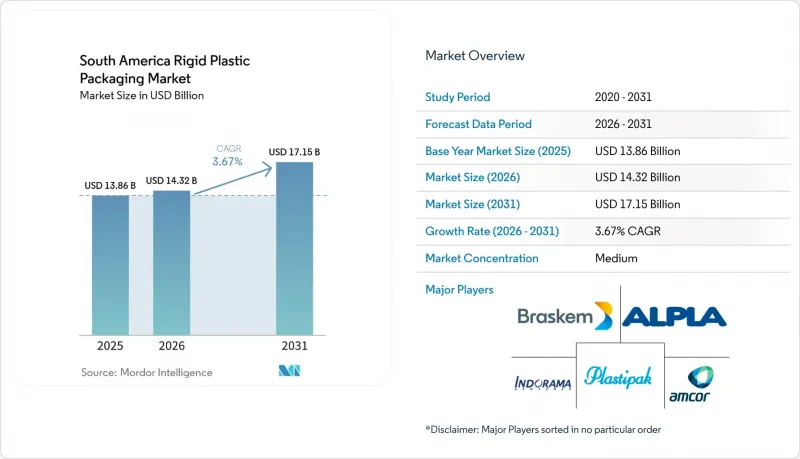
According to Mordor Intelligence, the South America rigid plastic packaging market size was valued at USD 13.86 billion in 2025 and estimated to expand from USD 14.32 billion in 2026 to reach USD 17.15 billion by 2031, at a CAGR of 3.67% during the forecast period (2026-2031).
South America Rigid Plastic Packaging Market Trends and Insights
Expansion of Food and Beverage Processing
Food and beverage processing remains a major source of demand for the South America rigid plastic packaging market. Processors are investing in automation and manufacturing sites closer to major consumer centers. These projects require containers that perform consistently on fast filling and packing lines. Brazil's organized grocery sector generated BRL 1.1451 trillion (USD 220.78 billion) in 2025 and represented 9.02% of national GDP. High-volume beverage and food operations continue to use PET bottles, jars, and trays across retail channels. Equipment designed around rigid containers can make a shift to other formats less attractive for established product lines.
Growth of Organized Retail, Convenience Foods, and Delivery
Formal retail and delivery channels are increasing the need for standardized packaging across South America. Hypermarkets, cash-and-carry stores, and online grocery services require packs that tolerate handling and repeated stacking. Rigid packs remain suitable for high-density products, carbonated drinks, and higher-value goods. They can offer consistent label adhesion and drop resistance during warehouse storage and courier delivery. The South America rigid plastic packaging market benefits when consumer goods move through formal distribution networks. Flexible pouches retain freight advantages for low-density products, which keeps format selection dependent on the product category.
Flexible Packaging Substitution
Flexible packaging presents the clearest substitution risk for the South America rigid plastic packaging market. Stand-up pouches and films are increasingly used for sauces, spreads, dairy products, and detergents. Their lower weight can reduce volumetric freight costs in third-party logistics networks. Rigid packs retain advantages for carbonation containment, resealable tamper-evident closures, and automated warehouse stacking. These requirements remain important in beverages, pharmaceutical products, and nutraceutical products. As a result, substitution pressure is concentrated in ambient and non-pressurized food and household categories.
Other drivers and restraints analyzed in the detailed report include:
- Expansion of Pharmaceutical, Personal Care, and Healthcare Packaging
- Lightweighting and Material Efficiency
- Virgin Resin Price and Foreign-Exchange Volatility
For complete list of drivers and restraints, kindly check the Table Of Contents.
Segment Analysis
Bottles and jars held 45.24% of regional rigid plastic packaging revenue share in 2025, supported by PET beverage bottles and HDPE household and personal care containers. These formats are used across convenience outlets, supermarkets, and cash-and-carry stores because they support reclosable closures, product presentation, and dependable handling. Brand owners have invested in filling lines and molds designed for round containers, which makes changes to other formats difficult outside major product relaunches. Trays and containers support ready-meal demand in urban Brazil and Colombia, while pallets support export logistics and returnable transport. IBCs are used for agricultural chemicals, industrial liquids, and food-grade products, and Mauser Packaging Solutions offers composite and stainless steel options across MERCOSUR.
Healthcare-grade bottles and containers are an important source of product development activity. Pharmaceutical producers require formats that accept machine-readable codes across different distribution environments without compromising container performance. Child-resistant and tamper-evident closures can carry higher unit values than standard beverage containers. Injection blow molding and stretch blow molding complement extrusion blow molding in this premium bottle category. These process capabilities position converters to serve healthcare and cosmetics customers during 2026-2031.
Polyethylene held 35.67% of regional rigid plastic packaging revenue share in 2025, anchored by HDPE bottles, drums, IBCs, and other containers. LDPE serves selected rigid and flexible-adjacent applications, while virgin and recycled PET form the core of beverage bottle supply. Polyethylene supports household, personal care, and industrial products where chemical resistance and impact performance are required. Its established processing base allows converters to serve large-volume customers across several end-use categories. PP remains widely used for heat-resistant food containers and closures, particularly where chemical compatibility is required.
Bioplastics are projected to expand at a 3.72% CAGR through 2031, with Braskem advancing commercial bio-based and circular polyolefin options for food-contact and healthcare uses. Braskem's bio-based ethylene capacity reached 275,000 tonnes per year at its Triunfo complex, giving bio-PE greater volume relevance. PS and EPS face pressure from PP and molded-fiber trays as foodservice operators shift toward durable alternatives. Food-grade recycled-content shortages and limited industrial composting infrastructure restrict broader use of PLA and PHA.
Complete Report Scope:
- By Product Type
- Bottles and Jars
- Trays and Containers
- Intermediate Bulk Containers (IBCs)
- Pallets
- Other Product Types
- By Material
- Polyethylene (PE)
- High-Density Polyethylene (HDPE)
- Low-Density Polyethylene (LDPE)
- Polyethylene Terephthalate (PET)
- Virgin PET
- Recycled PET (rPET)
- Polypropylene (PP)
- Polystyrene (PS) and Expanded Polystyrene (EPS)
- Bioplastics
- Polylactic Acid (PLA)
- Polyhydroxyalkanoates (PHA)
- Other Materials
- Polyethylene (PE)
- By End User Industry
- Food
- Dairy
- Confectionery and Bakery
- Ready Meals
- Beverage
- Carbonated Soft Drinks
- Bottled Water
- Alcoholic Beverages
- Healthcare
- Pharmaceuticals
- Medical Devices
- Cosmetics and Personal Care
- Industrial
- Building and Construction
- Automotive
- Other End-User Industries
- Food
- By Manufacturing Process
- Injection Molding
- Extrusion Blow Molding
- Injection Blow Molding
- Stretch Blow Molding
- Thermoforming
- Rotational Molding
- Compression Molding
- By Geography
- Brazil
- Argentina
- Colombia
- Rest of South America
List of Companies Covered in this Report:
- Amcor plc
- ALPLA Werke Alwin Lehner GmbH & Co KG
- Braskem S.A.
- Plastipak Holdings, Inc.
- Gerresheimer AG
- Graham Packaging Company, L.P.
- Indorama Ventures Public Company Limited
- Valgroup
- Logoplaste Group
- Carvajal Empaques S.A.
- Mauser Packaging Solutions
- Greif, Inc.
- Schutz GmbH & Co. KGaA
- Schoeller Allibert Services B.V.
- Resilux NV
- Unipac Embalagens Ltda.
- Plaszom Zomer Industria de Plasticos Ltda.
- Rose Plastic Brasil Embalagens Plasticas Ltda.
- Weener Plastics Group B.V.
Additional Benefits:
- The market estimate (ME) sheet in Excel format
- 3 months of analyst support
TABLE OF CONTENTS
1 INTRODUCTION
- 1.1 Study Assumptions and Market Definition
- 1.2 Scope of the Study
2 RESEARCH METHODOLOGY
3 EXECUTIVE SUMMARY
4 MARKET LANDSCAPE
- 4.1 Market Overview
- 4.2 Market Drivers
- 4.2.1 Expansion of Food and Beverage Processing
- 4.2.2 Growth of Organized Retail, Convenience Foods, and Delivery
- 4.2.3 Lightweighting and Material Efficiency
- 4.2.4 Expansion of Pharmaceutical, Personal Care, and Healthcare Packaging
- 4.2.5 Recycled-Content and Reverse-Logistics Investment
- 4.2.6 Returnable Bulk Packaging for Agribusiness and Chemicals
- 4.3 Market Restraints
- 4.3.1 Flexible Packaging Substitution
- 4.3.2 Virgin Resin Price and Foreign-Exchange Volatility
- 4.3.3 Uneven Collection and Food-Grade PCR Availability
- 4.3.4 Fragmented Compliance and Recovery Infrastructure
- 4.4 Impact of Macroeconomic Factors on the Market
- 4.5 Industry Value Chain Analysis
- 4.6 Regulatory Landscape
- 4.7 Technological Outlook
- 4.8 Porter's Five Forces Analysis
- 4.8.1 Threat of New Entrants
- 4.8.2 Bargaining Power of Suppliers
- 4.8.3 Bargaining Power of Buyers
- 4.8.4 Threat of Substitutes
- 4.8.5 Intensity of Competitive Rivalry
5 MARKET SIZE AND GROWTH FORECASTS (VALUE)
- 5.1 By Product Type
- 5.1.1 Bottles and Jars
- 5.1.2 Trays and Containers
- 5.1.3 Intermediate Bulk Containers (IBCs)
- 5.1.4 Pallets
- 5.1.5 Other Product Types
- 5.2 By Material
- 5.2.1 Polyethylene (PE)
- 5.2.1.1 High-Density Polyethylene (HDPE)
- 5.2.1.2 Low-Density Polyethylene (LDPE)
- 5.2.2 Polyethylene Terephthalate (PET)
- 5.2.2.1 Virgin PET
- 5.2.2.2 Recycled PET (rPET)
- 5.2.3 Polypropylene (PP)
- 5.2.4 Polystyrene (PS) and Expanded Polystyrene (EPS)
- 5.2.5 Bioplastics
- 5.2.5.1 Polylactic Acid (PLA)
- 5.2.5.2 Polyhydroxyalkanoates (PHA)
- 5.2.6 Other Materials
- 5.2.1 Polyethylene (PE)
- 5.3 By End User Industry
- 5.3.1 Food
- 5.3.1.1 Dairy
- 5.3.1.2 Confectionery and Bakery
- 5.3.1.3 Ready Meals
- 5.3.2 Beverage
- 5.3.2.1 Carbonated Soft Drinks
- 5.3.2.2 Bottled Water
- 5.3.2.3 Alcoholic Beverages
- 5.3.3 Healthcare
- 5.3.3.1 Pharmaceuticals
- 5.3.3.2 Medical Devices
- 5.3.4 Cosmetics and Personal Care
- 5.3.5 Industrial
- 5.3.6 Building and Construction
- 5.3.7 Automotive
- 5.3.8 Other End-User Industries
- 5.3.1 Food
- 5.4 By Manufacturing Process
- 5.4.1 Injection Molding
- 5.4.2 Extrusion Blow Molding
- 5.4.3 Injection Blow Molding
- 5.4.4 Stretch Blow Molding
- 5.4.5 Thermoforming
- 5.4.6 Rotational Molding
- 5.4.7 Compression Molding
- 5.5 By Geography
- 5.5.1 Brazil
- 5.5.2 Argentina
- 5.5.3 Colombia
- 5.5.4 Rest of South America
6 COMPETITIVE LANDSCAPE
- 6.1 Market Concentration
- 6.2 Strategic Moves
- 6.3 Market Share Analysis
- 6.4 Company Profiles (includes Global Level Overview, Market Level Overview, Core Segments, Financials as available, Strategic Information, Market Rank/Share, Products and Services, Recent Developments)
- 6.4.1 Amcor plc
- 6.4.2 ALPLA Werke Alwin Lehner GmbH & Co KG
- 6.4.3 Braskem S.A.
- 6.4.4 Plastipak Holdings, Inc.
- 6.4.5 Gerresheimer AG
- 6.4.6 Graham Packaging Company, L.P.
- 6.4.7 Indorama Ventures Public Company Limited
- 6.4.8 Valgroup
- 6.4.9 Logoplaste Group
- 6.4.10 Carvajal Empaques S.A.
- 6.4.11 Mauser Packaging Solutions
- 6.4.12 Greif, Inc.
- 6.4.13 Schutz GmbH & Co. KGaA
- 6.4.14 Schoeller Allibert Services B.V.
- 6.4.15 Resilux NV
- 6.4.16 Unipac Embalagens Ltda.
- 6.4.17 Plaszom Zomer Industria de Plasticos Ltda.
- 6.4.18 Rose Plastic Brasil Embalagens Plasticas Ltda.
- 6.4.19 Weener Plastics Group B.V.
7 MARKET OPPORTUNITIES AND FUTURE OUTLOOK
- 7.1 White-Space and Unmet-Need Assessment

