PUBLISHER: Mordor Intelligence | PRODUCT CODE: 2119778

PUBLISHER: Mordor Intelligence | PRODUCT CODE: 2119778
United States IT Outsourcing - Market Share Analysis, Industry Trends & Statistics, Growth Forecasts (2026 - 2031)
According to Mordor Intelligence, the United States IT outsourcing market size is estimated at USD 185.33 billion in 2026, and is expected to reach USD 235.63 billion by 2031, at a CAGR of 4.92% during the forecast period (2026-2031).
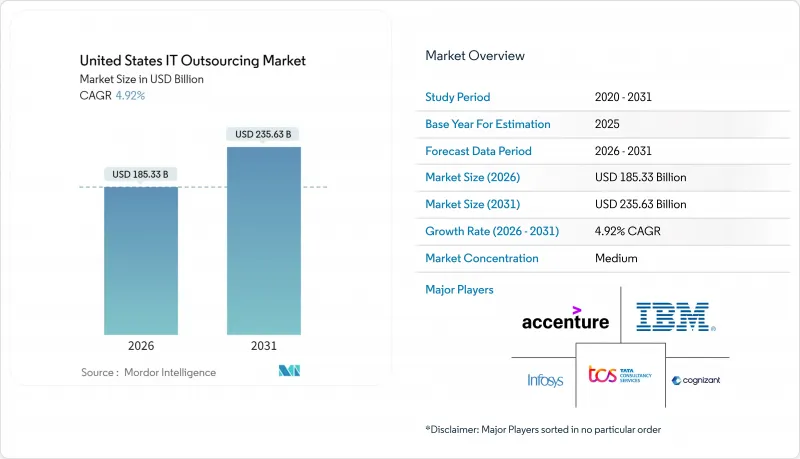
This report is Segmented by Service Type (Application Outsourcing, Infrastructure Outsourcing, and More), Enterprise Size (Small and Medium Enterprises, and Large Enterprises), End-User Industry (BFSI, IT and Telecom, Government and Public Sector, Retail and E-Commerce, and More), Contract Type (Fixed-Price, and More), and Geography. The Market Forecasts are Provided in Terms of Value (USD).
United States IT Outsourcing Market Trends and Insights
Cost-Optimization Amid Domestic Tech-Talent Shortage
Median U.S. software-engineer salaries climbed to USD 130,000 in 2025 while unemployment in computer occupations hovered near 2.1%, underscoring a persistent skills gap. Enterprises, therefore, lean on global delivery, pairing U.S. architects with offshore developers to save roughly 40% on blended rates. Second-tier tech hubs such as Austin, Raleigh, and Denver feel this pressure acutely, as startups and incumbents compete for the same talent pools. Vendors position hybrid teams as resilient to localized shortages and capable of 24-hour development cycles. The practice both cuts costs and compresses release timelines, reinforcing the appeal of the United States IT Outsourcing Market to buyers seeking rapid modernization.
Digital-First Transformation and Cloud-Migration Momentum
U.S. enterprise cloud spend exceeded USD 200 billion in 2025, led by infrastructure- and platform-as-a-service workloads that require containerization and observability expertise. Outsourcing vendors absorb migration risk by orchestrating cutovers and post-migration tuning, a capability that accelerates public-sector adoption following the Department of Defense cloud-first mandate. FedRAMP-authorized providers enjoy a captive market, raising entry barriers for offshore-only rivals lacking U.S. data-center footprints. Cloud momentum, therefore, fuels sustained growth in the United States IT Outsourcing Market.
Escalating Data-Security and Compliance Liabilities
Amended Regulation S-P requires financial institutions to notify regulators within 30 days of breaches affecting 500 or more consumers, raising legal exposure for vendors handling BFSI workloads. Cyber-insurance premiums for service providers jumped 18% in 2025, as underwriters demanded proof of zero-trust architectures. Smaller firms unable to meet these obligations exited highly regulated verticals, concentrating share among Tier-1 players. Across healthcare and state-government accounts, a patchwork of breach-notification laws amplifies compliance overhead, tempering growth in the United States IT Outsourcing Market.
Other drivers and restraints analyzed in the detailed report include:
- Enterprises Focusing on Core Competencies via Selective Sourcing
- Outcome-Based Pricing Pressure Under Constrained IT Budgets
- Integration Complexity in a Fragmented Provider Ecosystem
For complete list of drivers and restraints, kindly check the Table Of Contents.
Segment Analysis
Application Outsourcing accounted for 45.11% of 2025 spend, as firms rushed to re-platform legacy estates before vendor support sunsets. Generative-AI coding assistants and automated regression testing trimmed ticket volumes, reducing maintenance cost yet boosting modernization demand. Cloud migration incentives, such as AWS .NET Modernization credits of up to USD 500,000, supported this push. Infrastructure Outsourcing is forecast to grow at 5.08% through 2031, supported by managed Kubernetes, SD-WAN, and FedRAMP-compliant SASE offerings. High-density GPU colocation for AI training commands premium rates, offsetting price erosion in traditional data-center racks. The United States IT Outsourcing market size for Infrastructure Outsourcing is therefore poised to expand faster than the overall market.
Vendor strategy now pivots to platform-led delivery. Managed Kubernetes clusters, database-as-a-service, and automated observability tools reduce labor intensity. Vendors bundle these with advisory services around zero-trust security, creating integrated propositions that defend margin. Clients value consumption-based models that replace capex with opex, so providers embed flexible SLAs that align fees with resource utilization. As a result, Application Outsourcing retains scale while Infrastructure Outsourcing delivers the strongest incremental lift to the United States IT Outsourcing Market.
Large Enterprises captured 58.83% of 2025 revenue, leveraging master service agreements to lock in discounts and payment terms. They pursue modular contracts that carve out specific towers, preserving optionality to pivot providers. Conversely, Small and Medium Enterprises are projected to post a 5.64% CAGR to 2031 as bundled SaaS packages like Microsoft's Azure for SMB, priced from USD 2,500 per month, eliminate capital outlays. Google Cloud waives egress fees for the first 10 terabytes, further lowering adoption barriers.
The United States IT Outsourcing market for SMEs is still smaller than that for Large Enterprises, yet growth is rapid. Vertical SaaS, from cloud EHRs in healthcare to turnkey e-commerce suites in retail, effectively functions as outsourcing. These platforms bundle hosting, security, and help-desk support, allowing firms with fewer than 500 employees to access enterprise-grade capabilities. Large Enterprises, meanwhile, increase selective sourcing, retaining customer-experience platforms in-house while offloading infrastructure monitoring. This bifurcated pattern ensures expansion across both segments, reinforcing resilience in the United States IT Outsourcing Market.
Complete Report Scope:
- By Service Type
- Application Outsourcing
- Development
- Maintenance and Support
- Testing
- Modernisation
- Infrastructure Outsourcing
- Data-center
- Network
- End-user/Device
- Cloud Infrastructure
- Business Process and Other IT Services
- Application Outsourcing
- By Enterprise Size
- Small and Medium Enterprises
- Large Enterprises
- By End-user Industry
- BFSI
- IT and Telecom
- Government and Public Sector
- Retail and E-commerce
- Manufacturing
- Energy, Utilities and Mining
- Healthcare and Life Sciences
- Media and Entertainment
- By Contract Type
- Fixed-price
- Time-and-materials
- Outcome-based
List of Companies Covered in this Report:
- Accenture plc
- International Business Machines Corporation
- Cognizant Technology Solutions Corporation
- Tata Consultancy Services Limited
- Infosys Limited
- Wipro Limited
- HCL Technologies Limited
- Hewlett Packard Enterprise Company
- DXC Technology Company
- Microsoft Corporation
- Amazon.com, Inc. (AWS Professional Services)
- Google LLC
- NTT DATA Corporation
- Kyndryl Holdings, Inc.
- CGI Inc.
- Capgemini SE
- CDW Corporation
- Rackspace Technology, Inc.
- Salesforce, Inc.
- Deloitte Consulting LLP
- Atos SE
- EPAM Systems, Inc.
- Tech Mahindra Limited
Additional Benefits:
- The market estimate (ME) sheet in Excel format
- 3 months of analyst support
TABLE OF CONTENTS
1 INTRODUCTION
- 1.1 Study Assumptions and Market Definition
- 1.2 Scope of the Study
2 RESEARCH METHODOLOGY
3 EXECUTIVE SUMMARY
4 MARKET LANDSCAPE
- 4.1 Market Overview
- 4.2 Market Drivers
- 4.2.1 Cost-Optimisation Amid Domestic Tech-Talent Shortage
- 4.2.2 Digital-First Transformation And Cloud-Migration Momentum
- 4.2.3 Enterprises Focusing On Core Competencies Via Selective Sourcing
- 4.2.4 Outcome-Based Pricing Pressure Under Constrained IT Budgets
- 4.2.5 Federal CHIPS Act Incentives Reshaping On/Near-Shoring Mix
- 4.2.6 Generative-AI-Assisted Coding Boosting Vendor Productivity
- 4.3 Market Restraints
- 4.3.1 Escalating Data-Security And Compliance Liabilities
- 4.3.2 Integration Complexity In A Fragmented Provider Ecosystem
- 4.3.3 Offshore Wage Inflation Eroding Labour-Arbitrage Advantage
- 4.3.4 State-Level Data-Residency Statutes Raising Governance Costs
- 4.4 Industry Value Chain Analysis
- 4.5 Regulatory Landscape
- 4.6 Technological Outlook
- 4.7 Porter's Five Forces Analysis
- 4.7.1 Bargaining Power of Suppliers
- 4.7.2 Bargaining Power of Buyers
- 4.7.3 Threat of New Entrants
- 4.7.4 Threat of Substitutes
- 4.7.5 Intensity of Competitive Rivalry
5 MARKET SIZE AND GROWTH FORECASTS (VALUE)
- 5.1 By Service Type
- 5.1.1 Application Outsourcing
- 5.1.1.1 Development
- 5.1.1.2 Maintenance and Support
- 5.1.1.3 Testing
- 5.1.1.4 Modernisation
- 5.1.2 Infrastructure Outsourcing
- 5.1.2.1 Data-center
- 5.1.2.2 Network
- 5.1.2.3 End-user/Device
- 5.1.2.4 Cloud Infrastructure
- 5.1.3 Business Process and Other IT Services
- 5.1.1 Application Outsourcing
- 5.2 By Enterprise Size
- 5.2.1 Small and Medium Enterprises
- 5.2.2 Large Enterprises
- 5.3 By End-user Industry
- 5.3.1 BFSI
- 5.3.2 IT and Telecom
- 5.3.3 Government and Public Sector
- 5.3.4 Retail and E-commerce
- 5.3.5 Manufacturing
- 5.3.6 Energy, Utilities and Mining
- 5.3.7 Healthcare and Life Sciences
- 5.3.8 Media and Entertainment
- 5.4 By Contract Type
- 5.4.1 Fixed-price
- 5.4.2 Time-and-materials
- 5.4.3 Outcome-based
6 COMPETITIVE LANDSCAPE
- 6.1 Market Concentration
- 6.2 Strategic Moves
- 6.3 Market Share Analysis
- 6.4 Company Profiles (includes Global level Overview, Market Level Overview, Core Segments, Financials as Available, Strategic Information, Market Rank/Share for Key Companies, Products and Services, and Recent Developments)
- 6.4.1 Accenture plc
- 6.4.2 International Business Machines Corporation
- 6.4.3 Cognizant Technology Solutions Corporation
- 6.4.4 Tata Consultancy Services Limited
- 6.4.5 Infosys Limited
- 6.4.6 Wipro Limited
- 6.4.7 HCL Technologies Limited
- 6.4.8 Hewlett Packard Enterprise Company
- 6.4.9 DXC Technology Company
- 6.4.10 Microsoft Corporation
- 6.4.11 Amazon.com, Inc. (AWS Professional Services)
- 6.4.12 Google LLC
- 6.4.13 NTT DATA Corporation
- 6.4.14 Kyndryl Holdings, Inc.
- 6.4.15 CGI Inc.
- 6.4.16 Capgemini SE
- 6.4.17 CDW Corporation
- 6.4.18 Rackspace Technology, Inc.
- 6.4.19 Salesforce, Inc.
- 6.4.20 Deloitte Consulting LLP
- 6.4.21 Atos SE
- 6.4.22 EPAM Systems, Inc.
- 6.4.23 Tech Mahindra Limited
7 MARKET OPPORTUNITIES AND FUTURE OUTLOOK
- 7.1 White-space and Unmet-Need Assessment

