PUBLISHER: Mordor Intelligence | PRODUCT CODE: 2119779

PUBLISHER: Mordor Intelligence | PRODUCT CODE: 2119779
Europe Data Center Networking - Market Share Analysis, Industry Trends & Statistics, Growth Forecasts (2026 - 2031)
According to Mordor Intelligence, Europe data center networking market size in 2026 is estimated at USD 8.31 billion, growing from 2025 value of USD 7.78 billion with 2031 projections showing USD 11.58 billion, growing at 6.85% CAGR over 2026-2031.
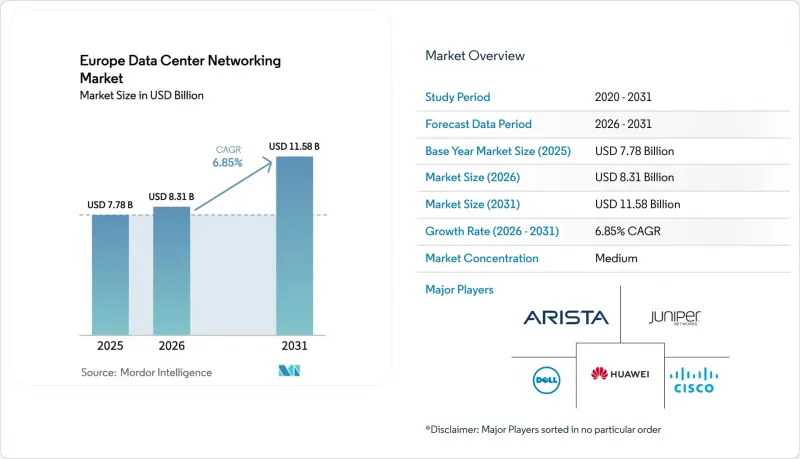
This report Segments the Industry Into Components (By Product, by Services), End-Users (IT & Telecommunication, BFSI, Other End-Users). By Data-Center Type(Colocation, Hyperscalers/Cloud Service Providers, and More). And Bandwidth( <=10 GbE, 25-40 GbE, and More). The Market Forecasts are Provided in Terms of Value (USD).
Europe Data Center Networking Market Trends and Insights
Cloud Storage and Reliable Application Performance
Forty-five percent of EU businesses procured cloud services in 2024, primarily for email hosting and file storage, underscoring mainstream reliance on off-premise platforms. Oracle Cloud Infrastructure was selected for European government workloads, indicating public-sector trust in cloud-native networks. Instant payment regulations require European banks to clear transactions within 10 seconds by 2025, a mandate that tightens latency budgets and favors ultra-low-jitter switching fabrics. The Trustworthy & Responsible AI Network linking leading hospitals depends on resilient inter-data-center paths to keep diagnostic AI online while remaining privacy-compliant. Together, regulatory imperatives and performance expectations elevate high-availability networking from operational necessity to board-level differentiator.
5G and Edge-Computing Traffic Surge
The EU intends to deploy 10,000 climate-neutral edge nodes by 2030, expecting 80% of processing to occur outside core sites. Demonstrations under the 5GMEC4EU program validate sub-millisecond edge fabrics that integrate optical circuit switching with SDN control planes. Deutsche Telekom positions edge as a pillar for national digital agendas, enabling smart-city telemetry and autonomous mobility. Micro data center revenues already exceeded USD 5.8 billion in 2023 and have a runway toward USD 160.8 billion by 2036, revealing a robust pipeline for ruggedized switches and intelligent edge controllers. This distributed topology re-routes traffic away from FLAP hubs, demanding new orchestration layers capable of real-time fault isolation across thousands of mini-sites.
Rising Network Complexity
Hybrid cloud sprawl and AI pipelines complicate topologies faster than European enterprises can recruit qualified engineers. Juniper's Apstra applies intent-based automation to multivendor fabrics, yet skills shortages persist as teams juggle Kubernetes, Terraform, and optical circuit switching. ETNO argues for policy relief that lets carriers recoup investments while delivering edge services. Without broad expertise, organisations defer upgrades, slowing refresh activity in the Europe data center networking market.
Other drivers and restraints analyzed in the detailed report include:
- Migration to 400G/800G Ethernet Switching
- EU Push for Energy-Efficient Liquid-Cooled Switching
- Supply-Chain Shortage of Optics and ASICs
For complete list of drivers and restraints, kindly check the Table Of Contents.
Segment Analysis
Ethernet switches commanded 34.78% Europe data center networking market share in 2025, underscoring their role in leaf-spine fabrics that feed GPU clusters. Software-defined networking controllers, expanding at 11.76% CAGR, orchestrate diverse ASIC generations and automate failover, a necessity as average cluster sizes surpass 10,000 servers. Routers retain relevance for WAN ingress but cede internal roles to converged switches that flatten layers and squeeze latency. Storage networking, though growing slower, gains interest from financial services adopting immutable backup vaults to satisfy operational resilience rules. Application delivery controllers become indispensable at the edge, handling TLS offload near user eyeballs. Security appliances increasingly embed in switching OS images to comply with EU Digital Operational Resilience Act rules. Optical interconnects evolve fastest; co-packaged optics and linear pluggable optics battle for sockets as operators weigh cost, power and upgrade ease. Services hold a stabilizing influence as managed network contracts let enterprises offset the expertise gap that complexity creates.
A second-wave replacement super-cycle is forming around liquid-cool ready gear. Vendors pairing cold-plate chassis with direct-to-chip loops appeal to colocation landlords who must publish PUE scores. Merchant silicon levels hardware performance, shifting differentiation toward NOS features such as real-time fabric telemetry. Open networking distributions like SONiC persuade buyers that they can swap vendors without forklift rewires, making software support and lifecycle stewardship the new trust metric. This pivot realigns profit pools toward licenses and subscription telemetry rather than physical ports, yet packet-processing ASIC innovation remains critical for line-rate encryption and AI cluster congestion control.
IT and telecommunications firms delivered 36.05% of 2025 revenue, leveraging rich peering and backbone assets to monetise hybrid cloud and 5G. Banks and insurers post the fastest 12.65% CAGR as instant-payment rules and model-driven risk scoring force ultra-low latency links between vaults and analytics engines. Government and defence entities adopt sovereign cloud frameworks such as Germany's Deutsche Verwaltungscloud, prioritising data residency and zero-trust segmentation. Media and entertainment houses expand private CDNs, shifting transcoding to edge racks to curb backbone congestion during live sports streams. Healthcare networks participate in shared AI models for radiology, fuelling demand for encrypted east-west traffic inspection. Manufacturing deploys deterministic Ethernet for robotic cells and predictive maintenance, pushing OT and IT domain convergence. Education, retail and logistics round out remaining spend, upgrading campus cores to 100 GbE as digital curricula and omnichannel fulfilment mature.
EU regulatory pressure for operational resilience anchors capital outlays. The Digital Operational Resilience Act compels even mid-tier financial entities to test failover quarterly, driving redundant mesh deployments. Telecommunication operators reroute traffic toward multi-access edge units to offload RAN congestion, embedding workload-aware routing into core switches. Overall, vertical diversity cushions cyclical swings in the Europe data center networking market while BFSI share grows.
Complete Report Scope:
- By Component
- Products
- Ethernet Switches
- Routers
- Storage Area Network (SAN)
- Application Delivery Controllers (ADC)
- Network Security Appliances
- Software-Defined Networking (SDN) Controllers
- Optical Interconnects
- Services
- Installation and Integration
- Training and Consulting
- Support and Maintenance
- Managed Network Services
- Products
- By End-User
- IT and Telecommunications
- Banking, Financial Services and Insurance (BFSI)
- Government and Defense
- Media and Entertainment
- Healthcare and Life Sciences
- Manufacturing and Industrial
- Other End-Users
- By Data-Center Type
- Colocation
- Hyperscalers/Cloud Service Providers
- Edge/Micro Data Centers
- By Bandwidth
- Less Than or equals to 10 GbE
- 25-40 GbE
- 50-100 GbE
- Greater than 100 GbE
- By Country
- United Kingdom
- Germany
- France
- Netherlands
- Ireland
- Spain
- Italy
- Sweden
- Denmark
- Norway
- Poland
- Austria
- Belgium
- Switzerland
- Rest of Europe
List of Companies Covered in this Report:
- Cisco Systems Inc.
- Arista Networks Inc.
- Juniper Networks Inc.
- Huawei Technologies Co. Ltd.
- Dell Technologies Inc.
- Extreme Networks Inc.
- Broadcom Inc.
- Hewlett Packard Enterprise Co.
- Lenovo Group Ltd.
- NEC Corp.
- Fortinet Inc.
- VMware Inc.
- Nokia Corp.
- NVIDIA Corp. (Mellanox)
- Array Networks Inc.
- Radware Ltd.
- A10 Networks Inc.
- Moxa Inc.
- Ericsson AB
- Check Point Software Technologies Ltd.
Additional Benefits:
- The market estimate (ME) sheet in Excel format
- 3 months of analyst support
TABLE OF CONTENTS
1 INTRODUCTION
- 1.1 Study Assumptions and Market Definition
- 1.2 Scope of the Study
2 RESEARCH METHODOLOGY
3 EXECUTIVE SUMMARY
4 MARKET LANDSCAPE
- 4.1 Market Overview
- 4.2 Market Drivers
- 4.2.1 Cloud storage and reliable application performance
- 4.2.2 5G and edge-computing traffic surge
- 4.2.3 Migration to 400G/800G Ethernet switching
- 4.2.4 EU push for energy-efficient liquid-cooled switching
- 4.2.5 Shift of builds to secondary EU metros after FLAP moratoria
- 4.2.6 Merchant silicon and open NOS adoption cuts capex
- 4.3 Market Restraints
- 4.3.1 Rising network complexity
- 4.3.2 Supply-chain shortage of optics and ASICs
- 4.3.3 Power-grid bottlenecks and permitting delays
- 4.3.4 Carbon-/water-use caps inflate TCO
- 4.4 Value / Supply-Chain Analysis
- 4.5 Regulatory Landscape
- 4.6 Technological Outlook
- 4.7 Porter's Five Forces
- 4.7.1 Threat of New Entrants
- 4.7.2 Bargaining Power of Buyers/Consumers
- 4.7.3 Bargaining Power of Suppliers
- 4.7.4 Threat of Substitute Products
- 4.7.5 Intensity of Competitive Rivalry
- 4.8 Assessment of the Impact on Macro Economic Trends on the Market
5 MARKET SIZE and GROWTH FORECASTS (VALUE)
- 5.1 By Component
- 5.1.1 Products
- 5.1.1.1 Ethernet Switches
- 5.1.1.2 Routers
- 5.1.1.3 Storage Area Network (SAN)
- 5.1.1.4 Application Delivery Controllers (ADC)
- 5.1.1.5 Network Security Appliances
- 5.1.1.6 Software-Defined Networking (SDN) Controllers
- 5.1.1.7 Optical Interconnects
- 5.1.2 Services
- 5.1.2.1 Installation and Integration
- 5.1.2.2 Training and Consulting
- 5.1.2.3 Support and Maintenance
- 5.1.2.4 Managed Network Services
- 5.1.1 Products
- 5.2 By End-User
- 5.2.1 IT and Telecommunications
- 5.2.2 Banking, Financial Services and Insurance (BFSI)
- 5.2.3 Government and Defense
- 5.2.4 Media and Entertainment
- 5.2.5 Healthcare and Life Sciences
- 5.2.6 Manufacturing and Industrial
- 5.2.7 Other End-Users
- 5.3 By Data-Center Type
- 5.3.1 Colocation
- 5.3.2 Hyperscalers/Cloud Service Providers
- 5.3.3 Edge/Micro Data Centers
- 5.4 By Bandwidth
- 5.4.1 Less Than or equals to 10 GbE
- 5.4.2 25-40 GbE
- 5.4.3 50-100 GbE
- 5.4.4 Greater than 100 GbE
- 5.5 By Country
- 5.5.1 United Kingdom
- 5.5.2 Germany
- 5.5.3 France
- 5.5.4 Netherlands
- 5.5.5 Ireland
- 5.5.6 Spain
- 5.5.7 Italy
- 5.5.8 Sweden
- 5.5.9 Denmark
- 5.5.10 Norway
- 5.5.11 Poland
- 5.5.12 Austria
- 5.5.13 Belgium
- 5.5.14 Switzerland
- 5.5.15 Rest of Europe
6 COMPETITIVE LANDSCAPE
- 6.1 Market Concentration
- 6.2 Strategic Moves
- 6.3 Market Share Analysis
- 6.4 Company Profiles (includes Global level Overview, Market level overview, Core Segments, Financials as available, Strategic Information, Market Rank/Share, Products and Services, Recent Developments)
- 6.4.1 Cisco Systems Inc.
- 6.4.2 Arista Networks Inc.
- 6.4.3 Juniper Networks Inc.
- 6.4.4 Huawei Technologies Co. Ltd.
- 6.4.5 Dell Technologies Inc.
- 6.4.6 Extreme Networks Inc.
- 6.4.7 Broadcom Inc.
- 6.4.8 Hewlett Packard Enterprise Co.
- 6.4.9 Lenovo Group Ltd.
- 6.4.10 NEC Corp.
- 6.4.11 Fortinet Inc.
- 6.4.12 VMware Inc.
- 6.4.13 Nokia Corp.
- 6.4.14 NVIDIA Corp. (Mellanox)
- 6.4.15 Array Networks Inc.
- 6.4.16 Radware Ltd.
- 6.4.17 A10 Networks Inc.
- 6.4.18 Moxa Inc.
- 6.4.19 Ericsson AB
- 6.4.20 Check Point Software Technologies Ltd.
7 MARKET OPPORTUNITIES and FUTURE OUTLOOK
- 7.1 White-space and Unmet-Need Assessment

