PUBLISHER: Mordor Intelligence | PRODUCT CODE: 2119791

PUBLISHER: Mordor Intelligence | PRODUCT CODE: 2119791
Germany Data Center Networking - Market Share Analysis, Industry Trends & Statistics, Growth Forecasts (2026 - 2031)
According to Mordor Intelligence, Germany data center networking market size in 2026 is estimated at USD 1.11 billion, growing from 2025 value of USD 1.05 billion with 2031 projections showing USD 1.43 billion, growing at 5.32% CAGR over 2026-2031.
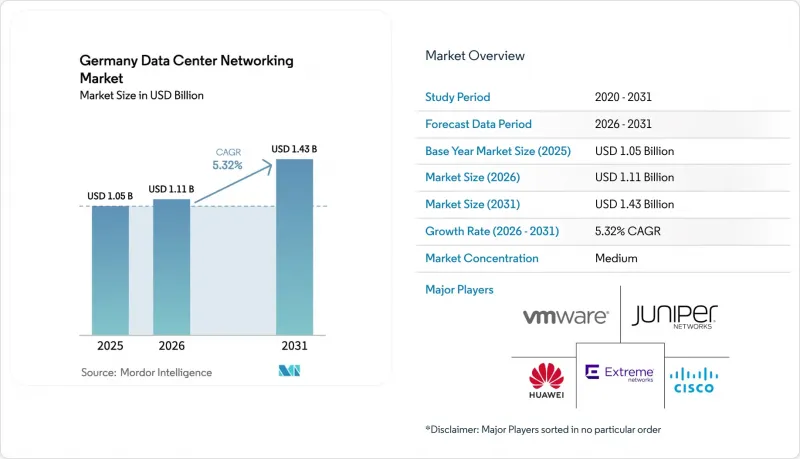
This report is Segmented by Component (Product and Services), End User( IT and Telecommunications, Banking, Financial Services and Insurance (BFSI), Government and Defense and More), Data Center Type (Colocation, Hyperscalers/Cloud Service Providers, Edge/Micro Data Centers), by Bandwidth (<=10 GbE, 25-40 GbE and More). The Market Forecasts are Provided in Terms of Value (USD).
Germany Data Center Networking Market Trends and Insights
Expansion of hyperscale cloud and colocation footprints
Hyperscalers are reshaping procurement cycles by specifying 800G-ready fabrics and InfiniBand clusters for AI training. AWS alone committed USD 9.44 billion to its Frankfurt region, pushing switch vendors to deliver high-density, liquid-cooling-compatible platforms. Colocation operators such as Digital Realty respond with AI-focused halls, drawing enterprise tenants that then require premium interconnects capable of multi-tenant segmentation. These parallel investments compress equipment lifecycles to under four years and create multiplier effects in secondary metros.
Government Gigabit Strategy accelerating fiber and 5G rollout
Berlin's Gigabit Strategy funds EUR 17 billion (USD 19.93 billion) for nationwide fiber and 5G, obliging data-center owners to adopt higher-capacity interconnects that sustain rural back-haul traffic.Grants stipulate adherence to BSI C5 security rules, steering demand toward vendors with European manufacturing lines. Fiber densification also enables distributed edge nodes that rely on software-defined overlays to link new regional facilities with Frankfurt's internet exchanges.
Energy-grid constraints and high electricity costs in FLAP-D
Frankfurt's power caps force operators to distribute AI loads across multiple smaller halls, inflating port counts and cabling runs. The Energy Efficiency Act sets a PUE ceiling of 1.3 by 2030, pushing buyers toward higher-price, low-watt ASICs and liquid-cooled optics that lengthen ROI horizons. Renewable-power sourcing adds spatial constraints because solar or wind adjuncts consume land that could host additional racks.
Other drivers and restraints analyzed in the detailed report include:
- Surging AI/ML traffic driving 400G/800G switch refresh
- Rising edge-data-center deployments for IoT/low latency
- Shortage of certified network-automation engineers
For complete list of drivers and restraints, kindly check the Table Of Contents.
Segment Analysis
Products held 75.30% of Germany data center networking market share in 2025 of Germany data center networking market size. Switch refresh programs shift toward 400G and 800G platforms, and optical interconnect uptake scales with liquid-cooling aisle designs. SDN controller licenses rise as operators centralize management for metro-edge fabrics. Services are forecast to expand at a 5.61% CAGR, adding recurring revenue streams tied to AI-cluster optimisation and IPv6 migration. Managed Network Services absorb the skills gap, while integration specialists link private-5G cells to core data-center fabrics. Training programs see uptake as enterprises re-tool teams for GPU-centric traffic patterns. This mix elevates service spend from 2025 onward, yet hardware outlays remain dominant through 2030 in the Germany data center networking market.
IT and Telecommunications continued to command 35.20% of Germany data center networking market share in 2025, anchored by carriers upgrading core routers for 5G and cloud providers scaling AI regions. DORA compliance bolsters switch-level segmentation and telemetry in financial data centers.Manufacturing and Industrial is projected to register 6.05% CAGR, outpacing all peers. Private 5G at facilities like Tesla's Gigafactory creates micro-data-centers adjacent to production lines, each demanding low-latency fabrics. Factories integrate OT sensor grids with IT analytics, necessitating deterministic traffic engineering and redundant edge aggregation layers that lift spending per square meter.
Complete Report Scope:
- By Component
- Products
- Ethernet Switches
- Routers
- Storage Area Network (SAN)
- Application Delivery Controllers (ADC)
- Network Security Appliances
- Software-Defined Networking (SDN) Controllers
- Optical Interconnects
- Services
- Installation and Integration
- Training and Consulting
- Support and Maintenance
- Managed Network Services
- Products
- By End-User
- IT and Telecommunications
- Banking, Financial Services and Insurance (BFSI)
- Government and Defense
- Media and Entertainment
- Healthcare and Life Sciences
- Manufacturing and Industrial
- Other End-Users
- By Data-Center Type
- Colocation
- Hyperscalers/Cloud Service Providers
- Edge/Micro Data Centers
- By Bandwidth
- Less than 10 GbE
- 25-40 GbE
- 50-100 GbE
- Greater Than 100 GbE
List of Companies Covered in this Report:
- Cisco Systems Inc.
- Juniper Networks Inc.
- VMware Inc.
- Huawei Technologies Co. Ltd.
- Extreme Networks Inc.
- NVIDIA Corp. (Cumulus Networks)
- Dell Technologies Inc.
- NEC Corporation
- IBM Corporation
- Intel Corporation
- Arista Networks Inc.
- Broadcom Inc.
- Hewlett Packard Enterprise (Aruba)
- Nokia Corporation
- ADVA Optical Networking SE
- FS.COM GmbH
- Giax GmbH
- Lenovo Group Ltd.
- NetApp Inc.
- Super Micro Computer Inc.
Additional Benefits:
- The market estimate (ME) sheet in Excel format
- 3 months of analyst support
TABLE OF CONTENTS
1 INTRODUCTION
- 1.1 Study Assumptions and Market Definition
- 1.2 Scope of the Study
2 RESEARCH METHODOLOGY
3 EXECUTIVE SUMMARY
4 MARKET LANDSCAPE
- 4.1 Market Overview
- 4.2 Market Drivers
- 4.2.1 Expansion of hyperscale cloud and colocation footprints
- 4.2.2 Government Gigabit Strategy accelerating fiber and 5G rollout
- 4.2.3 Surging AI/ML traffic driving 400G/800G switch refresh
- 4.2.4 Rising edge-data-center deployments for IoT/low latency
- 4.2.5 Mandatory waste-heat-reuse rules boosting liquid-cooled gear
- 4.2.6 EU sovereign-AI grants funding InfiniBand clusters
- 4.3 Market Restraints
- 4.3.1 Energy-grid constraints and high electricity costs in FLAP-D
- 4.3.2 Shortage of certified network-automation engineers
- 4.3.3 Data-sovereignty (BSI C5) limits foreign white-box adoption
- 4.3.4 Optical-fiber raw-material shortages delaying builds
- 4.4 Supply-Chain Analysis
- 4.5 Regulatory Landscape
- 4.6 Technological Outlook
- 4.7 Porter's Five Forces Analysis
- 4.7.1 Threat of New Entrants
- 4.7.2 Bargaining Power of Buyers
- 4.7.3 Bargaining Power of Suppliers
- 4.7.4 Threat of Substitutes
- 4.7.5 Intensity of Competitive Rivalry
- 4.8 Assessment of Macroeconomic Factors on the Market
5 MARKET SIZE and GROWTH FORECASTS (VALUE)
- 5.1 By Component
- 5.1.1 Products
- 5.1.1.1 Ethernet Switches
- 5.1.1.2 Routers
- 5.1.1.3 Storage Area Network (SAN)
- 5.1.1.4 Application Delivery Controllers (ADC)
- 5.1.1.5 Network Security Appliances
- 5.1.1.6 Software-Defined Networking (SDN) Controllers
- 5.1.1.7 Optical Interconnects
- 5.1.2 Services
- 5.1.2.1 Installation and Integration
- 5.1.2.2 Training and Consulting
- 5.1.2.3 Support and Maintenance
- 5.1.2.4 Managed Network Services
- 5.1.1 Products
- 5.2 By End-User
- 5.2.1 IT and Telecommunications
- 5.2.2 Banking, Financial Services and Insurance (BFSI)
- 5.2.3 Government and Defense
- 5.2.4 Media and Entertainment
- 5.2.5 Healthcare and Life Sciences
- 5.2.6 Manufacturing and Industrial
- 5.2.7 Other End-Users
- 5.3 By Data-Center Type
- 5.3.1 Colocation
- 5.3.2 Hyperscalers/Cloud Service Providers
- 5.3.3 Edge/Micro Data Centers
- 5.4 By Bandwidth
- 5.4.1 Less than 10 GbE
- 5.4.2 25-40 GbE
- 5.4.3 50-100 GbE
- 5.4.4 Greater Than 100 GbE
6 COMPETITIVE LANDSCAPE
- 6.1 Market Concentration
- 6.2 Strategic Moves
- 6.3 Market Share Analysis
- 6.4 Company Profiles (includes Global Overview, Market-level Overview, Core Segments, Financials, Strategic Information, Market Rank/Share, Products and Services, Recent Developments)
- 6.4.1 Cisco Systems Inc.
- 6.4.2 Juniper Networks Inc.
- 6.4.3 VMware Inc.
- 6.4.4 Huawei Technologies Co. Ltd.
- 6.4.5 Extreme Networks Inc.
- 6.4.6 NVIDIA Corp. (Cumulus Networks)
- 6.4.7 Dell Technologies Inc.
- 6.4.8 NEC Corporation
- 6.4.9 IBM Corporation
- 6.4.10 Intel Corporation
- 6.4.11 Arista Networks Inc.
- 6.4.12 Broadcom Inc.
- 6.4.13 Hewlett Packard Enterprise (Aruba)
- 6.4.14 Nokia Corporation
- 6.4.15 ADVA Optical Networking SE
- 6.4.16 FS.COM GmbH
- 6.4.17 Giax GmbH
- 6.4.18 Lenovo Group Ltd.
- 6.4.19 NetApp Inc.
- 6.4.20 Super Micro Computer Inc.
7 MARKET OPPORTUNITIES and FUTURE OUTLOOK
- 7.1 White-space and Unmet-Need Assessment

