PUBLISHER: Mordor Intelligence | PRODUCT CODE: 2119780

PUBLISHER: Mordor Intelligence | PRODUCT CODE: 2119780
Africa Data Center Networking - Market Share Analysis, Industry Trends & Statistics, Growth Forecasts (2026 - 2031)
According to Mordor Intelligence, the Africa data center networking market size is expected to grow from USD 2.1 billion in 2025 to USD 2.38 billion in 2026 and is forecast to reach USD 4.41 billion by 2031 at 13.18% CAGR over 2026-2031.
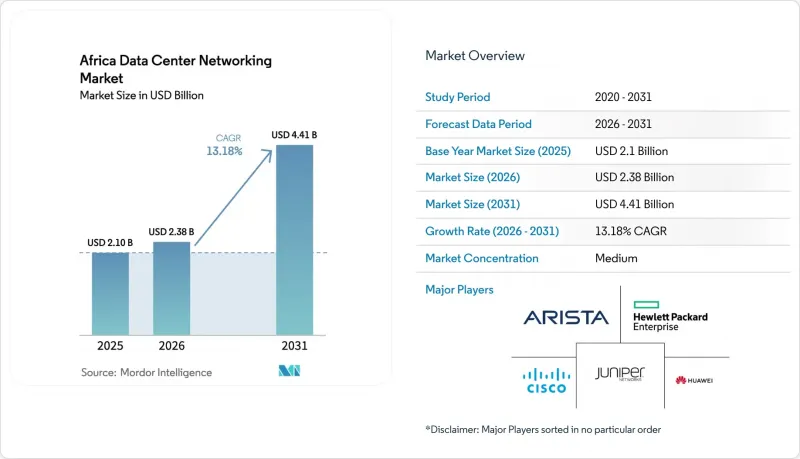
This report Segments the Industry Into Components (By Product, by Services), End-Users (IT & Telecommunication, BFSI, Other End-Users). By Data-Center Type(Colocation, Hyperscalers/Cloud Service Providers, and More). And Bandwidth( <=10 GbE, 25-40 GbE, and More). The Market Forecasts are Provided in Terms of Value (USD).
Africa Data Center Networking Market Trends and Insights
Rapid Expansion of Hyperscale and Cloud Deployments
Hyperscalers are reshaping the Africa data center networking market as Microsoft, Google, and Amazon Web Services commit fresh capital for sovereign cloud zones. Microsoft's USD 298 million South African program delivers AI-ready fabrics built around 25 GbE leaf and 100 GbE spine layers that support large-language-model training. Google's Johannesburg cloud region, live since early 2024, shows latency reductions of 80 milliseconds compared with Amsterdam routes, prompting regional SaaS firms to migrate workloads. Each new cloud availability zone triggers parallel investments in carrier-neutral meet-me rooms, dark-fiber routes, and open-bridged 400G optical uplinks that feed the new campuses. In Senegal, AWS partners with Sonatel to deliver sub-5 millisecond services for fintech workloads, underlining how sovereign cloud regions spur a multiplier effect on switching, routing, and interconnection spending.
Rising Cyber-Attack Surface and Compliance Mandates
Tighter privacy statutes increase capital allocation toward secure switching fabrics and micro-segmented leaf layers. South Africa's POPIA forces enterprises to deploy next-generation firewalls, zero-trust overlays, and telemetry-rich routers able to export flow data for audit trails.Banks in Nigeria and South Africa are early adopters of secure SD-WAN, illustrated by African Bank's Fortinet rollout that halved WAN expense while meeting PCI DSS rules. Compliance extends beyond finance as healthcare and public-sector clouds must maintain encrypted east-west pathways and demonstrate deterministic data-residency enforcement. Demand therefore migrates toward intent-based fabrics with embedded crypto engines and AI-driven anomaly detection that shortens mean-time-to-detect from hours to minutes.
Escalating Network Complexity in Multi-Cloud Fabric
African enterprises adopting multi-cloud strategies face inconsistent performance, tool sprawl, and higher operational costs. A South African retail bank needed five different control planes to secure traffic across two local clouds and one European zone, resulting in configuration drift and extended change windows. Limited in-house expertise pushes organisations toward managed overlay networks that raise opex even while solving skill gaps. The situation delays the adoption of software-defined fabrics and stalls the migration of latency-sensitive apps such as digital trading platforms.
Other drivers and restraints analyzed in the detailed report include:
- Surge in Mobile Data Traffic and OTT Content
- Government-Backed National Data-Residency Policies
- Scarcity of Skilled DC Networking Professionals
For complete list of drivers and restraints, kindly check the Table Of Contents.
Segment Analysis
Products retained 67.45% of the Africa data center networking market share in 2025, as every facility still requires a baseline of physical switches, routers, and optical transport gear. Ethernet switches remain the largest revenue contributor because leaf-spine designs rely on high-port-density TOR units coupled with low-latency spine blocks. Routing continues to find purchase within campus cores, internet gateways, and data-center interconnects that link metro nodes to subsea landing stations. Security appliances and ADCs are gaining momentum as zero-trust and SSL offload proliferate.
Services are scaling faster at a 14.08% CAGR through 2031 as enterprises aim to bridge operational skill deficiencies. Installation and integration engagements are the first port of call for hyperscaler newcomers that want assured time-to-market. Managed network services deliver continuous operations support, freeing local IT teams to focus on application enablement. Training and consulting lines are growing because large multinationals attempt to build regional centres of excellence that can eventually own leaf-spine operations internally. Support and maintenance revenues likewise climb as SLA-sensitive sectors such as finance and healthcare demand four-nines uptime.
IT and telecommunications players accounted for 32.65% of the Africa data center networking market size in 2025 as they deploy dense fabrics to host customer VMs, OTT caches, and 5G core functions. Telcos are refreshing edge aggregation sites from 10 GbE to 25 GbE in preparation for ultra-reliable low-latency traffic while also investing in segment routing to control inter-city paths. Cloud-native ISPs embrace white-box units running SONiC, which lowers capital spending by 40% relative to branded stacks and shortens lead times amid global supply constraints.
Government and defence workloads exhibit the swiftest growth at 14.72% CAGR. National clouds, e-health repositories, and smart-city telemetry demand encrypted 100 GbE links across redundant availability zones. Ministries adopt private access service edges that place inspection functions inside the core rather than at the perimeter, which changes traffic flow patterns and increases east-west bandwidth needs. Defence agencies also prioritise on-premise AI inference to analyse drone footage, thereby driving requests for GPU-aware network topologies.
Complete Report Scope:
- By Component
- Products
- Ethernet Switches
- Routers
- Storage Area Network (SAN)
- Application Delivery Controllers (ADC)
- Network Security Appliances
- Software-Defined Networking (SDN) Controllers
- Optical Interconnects
- Services
- Installation and Integration
- Training and Consulting
- Support and Maintenance
- Managed Network Services
- Products
- By End-User
- IT and Telecommunications
- Banking, Financial Services and Insurance (BFSI)
- Government and Defense
- Media and Entertainment
- Healthcare and Life Sciences
- Manufacturing and Industrial
- Other End-Users
- By Data-Center Type
- Colocation
- Hyperscalers/Cloud Service Providers
- Edge/Micro Data Centers
- By Bandwidth
- Less Than or equals to 10 GbE
- 25-40 GbE
- 50-100 GbE
- Greater than 100 GbE
- By Country
- South Africa
- Nigeria
- Kenya
- Egypt
- Morocco
- Rest of Africa
List of Companies Covered in this Report:
- Huawei Technologies Co. Ltd.
- Cisco Systems, Inc.
- F5, Inc.
- H3C Holding Limited
- NEC Corporation
- Juniper Networks, Inc.
- VMware, Inc.
- A10 Networks, Inc.
- Extreme Networks, Inc.
- Dell Technologies Inc.
- Array Networks, Inc.
- Radware Ltd.
- TP-Link Corporation Limited
- Moxa Inc.
- Arista Networks, Inc.
- Hewlett Packard Enterprise Company
- Nokia Corporation
- Ciena Corporation
- Fortinet, Inc.
- Check Point Software Technologies Ltd.
Additional Benefits:
- The market estimate (ME) sheet in Excel format
- 3 months of analyst support
TABLE OF CONTENTS
1 INTRODUCTION
- 1.1 Study Assumptions and Market Definition
- 1.2 Scope of the Study
2 RESEARCH METHODOLOGY
3 EXECUTIVE SUMMARY
4 MARKET LANDSCAPE
- 4.1 Market Overview
- 4.2 Market Drivers
- 4.2.1 Rapid expansion of hyperscale and cloud deployments
- 4.2.2 Rising cyber-attack surface and compliance mandates
- 4.2.3 Surge in mobile data traffic and OTT content
- 4.2.4 Government backed national data-residency policies
- 4.2.5 Sub-sea cable landings enabling low-latency peering
- 4.2.6 Adoption of white-box/open networking to cut TCO
- 4.3 Market Restraints
- 4.3.1 Escalating network complexity in multi-cloud fabric
- 4.3.2 Scarcity of skilled DC networking professionals
- 4.3.3 Chronic power-grid instability causing downtime
- 4.3.4 Import tariffs and customs delays on networking gear
- 4.4 Value / Supply-Chain Analysis
- 4.5 Regulatory Landscape
- 4.6 Technological Outlook
- 4.7 Investment and Funding Analysis
- 4.8 Porters Five Forces
- 4.8.1 Threat of New Entrants
- 4.8.2 Bargaining Power of Buyers
- 4.8.3 Bargaining Power of Suppliers
- 4.8.4 Threat of Substitutes
- 4.8.5 Intensity of Competitive Rivalry
- 4.9 Assessment of the impact of Macro Economic Trends on the Market
5 MARKET SIZE and GROWTH FORECASTS (VALUE)
- 5.1 By Component
- 5.1.1 Products
- 5.1.1.1 Ethernet Switches
- 5.1.1.2 Routers
- 5.1.1.3 Storage Area Network (SAN)
- 5.1.1.4 Application Delivery Controllers (ADC)
- 5.1.1.5 Network Security Appliances
- 5.1.1.6 Software-Defined Networking (SDN) Controllers
- 5.1.1.7 Optical Interconnects
- 5.1.2 Services
- 5.1.2.1 Installation and Integration
- 5.1.2.2 Training and Consulting
- 5.1.2.3 Support and Maintenance
- 5.1.2.4 Managed Network Services
- 5.1.1 Products
- 5.2 By End-User
- 5.2.1 IT and Telecommunications
- 5.2.2 Banking, Financial Services and Insurance (BFSI)
- 5.2.3 Government and Defense
- 5.2.4 Media and Entertainment
- 5.2.5 Healthcare and Life Sciences
- 5.2.6 Manufacturing and Industrial
- 5.2.7 Other End-Users
- 5.3 By Data-Center Type
- 5.3.1 Colocation
- 5.3.2 Hyperscalers/Cloud Service Providers
- 5.3.3 Edge/Micro Data Centers
- 5.4 By Bandwidth
- 5.4.1 Less Than or equals to 10 GbE
- 5.4.2 25-40 GbE
- 5.4.3 50-100 GbE
- 5.4.4 Greater than 100 GbE
- 5.5 By Country
- 5.5.1 South Africa
- 5.5.2 Nigeria
- 5.5.3 Kenya
- 5.5.4 Egypt
- 5.5.5 Morocco
- 5.5.6 Rest of Africa
6 COMPETITIVE LANDSCAPE
- 6.1 Market Concentration
- 6.2 Strategic Moves
- 6.3 Market Share Analysis
- 6.4 Company Profiles (includes Global level Overview, Market level overview, Core Segments, Financials as available, Strategic Information, Market Rank/Share for key companies, Products and Services, and Recent Developments)
- 6.4.1 Huawei Technologies Co. Ltd.
- 6.4.2 Cisco Systems, Inc.
- 6.4.3 F5, Inc.
- 6.4.4 H3C Holding Limited
- 6.4.5 NEC Corporation
- 6.4.6 Juniper Networks, Inc.
- 6.4.7 VMware, Inc.
- 6.4.8 A10 Networks, Inc.
- 6.4.9 Extreme Networks, Inc.
- 6.4.10 Dell Technologies Inc.
- 6.4.11 Array Networks, Inc.
- 6.4.12 Radware Ltd.
- 6.4.13 TP-Link Corporation Limited
- 6.4.14 Moxa Inc.
- 6.4.15 Arista Networks, Inc.
- 6.4.16 Hewlett Packard Enterprise Company
- 6.4.17 Nokia Corporation
- 6.4.18 Ciena Corporation
- 6.4.19 Fortinet, Inc.
- 6.4.20 Check Point Software Technologies Ltd.
7 MARKET OPPORTUNITIES and FUTURE OUTLOOK
- 7.1 White-space and Unmet-Need Assessment

