PUBLISHER: Mordor Intelligence | PRODUCT CODE: 2119783

PUBLISHER: Mordor Intelligence | PRODUCT CODE: 2119783
South America Data Center Networking - Market Share Analysis, Industry Trends & Statistics, Growth Forecasts (2026 - 2031)
According to Mordor Intelligence, the South America data center networking market size is expected to grow from USD 0.88 billion in 2025 to USD 0.98 billion in 2026 and is forecast to reach USD 1.68 billion by 2031 at 11.38% CAGR over 2026-2031.
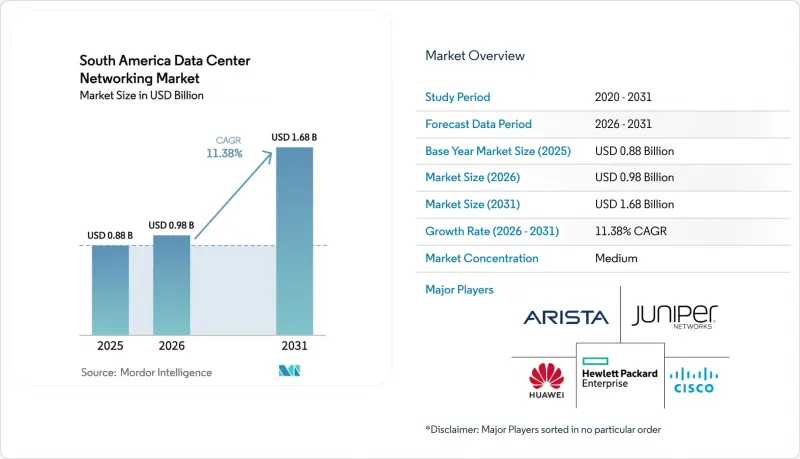
This report is Segmented by Component (Product and Services), End User( IT and Telecommunications, Banking, Financial Services and Insurance (BFSI), Government and Defense and More), Data Center Type (Colocation, Hyperscalers/Cloud Service Providers, Edge/Micro Data Centers), by Bandwidth (<=10 GbE, 25-40 GbE and More) and by Country. The Market Forecasts are Provided in Terms of Value (USD).
South America Data Center Networking Market Trends and Insights
Increasing need for cloud storage and reliable application performance
Enterprises are shifting mission-critical workloads to cloud platforms, which raises throughput and latency requirements inside regional facilities. Banco Itau's program to move all core systems to the cloud by 2028 typifies the demand spike, prompting carriers to light new 400G and 800G links. Cirion Technologies has already demonstrated a 1.6 Tb/s single-carrier wavelength between Sao Paulo and Santiago, proving that optical backbones can stay ahead of AI-era traffic. Storage performance is equally vital for hybrid deployments that synchronize on-premises and cloud repositories in real time.
Rising cyber-attacks among enterprises
Latin-American companies now record 2,569 attacks per week-40% above the global average-pushing CISOs to buy next-generation firewalls, secure SD-WAN, and AI-augmented threat analytics. Mutual Ser EPS, a Colombian insurer, adopted Fortinet's FortiGate appliances to harden more than 50 branch locations that run multi-cloud applications. Budgets are shifting fast; half of regional firms allocate between USD 10 million and USD 49 million annually to cybersecurity controls
Increasing network complexity
Hybrid-cloud overlays, east-west microsegmentation, and edge bursts expose skill gaps. Enterprises deploying intent-based controllers face multi-vendor API sprawl that strains thin NOC teams. Lack of trained staff delays 400G adoption schedules, inflates consulting reliance, and limits achievable automation depth.
Other drivers and restraints analyzed in the detailed report include:
- Proliferation of hyperscale data-center builds by global cloud providers
- Surge in submarine-cable landings enabling low-latency coastal hubs
- High import tariffs & CAPEX for advanced equipment
For complete list of drivers and restraints, kindly check the Table Of Contents.
Segment Analysis
Products anchored 75.63% of 2025 revenue, reflecting heavy outlays on switches, routers, optical transponders, and security appliances that form the bedrock of every data center networking market deployment. Ethernet leaf-spine upgrade cycles shift from 25G/100G toward 400G class, while modular routers integrate SR-MPLS for simplified underlay automation. Vendors synchronize switch ASIC roadmaps with merchant-silicon breakthroughs to meet latency budgets of AI clusters running RDMA over Converged Ethernet.Services expand at an 11.49% CAGR, fueled by managed SDN controllers, lifecycle automation, and white-glove zero-trust overlays for enterprises lacking in-house skill sets. Consulting arms of OEMs bundle network-as-code blueprints plus DevNet-style training that compress deployment lead times. Regional MSPs carve niches by delivering multicloud connectivity hand-offs and ISO 27001-aligned managed detection and response, ensuring compliance across heterogeneous domiciles.
IT & Telecommunications kept a 36.89% revenue lead in 2025 as telco clouds virtualized core network slices and OTT video platforms cached near-edge nodes. Banking retained multi-region active-active data stores to satisfy instant-payment directives, lifting demand for encrypted 100G MAC-sec ports. Yet Manufacturing & Industrial registers the fastest 11.88% CAGR as Industry 4.0 retrofits call for deterministic Ethernet, Time-Sensitive Networking, and private 5G gateways linking PLCs to fog servers. Mining consortia run tele-remote haulage over Cisco URWB links under 10 ms RTT, demonstrating ruggedized optical rings that survive high-vibration pits. Automotive plants spearhead open networking pilots that enforce vendor-agnostic telemetry on CAN-bus digital twins feeding cloud AI quality-control engines.
Complete Report Scope:
- By Component
- Products
- Ethernet Switches
- Routers
- Storage Area Network (SAN)
- Application Delivery Controllers (ADC)
- Network Security Appliances
- Software-Defined Networking (SDN) Controllers
- Optical Interconnects
- Services
- Installation and Integration
- Training and Consulting
- Support and Maintenance
- Managed Network Services
- Products
- By End-User
- IT and Telecommunications
- Banking, Financial Services and Insurance (BFSI)
- Government and Defense
- Media and Entertainment
- Healthcare and Life Sciences
- Manufacturing and Industrial
- Other End-Users
- By Data-Center Type
- Colocation
- Hyperscalers/Cloud Service Providers
- Edge/Micro Data Centers
- By Bandwidth
- Less than or Equal to 10 GbE
- 25-40 GbE
- 50-100 GbE
- Greater than 100 GbE
- By Country
- Brazil
- Mexico
- Argentina
- Rest of South America
List of Companies Covered in this Report:
- Cisco Systems Inc.
- Huawei Technologies Co. Ltd.
- Juniper Networks Inc.
- Hewlett Packard Enterprise Development LP
- Arista Networks Inc.
- Dell Technologies Inc. (Dell EMC)
- Extreme Networks Inc.
- Fortinet Inc.
- VMware Inc.
- NEC Corporation
- TP-Link Corporation Ltd.
- A10 Networks Inc.
- Radware Ltd.
- Moxa Inc.
- EdgeCore Networks Corp.
- Nokia Corp.
- FiberHome Telecommunication Technologies Co. Ltd.
- Check Point Software Technologies Ltd.
- Palo Alto Networks Inc.
- Ciena Corp.
- Mellanox Technologies Ltd. (NVIDIA)
- Super Micro Computer Inc.
- Ubiquiti Inc.
- NetScout Systems Inc.
- F5 Inc.
Additional Benefits:
- The market estimate (ME) sheet in Excel format
- 3 months of analyst support
TABLE OF CONTENTS
1 INTRODUCTION
- 1.1 Study Assumptions and Market Definition
- 1.2 Scope of the Study
2 RESEARCH METHODOLOGY
3 EXECUTIVE SUMMARY
4 MARKET LANDSCAPE
- 4.1 Market Overview
- 4.2 Market Drivers
- 4.2.1 Increasing need for cloud storage and reliable application performance
- 4.2.2 Rising cyber-attacks among enterprises
- 4.2.3 Proliferation of hyperscale data-center builds by global cloud providers
- 4.2.4 Surge in submarine-cable landings enabling low-latency coastal hubs
- 4.2.5 Brazil's renewable-energy incentives for green networking upgrades
- 4.2.6 Adoption of open networking (white-box + SONiC) cutting CAPEX
- 4.3 Market Restraints
- 4.3.1 Increasing network complexity
- 4.3.2 High import tariffs and CAPEX for advanced equipment
- 4.3.3 Shortage of automation-skilled network engineers
- 4.3.4 Fragmented data-sovereignty regulations across South America
- 4.4 Supply-Chain Analysis
- 4.5 Regulatory Landscape
- 4.6 Technological Outlook
- 4.7 Porter's Five Forces Analysis
- 4.7.1 Threat of New Entrants
- 4.7.2 Bargaining Power of Buyers
- 4.7.3 Bargaining Power of Suppliers
- 4.7.4 Threat of Substitutes
- 4.7.5 Intensity of Competitive Rivalry
- 4.8 Assessment of Macroeconomic Factors
5 MARKET SIZE and GROWTH FORECASTS
- 5.1 By Component
- 5.1.1 Products
- 5.1.1.1 Ethernet Switches
- 5.1.1.2 Routers
- 5.1.1.3 Storage Area Network (SAN)
- 5.1.1.4 Application Delivery Controllers (ADC)
- 5.1.1.5 Network Security Appliances
- 5.1.1.6 Software-Defined Networking (SDN) Controllers
- 5.1.1.7 Optical Interconnects
- 5.1.2 Services
- 5.1.2.1 Installation and Integration
- 5.1.2.2 Training and Consulting
- 5.1.2.3 Support and Maintenance
- 5.1.2.4 Managed Network Services
- 5.1.1 Products
- 5.2 By End-User
- 5.2.1 IT and Telecommunications
- 5.2.2 Banking, Financial Services and Insurance (BFSI)
- 5.2.3 Government and Defense
- 5.2.4 Media and Entertainment
- 5.2.5 Healthcare and Life Sciences
- 5.2.6 Manufacturing and Industrial
- 5.2.7 Other End-Users
- 5.3 By Data-Center Type
- 5.3.1 Colocation
- 5.3.2 Hyperscalers/Cloud Service Providers
- 5.3.3 Edge/Micro Data Centers
- 5.4 By Bandwidth
- 5.4.1 Less than or Equal to 10 GbE
- 5.4.2 25-40 GbE
- 5.4.3 50-100 GbE
- 5.4.4 Greater than 100 GbE
- 5.5 By Country
- 5.5.1 Brazil
- 5.5.2 Mexico
- 5.5.3 Argentina
- 5.5.4 Rest of South America
6 COMPETITIVE LANDSCAPE
- 6.1 Market Concentration
- 6.2 Strategic Moves
- 6.3 Market Share Analysis
- 6.4 Company Profiles (includes Global level Overview, Market level overview, Core Segments, Financials as available, Strategic Information, Market Rank/Share for key companies, Products and Services, and Recent Developments)
- 6.4.1 Cisco Systems Inc.
- 6.4.2 Huawei Technologies Co. Ltd.
- 6.4.3 Juniper Networks Inc.
- 6.4.4 Hewlett Packard Enterprise Development LP
- 6.4.5 Arista Networks Inc.
- 6.4.6 Dell Technologies Inc. (Dell EMC)
- 6.4.7 Extreme Networks Inc.
- 6.4.8 Fortinet Inc.
- 6.4.9 VMware Inc.
- 6.4.10 NEC Corporation
- 6.4.11 TP-Link Corporation Ltd.
- 6.4.12 A10 Networks Inc.
- 6.4.13 Radware Ltd.
- 6.4.14 Moxa Inc.
- 6.4.15 EdgeCore Networks Corp.
- 6.4.16 Nokia Corp.
- 6.4.17 FiberHome Telecommunication Technologies Co. Ltd.
- 6.4.18 Check Point Software Technologies Ltd.
- 6.4.19 Palo Alto Networks Inc.
- 6.4.20 Ciena Corp.
- 6.4.21 Mellanox Technologies Ltd. (NVIDIA)
- 6.4.22 Super Micro Computer Inc.
- 6.4.23 Ubiquiti Inc.
- 6.4.24 NetScout Systems Inc.
- 6.4.25 F5 Inc.
7 MARKET OPPORTUNITIES and FUTURE OUTLOOK
- 7.1 White-Space and Unmet-Need Assessment

