PUBLISHER: Mordor Intelligence | PRODUCT CODE: 2119811

PUBLISHER: Mordor Intelligence | PRODUCT CODE: 2119811
Europe Defense Logistics - Market Share Analysis, Industry Trends & Statistics, Growth Forecasts (2026 - 2031)
According to Mordor Intelligence, the Europe defense logistics market size is estimated at USD 32.23 billion in 2026, and is expected to reach USD 40.97 billion by 2031, at a CAGR of 4.92% during the forecast period (2026-2031).
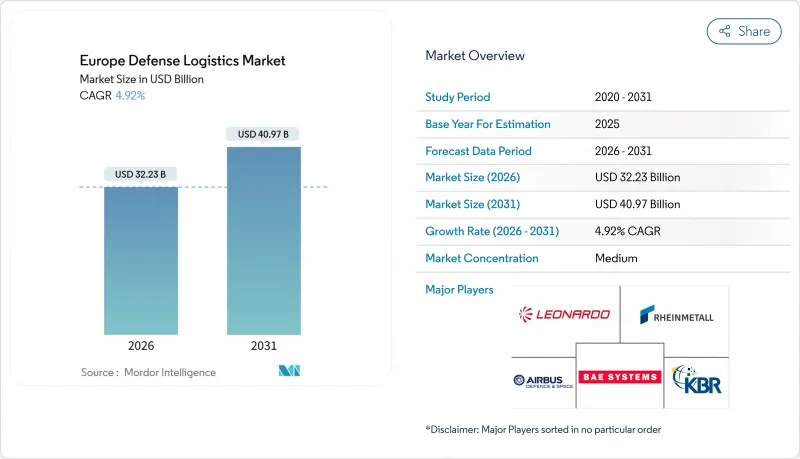
This report is Segmented by Service Type (Armament, Military Troops Support, and More), by Logistics Function (Transportation [Road, Air, and More], Warehousing & Distribution, Value-Added Services), by End User (Army, Navy, Air Force, and More), by Country (United Kingdom, Germany, France, Italy, Spain, Poland and More). The Market Forecasts are Provided in Terms of Value (USD).
Europe Defense Logistics Market Trends and Insights
Surge in EU and NATO Joint Procurement Frameworks
The European Defense Industrial Strategy sets a binding goal that 50% of defense purchases be collaborative by 2030, with 60% sourced from European suppliers. Pooling demand allows ministries to standardize platforms, cut acquisition costs by as much as 20%, and simplify downstream logistics. The European Defense Agency recently brokered a EUR 550 million (USD 642 million) joint ammunition purchase that demonstrated the financial and operational leverage of coordinated buying. These frameworks push logistics providers to develop pan-European footprints, favor large contractors with multi-national clearance, and streamline technical training across fleets. Suppliers able to certify technicians for multiple allied operators capture incremental revenue and boost equipment availability.
Acceleration of Digitized Supply-Chain Platforms Across European Forces
European militaries are fielding artificial-intelligence-enabled software that replaces manual tracking with real-time inventory visibility. NATO's order for Palantir's Maven Smart System shows a clear preference for data-centric decision tools capable of integrating logistics metrics with battlefield intelligence. Predictive maintenance platforms such as Lockheed Martin's Herc Fusion have achieved 15% fuel savings and a 3% mission capability jump on test fleets. Contractors that can demonstrate higher mission-ready rates through advanced analytics win long-term performance-based logistics contracts. However, success hinges on secure connectivity, common data standards, and the cyber-hardening of legacy networks.
Fragmented Customs and VAT Regimes Across Non-Schengen Defense Movements
Divergent customs documentation and inconsistent VAT rules delay cross-border equipment shipments, especially along NATO's northeast corridor. The European Commission proposed a defense-mobility waiver in 2024, but member-state implementation is uneven. Delays jeopardize readiness when ammunition, spare parts, or fuel convoys are held at borders. Unified electronic manifests, simplified VAT exemptions, and mutual-recognition agreements could unlock smoother flows and save millions in demurrage fees.
Other drivers and restraints analyzed in the detailed report include:
- Increased Outsourcing of Non-Core Logistics to European 3PL and 4PL Providers
- Increasing Security Concerns and Geopolitical Instability in the Region
- Aging European Military Transport Fleet Pressures MRO Budgets
For complete list of drivers and restraints, kindly check the Table Of Contents.
Segment Analysis
Technical support and maintenance represents the fastest-growing service line, recording a 7.27% CAGR as highly digital platforms demand OEM-certified technicians and specialized diagnostic tooling. Modern fighters such as the F-35 and remote-weapon stations require proprietary software updates, secure data transfer, and component-level repairs that only a handful of firms can deliver. Armament services, which held 30.73% of Europe's defense logistics market share in 2025, continue to benefit from urgent ammunition restocking. Military troops support retains a steady baseline demand due to ongoing overseas deployments and training cycles. Medical aid, firefighting protection, and emergent cybersecurity support round out the portfolio, signaling a market that is rapidly diversifying beyond traditional lift and sustain lines.
Complexity favors firms with integrated services that package technical support with inventory management, parts distribution, and training. Full-spectrum offerings lock in longer revenue streams and raise switching costs for ministries. The European defense logistics market size for technical support is projected to climb steadily as each new platform enters operational service, generating a predictable aftermarket workload. Meanwhile, legacy platforms will remain in service during transition, creating parallel sustainment challenges and additional volume for maintenance providers.
Transportation dominated with 69.78% of functional demand in 2025, underscoring the ongoing importance of fast, flexible lift. Road haulage provides last-mile reach while airlift handles time-critical, high-value cargo. However, value-added services are projected to expand at an 8.38% CAGR as forces embrace commercial inventory-optimization techniques. Kitting, configuration management, and data analytics drive down order-to-delivery times and improve asset visibility. The Europe defense logistics market size for value-added services is expected to surpass earlier forecasts as ministries formalize performance-based logistics contracts.
Warehousing and distribution maintain moderate growth as pre-positioned stocks become standard practice on the eastern flank. New depots incorporate automated picking, cold-chain storage, and climate-resilient design. Providers that integrate warehousing with real-time tracking and automated customs clearance attract premium margins. Coordination among multimodal transport, high-density warehousing, and digital demand forecasting forms a key competitive lever in the evolving Europe defense logistics market.
Complete Report Scope:
- By Service Type
- Armament
- Military Troops Support
- Technical Support & Maintenance
- Medical Aid & Health Services
- Fire-fighting Protection
- Other Services
- By Logistics Function
- Transportation
- Road
- Air
- Sea and Inland Waterways
- Rail
- Warehousing & Distribution
- Value-added Services (Labelling, Kitting, Consulting)
- Transportation
- By End User
- Army
- Navy
- Air Force
- Other
- By Country
- United Kingdom
- Germany
- France
- Italy
- Spain
- Poland
- Netherlands
- Norway
- Sweden
- Rest of Europe
List of Companies Covered in this Report:
- G.A.P. Vassilopoulos Group
- AKM Group-CZ
- LASO Transportes
- CMA CGM Group (including CEVA Logistics)
- DHL Group
- DSV A/S
- Kuehne + Nagel
- NYK Line (Including Yusen Logistics)
- Enwrap Logistics
- Jet Logistics
- Nora Global Logistics
- Advanced Road sro
- Transports Capelle
- GEODIS
- Embassy Freight GmbH
- Millog Group
- Prolog Group
- OMIDA Group
- Yeditepe Transportation
- DFDS A/S*
Additional Benefits:
- The market estimate (ME) sheet in Excel format
- 3 months of analyst support
TABLE OF CONTENTS
1 Introduction
- 1.1 Study Assumptions & Market Definition
- 1.2 Scope of the Study
2 Research Methodology
3 Executive Summary
4 Market Landscape
- 4.1 Market Overview
- 4.2 Market Drivers
- 4.2.1 Surge in EU & NATO joint procurement frameworks
- 4.2.2 Acceleration of digitised supply-chain platforms across European forces
- 4.2.3 Increased outsourcing of non-core logistics to European 3PL/4PL providers
- 4.2.4 Increasing security concerns and geopolitical instability in region
- 4.2.5 Rapid military modernization programs
- 4.2.6 Multinational defense collaborations and interoperability
- 4.3 Market Restraints
- 4.3.1 Fragmented customs & VAT regimes across non-Schengen defence movements
- 4.3.2 Ageing European military transport fleet pressures MRO budgets
- 4.3.3 Cyber-hardening gaps in legacy logistics IT
- 4.3.4 Budget volatility and fiscal caps
- 4.4 Value / Supply-Chain Analysis
- 4.5 Regulatory Landscape
- 4.6 Technological Outlook
- 4.7 Porter's Five Forces
- 4.7.1 Bargaining Power of Suppliers
- 4.7.2 Bargaining Power of Buyers/Consumers
- 4.7.3 Threat of New Entrants
- 4.7.4 Threat of Substitute Products
- 4.7.5 Intensity of Competitive Rivalry
5 Market Size & Growth Forecasts (Value)
- 5.1 By Service Type
- 5.1.1 Armament
- 5.1.2 Military Troops Support
- 5.1.3 Technical Support & Maintenance
- 5.1.4 Medical Aid & Health Services
- 5.1.5 Fire-fighting Protection
- 5.1.6 Other Services
- 5.2 By Logistics Function
- 5.2.1 Transportation
- 5.2.1.1 Road
- 5.2.1.2 Air
- 5.2.1.3 Sea and Inland Waterways
- 5.2.1.4 Rail
- 5.2.2 Warehousing & Distribution
- 5.2.3 Value-added Services (Labelling, Kitting, Consulting)
- 5.2.1 Transportation
- 5.3 By End User
- 5.3.1 Army
- 5.3.2 Navy
- 5.3.3 Air Force
- 5.3.4 Other
- 5.4 By Country
- 5.4.1 United Kingdom
- 5.4.2 Germany
- 5.4.3 France
- 5.4.4 Italy
- 5.4.5 Spain
- 5.4.6 Poland
- 5.4.7 Netherlands
- 5.4.8 Norway
- 5.4.9 Sweden
- 5.4.10 Rest of Europe
6 Competitive Landscape
- 6.1 Market Concentration
- 6.2 Strategic Moves
- 6.3 Market Share Analysis
- 6.4 Company Profiles (includes Global level Overview, Market level overview, Core Segments, Financials as available, Strategic Information, Market Rank/Share for key companies, Products & Services, and Recent Developments)
- 6.4.1 G.A.P. Vassilopoulos Group
- 6.4.2 AKM Group-CZ
- 6.4.3 LASO Transportes
- 6.4.4 CMA CGM Group (including CEVA Logistics)
- 6.4.5 DHL Group
- 6.4.6 DSV A/S
- 6.4.7 Kuehne + Nagel
- 6.4.8 NYK Line (Including Yusen Logistics)
- 6.4.9 Enwrap Logistics
- 6.4.10 Jet Logistics
- 6.4.11 Nora Global Logistics
- 6.4.12 Advanced Road sro
- 6.4.13 Transports Capelle
- 6.4.14 GEODIS
- 6.4.15 Embassy Freight GmbH
- 6.4.16 Millog Group
- 6.4.17 Prolog Group
- 6.4.18 OMIDA Group
- 6.4.19 Yeditepe Transportation
- 6.4.20 DFDS A/S*
7 Market Opportunities & Future Outlook

