PUBLISHER: Mordor Intelligence | PRODUCT CODE: 2119817

PUBLISHER: Mordor Intelligence | PRODUCT CODE: 2119817
Airport Sleeping Pods - Market Share Analysis, Industry Trends & Statistics, Growth Forecasts (2026 - 2031)
According to Mordor Intelligence, the airport sleeping pods market size was valued at USD 81.80 million in 2025 and estimated to grow from USD 87.12 million in 2026 to reach USD 119.28 million by 2031, at a CAGR of 6.48% during the forecast period (2026-2031).
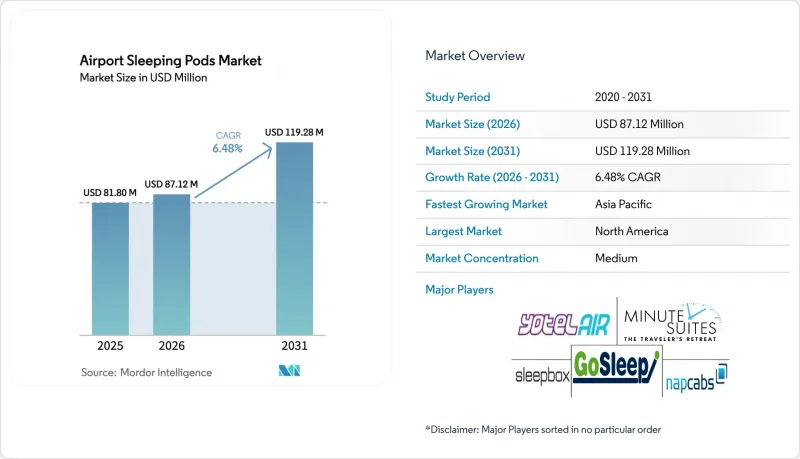
This report is Segmented by Occupancy Type (Single and Shared), Stay Duration (Short Stay, Standard Stay, and Overnight Stay), Airport Type (International and Domestic), Ownership Model (Airport-Operated, Franchise/Concession-Operated, and Third-Party Managed), and Geography (North America, Europe, Asia-Pacific, and More). The Market Forecasts are Provided in Terms of Value (USD).
Global Airport Sleeping Pods Market Trends and Insights
Rising Global Passenger Volumes and Longer Average Layover Times
Hub airports are recording average layover extensions of 45-90 minutes as security processing and slot limitations tighten schedules. Those added dwell windows enable sleep-pod operators to generate higher revenue per square meter than many retail concepts. As airlines concentrate long-haul flows into fewer banks, demand spikes align with pod availability, prompting terminal redesigns that position pods near under-utilized gate clusters. Airports in the Middle East, Asia, and North America increasingly view pods as anchor tenants in "dwell-time monetization" zones that also improve passenger satisfaction.
Growth of Gen Z and Millennial Long-Haul Travel Preferring Experiential Micro-Accommodation
More than 70% of flyers under 35 show strong interest in sleep pods versus 40% for conventional shopping offers, marking a structural redirect of on-premise spending. Experiential allocations already average 11% of total discretionary outlays for these cohorts, and Asia-Pacific business-travel surveys register a willingness to pay premiums that secure productivity during transits. Airlines are reinforcing the trend - Air New Zealand's economy-class bunk concept mirrors the expectation that rest options exist across the journey. Because these travelers wield high lifetime value and social-media influence, airports integrating pods benefit from amplified digital word-of-mouth.
High Capex per m2 vs. Retail Alternatives Limiting Footprint in Space-Constrained Terminals
Sleeping pods demand dedicated ventilation, electrical, and security integrations that can elevate per-square-meter installation costs above USD 50,000 in retrofit environments. European airports are already short on leasable area; therefore, pods should be weighed against duty-free outlets offering guaranteed minimum rents. Modular pod designs and plug-and-play utility couplings are closing the cost gap, yet real-estate committees still require compelling density metrics before greenlighting deployments in premium concourses.
Other drivers and restraints analyzed in the detailed report include:
- Roll-out of Smart-Airport Infrastructure (IoT, Mobile Access, Biometrics)
- Airline and Travel-Tech Partnerships Bundling "Sleep Time"
- Competition from On-Airport Micro-Hotels and Airline Lounges
For complete list of drivers and restraints, kindly check the Table Of Contents.
Segment Analysis
Single units secured 65.62% of the airport sleeping pods market in 2025 as business travelers prioritized exclusive space and hygiene assurance at Abu Dhabi International's AED 45-per-hour suites. The airport sleeping pods market size for single units equated to roughly USD 53.7 million that year. Early post-pandemic sentiment and laptop-friendly work surfaces amplify willingness to pay, cementing individual capsules as the premium benchmark.
Shared configurations are advancing at an 8.62% CAGR through 2031, reflecting price-sensitive leisure traffic and families pursuing affordable respite. For example, operators in Japan's Narita Terminal allocate female-only corridors to preserve privacy while improving density. These mixed-use formats expand the total addressable audience yet require stringent occupancy-mix algorithms to avoid over-booking or low-turnover drift. The segment's airport sleeping pods market size is projected to almost double by 2031, diversifying revenue streams for facility managers.
Standard stays spanning two to six hours dominated with a 49.78% market share in 2025, capturing predictable transfer windows that allow airports to rotate pods four or five times per day. Because cleaning can be batched between waves, operating margins remain attractive even at moderate hourly rates. Overnight bookings past six hours, while smaller in volume, expand at a 7.79% CAGR as flight disruptions and red-eye scheduling proliferate, especially across intercontinental routes from Europe to Asia-Pacific.
The longer-stay cohort materially lifts revenue per transaction: at Helsinki Airport, average receipts on overnight sessions exceed daytime naps by 60%. Airports accordingly experiment with bundled shower and locker add-ons to drive ancillary spend. Sub-2-hour "power naps" fill trough periods yet rarely exceed 15% of bookings, limiting their overall impact on the airport sleeping pods market.
Complete Report Scope:
- By Occupancy Type
- Single
- Shared
- By Stay Duration
- Short Stay (Less than 2 hours)
- Standard Stay (2 to 6 hours)
- Overnight Stay (Greater than 6 hours)
- By Airport Type
- International
- Domestic
- By Ownership Model
- Airport-Operated
- Franchise/Concession-Operated
- Third-Party Managed
- By Geography
- North America
- United States
- Canada
- South America
- Brazil
- Rest of South America
- Europe
- Germany
- United Kingdom
- France
- Rest of Europe
- Asia-Pacific
- China
- India
- Japan
- South Korea
- Rest of Asia-Pacific
- Middle East and Africa
- Middle East
- United Arab Emirates
- Saudi Arabia
- Rest of Middle East
- Africa
- South Africa
- Rest of Africa
- Middle East
- North America
Geography Analysis
North America's 37.92% revenue lead is anchored by robust business-travel recovery and sophisticated concession partnerships that bundle pods with credit-card lounge access. Minute Suites' forthcoming rollout at JFK Terminal 4 exemplifies this synergy, enabling travelers to book through mobile apps and loyalty programs in tandem. Regulatory initiatives such as the FAA's technology-research funds lower adoption risk by offsetting innovation expenses and encouraging integrations like biometric access.
Asia-Pacific's 8.69% CAGR to 2031 underscores rapid terminal modernization and growing long-haul connectivity that elevate layover lengths. Singapore, South Korea, and India governments provide capital incentives for passenger-experience features, while regional carriers position rest amenities as key differentiators in fare classes. The region's advanced IoT adoption accelerates the deployment of sensor-rich pods capable of predictive maintenance and energy optimization, improving uptime and lowering lifecycle costs.
Europe balances real-estate scarcity with intense competition among hubs for international transfer traffic. Heathrow's recently unveiled Ultra Pods integrate advanced HVAC, circadian lighting, and real-time occupancy updates, aligning with continent-wide sustainability directives. Airports use granular utilization data to demonstrate revenue density superior to luxury-retail tenants, supporting continued pod footprint expansion despite space constraints.
- GoSleep
- Napcabs GmbH
- Minute Suites, LLC
- Sleepbox
- YOTELAir (Yotel Limited)
- RelaxBox Srl
- 9h nine hours
- SAMS SNOOZE AT MY SPACE
- MetroNaps
- Aviserv Airport Services India Pvt Ltd.
- iGA Sleepod
- capsule services AG
- Sleep 'n Fly (Airport Dimensions Holdings Limited)
- Jet Quay Pte. Ltd.
Additional Benefits:
- The market estimate (ME) sheet in Excel format
- 3 months of analyst support
TABLE OF CONTENTS
1 INTRODUCTION
- 1.1 Study Assumptions and Market Definition
- 1.2 Scope of the Study
2 RESEARCH METHODOLOGY
3 EXECUTIVE SUMMARY
4 MARKET LANDSCAPE
- 4.1 Market Overview
- 4.2 Market Drivers
- 4.2.1 Rising global passenger volumes and longer average layover times
- 4.2.2 Growth of Gen Z and Millennial long-haul travel preferring experiential micro-accommodation
- 4.2.3 Roll-out of smart-airport infrastructure (IoT, mobile access, biometrics)
- 4.2.4 Airline and travel-tech partnerships bundling "sleep time"
- 4.2.5 Airports' pivot to non-aeronautical revenue streams
- 4.2.6 Post-pandemic preference for private, hygienic rest spaces
- 4.3 Market Restraints
- 4.3.1 High capex per m2 vs. retail alternatives limiting footprint in space-constrained terminals
- 4.3.2 Competition from on-airport micro-hotels and airline lounges
- 4.3.3 Legacy terminal space constraints
- 4.3.4 Strict aviation security, fire-safety and building-code compliance
- 4.4 Value Chain Analysis
- 4.5 Regulatory and Certification Outlook
- 4.6 Technological Outlook
- 4.7 Porter's Five Forces Analysis
- 4.7.1 Threat of New Entrants
- 4.7.2 Bargaining Power of Buyers
- 4.7.3 Bargaining Power of Suppliers
- 4.7.4 Threat of Substitutes
- 4.7.5 Intensity of Competitive Rivalry
5 MARKET SIZE AND GROWTH FORECASTS (VALUE)
- 5.1 By Occupancy Type
- 5.1.1 Single
- 5.1.2 Shared
- 5.2 By Stay Duration
- 5.2.1 Short Stay (Less than 2 hours)
- 5.2.2 Standard Stay (2 to 6 hours)
- 5.2.3 Overnight Stay (Greater than 6 hours)
- 5.3 By Airport Type
- 5.3.1 International
- 5.3.2 Domestic
- 5.4 By Ownership Model
- 5.4.1 Airport-Operated
- 5.4.2 Franchise/Concession-Operated
- 5.4.3 Third-Party Managed
- 5.5 By Geography
- 5.5.1 North America
- 5.5.1.1 United States
- 5.5.1.2 Canada
- 5.5.2 South America
- 5.5.2.1 Brazil
- 5.5.2.2 Rest of South America
- 5.5.3 Europe
- 5.5.3.1 Germany
- 5.5.3.2 United Kingdom
- 5.5.3.3 France
- 5.5.3.4 Rest of Europe
- 5.5.4 Asia-Pacific
- 5.5.4.1 China
- 5.5.4.2 India
- 5.5.4.3 Japan
- 5.5.4.4 South Korea
- 5.5.4.5 Rest of Asia-Pacific
- 5.5.5 Middle East and Africa
- 5.5.5.1 Middle East
- 5.5.5.1.1 United Arab Emirates
- 5.5.5.1.2 Saudi Arabia
- 5.5.5.1.3 Rest of Middle East
- 5.5.5.2 Africa
- 5.5.5.2.1 South Africa
- 5.5.5.2.2 Rest of Africa
- 5.5.5.1 Middle East
- 5.5.1 North America
6 COMPETITIVE LANDSCAPE
- 6.1 Market Concentration
- 6.2 Strategic Moves
- 6.3 Market Share Analysis
- 6.4 Company Profiles (includes Global-level Overview, Market-level Overview, Core Segments, Financials as available, Strategic Information, Market Rank/Share, Products and Services, Recent Developments)
- 6.4.1 GoSleep
- 6.4.2 Napcabs GmbH
- 6.4.3 Minute Suites, LLC
- 6.4.4 Sleepbox
- 6.4.5 YOTELAir (Yotel Limited)
- 6.4.6 RelaxBox Srl
- 6.4.7 9h nine hours
- 6.4.8 SAMS SNOOZE AT MY SPACE
- 6.4.9 MetroNaps
- 6.4.10 Aviserv Airport Services India Pvt Ltd.
- 6.4.11 iGA Sleepod
- 6.4.12 capsule services AG
- 6.4.13 Sleep 'n Fly (Airport Dimensions Holdings Limited)
- 6.4.14 Jet Quay Pte. Ltd.
7 MARKET OPPORTUNITIES AND FUTURE OUTLOOK
- 7.1 White-space and Unmet-Need Assessment

