PUBLISHER: Mordor Intelligence | PRODUCT CODE: 2119859

PUBLISHER: Mordor Intelligence | PRODUCT CODE: 2119859
Urban/Street Furniture - Market Share Analysis, Industry Trends & Statistics, Growth Forecasts (2026 - 2031)
According to Mordor Intelligence, the urban/street furniture market size is expected to grow from USD 11.39 billion in 2025 to USD 12.17 billion in 2026 and is forecast to reach USD 16.95 billion by 2031 at 6.85% CAGR over 2026-2031.
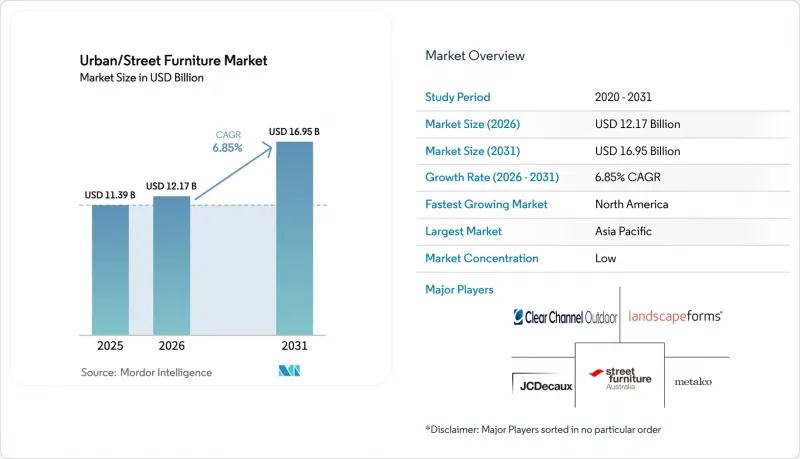
This report is Segmented by Product Type (Benches & Tables, Litter Bins, Bollards & Barriers, Transit Shelters & Kiosks, Bicycle Racks & Micro-Mobility Hubs, Others), Material (Metal, Wood, Concrete, Plastic & Composite, Others), Installation Site (Parks & Recreational Areas, and Other), and Geography (North America, and Other). The Market Forecasts are Provided in Terms of Value (USD).
Global Urban/Street Furniture Market Trends and Insights
Urban Population Growth & Densification
Cities accommodating swelling populations are retrofitting streetscapes with multifunctional fixtures that economize on ground space while serving more users. Connected benches equipped with occupancy sensors enable real-time monitoring, allowing planners to redeploy units to under-served blocks and to schedule maintenance before breakage occurs. Demand skews toward vandal-resistant metals and recycled composites that stand up to intensified wear, thereby containing lifetime costs for overstretched municipal budgets. Projects combining seating, shade structures, and device charging respond to the need for rest points in dense pedestrian corridors. Data collected from IoT modules feeds mobility dashboards and informs equitable amenity distribution, shifting asset management from reactive to predictive. Consequently, densification is a structural tailwind for the urban/street furniture market.
Government-Led Smart-City Programs
National smart-city blueprints are recasting street furniture as frontline nodes in wider urban data networks. China's 2024 "new-type urban infrastructure" guideline requires IoT sensors, connectivity, and environmental monitoring across 500+ cities, standardizing bid specifications and unlocking scale economics for compliant suppliers . South Korea's strategic smart-city fund earmarked KRW 5.6 billion (USD 4.2 million) for climate-controlled shelters that feed transit updates to passengers. Such mandates reward vendors that ship pre-integrated hardware-software stacks, accelerating orders for solar-powered smart seats, air-quality kiosks, and 5G-ready poles. Compliance with cybersecurity and data-privacy rules, notably GDPR in Europe, adds a premium for established firms with certified platforms, magnifying competitive differentiation within the urban/street furniture market.
High Upfront CAPEX & Municipal Budget Limits
Cash-constrained cities struggle to finance connected furniture that commands premiums of 15-25% over legacy models. Public-private partnerships mitigate sticker shock yet require intricate revenue-sharing formulas and long-term performance guarantees reviewed by multilateral lenders . Misaligned risk allocations, exemplified by Chicago's parking-meter lease, underscore the pitfalls of off-balance-sheet deals that lock municipalities into decades-long commitments. When budgets tighten, decision-makers defer non-critical aesthetic upgrades, dampening short-term order flow in the urban/street furniture market.
Other drivers and restraints analyzed in the detailed report include:
- Public-Transport Infrastructure Expansion
- Outdoor-Advertising Revenue Models (IoT Furniture)
- Vandalism & Maintenance Costs
For complete list of drivers and restraints, kindly check the Table Of Contents.
Segment Analysis
Transit shelters and kiosks generated the fastest 8.02% CAGR outlook, even as benches and tables retained the largest 38.67% portion of urban street furniture market share in 2025. Kiosks equipped with real-time passenger displays and advertising panels capitalize on ridership growth and municipal revenue targets. Clear Channel Outdoor, whose furniture arm accounts for 3% of Americas revenue, illustrates how outdoor-media incumbents bundle shelter upgrades with digital ad networks.
Emerging mobility models spur demand for bicycle racks and hybrid micro-mobility hubs that pair docking rails with charger ports and e-scooter corrals. Bin manufacturers such as Bigbelly add fullness sensors that cut collection drives and shrink emissions. Commoditized bollards and litter bins find margin defense through anti-corrosion alloys and design patents that align with architectural themes. Local artisans also win heritage projects by supplying cast-iron replicas that preserve historic streetscapes, ensuring diversity across the urban street furniture market.
Complete Report Scope:
- By Product Type
- Benches & Tables
- Litter Bins
- Bollards & Barriers
- Transit Shelters & Kiosks
- Bicycle Racks & Micro-mobility Hubs
- Others (Planters, Signage, Tree Grates, Loungers, Ashtrays etc.)
- By Material
- Metal
- Wood
- Concrete
- Plastic & Composite
- Others (Recycled/Up-cycled Materials, Glass, Stone)
- By Installation Site
- Parks & Recreational Areas
- Roadways & Sidewalks
- Public Transit Nodes
- Commercial Districts & Campuses
- By Geography
- North America
- United States
- Canada
- Mexico
- South America
- Brazil
- Peru
- Chile
- Argentina
- Rest of South America
- Europe
- United Kingdom
- Germany
- France
- Spain
- Italy
- BENELUX (Belgium, Netherlands, Luxembourg)
- NORDICS (Denmark, Finland, Iceland, Norway, Sweden)
- Rest of Europe
- Asia-Pacific
- China
- India
- Japan
- South Korea
- Australia
- South-East Asia
- Rest of Asia-Pacific
- Middle East & Africa
- United Arab Emirates
- Saudi Arabia
- South Africa
- Nigeria
- Rest of Middle East & Africa
- North America
Geography Analysis
Europe retained 39.88% revenue share in 2025, underpinned by stringent accessibility codes and data-privacy statutes that favor incumbents with certified solutions. Regional growth moderates to 5.55% CAGR because streetscape stock is already extensive; most spend now flows to retrofits that replace legacy units with recycled-content models and GDPR-compliant sensors. Northern nations further accelerate adoption of solar-powered benches that exploit long summer daylight.
Asia-Pacific leads with an 8.14% CAGR outlook as megacity development, especially in China, deploys urban furniture at scale under standardized smart-city procurement frameworks. South Korea's climate-controlled shelters and Japan's disaster-resilient kiosks set high technical benchmarks. Australia's councils bundle advertising concessions with sustainability clauses, boosting orders for locally sourced recycled composites, while ASEAN cities pursue cost-efficient modular ranges to stretch infrastructure budgets.
North America tracks a 6.05% CAGR, lifted by federal infrastructure grants and robust outdoor-advertising ecosystems that subsidize shelter upgrades. Los Angeles Metro's BIM-driven corridor project typifies sophisticated specification requirements that elevate barriers to entry. Canada's Smart Cities Challenge funds data-rich furniture pilots, and Mexico's urban renewal programs open opportunities for durable yet affordable metal-and-wood hybrids, broadening supplier diversity in the urban/street furniture market.
- JCDecaux SA
- Clear Channel Outdoor Holdings Inc.
- Metalco Srl
- Landscape Forms Inc.
- Street Furniture Australia Pty Ltd
- Furnitubes International Ltd
- Astra Street Furniture
- Site Furniture Ltd (UK)
- Victor Stanley Inc.
- Bench Depot
- KELOX (Oaklands Group)
- Driade Srl
- mmcite 1 a.s.
- Maglin Site Furniture
- Forms+Surfaces Inc.
- Hauser Site Furnishings
- Broxap Ltd
- Smith Steel & Fabrication Inc.
- Bigbelly Solar Inc.
- oOh!media Ltd
- Lamar Advertising Company
Additional Benefits:
- The market estimate (ME) sheet in Excel format
- 3 months of analyst support
TABLE OF CONTENTS
1 Introduction
- 1.1 Study Assumptions & Market Definition
- 1.2 Scope of the Study
2 Research Methodology
3 Executive Summary
4 Market Landscape
- 4.1 Market Overview
- 4.2 Market Drivers
- 4.2.1 Urban population growth & densification
- 4.2.2 Government-led smart-city programs
- 4.2.3 Public-transport infrastructure expansion
- 4.2.4 Outdoor-advertising revenue models (IoT furniture)
- 4.2.5 ESG-focused modular & recyclable designs
- 4.2.6 Solar-powered micro-mobility charging benches
- 4.3 Market Restraints
- 4.3.1 High upfront CAPEX & municipal budget limits
- 4.3.2 Vandalism & maintenance costs
- 4.3.3 Multi-stakeholder design-approval delays
- 4.4 Industry Value Chain Analysis
- 4.4.1 Privacy concerns over sensor-equipped units
- 4.5 Porter's Five Forces
- 4.5.1 Threat of New Entrants
- 4.5.2 Bargaining Power of Suppliers
- 4.5.3 Bargaining Power of Buyers
- 4.5.4 Threat of Substitutes
- 4.5.5 Competitive Rivalry
- 4.6 Insights Into The Latest Trends And Innovations in the Market
- 4.7 Insights on Recent Developments (New Product Launches, Strategic Initiatives, Investments, Partnerships, JVs, Expansion, M&As, etc.) in the Market
5 Market Size & Growth Forecasts
- 5.1 By Product Type
- 5.1.1 Benches & Tables
- 5.1.2 Litter Bins
- 5.1.3 Bollards & Barriers
- 5.1.4 Transit Shelters & Kiosks
- 5.1.5 Bicycle Racks & Micro-mobility Hubs
- 5.1.6 Others (Planters, Signage, Tree Grates, Loungers, Ashtrays etc.)
- 5.2 By Material
- 5.2.1 Metal
- 5.2.2 Wood
- 5.2.3 Concrete
- 5.2.4 Plastic & Composite
- 5.2.5 Others (Recycled/Up-cycled Materials, Glass, Stone)
- 5.3 By Installation Site
- 5.3.1 Parks & Recreational Areas
- 5.3.2 Roadways & Sidewalks
- 5.3.3 Public Transit Nodes
- 5.3.4 Commercial Districts & Campuses
- 5.4 By Geography
- 5.4.1 North America
- 5.4.1.1 United States
- 5.4.1.2 Canada
- 5.4.1.3 Mexico
- 5.4.2 South America
- 5.4.2.1 Brazil
- 5.4.2.2 Peru
- 5.4.2.3 Chile
- 5.4.2.4 Argentina
- 5.4.2.5 Rest of South America
- 5.4.3 Europe
- 5.4.3.1 United Kingdom
- 5.4.3.2 Germany
- 5.4.3.3 France
- 5.4.3.4 Spain
- 5.4.3.5 Italy
- 5.4.3.6 BENELUX (Belgium, Netherlands, Luxembourg)
- 5.4.3.7 NORDICS (Denmark, Finland, Iceland, Norway, Sweden)
- 5.4.3.8 Rest of Europe
- 5.4.4 Asia-Pacific
- 5.4.4.1 China
- 5.4.4.2 India
- 5.4.4.3 Japan
- 5.4.4.4 South Korea
- 5.4.4.5 Australia
- 5.4.4.6 South-East Asia
- 5.4.4.7 Rest of Asia-Pacific
- 5.4.5 Middle East & Africa
- 5.4.5.1 United Arab Emirates
- 5.4.5.2 Saudi Arabia
- 5.4.5.3 South Africa
- 5.4.5.4 Nigeria
- 5.4.5.5 Rest of Middle East & Africa
- 5.4.1 North America
6 Competitive Landscape
- 6.1 Market Concentration
- 6.2 Strategic Moves
- 6.3 Market Share Analysis
- 6.4 Company Profiles (includes Global level Overview, Market level overview, Core Segments, Financials as available, Strategic Information, Market Rank/Share for key companies, Products & Services, and Recent Developments)
- 6.4.1 JCDecaux SA
- 6.4.2 Clear Channel Outdoor Holdings Inc.
- 6.4.3 Metalco Srl
- 6.4.4 Landscape Forms Inc.
- 6.4.5 Street Furniture Australia Pty Ltd
- 6.4.6 Furnitubes International Ltd
- 6.4.7 Astra Street Furniture
- 6.4.8 Site Furniture Ltd (UK)
- 6.4.9 Victor Stanley Inc.
- 6.4.10 Bench Depot
- 6.4.11 KELOX (Oaklands Group)
- 6.4.12 Driade Srl
- 6.4.13 mmcite 1 a.s.
- 6.4.14 Maglin Site Furniture
- 6.4.15 Forms+Surfaces Inc.
- 6.4.16 Hauser Site Furnishings
- 6.4.17 Broxap Ltd
- 6.4.18 Smith Steel & Fabrication Inc.
- 6.4.19 Bigbelly Solar Inc.
- 6.4.20 oOh!media Ltd
- 6.4.21 Lamar Advertising Company
7 Market Opportunities & Future Outlook
- 7.1 Smart Street Furniture with IoT-Enabled Services (Wi-Fi, EV Charging, Sensors)
- 7.2 Sustainable Materials and Circular Economy in Outdoor Installations
- 7.3 Modular & Adaptive Designs Supporting Dynamic Urban Spaces

