PUBLISHER: Mordor Intelligence | PRODUCT CODE: 2124620

PUBLISHER: Mordor Intelligence | PRODUCT CODE: 2124620
United States Outdoor Furniture - Market Share Analysis, Industry Trends & Statistics, Growth Forecasts (2026 - 2031)
According to Mordor Intelligence, the United States outdoor furniture market size is expected to grow from USD 6.98 billion in 2025 to USD 7.41 billion in 2026 and is forecast to reach USD 10.03 billion by 2031 at 6.24% CAGR over 2026-2031.
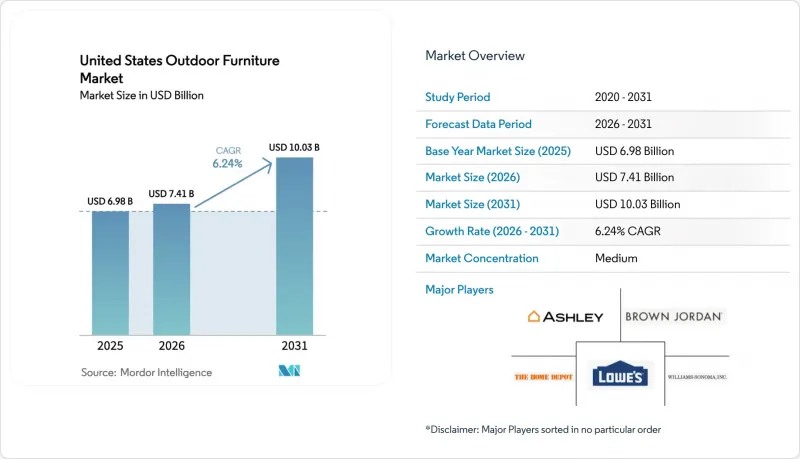
This report is Segmented by Product (Chairs, Tables, Seating Sets, Loungers and Daybeds, and More), Material (Wood, Metal, and More), End User (Residential and Commercial), Price Range (Economy, Mid-Range, Premium), Distribution Channel (Retail/B2C Channels, and B2B Channel/Contractors), and Geography (Northeast, Midwest, and More). The Market Forecasts are Provided in Terms of Value (USD).
United States Outdoor Furniture Market Trends and Insights
Remote work-driven outdoor renovations
Remote work normalization has reshaped how households use exterior areas by making patios and porches extensions of daily life. In 2025, 59% of United States consumers indicated plans to buy new outdoor furniture, with Millennials showing the highest intent at 76%, which reinforced the role of seating and dining pieces in home-based entertaining and work-from-home routines. Consumers who upgrade outdoor spaces report spending more time relaxing and entertaining after installations, which keeps the category on replacement cycles instead of being a one-off seasonal purchase. Preferences in the South and West emphasize covered outdoor rooms, fire features, and outdoor kitchens, which support demand for both weather-resistant materials and comfort-focused upholstery. The residential segment benefits from these patterns and maintains the fastest growth outlook through 2031 as household use of outdoor assets becomes a standard part of American home life.
Hospitality shift to expanded outdoor dining
Operators in restaurants and hotels have moved temporary outdoor seating into standard operating configurations by using codified permit programs. Dining Out NYC rules set clear parameters for placement, safety, and structures, while cities like Portland have established permit types with annual fees and area-based charges that formalize year-round outdoor operations. Accessibility rules require clear floor space at fixed tables and compliant surface heights, which pushes operators toward commercial-grade furniture that meets ADA guidance. The industry has also advanced outdoor performance testing by consolidating standards for structural integrity and accelerated weathering through BIFMA's OF-2025 framework. These policies and standards align with high utilization in urban and resort locations and support volume orders of durable seating, tables, and shade systems.
Other drivers and restraints analyzed in the detailed report include:
- Eco mandates boosting certified wood and recycled plastics
- Sunbelt housing boom raising patio spending
- Lumber and aluminum price swings
- Skilled labor shortages in furniture manufacturing
For complete list of drivers and restraints, kindly check the Table Of Contents.
Segment Analysis
Chairs accounted for 45.74% of the United States outdoor furniture market in 2025, driven by high sales, diverse formats in dining and lounge sets, and steady replacement cycles. In 2024, lounge seating gained popularity, boosting demand for comfort-focused designs with quick-dry cushions and weather-resistant upholstery. Accessibility guidelines for public seating areas, requiring compliance with floor space and height standards, supported demand for commercial fixtures. Dining and conversation sets benefited from coordinated purchases, creating cohesive outdoor spaces for homes and restaurants. Loungers and daybeds grew at a 9.78% CAGR, reflecting consumer preferences for relaxation, poolside use, and seamless indoor-outdoor transitions.
Product preferences in the United States outdoor furniture market balance availability, durability, and aesthetics. Chairs remain essential for residential patios and commercial terraces, accommodating daily meals and large gatherings with minimal adjustments. The rise in loungers and daybeds aligns with the trend toward multifunctional outdoor spaces for leisure and social activities. Tables anchor dining and coffee areas, while modular seating sets attract coordinated-buy shoppers. Hospitality and municipal buyers sustain demand for contract-grade pieces by standardizing specifications to simplify maintenance and replacement.
Wood held a 51.36% market share in 2025, driven by natural aesthetics, repairability, and premium species like teak. Metal achieved an 8.76% CAGR due to its corrosion resistance and structural strength in the United States outdoor furniture market. While few companies excelled in responsible wood practices, leading retailers advanced certified sourcing and traceability. Salt spray and thermal cycling tests differentiate contract and residential-grade offerings. Plastics and polymers, such as recycled HDPE, dominate the economy and mid-range segments, reducing maintenance without compromising weatherability. Composite lumber suppliers emphasize recycled content and heat-mitigating innovations for hot climates.
Regulatory limits on formaldehyde emissions influence material and coating choices. Procurement policies in the West Coast and Northeast markets favor certified wood and low-VOC products. Recycled resin adoption grows as municipalities and commercial buyers align with eco-labeling and lifecycle considerations. Metals gain popularity in coastal and humid regions, with aluminum frames and powder coating offering durability and predictable maintenance. Advances in powder-coat chemistry and fastener selection address corrosion and thermal expansion. The material mix reflects practical use cases, building codes, and sustainability commitments in the United States outdoor furniture market.
Complete Report Scope:
- By Product
- Chairs
- Tables
- Seating Sets
- Loungers and Daybeds
- Dining Sets
- Other Products
- By Material
- Wood
- Metal
- Plastic & Polymer
- Other Materials
- By End User
- Residential
- Commercial
- By Price Range
- Economy
- Mid-Range
- Premium
- By Distribution Channel
- Retail/B2C Channels
- Home Centers
- Specialty Stores
- Online
- Other Distribution Channels
- B2B Channel/Contractors
- Retail/B2C Channels
- By Geography
- Northeast
- Midwest
- South
- West
List of Companies Covered in this Report:
- Ashley Furniture Industries Inc.
- Brown Jordan Inc.
- Home Depot Product Authority LLC
- Lowe's Companies Inc.
- Williams-Sonoma Inc.
- Polywood LLC
- Telescope Casual Furniture Co.
- RH (Restoration Hardware)
- Hayneedle Inc.
- Highwood USA
- Loll Designs
- Outer Inc.
- Trex Company Inc.
- Hanamint Corp.
- Bassett Furniture Industries
- Yardbird LLC
- Tropitone Furniture Co. Inc.
- Harmonia Living
- Century Furniture LLC
- Castelle
- Lloyd Flanders Industries
- IKEA
- Agio International Company Ltd.
- Gloster Furniture GmbH
- Keter Group
Additional Benefits:
- The market estimate (ME) sheet in Excel format
- 3 months of analyst support
TABLE OF CONTENTS
1 Introduction
- 1.1 Study Assumptions & Market Definition
- 1.2 Scope of the Study
2 Research Methodology
3 Executive Summary
4 Market Landscape
- 4.1 Market Overview
- 4.2 Market Drivers
- 4.2.1 Remote work-driven outdoor renovations
- 4.2.2 Hospitality shift to expanded outdoor dining
- 4.2.3 Eco mandates boosting certified wood and recycled plastics
- 4.2.4 Sunbelt housing boom raising patio spending
- 4.2.5 Smart-enabled furniture with lighting and charging features
- 4.2.6 Online retail surge powered by AR visualization tools
- 4.3 Market Restraints
- 4.3.1 Lumber and aluminum price swings
- 4.3.2 Skilled labor shortages in furniture manufacturing
- 4.3.3 Fire-safety and VOC compliance costs for cushions
- 4.3.4 Distribution hub reductions and logistic bottlenecks
- 4.4 Industry Value Chain Analysis
- 4.5 Porter's Five Forces Analysis
- 4.5.1 Threat of New Entrants
- 4.5.2 Bargaining Power of Suppliers
- 4.5.3 Bargaining Power of Buyers
- 4.5.4 Threat of Substitutes
- 4.5.5 Competitive Rivalry
- 4.6 Insights into the Latest Trends and Innovations in the Market
- 4.7 Insights on Recent Developments (New Product Launches, Strategic Initiatives, Investments, Partnerships, JVs, Expansion, M&As, etc.) in the Market
5 Market Size & Growth Forecasts (Value)
- 5.1 By Product
- 5.1.1 Chairs
- 5.1.2 Tables
- 5.1.3 Seating Sets
- 5.1.4 Loungers and Daybeds
- 5.1.5 Dining Sets
- 5.1.6 Other Products
- 5.2 By Material
- 5.2.1 Wood
- 5.2.2 Metal
- 5.2.3 Plastic & Polymer
- 5.2.4 Other Materials
- 5.3 By End User
- 5.3.1 Residential
- 5.3.2 Commercial
- 5.4 By Price Range
- 5.4.1 Economy
- 5.4.2 Mid-Range
- 5.4.3 Premium
- 5.5 By Distribution Channel
- 5.5.1 Retail/B2C Channels
- 5.5.1.1 Home Centers
- 5.5.1.2 Specialty Stores
- 5.5.1.3 Online
- 5.5.1.4 Other Distribution Channels
- 5.5.2 B2B Channel/Contractors
- 5.5.1 Retail/B2C Channels
- 5.6 By Geography
- 5.6.1 Northeast
- 5.6.2 Midwest
- 5.6.3 South
- 5.6.4 West
6 Competitive Landscape
- 6.1 Market Concentration
- 6.2 Strategic Moves (M&A, Partnerships, Product Launches)
- 6.3 Market Share Analysis
- 6.4 Company Profiles (includes Global level Overview, Market level overview, Core Segments, Financials as available, Strategic Information, Market Rank/Share for key companies, Products & Services, and Recent Developments)
- 6.4.1 Ashley Furniture Industries Inc.
- 6.4.2 Brown Jordan Inc.
- 6.4.3 Home Depot Product Authority LLC
- 6.4.4 Lowe's Companies Inc.
- 6.4.5 Williams-Sonoma Inc.
- 6.4.6 Polywood LLC
- 6.4.7 Telescope Casual Furniture Co.
- 6.4.8 RH (Restoration Hardware)
- 6.4.9 Hayneedle Inc.
- 6.4.10 Highwood USA
- 6.4.11 Loll Designs
- 6.4.12 Outer Inc.
- 6.4.13 Trex Company Inc.
- 6.4.14 Hanamint Corp.
- 6.4.15 Bassett Furniture Industries
- 6.4.16 Yardbird LLC
- 6.4.17 Tropitone Furniture Co. Inc.
- 6.4.18 Harmonia Living
- 6.4.19 Century Furniture LLC
- 6.4.20 Castelle
- 6.4.21 Lloyd Flanders Industries
- 6.4.22 IKEA
- 6.4.23 Agio International Company Ltd.
- 6.4.24 Gloster Furniture GmbH
- 6.4.25 Keter Group
7 Market Opportunities & Future Outlook
- 7.1 Adoption of AR-enabled omnichannel retail models
- 7.2 Urban Modular Eco-Furniture Boom

