PUBLISHER: Mordor Intelligence | PRODUCT CODE: 2125678

PUBLISHER: Mordor Intelligence | PRODUCT CODE: 2125678
Hammocks - Market Share Analysis, Industry Trends & Statistics, Growth Forecasts (2026 - 2031)
According to Mordor Intelligence, the hammocks market size is expected to grow from USD 560 million in 2025 to USD 591.08 million in 2026 and is forecast to reach USD 774.31 million by 2031 at 5.55% CAGR over 2026-2031.
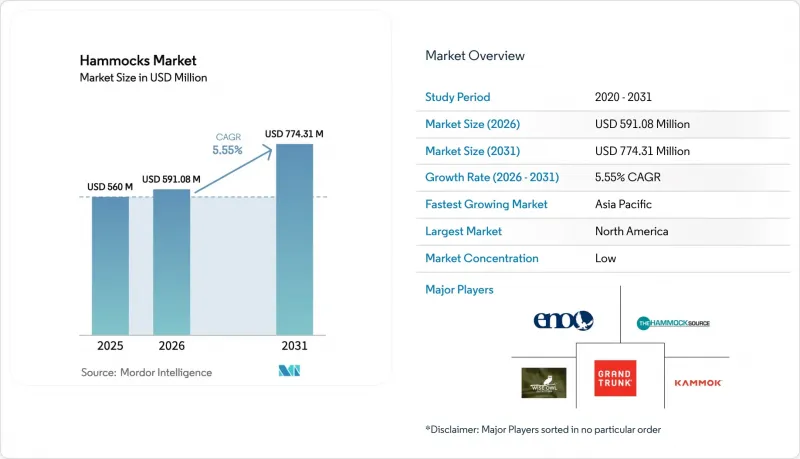
This report is Segmented by Product Type (Rope Hammock, Quilted Hammock, and More), Materials (Cotton, Nylon, and More), Purpose / Application (Outdoors and Indoors), End User (Residential and Commercial), Distribution Channels (Supermarkets and Hypermarkets, Home Centers, and More) and Geography (North America, South America, and More). The Market Forecasts are Provided in Terms of Value (USD).
Global Hammocks Market Trends and Insights
Rising Global Participation in Outdoor Recreation and Camping Activities Post-COVID-19
Outdoor recreation remained popular after travel restrictions eased, with more than half of the Americans aged 6 and older taking part in at least one activity in 2024 . Similar enthusiasm is visible in China, where government policy promotes outdoor sports. Such structural tailwinds translate into sustained demand for versatile entry-level hammocks that offer comfort without technical complexity. Suppliers respond with lightweight cotton and nylon blends that pack small yet support heavier loads. Retail promotions now span all seasons, reflecting steady rather than cyclical buying.
Growth of Adventure Tourism and Experience-Based Leisure Spending Worldwide
Millennials and Gen Z allocate more income to experiential travel, driving glamping resorts and eco-lodges to install premium hammock lounges that complement nature immersion. Operators prefer Brazilian styles that balance aesthetics and durability, often sourced through fair-trade collectives to reinforce a sustainability narrative. Brand collaborations with tour providers deliver bundled gear plus curated travel itineraries, extending visibility across multiple touchpoints. The linkage between adventure tourism and the hammock market is expected to deepen as demand shifts from basic shelter to value-added comfort.
Intensifying Price Competition from Low-Cost Manufacturers
Tariffs on Chinese and Vietnamese imports raise costs, yet competing factories in Southeast Asia absorb part of the increase to maintain export volumes. Established brands, therefore, face shrinking gross margins, especially in mainstream cotton hammock categories. Some counter pressure by shifting to recycled nylon and value-added accessories, supporting premium price points that limit direct comparison with budget entries. Others explore near-shoring to insulate against currency swings and freight volatility, highlighting domestic manufacturing as a quality cue.
Other drivers and restraints analyzed in the detailed report include:
- Increasing Urban Demand for Space-Efficient Relaxation & Wellness Furniture
- Rapid Expansion of Cross-Border E-commerce Enabling Direct-to-Consumer Sales of Premium Hammocks
- Seasonality of Demand in Temperate Zones Causing Volatile Sales Cycles
For complete list of drivers and restraints, kindly check the Table Of Contents.
Segment Analysis
Brazilian formats are projected to register a 6.1% CAGR through 2031, reflecting recognition of hand-loom techniques that create dense, supportive weaves favored for extended lounging. Rope variants held 29.30% of the hammocks market size in 2025, underpinned by broad retail distribution and competitive price points. Manufacturers promote improved cord tension and weather-treated finishes to refresh an otherwise mature sub-segment. Emerging designs such as inflatable models incorporate insulated air chambers that regulate temperature, signaling convergence between traditional fabric hammocks and technical camping mats. Brazilian offerings increasingly feature organic cotton yarns and artisan branding, reinforcing storytelling that resonates with lifestyle buyers seeking authenticity over generic mass production.
Growth prospects for quilted, Nicaraguan, and camping-specific lines rely on niche positioning around distinct use cases. Quilted versions, often paired with spreader bars, appeal to resort operators keen on poolside aesthetics. Camping models integrate bug nets and suspension straps to attract backpackers who reject heavier ground tents. The product mix demonstrates that the hammock market continues to broaden from a single outdoor leisure item into a multi-faceted category that satisfies relaxation, decor, and sport applications, ensuring future diversification.
Cotton retained 39.40% of the hammock market size in 2025, owing to comfortable hand feel and wide style choices. Brands differentiate through organic certifications that justify premiums among eco-conscious shoppers. Nevertheless, nylon's 6.41% forecast CAGR signals accelerating substitution, driven by weight savings and moisture resistance prized by trekkers. Hybrid weaves combine nylon warp threads with cotton weft to balance feel and strength, illustrating how fabric innovation defends share while reducing reliance on a single fiber type.
Wood and plastic remain ancillary, typically used in stands and spacer bars rather than sling fabrics, yet advances in bio-composites promise lower weight and reduced environmental impact. Cellulosic yarns such as Naia(TM) Renew, debuted by Eastman in 2025, showcase recyclable inputs and hypoallergenic performance. Such developments highlight a material race where comfort, durability, and environmental profile converge to shape purchasing decisions in the hammock market.
Complete Report Scope:
- By Product
- Rope Hammock
- Quilted Hammock
- Brazilian Hammock
- Other Products (Nicaraguan Hammock, Camping Hammock, etc.)
- By Material
- Cotton
- Nylon
- Wood
- Plastic
- Other Materials
- By Purpose / Application
- Outdoors
- Indoors
- By End User
- Residential
- Commercial
- By Distribution Channel
- Supermarkets and Hypermarkets
- Home Centers
- Online
- Other Distribution Channels
- By Geography
- North America
- Canada
- United States
- Mexico
- South America
- Brazil
- Peru
- Chile
- Argentina
- Rest of South America
- Europe
- United Kingdom
- Germany
- France
- Spain
- Italy
- BENELUX (Belgium, Netherlands, Luxembourg)
- NORDICS (Denmark, Finland, Iceland, Norway, Sweden)
- Rest of Europe
- Asia-Pacific
- India
- China
- Japan
- Australia
- South Korea
- South East Asia (Singapore, Malaysia, Thailand, Indonesia, Vietnam, and Philippines)
- Rest of Asia-Pacific
- Middle East & Africa
- United Arab Emirates
- Saudi Arabia
- South Africa
- Nigeria
- Rest of Middle East & Africa
- North America
Geography Analysis
North America commanded 29.70% of the hammock market size in 2025, sustained by deep camping culture, high disposable incomes, and broad retailer networks. Tariff shifts temper imports yet may favor domestic sewing operations that champion locally sourced wood and fabric, providing differentiation for made-in-USA labels. Ongoing wellness trends spur indoor adoption in colder months, partially offsetting seasonal sales troughs. Municipal park improvements and campground reservations remain robust, supporting consistent baseline demand.
Asia-Pacific is the fastest-growing region at a 6.9% CAGR through 2031. Chinese consumer enthusiasm extends beyond professional outdoor sports to casual lifestyle use, aided by government infrastructure spending and social-media influencers who normalize hammock lounging in urban green spaces. Rising disposable income in India, Thailand, and Indonesia further widens the addressable customer pool. Brands often collaborate with online marketplaces to manage cross-border fulfillment and align with local payment preferences, accelerating market entry.
Europe shows steady yet moderate growth. Environmental sensitivity encourages uptake of organic cotton and recycled nylon varieties, allowing premium pricing that compensates for slower volume gains. Southern Europe's warmer climate broadens the usage window, whereas northern markets rely on indoor SKUs to navigate shorter summers. Brexit-related trade adjustments add cost uncertainty for UK distributors, spurring exploration of EU manufacturing to streamline customs procedures. Elsewhere, South America and the Middle East & Africa present attractive but volatile prospects. Economic cycles, currency swings, and infrastructural gaps require region-specific risk mitigation, though early adopters report strong brand loyalty once local presence is established.
- Eagles Nest Outfitters Inc. (ENO)
- The Hammock Source (Pawleys Island Hammock)
- Grand Trunk
- Wise Owl Outfitters
- Kammok
- Yellow Leaf Hammocks LLC
- La Siesta Inc.
- Tentsile Ltd.
- Hennessy Hammock
- Lawson Hammock Co.
- Sea to Summit Pty Ltd.
- Therm-a-Rest (Cascade Designs Inc.)
- Klymit
- DutchWare Gear
- Ticket To The Moon
- Serac Hammocks
- Vivere Ltd.
- DD Hammocks
- Warbonnet Outdoors
- Snugpak
- Hummingbird Hammocks
- Amazonas
- Tropilex
- Clark Outdoor
- Amok Equipment
Additional Benefits:
- The market estimate (ME) sheet in Excel format
- 3 months of analyst support
TABLE OF CONTENTS
1 Introduction
- 1.1 Study Assumptions & Market Definition
- 1.2 Scope of the Study
2 Research Methodology
3 Executive Summary
4 Market Landscape
- 4.1 Market Overview
- 4.2 Market Drivers
- 4.2.1 Rising Global Participation in Outdoor Recreation and Camping Activities Post-COVID-19
- 4.2.2 Growth of Adventure Tourism and Experience-Based Leisure Spending Worldwide
- 4.2.3 Increasing Urban Demand for Space-Efficient Relaxation & Wellness Furniture in Homes Globally
- 4.2.4 Rapid Expansion of Cross-Border E-commerce Enabling Direct-to-Consumer Sales of Premium Hammocks
- 4.2.5 Sustainability Certifications and Ethical Sourcing Driving Preference for Organic and Fair-Trade Hammocks Worldwide
- 4.3 Market Restraints
- 4.3.1 Intensifying Price Competition from Low-Cost Manufacturers Leading to Margin Pressure Globally
- 4.3.2 Seasonality of Demand in Temperate Zones Causing Volatile Global Sales Cycles
- 4.3.3 Availability of Substitute Portable Seating Options Globally (e.g., Camping Chairs, Inflatable Loungers)
- 4.4 Industry Value Chain Analysis
- 4.5 Porter's Five Forces Analysis
- 4.5.1 Threat of New Entrants
- 4.5.2 Bargaining Power of Suppliers
- 4.5.3 Bargaining Power of Buyers
- 4.5.4 Threat of Substitutes
- 4.5.5 Competitive Rivalry
- 4.6 Insights into the Latest Trends and Innovations in the Market
- 4.7 Insights on Recent Developments (New Product Launches, Strategic Initiatives, Investments, Partnerships, JVs, Expansion, M&As, etc.) in the Market
5 Market Size & Growth Forecasts (Value)
- 5.1 By Product
- 5.1.1 Rope Hammock
- 5.1.2 Quilted Hammock
- 5.1.3 Brazilian Hammock
- 5.1.4 Other Products (Nicaraguan Hammock, Camping Hammock, etc.)
- 5.2 By Material
- 5.2.1 Cotton
- 5.2.2 Nylon
- 5.2.3 Wood
- 5.2.4 Plastic
- 5.2.5 Other Materials
- 5.3 By Purpose / Application
- 5.3.1 Outdoors
- 5.3.2 Indoors
- 5.4 By End User
- 5.4.1 Residential
- 5.4.2 Commercial
- 5.5 By Distribution Channel
- 5.5.1 Supermarkets and Hypermarkets
- 5.5.2 Home Centers
- 5.5.3 Online
- 5.5.4 Other Distribution Channels
- 5.6 By Geography
- 5.6.1 North America
- 5.6.1.1 Canada
- 5.6.1.2 United States
- 5.6.1.3 Mexico
- 5.6.2 South America
- 5.6.2.1 Brazil
- 5.6.2.2 Peru
- 5.6.2.3 Chile
- 5.6.2.4 Argentina
- 5.6.2.5 Rest of South America
- 5.6.3 Europe
- 5.6.3.1 United Kingdom
- 5.6.3.2 Germany
- 5.6.3.3 France
- 5.6.3.4 Spain
- 5.6.3.5 Italy
- 5.6.3.6 BENELUX (Belgium, Netherlands, Luxembourg)
- 5.6.3.7 NORDICS (Denmark, Finland, Iceland, Norway, Sweden)
- 5.6.3.8 Rest of Europe
- 5.6.4 Asia-Pacific
- 5.6.4.1 India
- 5.6.4.2 China
- 5.6.4.3 Japan
- 5.6.4.4 Australia
- 5.6.4.5 South Korea
- 5.6.4.6 South East Asia (Singapore, Malaysia, Thailand, Indonesia, Vietnam, and Philippines)
- 5.6.4.7 Rest of Asia-Pacific
- 5.6.5 Middle East & Africa
- 5.6.5.1 United Arab Emirates
- 5.6.5.2 Saudi Arabia
- 5.6.5.3 South Africa
- 5.6.5.4 Nigeria
- 5.6.5.5 Rest of Middle East & Africa
- 5.6.1 North America
6 Competitive Landscape
- 6.1 Market Concentration
- 6.2 Strategic Moves
- 6.3 Market Share Analysis
- 6.4 Company Profiles {(includes Global level Overview, Market level overview, Core Segments, Financials as available, Strategic Information, Market Rank/Share for key companies, Products & Services, and Recent Developments)}
- 6.4.1 Eagles Nest Outfitters Inc. (ENO)
- 6.4.2 The Hammock Source (Pawleys Island Hammock)
- 6.4.3 Grand Trunk
- 6.4.4 Wise Owl Outfitters
- 6.4.5 Kammok
- 6.4.6 Yellow Leaf Hammocks LLC
- 6.4.7 La Siesta Inc.
- 6.4.8 Tentsile Ltd.
- 6.4.9 Hennessy Hammock
- 6.4.10 Lawson Hammock Co.
- 6.4.11 Sea to Summit Pty Ltd.
- 6.4.12 Therm-a-Rest (Cascade Designs Inc.)
- 6.4.13 Klymit
- 6.4.14 DutchWare Gear
- 6.4.15 Ticket To The Moon
- 6.4.16 Serac Hammocks
- 6.4.17 Vivere Ltd.
- 6.4.18 DD Hammocks
- 6.4.19 Warbonnet Outdoors
- 6.4.20 Snugpak
- 6.4.21 Hummingbird Hammocks
- 6.4.22 Amazonas
- 6.4.23 Tropilex
- 6.4.24 Clark Outdoor
- 6.4.25 Amok Equipment
7 Market Opportunities & Future Outlook
- 7.1 Expansion of E-commerce and Residential Use
- 7.2 Rapid Innovation in Hammock Design and Materials

